
UNITED STATES
SECURITIES AND EXCHANGE COMMISSION
Washington, D.C. 20549
FORM
(Mark One)
| | ANNUAL REPORT PURSUANT TO SECTION 13 OR 15(d) OF THE SECURITIES EXCHANGE ACT OF 1934 |
For the fiscal year ended
OR
| | TRANSITION REPORT PURSUANT TO SECTION 13 OR 15(d) OF THE SECURITIES EXCHANGE ACT OF 1934 FOR THE TRANSITION PERIOD FROM TO |
Commission File Number
TILRAY BRANDS, INC.
(Exact name of Registrant as specified in its Charter)
| | |
| (State or other jurisdiction of incorporation or organization) | (I.R.S. Employer Identification No.) |
| | |
| (Address of principal executive offices) | (Zip Code) |
Registrant’s telephone number, including area code: (
Securities registered pursuant to Section 12(b) of the Act:
| Title of each class | Trading Symbol(s) | Name of each exchange on which registered | ||
| | | The |
Securities registered pursuant to Section 12(g) of the Act: None
Indicate by check mark if the Registrant is a well-known seasoned issuer, as defined in Rule 405 of the Securities Act.
Indicate by check mark if the Registrant is not required to file reports pursuant to Section 13 or 15(d) of the Act. Yes ☐
Indicate by check mark whether the Registrant: (1) has filed all reports required to be filed by Section 13 or 15(d) of the Securities Exchange Act of 1934 during the preceding 12 months (or for such shorter period that the Registrant was required to file such reports), and (2) has been subject to such filing requirements for the past 90 days.
Indicate by check mark whether the Registrant has submitted electronically every Interactive Data File required to be submitted pursuant to Rule 405 of Regulation S-T (§232.405 of this chapter) during the preceding 12 months (or for such shorter period that the Registrant was required to submit such files).
Indicate by check mark whether the registrant is a large accelerated filer, an accelerated filer, a non-accelerated filer, smaller reporting company, or an emerging growth company. See the definitions of “large accelerated filer,” “accelerated filer,” “smaller reporting company,” and “emerging growth company” in Rule 12b-2 of the Exchange Act.
| | ☒ | Accelerated filer | ☐ |
| Non-accelerated filer | ☐ | Smaller reporting company | |
| Emerging growth company | | ||
If an emerging growth company, indicate by check mark if the registrant has elected not to use the extended transition period for complying with any new or revised financial accounting standards provided pursuant to Section 13(a) of the Exchange Act. ☐
Indicate by check mark whether the registrant has filed a report on and attestation to its management’s assessment of the effectiveness of its internal control over financial reporting under Section 404(b) of the Sarbanes-Oxley Act (15 U.S.C. 7262(b)) by the registered public accounting firm that prepared or issued its audit report.
If securities are registered pursuant to Section 12(b) of the Act, indicate by check mark whether the financial statements of the registrant included in the filing reflect the correction of an error to previously issued financial statements.
Indicate by check mark whether any of those error corrections are restatements that required a recovery analysis of incentive-based compensation received by any of the registrant’s executive officers during the relevant recovery period pursuant to §240.10D-1(b). ☐
Indicate by check mark whether the Registrant is a shell company (as defined in Rule 12b-2 of the Exchange Act). Yes
The aggregate market value of the voting and non-voting common equity held by non-affiliates of the Registrant, based on the closing price of the shares of the Registrant’s Common Stock on The Nasdaq Global Select Stock Market on November 29, 2024, was approximately $
As of July 24 2025, there were
DOCUMENTS INCORPORATED BY REFERENCE
Part III incorporates certain information by reference from the definitive proxy statement to be filed by the registrant in connection with the 2025 Annual Meeting of Stockholders (the “Proxy Statement”) with the Securities and Exchange Commission pursuant to Regulation 14A not later than 120 days after the end of the year ended May 31, 2025, provided that if such Proxy Statement is not filed within such period, such information will be included in an amendment to this Form 10‑K to be filed within such 120-day period.
Table of Contents
| Page |
||
| PART I |
||
| Item 1. |
||
| Item 1A. |
||
| Item 1B. |
||
| Item 1C. | Cybersecurity | 36 |
| Item 2. |
||
| Item 3. |
||
| Item 4. |
||
| PART II |
||
| Item 5. |
||
| Item 6. |
||
| Item 7. |
Management’s Discussion and Analysis of Financial Condition and Results of Operations |
|
| Item 7A. |
||
| Item 8. |
||
| Item 9. |
Changes in and Disagreements With Accountants on Accounting and Financial Disclosure |
|
| Item 9A. |
||
| Item 9B. |
||
| Item 9C. |
||
| PART III |
||
| Item 10. |
||
| Item 11. |
||
| Item 12. |
Security Ownership of Certain Beneficial Owners and Management and Related Stockholder Matters |
|
| Item 13. |
Certain Relationships and Related Transactions, and Director Independence |
|
| Item 14. |
||
| PART IV |
||
| Item 15. |
||
| Item 16. |
In this Annual Report on Form 10-K, “we,” “our,” “us,” “Tilray,” and the “Company” refer to Tilray Brands, Inc. and, where appropriate, its consolidated subsidiaries. This report contains references to our trademarks and trade names and to trademarks and trade names belonging to other entities. Solely for convenience, trademarks and trade names referred to in this report may appear without the ® or ™ symbols, but such references are not intended to indicate, in any way, that their respective owners will not assert, to the fullest extent under applicable law, their rights thereto. We do not intend our use or display of other companies’ trademarks or trade names to imply a relationship with, or endorsement or sponsorship of us by, any other companies.
Cautionary Note Regarding Forward-Looking Statements
This Annual Report on Form 10-K for the fiscal year ended May 31, 2025 (the “Form 10-K”) contains forward-looking statements under Canadian securities laws and within the meaning of Section 27A of the Securities Act of 1933, as amended, and Section 21E of the Securities Exchange Act of 1934, as amended (the “Exchange Act”), that are intended to be subject to the "safe harbor" created by those sections and other applicable laws. Such statements involve risks, uncertainties and assumptions. If the risks or uncertainties ever materialize or the assumptions prove incorrect, our results may differ materially from those expressed or implied by such forward-looking statements under the Canadian securities laws and within the meaning of Section 27A of the Securities Act of 1933, as amended, and Section 21E of the Exchange Act, that are intended to be subject to the “safe harbor” created by those sections and other applicable laws. The words “anticipate,” “believe,” “continue,” “could,” “estimate,” “expect,” “intend,” “may,” “might,” “plan,” “project,” “will,” “would,” “seek,” or “should,” or the negative or plural of these words or similar expressions or variations are intended to identify such forward-looking statements. Forward-looking statements include, among other things, our beliefs or expectations relating to our future performance, results of operations and financial condition; our intentions regarding our cost savings initiatives; our strategic initiatives, business strategy, supply chain, brand portfolio, product performance and expansion efforts; current or future macroeconomic trends and industry or regulatory trends; our statements regarding the consolidation of the Canadian cannabis industry; future corporate acquisitions and strategic transactions; and our synergies, cash savings and efficiencies anticipated from the integration of our completed acquisitions and strategic transactions.
Risks and uncertainties that may cause actual results to differ materially from forward-looking statements include, but are not limited to, those identified in this Form 10-K and those discussed in the sections titled “Risk Factor Summary” set forth below, titled “Risk Factors” set forth in Part I, Item 1A of this Form 10-K, and titled “Management’s Discussion and Analysis of Financial Condition and Results of Operation” set forth in Part II, Item 7 of this Form 10-K, as well as our other filings made from time to time with the U.S. Securities and Exchange Commission and in our Canadian securities filings.
Forward looking statements are based on information available to us as of the date of this Form 10-Q and, while we believe that information provides a reasonable basis for these statements, these statements are inherently uncertain, and investors are cautioned not to unduly rely on these statements. You should not rely upon forward-looking statements or forward-looking information as predictions of future events.
We undertake no obligation to update forward-looking statements to reflect actual results or changes in assumptions or circumstances, except as required by applicable law.
Risk Factor Summary
Investing in our securities involves a high degree of risk. Below is a summary of material factors that make an investment in our securities speculative or risky. Importantly, this summary does not address all of the risks that we face. Additional discussion of the risks summarized in this risk factor summary, as well as other risks that we face, can be found under the heading “Item 1A—Risk Factors” below.
| • |
We may not achieve the expected revenue or other benefits from the craft beer operations we acquired in fiscal years 2024 and 2025. |
| • |
We may experience difficulties integrating operations and realizing the expected benefits of recent acquisitions, including the Craft brands acquisitions. |
| • |
Our cannabis business is dependent upon regulatory approvals and licenses, ongoing compliance and reporting obligations, and timely renewals. |
| • |
Government regulation is evolving, including potential regulatory developments in the United States to reschedule cannabis from Schedule I to Schedule III under the Controlled Substances Act or revise the current federal framework under the 2018 Farm Bill for hemp-derived cannabis, including Delta-9. In addition, we are subject to potential modifications to existing regulatory frameworks outside of North America, as well as uncertainties and potential delays in receiving required export/import permits in Europe and Australia. Any unfavorable changes to or lack of commercial legalization, or extended delays in receipt of required permits, could negatively impact our businesses and the potential planned expansion of our business. |
| • |
We face intense competition, including from the illicit cannabis market, and anticipate competition will increase, which could hurt our business. |
| • |
Our production and processing facilities are integral to our business and adverse changes or developments affecting our facilities may have an adverse impact on our business. |
| • |
Regulations constrain our ability to market and distribute our products in Canada. |
| • |
United States regulations relating to hemp-derived CBD products, Delta-9 products, and medical cannabis products are new and rapidly evolving, and changes may not develop in the timeframe or manner most favorable to our business objectives. |
| • |
Changes in consumer preferences or public attitudes about alcohol could decrease demand for our beverage products. |
| • |
SweetWater, Breckenridge, Montauk and our recently-acquired craft beer brands each face substantial competition in the beer industry or the broader market for beverage products, which could impact our business and financial results. |
| • |
We are subject to litigation, arbitration and demands, which could result in significant liability and costs, and impact our resources and reputation. |
| • |
Our business may be materially adversely affected by the imposition of duties and tariffs and other trade barriers and retaliatory countermeasures implemented by the U.S. and other governments. |
| • |
Additional impairments of our goodwill, impairments of our intangible and other long-lived assets, and changes in the estimated useful lives of intangible assets could have a material adverse impact on our financial results. |
| • |
We have a limited operating history and a history of net losses, and we may not achieve or maintain profitability in the future. |
| • |
Our strategic alliances and other third-party business relationships may not achieve the intended beneficial impact and expose us to risks. |
| • |
We may not be able to successfully identify and execute future acquisitions, dispositions or other equity transactions or to successfully manage the impacts of such transactions on our operations. |
| • |
We are subject to risks inherent in an agricultural business, including the risk of crop failure. |
| • |
We depend on recurring customers for a substantial portion of our revenue. If we fail to retain or expand our customer relationships or these customers reduce their purchases, our revenue could decline significantly. |
| • |
Our products may be subject to recalls for a variety of reasons, which could require us to expend significant management and capital resources. |
| • |
Significant interruptions in our access to certain supply chains for key inputs such as raw materials, supplies, electricity, water and other utilities may impair our operations. |
| • |
Management may not be able to successfully establish and maintain effective internal controls over financial reporting. |
| • |
Our failure to meet the continued listing requirements of Nasdaq could result in a delisting of our publicly traded securities. |
| • |
There is uncertainty regarding the impact of our implementation of a reverse stock split. |
| • |
The price of our common stock in public markets has experienced and may continue to experience severe volatility and fluctuations. |
| • |
The volatility of our stock and the stockholder base may hinder or prevent us from engaging in beneficial corporate initiatives. |
| • |
The terms of our outstanding warrants may limit our ability to raise additional equity capital or pursue acquisitions, which may impact funding of our ongoing operations and cause significant dilution to existing stockholders. |
| • |
We may not have the ability to raise the funds necessary to settle conversions of the convertible securities in cash or to repurchase the convertible securities upon a fundamental change. |
| • |
Our planned cryptocurrency strategy faces high risk and uncertainty in light of market volatility and an evolving regulatory landscape. |
| • |
We are subject to other risks generally applicable to our industry and the conduct of our business. |
Our Company
Tilray Brands, Inc., a Delaware corporation (collectively, along with its subsidiaries, the “Company”, “Tilray”, “we”, “us” and “our”) is a leading global lifestyle consumer products company, which was incorporated on January 24, 2018 and is headquartered in Leamington and New York, with operations in Canada, the United States, Europe, Australia, and Latin America that is leading as a transformative force at the nexus of cannabis, beverage, wellness, and entertainment, elevating lives through moments of connection. Tilray’s mission is to be a leading premium lifestyle company with a house of brands and innovative products that inspire joy, wellness and create memorable experiences.
In January 2022, we changed our name from Tilray, Inc. to Tilray Brands, Inc, in order to reflect our consumer/patient-focused approach to sustainably growing our businesses by building brand equity and consumer/patient loyalty through the delivery of high-quality products under brands that emotionally connect with and are trusted by consumers/patients worldwide. Today, our portfolio includes some of the most well-known and beloved brands in their respective industries and markets including SweetWater Brewing, Montauk Brewing, Shock Top, 10 Barrell, Breckenridge Brewery, Blue Point Brewing, Breckenridge Distillery, Atwater, Revolver, Terrapin, Broken Coast, Good Supply, Redecan, Solei, Tilray, XMG and Manitoba Harvest. In the U.S., we are the 4th largest craft brewer. In Canada, we continued to lead the Canadian cannabis market with the highest cannabis revenue in Canada. Outside of North America, we have supplied high-quality medical cannabis products to patients in over 20 countries spanning five continents through our global subsidiaries, and through agreements with established distributors. Our Manitoba Harvest business is a leader in the hemp-based food category in the U.S.
Our core values drive our performance and guide our pursuits:
|
|
Creativity: We find solutions to challenges by exploring all options, and by leveraging the collective ingenuity of our teams, internal fortitude, and by putting the consumers’ needs first. We continually set the bar higher for ourselves by encouraging and embracing innovative thinking, crafting an environment where new ideas are valued, and growth opportunities and continuous improvement are cultivated. |
|
|
Respect: We treat everyone with dignity and consideration, acknowledging the diverse perspectives and contributions of individuals by fostering a culture of openness, inclusion and belonging. |
|
|
Accountability: We take ownership of our responsibilities and actions and are resilient and adaptive in the face of change. We take pride in the maintenance of our world-class facilities and the quality of our products. We make choices rooted in the belief that safety, transparency, integrity, and accountability are at the core of all that we do. |
|
|
Fun: We have fun by engaging the spirit and lifestyle of our brands. We love what we do, and it shows in the quality of our products, the passion of our teams, and the response of our consumers. We work hard and we also recognize the importance of enjoying the journey as much as the outcome. |
|
|
Teamwork: We strive for excellence and are steadfast yet agile in the pursuit of our goals by emphasizing collaboration and teamwork. We recognize that collective effort and shared goals lead to greater success, and we encourage open communication and mutual support within our team. |
Our Strategy and Outlook
Our overall strategy is to leverage our brands, infrastructure, expertise and capabilities to drive revenue growth in the industries in which we compete, achieve industry-leading, profitability and build sustainable, long-term shareholder value. In order to ensure the long-term sustainable growth of our Company, we continue to focus on developing strong capabilities in data analytics and consumer insights in order to drive category management leadership and assess opportunities for the introduction of new categories, products and entries into new geographies. In addition, we are relentlessly focused on managing our cost structure and expenses in order to maintain our strong financial position. Finally, our experienced leadership team provides a strong foundation to accelerate our growth. Our management team is complemented by experienced operators, cannabis industry experts, veteran beer and beverage industry specialists and leaders that are well-established in wellness foods, all of whom apply an innovative and consumer-centric approach to our businesses.
To achieve our vision of building the leading global lifestyle consumer products company that is leading as a transformative force at the nexus of cannabis, beverage, wellness, and entertainment, elevating lives through moments of connection, we will focus on the following strategies:
| • |
Build global brands that lead in their respective industries by winning the hearts and minds of our consumers and patients. We have a house of high-quality, consumer/patient connected brands, which are beloved and trusted by our consumers and patients. Through this extensive portfolio, we seek to continue to build loyalty by providing our consumers and patients with the value proposition they have come to expect. |
| • |
Develop innovative products and form factors that change the way the world consumes cannabis. In Canada, we produce, market and sell one of the most comprehensive portfolio of adult-use cannabis and medical form factors, including whole flower, pre-rolls, vapes, topicals, edibles (gummies and chocolates) and beverages. We plan to continue to develop innovative products that possess the most consumer demand and are truly differentiated from our competitors, while optimizing our cultivation and production facilities. We will continue to invest in innovation in order to continue to provide our patients and consumers with a differentiated portfolio of products that exceeds their expectations and meets their needs, driven by research and insights. |
| • |
Grow and leverage our investment in beverage and hemp-based food. Within the U.S., our strategic acquisitions of beverage businesses are the cornerstone of our longer-term U.S. strategy and an important step towards achieving our vision to lead as a transformative force at the nexus of cannabis, beverage, wellness, and entertainment, elevating lives through moments of connection. This diversification strategy not only provides us with a platform and infrastructure to enable us to access the U.S. market more quickly in the event of federal legalization, but also in advance of any federal legalization, a purposefully-built platform where we are focused on leading the beer and spirits segments, including building our ever-growing beverage portfolio by bringing new consumers into the segment, focusing on new product development and driving innovation that delights our consumers while expanding brand awareness. On September 29, 2023, we acquired a portfolio of craft brands, assets and businesses comprising eight beer and beverage brands from Anheuser-Busch Companies, LLC, (“AB”) including breweries and brewpubs associated with them (the “Craft Acquisition I”). This fiscal year we continued to invest in our expanding beverage business and capabilities by acquiring a portfolio of beverage brands, assets and businesses comprising four beer and beverage brands from Molson Coors Beverage Company (“Molson”), including Atwater Brewery, Hop Valley Brewing Company, Terrapin Beer Company., and Revolver Brewing as well as the breweries and brewpubs associated with them (“Craft Acquisition II”). The acquired businesses/brands are a welcomed addition to our growing beverage business. In addition to driving growth in our beverage businesses, we also seek to drive growth in our Tilray Wellness platform, which currently consists of our Manitoba Harvest brand and The Humble Seed cracker company and other hemp-based foods and ingredients products. We are focused on consumer insights and consumer marketing activities, new product development, as well as educating the consumer on the benefits from hemp-based foods. Furthermore, we expanded into the emerging hemp-derived Delta-9 (“HD-D9”) product category by introducing four new brands in legally permissible states. Lastly, in the event of federal legalization in the U.S., we expect to be well-positioned to compete in the U.S. cannabis market given our portfolio of strong brands and distribution system in addition to our track record of growth in consumer-packaged goods and cannabis products. Until federal legalization, we intend to continue to diversify and grow our businesses while maximizing their profitability. |
| • |
Expand the availability of high quality, consistent medical cannabis products for patients around the world, wherever it is legal. Since 2014, we have seen an increase in the demand for medical cannabis from patients, doctors and governments in conjunction with a shift in the medical community, which is increasingly recognizing medical cannabis as a viable option for the treatment of patients suffering from a variety of health conditions. We are focused on driving the availability of high-quality medical cannabis that is accessible to all who need it. Internationally, we have made significant investments in our operations within Europe and we are well-positioned to pursue international growth opportunities with our strong medical cannabis brands, distribution network in Germany with CC Pharma, and end-to-end European Union Good Manufacturing Practices (“EU-GMP”) supply chain, which includes EU-GMP production facilities in Portugal and Germany. We intend to continue to maximize the utilization of our existing assets and investments in connection with the development and execution of our international growth plans, while leveraging our cannabis expertise and well-established medical brands as well as our Canadian brands. Through our well positioned cultivation facilities in Portugal and Germany and those in Canada, we intend to fuel the demand for our EU-GMP certified medical grade cannabis internationally. Furthermore, in the event that recent efforts in the U.S. to reschedule cannabis as a Schedule III substance prevail and enable Tilray to enter the medical cannabis business, we believe that as a leader in medical cannabis businesses in both Canada, Europe and Australia, Tilray has the expertise to launch medical cannabis operations in the U.S. expeditiously. By leveraging our existing foundation, we plan to grow our leadership position in the evolving global cannabis industry. |
| • |
Optimize and drive efficiencies in our global operations with a relentless focus on cost reduction and cash generation. In each of our pillars, we continuously evaluate our cost structure for efficiencies and synergies and eliminate cost when warranted. In cannabis, our state-of-the-art facilities are among the lowest cost production operations with the capabilities to produce a complete portfolio of form factors and products, including flower, pre-roll, capsules, vapes, edibles and beverages. In beverage, we are focused on integrating our recently acquired craft brands and improving our cost structure. This approach has permitted us to maintain a strong, flexible balance sheet, cash balance and access to capital, which we believe will assist us in accelerating growth and deliver long-term sustainable value for our stockholders. |
Acquisitions and Strategic Transactions
In connection with executing our strategy as outlined above, during Fiscal 2025 we completed the following transaction:
On September 1, 2024, Tilray acquired Craft Acquisition II, which consisted of four craft beer brands and breweries from Molson including Atwater Brewery, Hop Valley Brewing Company, Terrapin Beer Company., and Revolver Brewing.
Reportable Segments
Our business consists of four reporting segments, which are defined by the industry in which we compete, target consumers and need, route to market, and margins. This enables us to track and measure our performance and build processes for repeatable success in each of these categories. Our defined reporting segments align with how our Chief Operating Decision Maker (“CODM”), our CEO and Chairman of the Board, evaluates and manages our business, including resource allocation and performance assessment. We report our operating results in four reportable segments:
| • |
Beverage – Production, marketing and sale of beverages. |
| • |
Cannabis – Cultivation, production, distribution and sale of both medical and adult-use cannabis products. |
| • |
Distribution – Purchase, resale and distribution of pharmaceutical and wellness products. |
| • |
Wellness – Production, marketing and distribution of hemp-based food and other wellness products. |
Net revenue in these four reportable business segments, and the year-over-year comparison, is as follows:
| Year Ended |
% of Total |
Year Ended |
% of Total |
Year Ended |
% of Total |
|||||||||||||||||||
| (In thousands of U.S. dollars) |
May 31, 2025 |
Revenue |
May 31, 2024 |
Revenue |
May 31, 2023 |
Revenue |
||||||||||||||||||
| Beverage business |
240,595 | 29 | % | 202,094 | 25 | % | 95,093 | 15 | % | |||||||||||||||
| Cannabis business |
249,001 | 30 | % | 272,798 | 35 | % | 220,430 | 35 | % | |||||||||||||||
| Distribution business |
271,228 | 33 | % | 258,740 | 33 | % | 258,770 | 41 | % | |||||||||||||||
| Wellness business |
60,485 | 8 | % | 55,310 | 7 | % | 52,831 | 9 | % | |||||||||||||||
| Total net revenue |
821,309 | 100 | % | 788,942 | 100 | % | 627,124 | 100 | % | |||||||||||||||
Net revenue in these four reportable business segments as reported in constant currency1, and the year-over-year comparison, is as follows:
| Year Ended |
Year Ended |
|||||||||||||||
| May 31, 2025 |
May 31, 2024 |
|||||||||||||||
| (In thousands of U.S. dollars) |
as reported in constant currency |
% of Total Revenue |
as reported in constant currency |
% of Total Revenue |
||||||||||||
| Beverage business |
240,595 | 29 | % | 202,094 | 25 | % | ||||||||||
| Cannabis business |
254,584 | 31 | % | 272,798 | 35 | % | ||||||||||
| Distribution business |
277,187 | 33 | % | 258,740 | 33 | % | ||||||||||
| Wellness business |
61,370 | 7 | % | 55,310 | 7 | % | ||||||||||
| Total net revenue |
833,736 | 100 | % | 788,942 | 100 | % | ||||||||||
Revenue from our cannabis operations from the following sales channels and the year-over-year comparison is as follows:
| Year Ended |
% of Total |
Year Ended |
% of Total |
Year Ended |
% of Total |
|||||||||||||||||||
| (In thousands of U.S. dollars) |
May 31, 2025 |
Revenue |
May 31, 2024 |
Revenue |
May 31, 2023 |
Revenue |
||||||||||||||||||
| Revenue from Canadian medical cannabis |
24,998 | 10 | % | 25,211 | 9 | % | 25,000 | 11 | % | |||||||||||||||
| Revenue from Canadian adult-use cannabis |
224,048 | 91 | % | 266,846 | 98 | % | 214,319 | 97 | % | |||||||||||||||
| Revenue from wholesale cannabis |
18,207 | 7 | % | 25,340 | 9 | % | 1,436 | 1 | % | |||||||||||||||
| Revenue from international cannabis |
63,356 | 25 | % | 53,295 | 20 | % | 43,559 | 20 | % | |||||||||||||||
| Less excise taxes |
(81,608 | ) | (33 | )% | (97,894 | ) | (36 | )% | (63,884 | ) | (29 | )% | ||||||||||||
| Total |
249,001 | 100 | % | 272,798 | 100 | % | 220,430 | 100 | % | |||||||||||||||
Revenue from our cannabis operations from the following sales channels as reported in constant currency1 and the year-over-year comparison is as follows:
| Year Ended |
Year Ended |
|||||||||||||||
| May 31, 2025 |
May 31, 2024 |
|||||||||||||||
| (In thousands of U.S. dollars) |
as reported in constant currency |
% of Total Revenue |
as reported in constant currency |
% of Total Revenue |
||||||||||||
| Revenue from Canadian medical cannabis |
25,797 | 10 | % | 25,211 | 9 | % | ||||||||||
| Revenue from Canadian adult-use cannabis |
230,953 | 91 | % | 266,846 | 98 | % | ||||||||||
| Revenue from wholesale cannabis |
18,779 | 7 | % | 25,340 | 9 | % | ||||||||||
| Revenue from international cannabis |
63,211 | 25 | % | 53,295 | 20 | % | ||||||||||
| Less excise taxes |
(84,156 | ) | (33 | )% | (97,894 | ) | (36 | )% | ||||||||
| Total |
254,584 | 100 | % | 272,798 | 100 | % | ||||||||||
| (1) |
The constant currency presentation of our Cannabis revenue based on market channel is a non-GAAP financial measure. See “Use of Non-GAAP Measures –Constant Currency Presentation” for a discussion of these Non-GAAP Measures. |
Beverage Segment
Our Brands and Products
We are a major player in the craft beverage business through our evolving portfolio and are the 4th largest craft brewery in the United States according to the Brewers Association 2024 U.S. Craft Brewing Industry Figures Report. Through our evolution of product offerings and exciting new brands, Tilray's craft beverages create a broad consumer appeal which has enabled strong distribution across the United States. The Company also operates in the craft spirits businesses through Breckenridge Distillery, which was founded in 2008 in Breckenridge, Colorado and has grown its award-winning bourbon whiskey collection and innovative craft spirits portfolio to be distributed in all 50 states in addition to operating two tasting rooms/retail shops and a world class restaurant.
Our beverage brands include:
| • |
Alpine Beer Company – An award-winning craft brand founded in 1999, Alpine is rated a top 50 brand in the United States with highly-rated favorites including Nelson IPA and Duet IPA. We added a Hazy into our lineup last year called Infinite Haze, a brilliant Hazy IPA bursting with endless aromas of citrus and sweet, tropical fruits which complement our existing product offerings that make up our highly acclaimed year-round lineup. |
| • |
Atwater Brewery – Atwater Brewery is Detroit’s craft brewery. Founded with a philosophy that hard work deserves a quality beer, Atwater was born in 1997 in the Rivertown neighborhood when its streets were pocked with potholes and lined with abandoned warehouses and the only people around were the ones high on their dreams or down on their luck. Its portfolio of award-winning craft beers offers something for everyone, based on the belief that beer should be approachable to every drinker. |
| • | Blue Point Brewing Company – Founded in 1998, Blue Point has grown into one of the largest breweries in New York State, offering a lineup of quality lagers and innovative craft beers. Its product portfolio includes Toasted Lager, Long Island Light, Imperial Sunshine, Hoptical Illusion as well as a rotating line of Innovation Beers. Blue Point has won numerous awards over the years that highlight the quality of innovation at forums such as the World Beer Cup, the Great American Beer Festival, the New York Craft Beer Competition, the Australian International Beer Awards, and the Atlantic City Beer Festival. |
| • | Breckenridge Brewery – Since its doors opened in 1990 in the ski town of Breckenridge, Colorado, the brand has grown into one of the most recognized craft breweries in the U.S. Today. Breckenridge Brewery has two locations to visit – the original brewpub in Breckenridge and its renowned Farm House restaurant in Littleton, CO, outside Denver. With a focus on balanced, approachable, and interesting beer, the brewery’s portfolio includes Avalanche Amber Ale, Palisade Peach Wheat, Juice Drop Hazy IPA, Funslinger Lager, Vanilla Porter, Juice Drop Imperial Hazy IPA, Strawberry Sky, Mountain Beach Session Sour, Agave Wheat, Palisade Peach, Nitro Vanilla Porter, Nitro Irish Stout, and Christmas Ale (seasonal). In 2022, Breckenridge Agave Wheat won a Bronze medal in the American Wheat Beer category at the Great American Beer Festival. |
| • |
Breckenridge Distillery – A highly sought-after and award-winning brand widely known for its blended bourbon whiskey and its collection of artisanal spirits including vodka and gin that brings to life the best that Colorado has to offer. Breckenridge continues to be one of the most awarded craft distilleries in the U.S. |
| • |
Green Flash – An award-winning craft brand founded in 2002 to bring fresh ideas and a sense of adventure to craft beer. Green Flash delivers an eclectic lineup of specialty craft beers and distributes them throughout the west. Our staple brand, West Coast IPA, as well as our newly launched Hazy West Coast IPA, continue to excite consumers across the west coast. Green Flash has created a variety 12-pack that takes the best of the west and the east to make an exciting and adventurous consumer experience. |
| • |
Hop Valley Brewing Company – Hop Valley Brewing Co. was founded in 2009 with the mission to create high-quality craft beers that push the boundaries of flavor and innovation. Based in Eugene, Oregon, Hop Valley Brewing’s award-winning brew team is known for their creative approach to brewing and its commitment to using the finest ingredients. The brewery embraces the spirit of the Pacific Northwest and is dedicated to crafting beers that reflect the vibrant culture and natural beauty of the region. |
| • |
Montauk – As the #1 craft brewer in Metro New York, Montauk is well-known for its easy-drinking product portfolio, its home on the Eastern end of Long Island, and premium price point. Wave Chaser IPA is a staple of Montauk and has expanded into Surf Beer, a Golden Ale, Tropical IPA, Juicy IPA and most recently NA IPA, a non-alcoholic offering. Montauk’s brand reach has predominantly been in New York City, Long Island, and northern New Jersey, but has now been expanded into Connecticut, Rhode Island, Upstate New York, Pennsylvania and the remainder of New Jersey. |
| • | Redhook Brewery – Founded in Seattle, Washington, Redhook is one of the nation’s original craft breweries, crafting better beer since 1981. Four decades later, one thing has never changed—Redhook is still brewing great beers. Its award-winning beers include Big Ballard Imperial IPA, Hazy Big Ballard Imperial IPA, Tropical Big Ballard Imperial IPA, Storm Surge Hazy IPA, Montlake Gameday Gold Lager, and Long Hammer IPA. |
| • | Revolver Brewing Company – Founded in Granbury, Texas, Revolver has built its reputation on pushing boundaries while staying true to its roots. With a lineup of innovative, high-quality brews, Revolver continues to craft beers that embody Texas tradition with a modern twist. |
| • | Shock Top – An award winning traditional Belgian-style wheat ale that was originally introduced in 2006 as a seasonal offering. After taking home the gold medal at the North American Beer Awards in the Belgian White category, it became a year-round offering. Shock Top Belgian White is a spiced wheat ale brewed with coriander spice and the peels of three different citrus fruits: orange, lemon, and lime. This uniquely crafted ale is unfiltered to create a naturally cloudy brew with a light golden color and a smooth, refreshing finish. |
| • | Square Mile Cider Company – Launched in 2013, Square Mile Cider offers ciders made with pure Pacific Northwest apples and lager yeast to create a perfectly crisp, clean, and semi-dry hard cider. Its offerings include Original Hard Cider, Rosé Apple Cider, Peach Lemonade Cider, Raspberry Lemonade Cider, and rotating Imperial series of ciders, including Blackberry, Key Lime Pie, Apple Pie and Tropical Punch. |
| • |
SweetWater – A craft brand with an award-winning lineup of year-round, seasonal and specialty beers under a portfolio of brands closely aligned with a cannabis lifestyle, which include the flagship 420 Extra Pale Ale, a strong supporting IPA portfolio, including newly released Day Trip IPA, and various supporting legacy beers. We believe the SweetWater product offerings resonate with consumers that want to drink flavorful and refreshing products. We also continue to be innovative with our 420 Strain G13 IPA, which plays a critical role in our portfolio and resonates as a cannabis lifestyle brand. SweetWater’s various 420 strains of craft brews use plant-based terpenes and natural hemp flavors that, when combined with select hops, emulate the flavors and aromas of popular cannabis strains to appeal to a loyal consumer base. |
| • | Terrapin Beer Company – Terrapin Beer Co. began with the ambition to create distinctive craft beers and officially launched in April 2002, introducing its inaugural brew, Rye Pale Ale, in Athens, GA. Within six months, Terrapin Beer achieved significant recognition by securing its first Gold Medal at the Great American Beer Festival in Denver. Terrapin Beer Co. has a sustainability initiative called Terraprint, which aims to reduce the environmental impact of its operations. This includes minimizing waste, conserving water, and promoting recycling to ensure responsible and sustainable growth. |
| • | Widmer Brothers Brewing – Founded in Portland, Oregon in 1984, Widmer Brothers is one of the largest craft breweries in the Pacific Northwest. In 1986, Widmer Brothers introduced its Hefe beer, an American variant on the traditional Hefeweizen, which spread widely across the country. In the 2023 Best of Craft Beer Awards, Hefe won Gold in the American Wheat category and Widmer Brothers was awarded “Large Brewery of the Year”. Its award-winning beers include Hefe, Drop Top Amber, Deadlift Imperial IPA, Hopcadia NW IPA, Cold Waters Cold IPA, Juicy Sunrise IPA, and Green Skies Hazy IPA. |
| • | 10 Barrel Brewing Company – Founded in 2006 in Bend, Oregon, 10 Barrel Brewing Company is one of the most acclaimed breweries in the U.S., and consistently a top medal winner at the Oregon Beer Awards. Its products include Apocalypse IPA, Nature Calls, Profuse Juice, Rock Hop IPA, All Ways Down, Club Tread Mandarin IPA, Pilsner, Pub Beer, and Cucumber Crush. 10 Barrel took home three Gold and one Silver medal at the 2023 World Beer Cup. |
Our alternative adult beverage brands include:
| • | Happy Flower – Inspired by classic cocktails, Happy Flower offers a citrusy Margarita, a juicy Strawberry Daiquiri, and a bubbly and fruity Peach Bellini. Each Happy Flower cocktail contains 5mg HD-D9 per can and provides a new way for consumers to relax and unwind in a format that’s familiar, convenient, and delicious. |
| • | 420 Fizz – A sleek and modern brand built off Tilray’s iconic 420 beverage platform. Enhanced with 5mg HD-D9 per can, 420 Fizz is an exciting new seltzer with a refreshing taste. |
| • | Herb & Bloom – A super-premium beverage, Herb & Bloom offers a unique way to experience timeless classics with its harmonious blend of refreshing fruit notes infused with 5mg HD-D9 per can. Each drink is crafted for a smooth and balanced experience, resulting in a delicious taste. |
| • | Fizzy Jane's – A light and delicious seltzer with 5mg HD-D9 per can and three classic flavors Blackberry, Blood Orange and Vanilla. Fizzy Jane's is a nostalgic brand created for the curious consumer. |
Our Operations
In beverage, we have diverse and expansive facilities across the U.S. which produce a balanced variety of year-round and seasonal specialty craft brews under our 18 craft beverage brands. Specifically, we have 7 production facilities across the U.S.: Atlanta, GA, Athens, GA, Portland, OR, Bend, OR, Littleton, CO, Detroit, MI, and Patchogue, NY as well as 16 vibrant brewpubs for our curated brand portfolio and our Breckenridge restaurant and Breckenridge tasting room. Through the continued expansion of our operational footprint, we have also broadened our production capabilities to include ciders, seltzers, non-alcoholic and functional beverages. Additionally, Breckenridge Distillery, the world’s highest distillery, located in Breckenridge, Colorado is where our award-winning craft spirits are produced.
Distribution
In the U.S., our beverage brands are distributed under a three-tier model. Tilray’s beverage portfolio is distributed in all 50 states, with brand strongholds in the Pacific Northwest, Southwest, Southeast, and Northeast. Our distribution points include nearly 50,000 off-premises retail locations ranging from independent bottle shops to national chains. Additionally, the Company’s significant on-premises business allows consumers to enjoy its brands in more than 30,000 restaurants and bars.
In addition to our traditional distribution footprint, our brands can be found in airports and sports venues across the U.S. with branded taprooms in John F. Kennedy International Airport and Long Island MacArthur Airport in Long Island, New York, Hartsfield-Jackson Atlanta International Airport, and Denver International Airport, and partnerships with the New York Mets, Denver Nuggets, Atlanta United, University of Florida, the Portland Timbers, University of Colorado, University of Denver, University of Oregon and University of Washington among others. Our brands can also be found aboard all Delta Air Lines flights nationwide and internationally. Additionally, the Company has developed an international presence with our craft beers and spirits being distributed across Europe, Asia and Australia as well as aboard international cruise lines.
Consistent with our distribution strategy, our craft spirit brands from Breckenridge Distillery are distributed in all 50 states, and in two on-premises tasting and retail store locations. In addition to our traditional distribution, Breckenridge Distillery is the official bourbon and vodka sponsor of the Denver Broncos. Breckenridge is also distributed globally in over 20 different countries, with the intention of further expanding our international distribution.
Regulatory Environment
Beverages in the United States
The beverage industry in the United States is regulated by federal, state and local governments. These regulations govern the production, sale and distribution of beverages, including permitting, licensing, marketing and advertising. To operate our production facilities, we must obtain and maintain numerous permits, licenses and approvals from various governmental agencies, including but not limited to, the Alcohol and Tobacco Tax and Trade Bureau (the “TTB”), the FDA, state alcohol regulatory agencies and state and federal environmental agencies. Our brewery and distillery operations are subject to audit and inspection by the TTB at any time.
In addition, the alcohol industry is subject to substantial federal and state excise taxes. Excise taxes may be increased in the future by the federal government or any state government or both. In the past, increases in excise taxes on alcoholic beverages have been considered in connection with various governmental budget-balancing or funding proposals.
Competitive Conditions
Beverage Markets
We compete in the craft brewing and distillery markets, respectively, as well as in the much larger beverage alcohol market, which encompasses domestic and imported beers, flavored alcoholic beverages, spirits, wine, hard ciders, ready to drink beverages (“RTDs”), fermented malt-based beverages (“FMBs”) and hard seltzers. With the proliferation of participants and offerings in the wider beverage market and within the craft beer and craft spirits segments, we face significant competition. There have also been numerous acquisitions and investments in craft brewers by larger breweries and private equity and other investors, which further intensified competition within the craft beer market. In addition, on a macro level, consumer reports indicate that consumers are drinking less beverage alcohol products for various reasons, including socioeconomic pressures and wellness concerns.
While the craft beer and craft spirits markets are highly competitive, we believe that we possess certain competitive advantages. Our unique portfolio combines an award-winning lineup of craft beers and craft spirits with a unique portfolio of brands closely aligned with a cannabis lifestyle and supported by state-of-the-art breweries and distilleries and strong distribution across the United States. Additionally, as our breweries and distillery are domestic, we maintain certain competitive advantages over imported beers and spirits, such as lower transportation costs, a lack of import charges and superior product freshness.
Cannabis Segment
Our Brands and Products
Our Medical Cannabis Brands
We were among the first companies to be permitted to cultivate and sell legal medical cannabis. To date, we have supplied high-quality medical cannabis products to patients in over 20 countries spanning five continents through our global subsidiaries, and through agreements with established pharmaceutical distributors. Tilray Medical is dedicated to transforming lives and fostering dignity for patients in need through safe and reliable access to a global portfolio of medical cannabis brands. In Canada, we supply medical cannabis to patients under the Tilray, Aphria, Broken Coast, Symbios, and Charlotte's WebTM brands. Outside of North America, we supply medical cannabis products to patients under the Tilray Medical, Broken Coast, Redecan, Good Supply, Tilray Craft and Navcora brands. Tilray grew from being one of the first companies to become an approved licensed producer of medical cannabis in Canada to building among the first EU-GMP certified cannabis production facilities in Portugal and Germany. Today, Tilray Medical is one of the largest suppliers of medical cannabis to patients, physicians, hospitals, pharmacies, researchers and governments in countries spanning across five continents. Our medical cannabis brands consist of:
| • |
Tilray Medical® - The Tilray Medical brand was designed for prescribers and patients in the global medical market and is well-known for offering a wide range of consistent high-quality, pharmaceutical-grade medical cannabis and cannabinoid-based products. We believe patients and prescribers choose the Tilray Medical brand because of the trust they have in our rigorous quality standards and our science-based approach to our medical-grade products. |
| • |
Aphria®- Since 2014, the Aphria brand is a leading, trusted choice for Canadian patients seeking high quality pharmaceutical-grade medical cannabis. Today, the Aphria brand continues to be a leading brand in Canada. |
| • |
Broken Coast® - Medical cannabis products under the Broken Coast brand are grown in small batches in single-strain rooms, with a commitment to product quality in order to meet our patient expectations around the world. |
| • |
Symbios® - Launched in 2021, Symbios was developed to provide Canadian patients with a broader spectrum of formats and unique cannabinoid ratios at a more approachable price point. |
| • |
Navcora® - Launched in 2020, Navcora is dedicated to making pharmaceutical grade cannabis more accessible in the German market. |
| • |
Charlotte's WebTM - In 2023, the Company entered into a strategic alliance which includes licensing, manufacturing, quality, marketing and distribution for Charlotte’s WebTM CBD hemp extract products in Canada. For the first time, Canadians had the ease of nationwide availability of Charlotte’s WebTM full spectrum CBD products through Tilray’s medical cannabis distribution network. |
| • |
Good Supply – Good Supply never misses the mark. With an established reputation for reliable, quality flower, we’re the go-to choice for thousands. By carefully selecting tried and trusted strains, you can count on us to deliver on our name: Good Supply, every time. |
| • |
Redecan – Redecan is more than a recognizable name. Our reputation’s built on a long legacy of trust. From day one, the love of growing has driven every decision. As growers, we never underestimate the role each harvest plays in writing the next chapter of the plant’s story. No shortcuts, the legacy lives on. |
| • |
Tilray Craft – Tilray Craft is next level quality. It’s our specialist range of high-potency flower, exclusive to German patients. Indoor grown in Neumunster, we focus on precision, optimizing every stage of the process so that we bring patients only the very best buds. |
Tilray Medical is a leading provider of EU-GMP certified medical cannabis products with a segmented approach to our brand portfolio and a comprehensive portfolio of THC and CBD products, which delivers on the value proposition required by our patients. Each medical cannabis product that Tilray offers has been selected to ensure patients can receive both the highest product quality as well as consistency when it comes to supply of their medicinal cannabis products.
We take a scientific approach to our medical-use product development, which we believe establishes credibility and trust in doctors, patients and governments. We continue to conduct extensive research and development activities in order to innovate and develop new products for medical use.
Our Adult-Use Cannabis Brands
We believe that our portfolio of brands, developed for consumers across broad demographics and targeted segments, remains unmatched in the industry. With a focus on brand building, innovation, loyalty and conversion, we seek to drive growth with our differentiated portfolio of brands and products, both in sales and market share across categories. The Company is investing capital and resources to establish a leadership position in the adult-use market in Canada. These investments are focused on building our brands with consumers through product innovation, distribution, trade marketing and cannabis education. Our strategy is to develop a brand focused portfolio that resonates with consumers in all category segments.
We are positioned to grow our adult-use brand portfolio to specifically meet the needs and preferences of different consumer segments of the adult-use cannabis market. We leverage our selection of strains to offer each consumer segment a different experience through its product and terpene profiles, while also focusing on the value proposition for each of these segments as it relates to price, potency and product assortment.
Each brand is unique to a specific consumer segment and designed to meet the needs of these targeted segments, as described below. Our portfolio of brands and products and our marketing activities have been carefully curated and structured to enable us to develop and promote our brands and product lines in an effective and compliant manner. We continue to develop additional brands and new products, such as edibles and beverages, with more innovative products in our pipeline. Our brand portfolio consists of the following:
| ECONOMY BRANDS |
|
| Bake Sale |
Unlock culinary creativity with Bake Sale's perfect balance of potency and affordability. Whether you're crafting in the kitchen or sparking up, Bake Sale delivers delectable cannabis experiences that won't break the bank. |
| VALUE BRANDS |
|
| Good Supply |
Good Supply offers feel good highs for the stoner in everyone. Consistent, dependable and readily available in classic, innovative and novel formats. We’re always up for a good time—and you should be too—because cannabis is supposed to be fun. Trust Good Supply to deliver an exciting sensorial experience that you can depend on. |
| Original Stash | Keep it real with Original Stash – staying true to the essence of the cannabis culture. Crafted with care and priced just right, our high-quality weed embodies the OG spirit. It's all about enjoying the pure thrill of toking without draining your wallet. No fuss, just quality bud. |
| MAINSTREAM BRANDS |
|
| Redecan |
Quality cannabis starts with how it’s made. No shortcuts, no excuses. Redecan was founded on the belief in quality at every stage. With a purpose-built facility and hand-trimmed buds, Redecan delivers on its promise of excellence. |
| Canaca |
Canaca brings Canadian inspiration to our technically innovative cannabis products that are potently Canadian and crafted for intensity. Prepare for your senses to be thrilled from the untamed flavors and aromas of our ultra-potent and pure products, for a homegrown experience that’s beautiful to behold – just like the country we call home. |
| RIFF |
RIFF loves a joint effort. We collaborate with growers and the hottest creatives in our communities to bring you that fire. It’s all about celebrating the joy of connecting with others and encouraging our community to create something meaningful. We strive to elevate the standard for cannabis in Canada, ‘cause if it’s not expertly grown, crafted or made — it's not worth being on the shelf. |
| Hexo |
Experience the essence of Quebec with HEXO's greenhouse-grown cannabis. Cultivated amidst the lush landscapes of Quebec, our buds embody the region's rich heritage and natural beauty. |
| Solei | Intentionally elevate your mind and body with Solei. With thoughtfully designed cannabis products, you can curate sensorial experiences based on what you need, when you need it, entirely on your terms. Let us be your well-being guide in innovative formats, featuring varied and rare cannabinoids, curated to allow you to easily fine-tune your wellness routines. |
| XMG | XMG is the #1 cannabis beverage brand in Canada focused on delivering high intensity and full flavor. Every beverage is maxed out at 10mg of nano-emulsified THC for a powerful and fast-acting experience. XMG is bold and unapologetic – our mission is to be straight-up, bold, and rebellious in creating beverages that are unique, intense, and fun. With multiple product lines ranging from XMG+, with naturally occurring caffeine, to XMG Zero, with zero calories and zero sugar, and a range of flavors across nostalgic sodas and refreshing fruit flavors, there’s something for everyone and every occasion. |
| Mollo | Mollo was one of the first cannabis-infused beverages launched in the Canadian market and continues to be a top five beverage brand nationally. Mollo is dedicated to crafting beverages for every social occasion and to offer Canadians healthier alternatives to alcohol-based beverages. Mollo is inviting, easygoing, and confident in helping consumers slow down and take it all in where chilling and connecting are the focus. Mollo 10 continues to be the top beer-analogue cannabis-infused beverage in the market, and Mollo has launched Ciders and Seltzers so that Canadians can have a variety of non-alcoholic options for every season and celebration! |
| Chowie Wowie | At Chowie Wowie, we think edibles should be fun, safe, tasty and consistent – and most importantly, enjoyed with friends. That’s why we make delicious edibles portioned for super shareability with consistent and reliable dosing. So, whether you’re looking for a fruity explosion of gummy deliciousness or a buttery-smooth chocolate indulgence, we’ve got something right for you and your friends. |
| PREMIUM BRANDS |
|
| Broken Coast |
Broken Coast is a heritage cannabis brand widely recognized for setting the standard for craft cannabis in Canada. We are relentlessly dedicated to producing the ultimate expression of craft cannabis by using proprietary growing practices in bespoke growing conditions for each cultivar that we diligently phenohunt. This means all our craft cannabis is grown indoors in small-batch, strain-specific rooms, then is slowly hang cured before being hand trimmed. |
Our Operations
Through our cannabis reporting segment, we have invested in state-of-the-art facilities and infrastructure, and we believe that we maintain some of the highest-quality, lowest cost cannabis production operations in Canada, with the scale and distribution network that differentiates us from our competitors in the industry. We also made significant investments in our operations within Europe and we are well-positioned to pursue international growth opportunities with our strong medical cannabis brands, distribution network in Germany, and end-to-end European Union Good Manufacturing Practices (“EU-GMP”) supply chain, which includes EU-GMP production facilities in Portugal and Germany. During the course of our fiscal year ended May 31, 2025, we invested in upgrading the quality and consistency of our flower production in both our Cantanhede, Portugal and Neumunster, Germany facilities, which included importing some of our most desired cultivars from our Canadian operations and improving our cultivation and post-harvest processes to improve upon our yields, potencies and the overall quality of our medical flowers. We also began to import cannabis flowers from our Canadian operations in order to provide our patients with a broad and differentiated portfolio. We seek to continue to invest in the expansion of our global supply chain to address the unmet needs of patients around the world.
We currently maintain key international operations in Portugal, Germany, Poland, Italy, United Kingdom, Australia and Argentina. While these markets are still in various stages of development, and the regulatory environment around them is either newly formed or still being formed, we are uniquely positioned to bring the knowledge and expertise gained in Canada and leverage our operational footprint in order to generate profitable growth in these geographies.
Distribution
Canadian Adult-use Market
Under the Canadian legislative regime, provincial, territorial and municipal governments have the authority to prescribe regulations regarding retail and distribution of adult-use cannabis. As such, the distribution model for adult-use cannabis is prescribed by provincial regulations and differs from province to province. Some provinces utilize government run retailers, while others utilize government-licensed private retailers, and some a combination of the two. All of our adult-use sales are conducted according to the applicable provincial and territorial legislation and through applicable local agencies.
Through our subsidiaries, Aphria and High Park Holdings Ltd. (“High Park”), we maintain supply agreements for adult-use cannabis with all the provinces and territories in Canada.
Tilray is party to a distribution agreement with Great North Distributors to provide sales force and wholesale/retail channel expertise required to efficiently distribute our adult-use products through each of the provincial/territorial cannabis control agencies, excluding Quebec where we utilize internal resources.
Canadian Medical Market
In Canada, Tilray Medical operates a direct to patient distribution model and online platform for patients to effectively and efficiently manage the process of registering and ordering medical products from Tilray Medical’s full portfolio of medical brands including Tilray, Aphria, Broken Coast, Symbios, Charlotte's WebTM, and select adult-use brands. In Canada, Tilray has also partnered with Indiva to carry a wider array of product offerings, specifically edibles and CBD vapes, through its medical platform to better serve the interests of our patients.
International Medical Markets
Tilray Medical currently offers broad access to medical cannabis products in legal medical markets across Europe, Australia, and Latin America. Through our various distribution subsidiaries and partnerships with distributors, our medical products are available to patients on 5 continents, which include the following international distribution channels:
| • |
CC Pharma, our wholly-owned subsidiary, is a leading importer and distributor of pharmaceuticals for the German market and we are leveraging its distribution network in Germany for medical cannabis. |
| • |
In Italy, FL Group, our wholly-owned subsidiary, distributes medical cannabis throughout Italy. |
| • |
In Argentina, ABP, S.A., our wholly-owned subsidiary, distributes medical cannabis throughout Argentina under the Argentinian “Compassionate Use” national law, which allows patients with refractory epilepsy, holding a medical prescription from a neurologist, to apply for special access to imported medical cannabis products. |
| • |
Our products are also distributed by multiple wholesalers and directly to pharmacies in various countries throughout Europe and in Australia. |
Wholesale
In Canada, we are authorized to sell wholesale bulk and finished cannabis products to other licensees under the Cannabis Regulations. The bulk wholesale sales and distribution channel requires minimal selling, administrative, and fulfillment costs. Our focus on the right strain assortment, quality of flower, extraction capabilities and processing, enables us to drive wholesale channel opportunities for revenue growth.
Changes in the Canadian market continue to result in more competitors moving towards an asset light model through the rationalization of cultivation facilities. As this transition occurs, the Company anticipates demand for its saleable flower to increase, providing new opportunities in the wholesale channel.
We also intend to expand our capabilities outside of saleable flower, as our quality of extraction processes continue to grow into new categories including the latest in cannabis 3.0 products. We plan to be selective in choosing partners, with the intent to secure supply agreements to further optimize and drive efficiency within our supply chain and operations. While we intend to pursue wholesale sales channels as part of our growth strategies in Canada, these sales will continue to be used to aid in balancing inventory levels.
Regulatory Environment
Canadian Medical and Adult-Use
Medical and adult-use cannabis in Canada is regulated under the federal Cannabis Act (Canada) (the “Cannabis Act”) and the Cannabis Regulations (“CR”) promulgated under the Cannabis Act. Both the Cannabis Act and CR came into force in October 2018, superseding earlier legislation that only permitted commercial distribution and home cultivation of medical cannabis. The following are the highlights of the current federal legislation:
| • |
a federal license is required for companies to cultivate, process and sell cannabis for medical or non-medical purposes. Health Canada, a federal government entity, is the oversight and regulatory body for cannabis licenses in Canada; |
| • |
allows individuals to purchase, possess and cultivate limited amounts of cannabis for medical purposes and, for individuals over the age of 18 years, for adult-use recreational purposes; |
| • |
enables the provinces and territories to regulate other aspects associated with recreational adult-use. In particular, each province or territory may adopt its own laws governing the distribution, sale and consumption of cannabis and cannabis accessory products, and those laws may set lower maximum permitted quantities for individuals and higher age requirements; |
| • |
promotion, packaging and labelling of cannabis is strictly regulated. For example, promotion is largely restricted to the place of sale and age-gated environments (i.e., environments with verification measures in place to restrict access to persons of legal age). Promotions that appeal to underage individuals are prohibited; |
| • |
since the current federal regime came into force on October 17, 2018, certain classes of cannabis, including dried cannabis and oils, have been permitted for sale into the medical and adult-use markets; |
| • |
following amendments to the CR that came into force on October 17, 2019 (often referred to as Cannabis 2.0 regulations), other non-combustible form-factors, including edibles, topicals, and extracts (both ingested and inhaled), are permitted in the medical and adult-use markets; |
| • |
export is restricted to medical cannabis, cannabis for scientific purposes, and industrial hemp; and |
| • |
sale of medical cannabis occurs on a direct-to-patient basis from a federally licensed provider, while sale of adult-use cannabis occurs through retail-distribution models established by provincial and territorial governments. |
All provincial and territorial governments have, to varying degrees, enacted regulatory regimes for the distribution and sale of recreational adult-use cannabis within their jurisdiction, including minimum age requirements. The retail-distribution models for adult-use cannabis varies nationwide:
| • |
Quebec, New Brunswick, Nova Scotia and Prince Edward Island adopted a government-run model for retail and distribution; |
| • |
Ontario, British Columbia, Alberta, and Newfoundland and Labrador adopted a hybrid model with some aspects, including distribution and online retail being government-run while allowing for private licensed retail stores; |
| • |
Manitoba and Saskatchewan adopted a private model, with privately-run retail stores and online sales, with distribution in Manitoba managed by the provincial government; |
| • |
the three northern territories of Yukon, Northwest Territories and Nunavut adopted a model that mirrors their government-run liquor distribution model. |
In addition, the cannabis industry is subject to substantial federal and provincial excise taxes. Excise taxes may be increased in the future by the federal or any provincial government or both.
European Union Medical Use
Each country within the European Union (“EU”) has its own laws and regulations relating to medical and adult-use cannabis, with most countries only permitting the use of medical cannabis and then to varying degrees. Countries within the EU are at different stages of legalization of medical and adult-use cannabis as some countries have expressed a clear political ambition to legalize adult-use cannabis (Germany, Portugal, Luxembourg and Czech Republic), some are engaging in an experiment for adult-use (Germany, Netherlands and Switzerland) and some are debating regulations for cannabinoid-based medicine (France and Spain).
The EU also requires adherence to EU-GMP standards for the manufacture of active substances and medicinal products, including cannabis products. The EU system for certification of EU-GMP allows a Competent Authority of any EU member state to conduct inspections of manufacturing sites and, if the strict EU-GMP standards are met, to issue a certificate of EU-GMP compliance that is also accepted in other EU member countries.
Competitive Conditions
We continue to face intense competition from the illicit market as well as other companies, some of which may have longer operating histories and more financial resources and manufacturing and marketing experience. With potential consolidation in the cannabis industry, we could face increased competition by larger and better financed competitors.
Growers of cannabis and retailers operating in the illicit market continue to hold significant market share in Canada and are effectively competitors to our business. Illicit market participants divert consumers away through product offerings, price point, anonymity and convenience.
Outdoor cultivation also significantly reduces the barrier to entry by reducing the start-up capital required for new entrants in the cannabis industry. It may also ultimately lower prices as capital expenditure requirements related to growing outside are typically much lower than those associated with indoor growing. Further, the licensed outdoor cultivation capacity is extremely large. While outdoor cultivation is almost exclusively extraction grade, its presence in the market will have a negative effect on pricing of extraction grade wholesale cannabis.
As of May 31, 2025, Health Canada has issued approximately 1,000 active licenses to cannabis cultivators, processors and sellers. Health Canada licenses are limited to individual properties. As such, if a licensed producer seeks to commence production at a new site, it must apply to Health Canada for a new license. As of May 31, 2025, approximately 3,700 authorized retail cannabis stores have opened across Canada. As demand for legal cannabis increases and the number of authorized retail distribution points increases, we believe new competitors are likely to enter the Canadian cannabis market. Nevertheless, we believe our brand recognition combined with the quality, consistency, and variety of cannabis products we offer will allow us to maintain a prominent position in the Canadian adult use and medical markets.
Competition is also based on product innovation, product quality, price, brand recognition and loyalty, effectiveness of marketing and promotional activity, the ability to identify and satisfy consumer preferences, as well as convenience and service.
Internationally, cannabis companies are limited to those countries which have adopted a drug policy that has legalized various aspects of the cultivation, distribution, sale or use of medical cannabis. These disparate frameworks previously have created a barrier to entry for competitors. While navigating these regulatory frameworks remains challenging, we continue to observe more entrants into various markets, especially Germany and Australia.
We expect more countries to pass regulation allowing for the use of medical and/or recreational cannabis. While expansion of the global cannabis market will provide more opportunities to grow our international business, we also expect to experience increased global competition.
Distribution Segment
Our Business
CC Pharma GmbH (“CC Pharma”) was founded in 1999 and is today one of the leading drug importers in Germany. It specializes in the re-importation and parallel importation of European pharmaceuticals, providing the healthcare market with branded medicines in a more cost-effective manner. This serves a socially and economically responsible supply of medicines, to which we have been committed for over 25 years. We import pharmaceuticals and make them fit for exclusive distribution in the German market. By supplying our services as a pharmaceutical importer, we actively contribute to reducing the costs of medicinal products within the scope of healthcare policy. CC Pharma also contributes extensively to our medical cannabis business in Germany, providing services relating to packaging, order fulfilment, customer service, warehousing and logistics.
Our Customers and Product Lines
Our customers include public pharmacies, hospital pharmacies, and specialized pharmacies as well as pharmaceutical wholesalers. Distributing roughly 1,200 product lines, we offer a wide range of medicinal productions for different indications, including anti-rheumatic, oncology, and HIV prescription drugs.
As one of the leading pharmaceutical importers, we have leveraged our core expertise and years of experience in the import business to import high-quality, medical cannabis products for supply to pharmacies and pharmaceutical wholesalers. We also bring experience in the pharmacy market – especially in the areas of infrastructure, international logistics, distribution and regulatory requirements.
Regulatory Environment
Stringent quality control and assurance are a top priority at CC Pharma. The basis of our quality management is the legal regulations, especially the GDP and GMP guidelines. We use the latest technological means and qualified personnel to continuously improve our company processes.
Wellness Segment
Our Brands and Products
Our Tilray Wellness segment primarily consists of the Manitoba Harvest branded hemp-based food business, which develops, manufactures, markets and distributes a diverse portfolio of hemp-based food and wellness products under various brands, which include Manitoba Harvest, Hemp Yeah!, Just Hemp Foods and The Humble Seed cracker company. Manitoba Harvest products are sold in major retailers across the U.S. and Canada. Tilray Wellness also manufactures, markets, and distributes wellness beverages, including HiBall Energy and Happy Flower. HiBall Energy was acquired through Craft Acquisition I and is made with zero sugar, zero calories, and organic caffeine. HiBall’s products have included Grapefruit, Watermelon Mint, Wild Berry, Blackberry, and Vanilla – all crafted with a proprietary energy blend, consisting of caffeine, guarana, and ginseng.
Our Operations
In our Wellness segment, we own two BRC accredited facilities located in Manitoba, Canada that are dedicated to hemp processing and packaging Manitoba Harvest, Just Hemp Foods, and Hemp Yeah! branded products and private label products including hulled hemp seeds, hemp oil, and hemp protein.
Distribution
Our wellness sales consist of hemp and other hemp-based food products, which are sold to retailers, wholesalers, and direct to consumers. We are a leading provider of hemp seeds and related food products that are sold in over 21,000 retail locations in the United States and Canada and available globally in 18 countries.
Regulatory Environment
United States Regulation of Hemp-Based CBD & THC
Hemp products are subject to state and federal regulation with respect to the production, distribution and sale of products intended for human ingestion or topical application. Hemp is categorized as Cannabis sativa L., a subspecies of the cannabis genus. Numerous unique, chemical compounds are extractable from Hemp, including CBD and THC. Hemp, as defined in the Agriculture Improvement Act of 2018 (the “2018 Farm Bill”), is distinguishable from marijuana, which also comes from the Cannabis sativa L. subspecies, by its absence of more than trace amounts (0.3% or less) of the psychoactive compound THC.
The 2018 Farm Bill preserves the authority and jurisdiction of the Food and Drug Administration (the “FDA”), under the Food Drug & Cosmetic Act (the “FD&C Act”), to regulate the manufacture, marketing, and sale of food, drugs, dietary supplements, and cosmetics, including products that contain Hemp extracts and derivatives, such as CBD. As a result, the FD&C Act will continue to apply to Hemp-derived food, drugs, dietary supplements, cosmetics, and devices introduced, or prepared for introduction, into interstate commerce. The 2018 Farm Bill has also enabled production of hemp seed in the U.S. and the FDA approved these products for sale as a food by acknowledging them as GRAS (Generally Recognized as Safe). As a producer and marketer of Hemp-derived products and hemp seed-derived food products, the Company must comply with the FDA regulations applicable to manufacturing and marketing of certain products, including food, dietary supplements, and cosmetics.
As a result of the 2018 Farm Bill, federal law dictates that CBD and THC derived from Hemp is not a controlled substance; however, CBD and THC derived from Hemp may still be considered a controlled substance under applicable state law. Individual states take varying approaches to regulating the production and sale of Hemp and Hemp-derived CBD and THC. Some states explicitly authorize and regulate the production and sale of Hemp-derived CBD and THC or otherwise provide legal protection for authorized individuals to engage in commercial Hemp activities. Other states, however, maintain drug laws that do not distinguish between marijuana and Hemp and/or Hemp-derived CBD or THC which results in Hemp being classified as a controlled substance under certain state laws.
Seasonality
Our sales of craft beer and spirits generally reflect a degree of seasonality, with comparatively higher sales in the summer and the winter holiday season. Typically, the demand for cannabis and hemp-based products is fairly consistent throughout the calendar year, with an increase in the pre-roll cannabis category in the Canadian adult-use market during the summer months. Therefore, the results for any particular quarter may not be indicative of the results to be achieved for the full year.
Environmental and Social
Environmental
Tilray recognizes the importance of climate change and the potential risks it poses to our business and the environment. We are committed to playing our part in mitigating climate change by monitoring our greenhouse gas (GHG) emissions, minimizing our environmental footprint, and promoting sustainable practices within our operations. We understand that climate change presents both risks and opportunities to our business. As a global lifestyle consumer products company, we recognize that climate-related risks may include changing weather patterns, water scarcity, and regulatory developments related to emissions and energy consumption. These risks can affect our supply chain, cultivation processes, and distribution networks, potentially impacting our financial performance. On the other hand, we see opportunities in adopting sustainable practices, developing innovative solutions, and embracing renewable energy sources. By proactively managing climate-related risks and identifying opportunities, we aim to enhance our resilience, reduce costs, and create long-term value for our shareholders. As such, the Company has implemented several initiatives to address climate change and promote sustainability across our operations which include:
| • |
GHG Emissions Monitoring: We are committed to monitoring our GHG emissions by assessing energy-efficient technologies, optimizing transportation logistics, and monitoring our energy consumption. |
| • |
Supply Chain Sustainability: We are working closely with our suppliers to encourage innovative solutions to improve our environmental footprint. This includes assessing suppliers' environmental performance, promoting responsible sourcing, and supporting initiatives that enhance sustainability throughout the value chain. Specifically, in our Cannabis business we recently adopted the use of biodegradable Hemp packaging on certain products to reduce the use of single-use plastics. |
| • |
Waste Management: We have implemented waste management programs to minimize waste generation and promote recycling and reuse. Through these efforts, we strive to reduce our environmental impact and contribute to the circular economy. |
Environmental Regulation
Our cannabis, brewing and spirits operations are subject to a variety of federal, state and local environmental laws and regulations and local permitting requirements and agreements regarding, among other things, the maintenance of air and water quality standards and land reclamation. They also set forth limitations on the generation, transportation, storage and disposal of hazardous waste. In addition, any new products introduced by us are subject to a comprehensive environmental assessment by an independent third-party expert, including an assessment of how such products may create environmental risks.
While we have no reason to believe the operation of our facilities violates any such regulation or requirement, including the Clean Air Act, the Clean Water Act and the Resource Conservation and Recovery Act, environmental regulation is evolving in a manner which may require stricter standards and enforcement, increased fines and penalties for non-compliance, more stringent environmental assessments of proposed projects and a heightened degree of responsibility for companies and their officers, directors and employees. If a violation were to occur, or if environmental regulations were to become more stringent in the future, we could be adversely affected.
Social
As a socially responsible corporation, Tilray recognizes the importance of addressing the social dimensions of our operations and their impact on various stakeholders. We actively engage with the communities in which we operate, understanding that our success is intertwined with their well-being. Through donations to the Erie Shores Community Hospital in Leamington, support to our Canadian veterans and other compassionate use cannabis programs, and donations to the Waterkeeper Alliance from Sweetwater's 420 fest, we aim to address local needs and contribute to social development. As well, during the year the Company launched a podcast “Men’s Health on Tap” with our Beverage division and renowned doctors to spark conversations and encourage friends, family, and colleagues to discuss men’s health openly through awareness, education, and launching outreach activities aimed at increasing men’s health literacy.
Our commitment to social responsibility is further evident in the various wellness initiatives undertaken by Manitoba Harvest. These include environmental and community support activities such as garbage pickups for Earth Day, and partnerships with the Soil Health Institute and One Tree Planted. Furthermore, we ensure the sustainability of our practices through donations of dated items to Second Harvest and maintaining the Certified Carbon Neutral status for Fresh Hemp Foods. Fresh Hemp Foods has also been a certified B Corp for 11 years, reflecting our dedication to social and environmental performance, accountability, and transparency. Additionally, our product line boasts four Regenerative Organic Certified (ROC) SKUs, underscoring our commitment to regenerative agriculture and sustainable practices.
In our facility operations, we also monitor and implement sustainability programs globally to minimize our environmental footprint. These initiatives include comprehensive recycling programs, the installation of an additional solar power plant to supplement our existing one, retrofitting greenhouse lighting from high-pressure sodium (HPS) to LED technology, and substituting natural gas-powered boilers with heat-pumps. These efforts reflect our unwavering commitment to environmental stewardship and sustainable practices.
We strive to help inspire and empower the worldwide community to live their very best life and build long-lasting relationships based on trust and mutual benefit.
Employees and Human Capital Resources
Our Commitments and Values
Our vision and purpose unite, inform and inspire our employees to apply their talents to make a positive difference. We foster a collaborative and dynamic work environment providing all employees with the opportunity to work cross-functionally and easily gain exposure to other teams’ diverse opinions and perspectives. We strive for every employee to reach their full potential and grow with Tilray.
We continue to focus on developing a culture of compliance, which includes annual training for the Company's employees on applicable corporate policies, including our Code of Conduct, Insider Trading and Trading Window Policy, Corporate Governance Guidelines and Open Door Policy for Reporting Complaints Regarding Accounting and Auditing Matters.
At Tilray, we recognize that our people are our greatest asset, and we strive to create a workplace that fosters their growth, development, and wellbeing. As of May 31, 2025, we have approximately 2,842 employees worldwide. We consider relations with our employees to be good and have never experienced work stoppages. Aside from certain of our Cantanhede, Portugal and Portland Oregon employees from the initial Craft Brand acquisition, none of our employees are represented by labor unions or are subject to collective bargaining agreements. As is common for most companies doing business in Portugal, we are subject to a government-mandated collective bargaining agreement which grants employees nominal additional benefits beyond those required by the local labor code.
Our human capital resource management approach is centered on the following key areas:
| • |
Talent Acquisition and Development. We have implemented a comprehensive talent acquisition and development program to attract, retain, and develop our employees. This includes regular performance assessments, feedback mechanisms, and opportunities for skill-building and career advancement. |
| • |
Health and Safety. We are committed to providing a safe and healthy workplace for all employees. We have implemented strict health and safety protocols, including regular safety training, ergonomic assessments, and mental health support. |
| • |
Compensation and Benefits. We strive to provide competitive compensation and benefits packages that align with industry standards and reflect the value that our employees bring to the organization. |
| • |
Employee Engagement. We prioritize employee engagement and satisfaction, as we believe that engaged employees are more productive, innovative, and committed. |
AI and Cryptocurrency Business Strategy
We are dedicated to leveraging advanced technologies to align with our shareholder interests, the consumer of tomorrow, enhancing efficiency and driving growth. We are implementing AI across our global operations to enhance our expertise, optimize processes, achieve substantial improvements, and advance our business objectives. In the cultivation sector, we are utilizing advanced horticulture automation technology throughout our global greenhouse operations. By integrating this technology with AI-driven data insights, we can manage greenhouse conditions in real-time, leading to more efficient operations, increased output, superior quality, and reduced costs for resources such as labor, water, and energy. Additionally, Tilray plans to accept cryptocurrency as a payment method within the Company’s online operations. The Company is also exploring strategic initiatives related to cryptocurrency that align with our business goals.
Available Information
Our website address is www.tilray.com. We file or furnish annual, quarterly and current reports, proxy statements and other information with the United States Securities and Exchange Commission (“SEC”). You may obtain a copy of any of these reports, free of charge, from the investors section of our website as soon as reasonably practicable after we electronically file such material with, or furnish it to, the SEC. The SEC maintains an Internet site that also contains these reports at: www.sec.gov. In addition, copies of our annual report are available, free of charge, on written request to us.
We have a Code of Conduct that applies to our Board of Directors (“Board”) and all of our officers and employees, including, without limitation, our Chief Executive Officer and Chief Financial Officer. You can obtain a copy of our Code of Conduct, as well as our Corporate Governance Guidelines and charters for each of the Board’s standing committees, from the Investors section of our website at: www.tilray.com. If we change or waive any portion of the Code of Conduct that applies to any of our directors, executive officers or senior financial officers, we will disclose such information. Information on our website is not incorporated by reference into this Form 10-K or any other report filed with the SEC.
Risks Related to the Cannabis Business
Our cannabis business is dependent upon regulatory approvals and licenses, ongoing compliance and reporting obligations, and timely renewals.
Our ability to cultivate, process, and sell medical and adult-use cannabis, cannabis-derived extracts and derivative cannabis products in Canada is dependent on maintaining the licenses issued to our operating subsidiaries by Health Canada under the Cannabis Regulations, or CR. These licenses allow us to produce cannabis in bulk and finished forms and to sell and distribute such cannabis in Canada. They also allow us to export medical cannabis in bulk and finished form to and from specified jurisdictions around the world, subject to obtaining, for each specific shipment, an export approval from Health Canada and an import approval (or no objection notice) from the applicable regulatory authority in the country to or from which the export or import is being made. These CR licenses and other approvals are valid for fixed periods and we must obtain renewals on a periodic basis. There can be no assurance that existing licenses will be renewed or new licenses obtained on the same or similar terms as our existing licenses, nor can there be any assurance that Health Canada will continue to issue import or export permits on the same terms or on the same timeline, or that other countries will allow, or continue to allow, imports or exports.
We are also required to obtain and maintain certain permits, licenses or other approvals from regulatory agencies in countries and markets outside of Canada in which we operate or to which we export our product, including, in the case of certain countries, the ability to demonstrate compliance with EU-GMP standards. We have received certification of compliance with EU-GMP standards for cultivation and production at Tilray Portugal and Aphria RX in Germany. These GMP certified facilities are subject to extensive ongoing compliance reviews to ensure that we continue to maintain compliance with current GMP standards. There can be no assurance that we will be able to continue to comply with these standards. Moreover, future governmental actions in countries where we operate, or import/export products, may limit, delay or altogether restrict the import and/or export of cannabis products.
Any future cannabis production facilities that we operate in Canada or elsewhere will also be subject to separate licensing requirements under the CR or applicable local requirements. Although we believe that we will meet the requirements for future renewals of our existing licenses and obtain requisite licenses for future facilities, there can be no assurance that existing licenses will be renewed or new licenses obtained on the same or similar terms as our existing licenses, nor can there be any assurance that Health Canada will continue to issue import or export permits on the same terms or on the same timeline, or that other countries will allow, or continue to allow, imports or exports. An agency’s denial of or delay in issuing or renewing a permit, license or other approval, or revocation or substantial modification of an existing permit, license or approval, could restrict or prevent us from continuing the affected operations, or limit the export and/or import of our cannabis products. In addition, the export and import of cannabis is subject to United Nations treaties establishing country-by-country national estimates and our export and import permits are subject to these estimates which could limit the amount of cannabis we can export to any particular country.
Further, our facilities are subject to ongoing inspections by the governing regulatory authority to monitor our compliance with their licensing requirements. Our existing licenses and any new licenses that we may obtain in the future in Canada or other jurisdictions may be revoked or restricted in the event that we are found not to be in compliance. Should we fail to comply with the applicable regulatory requirements or with conditions set out under our licenses, should our licenses not be renewed when required, be renewed on different terms, or be revoked, we may not be able to continue producing or distributing cannabis in Canada or other jurisdictions or to import or export cannabis products. In addition, we may be subject to enforcement proceedings resulting from a failure to comply with applicable regulatory requirements in Canada or other jurisdictions, which could result in damage awards, the suspension, withdrawal or non-renewal of our existing approvals or denial of future approvals, recall of products, the imposition of future operating restrictions on our business or operations or the imposition of fines or other penalties.
Government regulation of the cannabis industry is evolving, including recent regulatory developments in the United States to reschedule cannabis from Schedule I to Schedule III under the Controlled Substances Act or revise the current federal framework under the 2018 Farm Bill for hemp-derived cannabis, including Delta-9, and any unfavorable changes or lack of commercial legalization could impact our ability to carry on our business as currently conducted and the potential expansion of our business.
We operate in a highly regulated and rapidly evolving industry. The successful execution of our business objectives is contingent upon compliance with all applicable laws and regulatory requirements in Canada (including the Cannabis Act and CR), Europe and other jurisdictions, and obtaining all required regulatory approvals for the production, sale, import and export of our cannabis products. The laws, regulations and guidelines generally applicable to the cannabis industry domestically and internationally may change in ways currently unforeseen. Any amendment to or replacement of existing laws, regulations, guidelines or policies may cause adverse effects to our operations, financial condition, results of operations and prospects.
The federal legislative framework pertaining to the Canadian cannabis market is still very new. In addition, the governments of every Canadian province and territory have implemented different regulatory regimes for the distribution and sale of cannabis for adult-use purposes within those jurisdictions. There is no guarantee that the Canadian legislative framework regulating the cultivation, processing, distribution and sale of cannabis will not be amended or replaced or the current legislation will create the growth opportunities we currently anticipate.
In the United States, despite cannabis having been legalized at the state level for medical use in many states and for adult-use in a number of states, cannabis meeting the statutory definition of “marijuana” continues to be categorized as a Schedule I controlled substance under the federal Controlled Substances Act, or the CSA, and subject to the Controlled Substances Import and Export Act, or the CSIEA. Hemp and marijuana both originate from the Cannabis sativa plant and CBD is a constituent of both. There have been regulatory efforts in the United States to broaden medical access to cannabis and reschedule cannabis from Schedule I to Schedule III under the Controlled Substances Act. “Marihuana” or “marijuana” is defined in the CSA as a Schedule I controlled substance whereas “hemp” is essentially any parts of the Cannabis sativa plant that has not been determined to be marijuana. Pursuant to the 2018 Farm Bill, “hemp,” or cannabis and cannabis derivatives containing no more than 0.3% of tetrahydrocannabinol, or THC, is as of the date of this Form 10-K excluded from the statutory definition of “marijuana” and, as such, is no longer a Schedule I controlled substance under the CSA. As a result, our activity in the United States is limited to (a) certain corporate and administrative services, including accounting, legal and creative services, (b) supply of study drug for clinical trials under DEA and FDA authorization, and (c) participation in the market for hemp and hemp-derived products containing CBD in compliance with the 2018 Farm Bill.
There can be no assurance that the United States will implement federal legalization of cannabis. With respect to CBD and hemp, while the 2018 Farm Bill exempts hemp and hemp derived products from the CSA, the commercialization of hemp products in the United States is subject to various laws, including the 2018 Farm Bill, the FD&C Act, the Dietary Supplement Health and Education Act, or (the “DSHEA”), applicable state and/or local laws, and FDA regulations. See also Risk Factor “United States regulations relating to hemp-derived CBD products are new and rapidly evolving, and changes may not develop in the timeframe or manner most favorable to our business objectives”.
Our ability to expand internationally is also contingent, in part, upon compliance with applicable regulatory requirements enacted by governmental authorities and obtaining all requisite regulatory approvals. We cannot predict the impact of the compliance regime that governmental authorities may implement to regulate the adult-use or medical cannabis industry. Similarly, we cannot predict how long it will take to secure all appropriate regulatory approvals for our products, or the extent of testing and documentation that may be required by governmental authorities. The impact of the various compliance regimes, any delays in obtaining, or failure to obtain regulatory approvals may significantly delay or impact the development of markets, products and sales initiatives and could have a material adverse effect on our business, financial condition, results of operations and prospects. As the commercial cannabis industry develops in Canada and other jurisdictions, we anticipate that regulations governing cannabis in Canada and globally will continue to evolve. Further, Health Canada or the regulatory authorities in other countries in which we operate or to which we export our cannabis products may change their administration or application of the applicable regulations or their compliance or enforcement procedures at any time. There is no assurance that we will be able to comply or continue to comply with applicable regulations, which could impact our ability to continue to carry on business as currently conducted and the potential expansion of our business.
We currently incur and will continue to incur ongoing costs and obligations related to regulatory compliance. A failure on our part to comply with regulations may result in additional costs for corrective measures, penalties or restrictions on our business or operations. In addition, changes in regulations, more vigorous enforcement thereof or other unanticipated events could require extensive changes to our operations, increased compliance costs or give rise to material liabilities, which could have a material adverse effect on our business, financial condition, results of operations and prospects.
Competition from the illicit cannabis market could impact our ability to succeed.
We face competition from illegal market operators that are unlicensed and unregulated including illegal dispensaries and illicit market suppliers selling cannabis and cannabis-based products. As these illegal market participants do not comply with the regulations governing the cannabis industry, their operations may have significantly lower costs. The perpetuation of the illegal market for cannabis may have a material adverse effect on our business, results of operations, as well as the perception of cannabis use. Furthermore, given the restrictions on regulated cannabis retail, it is possible that legal cannabis consumers revert to the illicit market as a matter of convenience.
Our production and processing facilities are integral to our business and adverse changes or developments affecting our facilities may have an adverse impact on our business.
Our cultivation and processing facilities are integral to our business and the licenses issued by applicable regulatory authorities are specific to each of these facilities. Adverse changes or developments affecting these facilities, including, but not limited to, disease or infestation of our crops, a fire, an explosion, a power failure, a natural disaster, an epidemic, pandemic or other public health crisis, or a material failure of our security infrastructure, could reduce or require us to entirely suspend operations at the affected facilities.
A significant failure of our site security measures and other facility requirements, including failure to comply with applicable regulatory requirements, could have an impact on our ability to continue operating under our facility licenses and our prospects of renewing our licenses, and could also result in a suspension or revocation of these licenses.
We face intense competition, and anticipate competition will increase, which could hurt our business.
We face, and we expect to continue to face, intense competition from other Licensed Producers and other potential competitors, some of which have longer operating histories and more financial resources than we have. In addition, we anticipate that the cannabis industry will continue to undergo consolidation, creating larger companies with financial resources, manufacturing and marketing capabilities and product offerings that may be greater than ours. As a result of this competition, we may be unable to maintain our operations or develop them as currently proposed, on terms we consider acceptable, or at all.
Health Canada has issued approximately a thousand licenses for Licensed Producers. The number of licenses granted and the number of Licensed Producers ultimately authorized by Health Canada could have an adverse impact on our ability to compete for market share in Canada. We expect to face additional competition from new market entrants and may experience downward price pressure on our cannabis products as new entrants increase production. If the number of users of cannabis in Canada increases, the demand for products will increase and the Company expects that competition will become more intense, as current and future competitors begin to offer an increasing number of diversified products and pricing strategies.
Our commercial opportunity in the medical and adult-use markets could also be impacted if our competitors produce and commercialize products that, among other things, are safer, more effective, more convenient or less expensive than the products that we may produce, have greater sales, marketing and distribution support than our products, enjoy enhanced timing of market introduction and perceived effectiveness advantages over our products and receive more favorable publicity than our products. To remain competitive, we intend to continue to invest in research and development, marketing and sales and client support. We may not have sufficient resources to maintain research and development, marketing and sales and client support efforts on a competitive basis.
In addition to the foregoing, the legal landscape for medical and adult-use cannabis is changing internationally. We maintain operations outside of Canada, which may be affected as other countries develop, adopt and change their laws related to medical and adult-use cannabis. Increased international competition, including competition from suppliers in other countries who may be able to produce at lower cost, and limitations placed on us by the countries in which we participate or other regulations, might lower the demand for our cannabis products on a global scale.
The cannabis industry and market are relatively new and evolving, which could impact our ability to succeed in this industry and market.
We are operating our business in a relatively new industry and market that is expanding globally, and our success depends on our ability to attract and retain consumers and patients. There are many factors which could impact our ability to attract and retain consumers and patients, including but not limited to brand awareness, our ability to continually produce desirable and effective cannabis products and the ability to bring new consumers and patients into the category. The failure to acquire and retain consumers and patients could have a material adverse effect on our business, financial condition, results of operations and prospects.
To remain competitive, we will continue to innovate new products, build brand awareness and make significant investments in our business strategy and production capacity. These investments include introducing new products into the markets in which we operate, adopting quality assurance protocols and procedures, building our international presence and undertaking research and development. These activities may not promote our products as effectively as intended, or at all, and we expect that our competitors will undertake similar investments to compete with us for market share. Competitive conditions, consumer preferences, regulatory conditions, patient requirements, prescribing practices, and spending patterns in this industry and market are relatively unknown and may have unique characteristics that differ from other existing industries and markets and that cause our efforts to further our business to be unsuccessful or to have undesired consequences. As a result, we may not be successful in our efforts to attract and retain customers or to develop new cannabis products and produce and distribute these products in time to be effectively commercialized, or these activities may require significantly more resources than we currently anticipate in order to be successful.
Regulations constrain our ability to market and distribute our products in Canada.
In Canada, there are significant regulatory restrictions on the marketing, branding, product formats, product composition, packaging, and distribution of adult-use cannabis products. For instance, the CR includes a requirement for health warnings on product packaging, the limited ability to use logos and branding (only one brand name and one brand element per package), restrictions on packaging itself, and restrictions on types and avenues of marketing. Cannabis 2.0 regulations, which govern the production and sale of new classes or forms of cannabis products (including vapes and edibles), impose considerable restrictions on product composition, labeling, and packaging in addition to being subject to similar marketing restrictions as existing form factors.
Further, each province and territory of Canada has the ability to separately regulate the distribution of cannabis within such province or territory (including the legal age), and the rules and regulations adopted vary significantly. Additional marketing and product composition restrictions have been imposed by some provinces and territories. Such federal and provincial restrictions may impair our ability to differentiate our products and develop our adult-use brands. Some provinces and territories also impose significant restrictions on our ability to merchandise products; for example, some provinces impose restrictions on investment in retailers or distributors as well as in our ability to negotiate for preferential retail space or in-store marketing. If we are unable to effectively market our products and compete for market share, our sales and results of operations may be adversely affected.
Research regarding the health effects of cannabis is in relatively early stages and subject to further study which could impact demand for cannabis products.
Research and clinical trials on the potential benefits and the short-term and long-term effects of cannabis use on human health remains in relatively early stages and there is limited standardization. As such, there are inherent risks associated with using cannabis and cannabis derivative products. Moreover, future research and clinical trials may draw opposing conclusions to statements contained in articles, reports and studies we relied on or could reach different or negative conclusions regarding the benefits, viability, safety, efficacy, dosing or other facts and perceptions related to cannabis, which could adversely affect social acceptance of cannabis and the demand for our products.
United States regulations relating to hemp-derived CBD products, Delta-9 products, and medical cannabis products are new and rapidly evolving, and changes may not develop in the timeframe or manner most favorable to our business objectives.
Our participation in the market for hemp-derived CBD products, Delta-9 products, and medical cannabis products in the United States and elsewhere may require us to employ novel approaches to existing regulatory pathways. Although the passage of the 2018 Farm Bill legalized the cultivation of hemp in the United States to produce products containing CBD and other non-THC cannabinoids, it remains unclear whether and when the FDA will propose or implement new or additional regulations. While, to date, there are no laws or regulations enforced by the FDA which specifically address the manufacturing, packaging, labeling, distribution, or sale of hemp or hemp-derived CBD products and Delta-9 products. The FDA has issued no formal regulations addressing such matters, the FDA has issued various guidance documents and other statements reflecting its non-binding opinion on the regulation of such products.
The hemp plant and the cannabis/marijuana plant are both part of the same cannabis sativa genus/species of plant, except that hemp, by definition, has less than 0.3% THC content, but the same plant with a higher THC content is cannabis/marijuana, which is legal under certain state laws, but which is not legal under United States federal law. The similarities between these two can cause confusion, and our activities with legal hemp in the United States may be incorrectly perceived as us being involved in federally illegal cannabis. The FDA has stated in guidance and other public statements that it is prohibited to sell a food, beverage or dietary supplement to which THC or CBD has been added. While the FDA does not have a formal policy of enforcement discretion with respect to any products with added CBD, the agency has stated that its primary focus for enforcement centers on products that put the health and safety of consumers at risk, such as those claiming to prevent, diagnose, mitigate, treat, or cure diseases in the absence of requisite approvals. While the agency’s enforcement to date has therefore focused on products containing CBD and that make drug-like claims, there is the risk that the FDA could expand its enforcement activities and require us to alter our marketing for our hemp-derived CBD products and Delta-9 products or cease distributing them altogether. The FDA could also issue new regulations that prohibit or limit the sale of hemp-derived CBD products and Delta-9 products. Such regulatory actions and associated compliance costs may hinder our ability to successfully compete in the market for such products.
In addition, such products may be subject to regulation at the state or local levels. State and local authorities have issued their own restrictions on the cultivation or sale of hemp or hemp-derived CBD and Delta-9 products. This includes laws that ban the cultivation or possession of hemp or any other plant of the cannabis genus and derivatives thereof, such as CBD. State regulators may take enforcement action against food and dietary supplement products that contain CBD, or enact new laws or regulations that prohibit or limit the sale of such products.
The regulation of hemp and CBD in the United States has been constantly evolving, with changes in federal and state laws and regulation occurring on a frequent basis. Violations of applicable FDA and other laws could result in warning letters, significant fines, penalties, administrative sanctions, injunctions, convictions or settlements arising from civil proceedings. Unforeseen regulatory obstacles or compliance costs may hinder our ability to successfully compete in the market for such products.
Risks related to the Beverage Business
Changes in consumer preferences or public attitudes about alcohol could decrease demand for our beverage products.
If general consumer trends lead to a decrease in the demand for our beers and other alcohol products or Breckenridge’s whiskey products, including craft beer, our sales and results of operations in the beverage segment may be adversely affected. There is no assurance that the craft brewing segment will experience growth in future periods. If the markets for wine, spirits or flavored alcohol beverages continue to grow, this could draw consumers away from the industry in general and our beverage products specifically.
Further, the beverage industry is subject to public concern and political attention over alcohol-related social problems, including drunk driving, underage drinking and health consequences from the misuse of alcohol. In reaction to these concerns, steps may be taken to restrict advertising, to impose additional cautionary labeling or packaging requirements, or to increase excise or other taxes on beverage products. Any such developments may have an adverse impact on the financial condition, operating results and cash flows for our beverage businesses.
Developments affecting production sites, including at our breweries or our distillery in Breckenridge, could negatively impact financial results for our beverage business segment.
Adverse changes or developments affecting our beer production sites, or our distillery in Breckenridge, including, fire, power failure, natural disaster, public health crisis, or a material failure of our security infrastructure, could reduce or require us to entirely suspend operations. Additionally, due to many factors, including seasonality and production schedules of our various products and packaging, actual production capacity may fluctuate throughout the year and may not reach full working capacity. If we experience contraction in our sales and production volumes, the excess capacity and unabsorbed overhead may have an adverse effect on gross margins, operating cash flows and overall financial performance of our beverage businesses.
Sweetwater, Breckenridge, Montauk and our other recently-acquired craft beverage brands portfolio each face substantial competition in the beer industry and the broader market for alcoholic beverage products, which could impact our business and financial results.
The market for alcoholic beverage products within the United States is highly competitive due to the increasing number of domestic and international beverage companies with similar pricing and target drinkers, the introduction and expansion of hard seltzers and ready-to-drink beverages, gains in market share achieved by domestic specialty beers and imported beers, and the acquisition of craft brewers and smaller producers by larger companies. We anticipate competition among domestic craft brewers and distillers will also remain strong as existing facilities build more capacity, expand geographically and add more products, flavors and styles. The continued growth in the sales of hard seltzers, craft-brewed domestic beers and imported beers is expected to increase competition in the market for alcoholic beverages within the United States and, as a result, prices and market share of Breckenridge’s and our other craft brands' products may fluctuate and possibly decline.
The alcohol industry has seen continued consolidation among producers in order to take advantage of cost savings opportunities for supplies, distribution and operations. Due to the increased leverage that these combined operations have in distribution and sales and marketing expenses, the costs to Breckenridge and our other craft brands of competing could increase. The potential also exists for these large competitors to increase their influence with their distributors, making it difficult for smaller producers to maintain their market presence or enter new markets. The increase in the number and availability of competing products and brands, the costs to compete and potential decrease in distribution support and opportunities may adversely affect our business and financial results.
Sweetwater, Breckenridge, Montauk and our other recently-acquired craft beverage brands portfolio are each dependent on distributors to deliver sustained growth and distribute products.
In the United States, each of SweetWater, Breckenridge, Montauk and our other craft brands sells its beverages to independent distributors for distribution to retailers and, ultimately, to consumers. No assurance can be given that SweetWater, Breckenridge, Montauk and our other craft brands will be able to maintain their current distribution networks or secure additional distributors on favorable terms. If existing distribution agreements are terminated, it may not be possible to enter into new distribution agreements on substantially similar terms or to timely put in place replacement distribution agreements, which may result in an impairment to distribution and an increase in the costs of distribution.
Risks Related to Ongoing Litigation Claims
We are subject to litigation, arbitration and demands, which could result in significant liability and costs, and impact our resources and reputation.
Tilray has previously been named as a defendant in multiple class-action cases, including securities litigation claims against its predecessor (Aphria) in the U.S. that remain ongoing. In addition, legal proceedings covering a wide range of matters are pending or threatened in various U.S. and foreign jurisdictions against the Company. The types of claims that may be raised in these proceedings include product liability, unfair trade practices, antitrust, tax, contraband shipments, patent infringement, employment matters, claims for contribution and claims of competitors, shareholders or distributors. Litigation is subject to uncertainty and it is possible that there could be adverse developments in pending or future cases.
We are also subject to other litigation and demands relating to business decisions, regulatory and industry changes, supply relationships, and our business acquisition matters and related activities. Litigation may include claims for substantial compensatory or punitive damages or claims for indeterminate amounts of damages. Tilray and its various subsidiaries are also involved from time to time in other reviews, investigations and proceedings (both formal and informal) by governmental and self-regulatory agencies regarding our business. These matters could result in adverse judgments, settlements, fines, penalties, injunctions or other relief.
We have incurred and may continue to incur substantial costs and expenses relating directly to these actions, and substantial losses if these actions are ultimately litigated. Responding to such actions could divert management’s attention away from our business operations and result in substantial costs and potential losses. For more information on our pending legal proceedings, see “Part I, Item 3. Legal Proceedings”.
General Business Risks and Risks Related to Our Financial Condition and Operations
The Company’s business may be materially adversely affected by the imposition of duties and tariffs and other trade barriers and retaliatory countermeasures implemented by the U.S. and other governments.
Recently there have been significant changes to U.S. trade policies, sanctions, legislation, treaties and tariffs, including, but not limited to, trade policies and tariffs affecting products from outside of the U.S. For example, in early 2025, the current U.S. presidential administration announced significant new tariffs on foreign imports into the U.S., specifically from Mexico and Canada, and has proposed additional new tariffs that may be implemented in the future. The extent and duration of increased tariffs and the resulting impact on general economic conditions and on our business are uncertain and depend on various factors, such as negotiations between the U.S. and affected countries, the responses of other countries or regions, exemptions or exclusions that may be granted, availability and cost of alternative sources of supply, and demand for our products in affected markets. Any new or additional tariffs on goods imported to the U.S. from Mexico, Canada, or other countries, or products imported into the European Union or other non-U.S. markets, could also increase the cost of some of our products and reduce our margins. In response to the tariffs, the Company may seek to increase prices to its customers, which may diminish demand for its products. The imposition of additional tariffs or other trade barriers could increase our costs in certain markets and may cause our customers to find alternative sourcing or could make it more difficult for us to sell our products in some markets. Other countries where we operate or sell our products have changed, and may continue to change, their own policies on trade as well as business and foreign investment in their respective countries. Additionally, it is possible that U.S. policy changes and uncertainty about such changes could increase market volatility and currency exchange rate fluctuations. As a result of these dynamics, we cannot predict the impact to our business of any future changes to the U.S.’s or other countries’ trading relationships or the impact of new laws or regulations adopted by the U.S. or other countries.
Additional impairments of our goodwill, additional impairments of our intangible and other long-lived assets, and changes in the estimated useful lives of intangible assets could have a material adverse impact on our financial results.
Goodwill, intangible and other long-lived assets comprise a significant portion of our total assets. As of May 31, 2025 our goodwill and intangible assets totaled $752.4 million and $21.4 million, respectively. We test goodwill and indefinite lived intangible assets for impairment annually, while our other long-lived assets, including our finite-lived intangible assets, are tested for impairment when circumstances indicate that the carrying amount may not be recoverable, in accordance with Generally Accepted Accounting Principles in the U.S. (“GAAP”). A further decrease in our market capitalization or profitability, or unfavorable changes in market, economic or industry conditions could increase the risk of additional impairment. Any resulting additional impairments could have a negative impact on our stock price.
We will continue to monitor key assumptions and other factors utilized in our goodwill, intangible and other long-lived assets impairment analysis, and if business or other market conditions develop that are materially different than we currently anticipate, we will conduct an additional impairment evaluation. Any additional reductions in or impairments of the value of goodwill, intangible assets and long-lived assets will result in an additional charge against earnings, which would have a material adverse impact on our reported financial results.
We have a limited operating history and a history of net losses, and we may not achieve or maintain profitability in the future.
We began operating in 2014 and have yet to generate a profit. We intend to continue to expend funds to explore potential opportunities and complete strategic mergers and acquisitions, invest in research and development, expand our marketing and sales operations and meet the compliance requirements as a public company.
Our efforts to grow our business may be more costly than we expect and we may not be able to increase our revenue enough to offset higher operating expenses. We may incur significant losses in the future for a number of reasons, including as a result of unforeseen expenses, difficulties, complications and delays, the other risks described herein and other unknown events. The amount of future net losses will depend, in part, on the growth of our future expenses and our ability to generate revenue. If we continue to incur losses in the future, the net losses and negative cash flows incurred to date, together with any such future losses, will have an adverse effect on our stockholders’ equity and working capital. Because of the numerous risks and uncertainties associated with producing and selling cannabis and beverage products, as outlined herein, we are unable to accurately predict when, or if, we will be able to achieve profitability. Even if we achieve profitability in the future, we may not be able to sustain profitability in subsequent periods. If we are unable to achieve and sustain profitability, the market price of our common stock may significantly decrease and our ability to raise capital, expand our business or continue our operations may be impaired.
We are exposed to risks relating to the laws of various countries as a result of our international operations.
We currently conduct operations in multiple countries and plan to expand these international operations. As a result of our operations, we are exposed to various levels of political, economic, legal and other risks and uncertainties associated with operating in or exporting to these jurisdictions. These risks and uncertainties include, but are not limited to, changes in the laws, regulations and policies governing the production, sale and use of our products, political instability, instability at the United Nations level, currency controls, fluctuations in currency exchange rates and rates of inflation, labor unrest, changes in taxation laws, regulations and policies, restrictions on foreign exchange and repatriation and changing political conditions and governmental regulations relating to foreign investment and the cannabis business more generally.
Changes, if any, in the laws, regulations and policies relating to the advertising, production, sale and use of our products or in the general economic policies in these jurisdictions, or shifts in political attitude related thereto, may adversely affect the operations, or profitability of our operations, in these countries. As we explore novel business models, such as global co-branded products, cannabinoid clinics and cannabis retail, international regulations will become increasingly challenging to manage. Specifically, our operations may be affected in varying degrees by government regulations with respect to, but not limited to, restrictions on advertising, production, price controls, export controls, controls on currency remittance, increased income taxes, restrictions on foreign investment, land and water use restrictions and government policies rewarding contracts to local competitors or requiring domestic producers or vendors to purchase supplies from a particular jurisdiction. Failure to comply strictly with applicable laws, regulations and local practices could result in additional taxes, costs, civil or criminal fines or penalties or other expenses being levied on our international operations, as well as other potential adverse consequences such as the loss of necessary permits or governmental approvals.
Furthermore, there is no assurance that we will be able to timely secure the requisite import and export permits for the international distribution of our products. Countries may also impose restrictions or limitations on imports that require the use of, or confer significant advantages upon, producers within that particular country. As a result, we may be required to establish facilities in one or more countries in the EU (or elsewhere) where we wish to distribute our products in order to take advantage of the favorable legislation offered to producers in these countries.
We are required to comply concurrently with all applicable laws in each jurisdiction where we operate or to which we export our products, and any changes to such laws could adversely impact our business.
Various federal, state, provincial and local laws and regulations govern our business in the jurisdictions in which we operate or propose to operate, and in which we export or propose to export our products. Such laws and regulations include those relating to health and safety, conduct of operations and the production, management, transportation, storage and disposal of our products and of certain material used in our operations. In many cases, we must concurrently comply with complex federal, provincial, state and/or local laws in multiple jurisdictions. These laws change frequently and may be difficult to interpret and apply. Compliance with these laws and regulations requires the investment of significant financial and managerial resources, and a determination that we are not in compliance with any of these laws and regulations could harm our brand image and business. Moreover, it is impossible for us to predict the cost or effect of such laws, regulations or guidelines upon our future operations. Changes to these laws or regulations could negatively affect our competitive position within our industry and the markets in which we operate, and there is no assurance that various levels of government in the jurisdictions in which we operate will not pass legislation or regulation that adversely impacts our business.
Our strategic alliances and other third-party business relationships may not achieve the intended beneficial impact and expose us to risks.
We currently have, and may adjust the scope of, and may in the future enter into, strategic alliances with third parties that we believe will complement or augment our existing business. Our ability to complete further strategic alliances is dependent upon, and may be limited by, among other things, the availability of suitable candidates and capital. In addition, strategic alliances could present unforeseen integration obstacles or costs, may not enhance our business or profitability and may involve risks that could adversely affect us, including the investment of significant amounts of management time that may be diverted from operations in order to pursue and complete such transactions or maintain such strategic alliances. We may become dependent on our strategic partners and actions by such partners could harm our business. Future strategic alliances could result in the incurrence of debt, impairment charges, costs and contingent liabilities, and there can be no assurance that future strategic alliances will achieve, or that our existing strategic alliances will continue to achieve, the expected benefits to our business or that we will be able to consummate future strategic alliances on satisfactory terms, or at all.
We may not be able to successfully identify and execute future acquisitions, dispositions or other equity transactions or to successfully manage the impacts of such transactions on our operations.
Material acquisitions, dispositions and other strategic transactions involve a number of risks, including: (i) the potential disruption of our ongoing business; (ii) the distraction of management away from the ongoing oversight of our existing business activities; (iii) incurring additional indebtedness; (iv) the anticipated benefits and cost savings of those transactions not being realized fully, or at all, or taking longer to realize than anticipated; (v) an increase in the scope and complexity of our operations; (vi) the loss or reduction of control over certain of our assets; and (vii) capital stock or cash to pay for the acquisition. Material acquisitions and strategic transactions have been and continue to be material to our business strategy. There can be no assurance that we will find suitable opportunities for strategic transactions at acceptable prices, have sufficient capital resources to pursue such transactions, be successful in negotiating required agreements, or successfully close transactions after signing such agreements. There is no guarantee that any acquisitions will be accretive, or that past or future acquisitions will not result in additional impairments or write downs.
The existence of one or more material liabilities of an acquired company that are unknown to us at the time of acquisition could result in our incurring those liabilities. A strategic transaction may result in a significant change in the nature of our business, operations and strategy, and we may encounter unforeseen obstacles or costs in implementing a strategic transaction or integrating any acquired business into our operations.
We are subject to risks inherent in an agricultural business, including the risk of crop failure.
We grow cannabis, which is an agricultural process. As such, our business is subject to the risks inherent in the agricultural business, including risks of crop failure presented by weather, climate change, forest fires, insects, plant diseases and similar agricultural risks. Although we primarily grow our products indoors under climate-controlled conditions, we also have certain outdoor cultivation capacity and there can be no assurance that natural elements, such as insects, climate change and plant diseases, will not interrupt our production activities or have an adverse effect on our business.
We depend on significant customers for a substantial portion of our revenue. If we fail to retain or expand our customer relationships or significant customers reduce their purchases, our revenue could decline significantly.
We derive a significant portion of revenue from the supply contracts we have with 12 Canadian provinces and territories for adult-use cannabis products. There are many factors which could impact our contractual agreements with the provinces and territories, including but not limited to availability of supply, product selection and the popularity of our products with retail customers. If our supply agreements with certain Canadian provinces and territories are amended, terminated or otherwise altered, our sales and results of operations could be adversely affected, which could have a material adverse effect on our business, financial condition, results of operations and prospects.
In addition, not all of our supply contracts with the Canadian provinces and territories contain purchase commitments or otherwise obligate the provincial or territorial wholesaler to buy a minimum or fixed volume of cannabis products from us. The amount of cannabis that the provincial or territorial wholesalers may purchase under the supply contracts may therefore vary from what we expect or planned for. As a result, our revenues could fluctuate materially in the future and could be materially and disproportionately impacted by the purchasing decisions of the provincial or territorial wholesalers. In the future, these customers may decide to purchase less product from us than they have in the past, may alter purchasing patterns or return inventory, or may decide not to continue to purchase our products, any of which could cause our revenue to decline materially and materially harm our financial condition and results of operations. If we are unable to diversify our customer base, we will continue to be susceptible to risks associated with customer concentration.
We may be unable to attract or retain key personnel, and we may be unable to attract, develop and retain additional employees required for our development and future success.
Our success is largely dependent on the performance of our management team and certain employees and our continuing ability to attract, develop, motivate and retain highly qualified and skilled employees. Qualified individuals are in high demand, and we may incur significant costs to attract and retain them. The loss of the services of any key personnel, or an inability to attract other suitably qualified persons when needed, could prevent us from executing on our business plan and strategy, and we may be unable to find adequate replacements on a timely basis, or at all.
Further, officers, directors, and certain key personnel at each of our facilities that are licensed by Health Canada are subject to the requirement to obtain and maintain a security clearance from Health Canada under the CR. Moreover, under the CR, an individual with security clearance must be physically present on site when other individuals are conducting activities with cannabis. Under the CR, a security clearance is valid for a limited time and must be renewed before the expiry of a current security clearance. There is no assurance that any of our existing personnel who presently or may in the future require a security clearance will be able to obtain or renew such clearances or that new personnel who require a security clearance will be able to obtain one. A failure by an individual in a key operational position to maintain or renew his or her security clearance could result in a reduction or complete suspension of our operations. In addition, if an individual in a key operational position leaves us, and we are unable to find a suitable replacement who is able to obtain a security clearance required by the CR in a timely manner, or at all, we may not be able to conduct our operations at planned production volume levels or at all.
The CR also requires us to designate a qualified individual in charge who is responsible for supervising activities relating to the production of study drugs for clinical trials, which individual must meet certain educational and security clearance requirements. If our current designated qualified person in charge fails to maintain their security clearance, or leaves us and we are unable to find a suitable replacement who meets these requirements, we may no longer be able to continue our clinical trial activities.
Increased labor costs, potential organization of our workforce, employee strikes, work stoppages, and other labor-related disruption may adversely affect our business, financial conditions and operations.
Outside Portugal and Portland, Oregon, none of our employees are represented by a labor union or subject to a collective bargaining agreement. In Portugal, none of our employees are represented by a labor union or subject to any workforce-initiated labor agreement. As with other companies carrying on business in Portugal, we are subject to a government-mandated collective bargaining agreement, which grants employees nominal additional benefits beyond those required by the local labor code. We cannot assure that our labor costs going forward will remain competitive based on various factors, such as: (i) our workforce may organize in the future and labor agreements may be put in place that have significantly higher labor rates and company obligations; (ii) our competitors may maintain significantly lower labor costs, thereby reducing or eliminating our comparative advantages vis-à-vis one or more of our competitors or the larger industry; and (iii) our labor costs may increase in connection with our growth. In Portland, Oregon , employees voted to ratify a three-year collective bargaining agreement that covers approximately 50 full-time and part-time employees.
Our unionized workforces could adversely impact our competitiveness and therefore adversely affect our business, financial condition, results of operations and cash flows. The further unionization of a greater portion of our workforce could also negatively impact our ability to run our business in the most efficient manner to remain competitive.
Significant interruptions in our access to certain supply chains for key inputs such as raw materials, supplies, electricity, water and other utilities may impair our operations.
Our business is dependent on a number of key inputs and their related costs (certain of which are sourced in other countries and on different continents), including raw materials, supplies and equipment related to our operations, as well as electricity, water and other utilities. We operate global manufacturing facilities, and have dispersed suppliers and customers. Governments may regulate or restrict the flow of labor or products, and the Company's operations, suppliers, customers and distribution channels could be severely impacted. While we have not experienced any material supply chain disruptions, any significant future governmental-mandated or market-related interruption, price increase or negative change in the availability or economics of the supply chain for key inputs and, in particular, rising or volatile energy costs could curtail or preclude our ability to continue production. In addition, our operations would be significantly affected by a prolonged power outage.
Our ability to compete is dependent on us having access, at a reasonable cost and in a timely manner, to skilled labor, equipment, parts and components. No assurances can be given that we will be successful in maintaining our required supply of labor, equipment, parts and components. In addition, the invasion of Ukraine by Russia and the resulting measures that have been taken, and could be taken in the future, have and may continue to have a negative impact on our costs, including for input materials, energy and transportation.
We may be negatively impacted by volatility in the political and economic environment, and a period of sustained inflation across the markets in which we operate could result in higher operating costs.
Trade, monetary and fiscal policies, and political and economic conditions may substantially change, and credit markets may experience periods of constriction and variability. These conditions may impact our business. Further rising inflation may negatively impact our business, raise cost and reduce profitability. While we would take actions, wherever possible, to reduce the impact of the effects of inflation, in the case of sustained inflation across several of the markets in which we operate, it could become increasingly difficult to effectively mitigate the increases to our costs. In addition, the effects of inflation on consumers’ budgets could result in the reduction of our customers’ spending habits. If we are unable to take actions to effectively mitigate the effect of the resulting higher costs, our profitability and financial position could be negatively impacted.
We face risks associated with the transportation of our products to consumers in a safe and efficient manner.
We depend on fast, cost-effective, and efficient courier services to distribute our products to both wholesale and retail customers. Any prolonged disruption of third-party transportation services could have a material adverse effect on our sales volumes or satisfaction with our services. Rising costs associated with third-party transportation services used by us to ship our products may also adversely impact our profitability, and more generally our business, financial condition and results of operations.
The security of our products during transportation to and from our facilities is of the utmost concern. A breach of security during transport or delivery could result in the loss of high-value product and forfeiture of import and export approvals, since such approvals are shipment specific. Any failure to take steps necessary to ensure the safekeeping of our cannabis products could also have an impact on our ability to continue supplying provinces and territories, to continue operating under our existing licenses, to renew or receive amendments to our existing licenses or to obtain new licenses.
Our products may be subject to recalls for a variety of reasons, which could require us to expend significant management and capital resources.
Manufacturers and distributors of cannabis, hemp and beverage products are sometimes subject to the recall or return of their products for a variety of reasons, including product defects, such as contamination, adulteration, unintended harmful side effects or interactions with other substances, packaging safety, and inadequate or inaccurate labeling disclosure. Although we have detailed procedures in place for testing finished products, there can be no assurance that any quality, potency or contamination problems will be detected in time to avoid unforeseen product recalls, regulatory action or lawsuits, whether frivolous or otherwise. If any of the products produced by us are recalled due to an alleged product defect or for any other reason, we could be required to incur the unexpected expense of the recall and any legal proceedings that might arise in connection with the recall. As a result of any such recall, we may lose a significant amount of sales and may not be able to replace those sales at an acceptable gross profit or at all. In addition, a product recall may require significant management attention or damage our reputation and goodwill or that of our products or brands.
Additionally, product recalls may lead to increased scrutiny of our operations by Health Canada or other regulatory agencies, requiring further management attention, increased compliance costs and potential legal fees, fines, penalties and other expenses. Any product recall affecting the cannabis industry more broadly, whether or not involving us, could also lead consumers to lose confidence in the safety and security of cannabis products generally, including products sold by us.
We may be subject to product liability claims or regulatory action. This risk is exacerbated by the fact that cannabis use may increase the risk of serious adverse side effects.
As a manufacturer and distributor of products, which are ingested by humans, we face the risk of exposure to product liability claims, regulatory action and litigation if our products are alleged to have caused loss or injury. We may be subject to these types of claims due to allegations that our products caused or contributed to injury or illness, failed to include adequate instructions for use or failed to include adequate warnings concerning possible side effects or interactions with other substances. This risk is exacerbated by the fact that cannabis use may increase the risk of developing schizophrenia and other psychoses, symptoms for individuals with bipolar disorder, and other side effects. Furthermore, we are as of the date of this Form 10-K offering an expanded assortment of form factors, some of which may have additional adverse side effects, such as vaping products. See also Risk Factor “Our vape business is subject to uncertainty in the evolving vape market due to negative public sentiment and regulatory scrutiny.” Previously unknown adverse reactions resulting from human consumption of cannabis or beverage products alone or in combination with other medications or substances could also occur.
In addition, the manufacture and sale of our products, like the manufacture and sale of any ingested product, involves a risk of injury to consumers due to tampering by unauthorized third parties or product contamination. We have in the past recalled, and may again in the future have to recall, certain products as a result of potential contamination and quality assurance concerns. A product liability claim or regulatory action against us could result in increased costs and could adversely affect our reputation and goodwill with our customers and consumers generally. There can be no assurance that we will be able to maintain product liability insurance on acceptable terms or with adequate coverage against potential liabilities. Such insurance is expensive and may not be available in the future on acceptable terms, or at all. The inability to obtain sufficient insurance coverage on reasonable terms or to otherwise protect against potential product liability claims could result in us becoming subject to significant liabilities that are uninsured and adversely affect our commercial arrangements with third parties.
We, or the cannabis industry more generally, may receive unfavorable publicity or become subject to negative consumer or investor perception.
We believe that the cannabis industry is highly dependent upon positive consumer and investor perception regarding the benefits, safety, efficacy and quality of the cannabis distributed to consumers. The perception of the cannabis industry and cannabis products, currently and in the future, may be significantly influenced by scientific research or findings, regulatory investigations, litigation, political statements, media attention and other publicity (whether or not accurate or with merit) both in Canada and in other countries relating to the consumption of cannabis products, including unexpected safety or efficacy concerns arising with respect to cannabis products or the activities of industry participants. There can be no assurance that future scientific research, findings, regulatory proceedings, litigation, media attention or other research findings or publicity will be favorable to the cannabis market or any particular cannabis product or will be consistent with earlier publicity. Adverse scientific research reports, findings and regulatory proceedings that are, or litigation, media attention or other publicity that is, perceived as less favorable than, or that questions, earlier research reports, findings or publicity (whether or not accurate or with merit) could result in a significant reduction in the demand for our products. Further, adverse publicity reports or other media attention regarding the safety, efficacy and quality of cannabis, or our products specifically, or associating the consumption of cannabis with illness or other negative effects or events, could adversely affect us. This adverse publicity could arise even if the adverse effects associated with cannabis products resulted from consumers’ failure to use such products legally, appropriately or as directed.
Failure to comply with safety, health and environmental regulations applicable to our operations and industry may expose us to liability and impact operations.
Safety, health and environmental laws and regulations affect nearly all aspects of our operations, including product development, working conditions, waste disposal, emission controls, the maintenance of air and water quality standards and land reclamation, and, with respect to environmental laws and regulations, impose limitations on the generation, transportation, storage and disposal of solid and hazardous waste. Compliance with GMP requires satisfying additional standards for the conduct of our operations and subjects us to ongoing compliance inspections in respect of these standards in connection with our GMP certified facilities. Compliance with safety, health and environmental laws and regulations can require significant expenditures, and failure to comply with such safety, health and environmental laws and regulations may result in the imposition of fines and penalties, the temporary or permanent suspension of operations, the imposition of clean-up costs resulting from contaminated properties, the imposition of damages and the loss of or refusal of governmental authorities to issue permits or licenses to us or to certify our compliance with GMP standards. Exposure to these liabilities may arise in connection with our existing operations, our historical operations and operations that we may undertake in the future. We could also be held liable for worker exposure to hazardous substances and for accidents causing injury or death. There can be no assurance that we will at all times be in compliance with all safety, health and environmental laws and regulations notwithstanding our attempts to comply with such laws and regulations.
In addition, government environmental approvals and permits are currently, and may in the future be required in connection with our operations. To the extent such approvals are required and not obtained, we may be curtailed or prohibited from its proposed business activities or from proceeding with the development of our operations as currently proposed. Failure to comply with applicable environmental laws, regulations and permitting requirements may result in enforcement actions thereunder, including orders issued by regulatory or judicial authorities causing operations to cease or be curtailed, and may include corrective measures requiring capital expenditures, installation of additional equipment, or remedial actions. We may be required to compensate those suffering loss or damage due to our operations and may have civil or criminal fines or penalties imposed for violations of applicable environmental laws or regulations.
Changes in applicable safety, health and environmental standards may impose stricter standards and enforcement, increased fines and penalties for non-compliance, more stringent environmental assessments of proposed projects and a heightened degree of responsibility for companies and their officers, directors and employees. We are not able to determine the specific impact that future changes in safety, health and environmental laws and regulations may have on our industry, operations and/or activities and our resulting financial position; however, we anticipate that capital expenditures and operating expenses will increase in the future as a result of the implementation of new and increasingly stringent safety, health and environmental laws and regulations. Further changes in safety, health and environmental laws and regulations, new information on existing safety, health and environmental conditions or other events, including legal proceedings based upon such conditions or an inability to obtain necessary permits in relation thereto, may require increased compliance expenditures by us.
We may experience breaches of security at our facilities, which could result in product loss and liability.
Because of the nature of our products and the limited legal channels for distribution, as well as the concentration of inventory in our facilities, we are subject to the risk of theft of our products and other security breaches. A security breach at any one of our facilities could result in a significant loss of available products, expose us to additional liability under applicable regulations and to potentially costly litigation or increase expenses relating to the resolution and future prevention of similar thefts, any of which could have an adverse effect on our business, financial condition and results of operations.
We may be subject to risks related to our information technology systems, including service interruption, cyber-attacks and misappropriation of data, which could disrupt operations and may result in financial losses and reputational damage.
We have entered into agreements with third parties for hardware, software, telecommunications and other information technology, or IT, services in connection with our operations. Our operations depend, in part, on how well we and our vendors protect networks, equipment, IT systems and software against damage from a number of threats, including, but not limited to, cable cuts, damage to physical plants, natural disasters, intentional damage and destruction, fire, power loss, hacking, computer viruses, vandalism, theft, malware, ransomware and phishing attacks. We are increasingly reliant on Cloud-based systems for economies of scale and our mobile workforce, which could result in increased attack vectors or other significant disruptions to our work processes. Any of these and other events could result in IT system failures, delays or increases in capital expenses. Our operations also depend on the timely maintenance, upgrade and replacement of networks, equipment and IT systems and software, as well as preemptive expenses to mitigate the risks of failures. The failure of IT systems or a component of IT systems could, depending on the nature of any such failure, adversely impact our reputation and results of operations.
There are a number of laws protecting the confidentiality of personal information and patient health information, and restricting the use and disclosure of that protected information. In particular, the privacy rules under the Personal Information Protection and Electronics Documents Act (Canada), or PIPEDA, the European Unions’ General Data Protection Regulation, or the GDPR, and similar laws in other jurisdictions, protect personal information, including medical records of individuals. We collect and store personal information about our employees and customers and are responsible for protecting that information from privacy breaches. A privacy breach may occur through a procedural or process failure, an IT malfunction or deliberate unauthorized intrusions. Theft of data for competitive purposes, particularly patient lists and preferences, is an ongoing risk whether perpetrated through employee collusion or negligence or through deliberate cyber-attack. Moreover, if we are found to be in violation of the privacy or security rules under PIPEDA or other laws protecting the confidentiality of patient health information, including as a result of data theft and privacy breaches, we could be subject to sanction, litigation and civil or criminal penalties, which could increase our liabilities and harm our reputation.
As cyber threats continue to evolve, we may be required to expend significant additional resources to continue to modify or enhance our protective measures or to investigate and remediate any information security vulnerabilities. While we have implemented security resources to protect our data security and information technology systems, such measures may not prevent such events. Significant disruption to our information technology system or breaches of data security could have a material adverse effect on our business, financial condition and results of operations.
The cannabis industry continues to face significant funding challenges, and we may not be able to secure adequate or reliable sources of funding, which may impact our operations and potential expansion.
The continued development of our business will require significant additional financing, and there is no assurance that we will be able to obtain the financing necessary to achieve our business objectives. Our ability to obtain additional financing will depend on investor demand, our performance and reputation, market conditions, and other factors. Our inability to raise such capital could result in the delay or indefinite postponement of our current business objectives or our inability to continue to operate our business. There can be no assurance that additional capital or other types of equity or debt financing will be available if needed or that, if available, the terms of such financing will be favorable to us.
In addition, from time to time, we may enter into transactions to acquire assets or the capital stock or other equity interests of other entities. Our continued growth may be financed, wholly or partially, with debt, which may increase our debt levels above industry standards.
Our existing and future debt agreements may contain covenant restrictions that limit our ability to operate our business and pursue beneficial transactions.
Our existing debt agreements and future debt agreements may contain, covenant restrictions that limit our ability to operate our business, including restrictions on our ability to invest in our existing facilities, incur additional debt or issue guarantees, create additional liens, repurchase stock or make other restricted payments. As a result of these covenants, our ability to respond to changes in business and economic conditions and engage in beneficial transactions, including to obtain additional financing and pursue business opportunities, may be restricted. Furthermore, our failure to comply with our debt covenants could result in a default under our debt agreements, which could permit the holders to accelerate our obligation to repay the debt and to enforce security over our assets. If any of our debt is accelerated, we may not have sufficient funds available to repay it or be able to obtain new financing to refinance the debt.
Servicing our debt will require a significant amount of cash, and we may not have sufficient cash flow from our business to pay our debt.
Our consolidated indebtedness (refer to the consolidated financial statements included elsewhere in this Form 10-K) may increase our vulnerability to any generally adverse economic and industry conditions. We and our subsidiaries may, subject to the limitations in the terms of our existing and future indebtedness, incur additional debt, secure existing or future debt or recapitalize our debt. Our ability to make scheduled payments of the principal of, to pay interest on or to refinance our current and future indebtedness, depends on our future performance, which is subject to economic, financial, competitive and other factors beyond our control, including rising interest rates. Our business has not generated positive cash flow from operations. If this continues in the future, we may not have sufficient cash flows to service our debt and make necessary capital expenditures. If we are unable to generate such cash flow, we may be required to adopt one or more alternatives, such as selling assets, restructuring debt or obtaining additional equity capital on terms that may be onerous or highly dilutive. Our ability to refinance our current and future indebtedness will depend on the capital markets and our financial condition at such time. We may not be able to engage in any of these activities or engage in these activities on desirable terms, which could result in a default on our debt obligations.
Management may not be able to successfully establish and maintain effective internal controls over financial reporting.
Management is responsible for establishing and maintaining adequate internal control over financial reporting. As defined in Rules 13a-15(f) and 15d(f) under the Exchange Act, internal control over financial reporting is a process designed to provide reasonable assurance regarding the reliability of our financial reporting and the preparation of financial statements for external purposes in accordance with United States Generally Accepted Accounting Principles (“GAAP”). Due to the work around integration and modification to internal control over financial reporting and other policies and procedures, internal control over financial reporting may not prevent or detect misstatements. Also, projections of any evaluation of effectiveness to future periods are subject to risk that controls may become inadequate because of changes in conditions, or that the degree of compliance with the policies or procedures may deteriorate.
It is not expected that our disclosure controls and procedures and internal controls over financial reporting will prevent all error or fraud. A control system, no matter how well designed and implemented, can provide only reasonable, not absolute, assurance that the control system’s objectives will be met. Further, the design of a control system must reflect the fact that there are resource constraints, and the benefits of controls must be considered relative to their costs. Due to inherent limitations, our internal control over financial reporting may not prevent or detect all misstatements. The inherent limitations include the realities that judgments in decision-making can be faulty, and that breakdowns can occur because of simple errors or mistakes. Controls can also be circumvented by individual acts of certain persons, by collusion of two or more people or by management override of the controls. Due to the inherent limitations in a cost-effective control system, misstatements due to error or fraud may occur and may not be detected in a timely manner or at all. We cannot guarantee that we will not have a material weakness in our internal controls in the future. If we experience any material weakness in our internal controls in the future, our financial statements may contain misstatements and we could be required to restate our financial statements.
Since a significant portion of our sales are generated in Canada and other countries outside the United States, fluctuations in foreign currency exchange rates could harm our results of operations.
The reporting currency for our financial statements is the United States dollar. We derive a significant portion of our revenue and incur a significant portion of our operating costs in Canada and Europe, as well as other countries outside the United States, including Australia. As a result, changes in the exchange rate in these jurisdictions relative to the United States dollar, may have a significant, and potentially adverse, effect on our results of operations. Our primary risk of loss regarding foreign currency exchange rate risk is caused by fluctuations in the exchange rates between the United States dollar against the Canadian dollar and the Euro, although as we expand internationally, we will be subject to additional foreign currency exchange risks. Because we recognize revenue in Canada in Canadian dollars and revenue in Europe in Euros, if either or both of these currencies weaken against the United States dollar it would have a negative impact on our Canadian and/or European operating results upon the translation of those results into United States dollars for the purposes of consolidation. In addition, a weakening of these foreign currencies against the United States dollar would make it more difficult for us to meet our obligations under the convertible securities we have issued. We have not historically engaged in hedging transactions and do not currently contemplate engaging in hedging transactions to mitigate foreign exchange risks. As we continue to recognize gains and losses in foreign currency transactions, depending upon changes in future currency rates, such gains or losses could have a significant, and potentially adverse, effect on our results of operations.
We may have exposure to greater than anticipated tax liabilities, which could harm our business.
Our income tax obligations are based on our corporate operating structure and third-party and intercompany arrangements, including the manner in which we develop, value and use our intellectual property and the valuations of our intercompany transactions. The tax laws applicable to our international business activities, including the laws of the United States, Canada and other jurisdictions, are subject to change and uncertain interpretation. The taxing authorities of the jurisdictions in which we operate may challenge our methodologies for valuing developed technology, intercompany arrangements, or transfer pricing, all of which could increase our worldwide effective tax rate and the amount of taxes that we pay and harm our business. Taxing authorities may also determine that the manner in which we operate our business is not consistent with how we report our income, which could increase our effective tax rate and the amount of taxes that we pay and could seriously harm our business. In addition, our future income taxes could fluctuate because of earnings being lower than anticipated in jurisdictions that have lower statutory tax rates and higher than anticipated in jurisdictions that have higher statutory tax rates, by changes in the valuation of our deferred tax assets and liabilities or by changes in tax laws, regulations or accounting principles.
We are subject to regular review and audit by federal, state, provincial and local tax authorities. Any adverse outcome from a review or audit could seriously harm our business. In addition, determining our worldwide provision for income taxes and other tax liabilities requires significant judgment by management, and there are many transactions where the ultimate tax determination is uncertain. Although we believe that the amounts recorded in our financial statements are reasonable, the ultimate tax outcome relating to such amounts may differ for such period or periods and may seriously harm our business. Furthermore, due to shifting economic and political conditions, tax policies, laws, or rates in various jurisdictions, we may be subject to significant changes in ways that impair our financial results. Our results of operations and cash flows could be adversely affected by additional taxes imposed on us prospectively or retroactively or additional taxes or penalties resulting from the failure to comply with any collection obligations or failure to provide information for tax reporting purposes to various government agencies.
We may not be able to utilize our net operating loss carryforwards which could result in greater than anticipated tax liabilities.
We have accumulated net operating loss carryforwards in the United States, Canada and other jurisdictions. Our ability to use our net operating loss carryforwards is dependent upon our ability to generate taxable income in future periods. In addition, these net operating loss carryforwards could expire unused or be subject to limitations which impact our ability to offset future income tax liabilities. U.S. federal net operating losses incurred in 2018 and in future years may be carried forward indefinitely. However, our Canadian net operating loss carryforwards begin to expire in 2028, and limited carryforward periods also exist in other jurisdictions. As a result, we may not be able realize the full benefit of our net operating loss carryforwards in Canada and other jurisdictions, which could result in increased future tax liability to us. Further, our ability to utilize net operating loss carryforwards in the United States and other jurisdictions could be limited from ownership changes in the current and/or prior periods.
Risks Related to Ownership of Our Securities
Our failure to meet the continued listing requirements of Nasdaq could result in a delisting of our securities.
On March 25, 2025, the Company received written notice (the “Notice”) from the Nasdaq Listing Qualifications Department of the Nasdaq Stock Market, LLC (“Nasdaq”) notifying the Company that it is not in compliance with the minimum bid price requirement set forth in Nasdaq Listing Rule 5450(a)(1) for continued listing on The Nasdaq Global Select Market. Nasdaq Listing Rule 5450(a)(1) requires listed securities to maintain a minimum bid price of $1.00 per share, and Listing Rule 5810(c)(3)(A) provides that a failure to meet the minimum bid price requirement exists if the deficiency continues for a period of 30 consecutive business days. The Notice does not impact the listing of the Company’s common stock on The Nasdaq Global Select Market at this time. In accordance with Nasdaq Listing Rule 5810(c)(3)(A), the Company has 180 calendar days to regain compliance with the minimum bid price requirement. To regain compliance, the closing bid price of the Company’s common stock must be at least $1.00 per share for a minimum of ten consecutive business days before September 21, 2025. In the event that the Company does not regain compliance within this 180-day period, the Company may be eligible to transfer from the Nasdaq Global Select Market to the Nasdaq Capital Market and seek an additional compliance period of 180 calendar days if it meets the continued listing requirement for market value of publicly held shares and all other initial listing standards for The Nasdaq Capital Market, with the exception of the minimum bid price requirement, and provides written notice to Nasdaq of its intent to cure the deficiency during this second compliance period by effecting a reverse stock split if necessary. However, if it appears to the Nasdaq staff that the Company will not be able to cure the deficiency, or if the Company is otherwise not eligible, Nasdaq will provide notice to the Company that its common stock will be subject to delisting. The Company is actively monitoring the closing bid price of its common stock and evaluating available options to regain compliance with the minimum bid price requirement. There can be no assurance that the Company will regain compliance with Nasdaq’s minimum bid price requirements.
There is Uncertainty Regarding the Impact of Tilray Implementing a Reverse Stock Split.
Tilray’s board of directors and stockholders have both approved a reverse stock split intended to comply with Nasdaq Listing Rule 5450(a)(1) and sustain our listing on The Nasdaq Global Select Market. However, the board of directors is continuing to consider whether and when to effect a reverse stock split. This uncertainty, combined with the unpredictable stock market behavior inherent in implementing a reverse split, could result in execution challenges and heightened market volatility, potentially undermining investor confidence or affecting our share price.
The proposed reverse split may be perceived by the market as an indicator of underlying financial or strategic challenges, which could adversely affect trading liquidity and shareholder sentiment. A reduction in the number of outstanding shares, while designed to boost our per‑share market price, carries the risk of dampening the overall attractiveness of our securities. Additionally, the reverse split process demands significant management focus and resource allocation, posing the risk of diverting attention from our core strategic initiatives. Strict regulatory compliance is crucial, and any difficulties in meeting these requirements or managing unforeseen adverse market conditions following the split could have a lasting impact on our stock’s trading dynamics.
The price of our common stock in public markets has experienced and may continue to experience severe volatility and fluctuations.
The market price for our common stock, and the market price of stock of other companies operating in the cannabis industry, has been extremely volatile. For example, during the 2025 fiscal year, the trading price of our common stock ranged between a low sales price of $0.42 and a high sales price of $2.03. The market price of our common stock may continue to be volatile and subject to wide fluctuations in response to numerous factors, many of which are beyond our control, including the following: (i) actual or anticipated fluctuations in our quarterly results of operations; (ii) recommendations by securities research analysts; (iii) changes in the economic performance or market valuations of other issuers that investors deem comparable to us; (iv) the addition or departure of our executive officers or other key personnel; (v) the release or expiration of lock-up or other transfer restrictions on our common stock; (vi) sales or perceived sales, or the expectation of future sales, of our common stock; (vii) significant acquisitions or business combinations, strategic partnerships, joint ventures or capital commitments by or involving us or our competitors; (viii) news reports or social media relating to trends, concerns, technological or competitive developments, regulatory changes and other related issues in the cannabis industry or our target markets; and (ix) the increase in the number of retail investors and their participation in social media platforms targeted at speculative investing.
The volatility of our stock and the stockholder base may hinder or prevent us from engaging in beneficial corporate initiatives.
Our stockholder base is comprised of a large number of retail (or non-institutional) investors, which creates more volatility since stock changes hands frequently. In accordance with our governing documents and applicable laws, there are a number of initiatives that require the approval of stockholders at the annual or a special meeting. To hold a valid meeting, a quorum comprised of stockholders representing one-third of the voting power of our outstanding shares of common stock is necessary. A record date is established to determine which stockholders are eligible to vote at the meeting, which record date must be 30 – 60 days prior to the meeting. Since our stocks change hands frequently, there can be a significant turnover of stockholders between the record date and the meeting date which makes it harder to get stockholders to vote. While we make every effort to engage retail investors, such efforts can be expensive and the frequent turnover creates logistical issues. Further retail investors tend to be less likely to vote in comparison to institutional investors. Failure to secure sufficient votes or to achieve the minimum quorum needed for a meeting to happen may impede our ability to move forward with initiatives that are intended to grow the business and create stockholder value or prevent us from engaging in such initiatives at all. If we find it necessary to delay or adjourn meetings or to seek approval again, it will be time consuming and we will incur additional costs.
The terms of our outstanding warrants may limit our ability to raise additional equity capital or pursue acquisitions, which may impact funding of our ongoing operations and cause significant dilution to existing stockholders.
On March 13, 2020, we entered into an underwriting agreement with Canaccord Genuity LLC relating to the issuance and sale of shares of our common stock at a price to the public of $4.76 per share and included warrants to purchase additional common stock at a price of $5.95 per warrant. As of May 31, 2025, 6,209,000 warrants remain outstanding and do not expire until September 17, 2025. The warrants contain a price protection, or anti-dilution feature, pursuant to which, the exercise price of such warrants will be reduced to the consideration paid for, or the exercise price or conversion price of, as the case may be, any newly issued securities issued at a discount to the original warrant exercise price of $5.95 per share. Therefore, the exercise price of the warrants may end up being lower than $5.95 per share, which could result in incremental dilution to existing stockholders.
Additionally, so long as the warrants remain outstanding, we may only issue up to $20 million in aggregate gross proceeds under our at-the-market offering program at prices less than the exercise price of the warrants, and in no event more than $6 million per quarter at prices below the exercise price of the warrants, without triggering the warrant’s anti-dilution feature described in the paragraph immediately above. During the fiscal period, our stock price traded below the warrant exercise price of $5.95 per share for an extended time. As a result, the warrant exercise price was contractually lowered. As of May 31, 2025, the warrant exercise price was $0.42. Refer to Part II, Item 8, Note 18, Warrants, of this Form 10-K for additional information.
If securities or industry analysts do not publish research, or publish inaccurate or unfavorable research, about our business, our stock price and trading volume could decline.
The trading market for our common stock depends, in part, on the research and reports that securities or industry analysts publish about us or our business. We do not have any control over these analysts. If one or more of the securities or industry analysts who cover us downgrade our stock or publish inaccurate or unfavorable research about our business, our stock price would likely decline. In addition, if our operating results fail to meet the forecast of analysts, our stock price would likely decline. If one or more of these analysts cease coverage of our company or fail to publish reports on us regularly, demand for our stock could decrease, which might cause our stock price and trading volume to decline.
Risks Related to our Convertible Securities
We may not have the ability to raise the funds necessary to settle conversions of the Convertible Securities in cash or to repurchase the Convertible Securities upon a fundamental change.
We issued various securities convertible into shares of our common stock, or “Convertible Securities”. Holders of certain Convertible Securities have the right to require us to repurchase their Convertible Securities upon the occurrence of a fundamental change. In addition, upon conversion, unless we deliver solely shares of our common stock to settle such conversion (other than paying cash in lieu of delivering any fractional share), we will be required to make cash payments in respect of the Convertible Securities being converted. However, we may not have enough available cash or be able to obtain financing at the time we are required to make repurchases of Convertible Securities surrendered. In addition, our ability to repurchase the Convertible Securities or to pay cash upon conversions of the Convertible Securities may be limited by law, by regulatory authority or by agreements governing our future indebtedness. Our failure to repurchase Convertible Securities at a time when the repurchase is required by the indenture or to pay any cash payable on future conversions of the Convertible Securities as required by the indenture would constitute a default under the indenture. A default under the indenture or the fundamental change itself could also lead to a default under agreements governing our existing or future indebtedness. If the repayment of the related indebtedness were to be accelerated after any applicable notice or grace periods, we may not have sufficient funds to repay the indebtedness and repurchase the Convertible Securities or make cash payments upon conversions thereof.
The conditional conversion feature of the Convertible Securities, if triggered, may adversely affect our financial condition and operating results.
In the event a conditional conversion feature of the Convertible Securities is triggered, holders of Convertible Securities will be entitled to convert the Convertible Securities at any time during specified periods at their option. If one or more holders elect to convert their Convertible Securities, unless we elect to satisfy our conversion obligation by delivering solely shares of our common stock (other than paying cash in lieu of delivering any fractional share), we would be required to settle a portion or all of our conversion obligation through the payment of cash, which could adversely affect our liquidity. In addition, even if holders of Convertible Securities do not elect to convert their Convertible Securities, we could be required under applicable accounting rules to reclassify all or a portion of the outstanding principal of the Convertible Securities as a current rather than long-term liability, which would result in a material reduction of our net working capital.
Conversion of the Convertible Securities may dilute the ownership interest of our stockholders or may otherwise depress the price of our common stock.
The conversion of some or all of the Convertible Securities may dilute the ownership interests of our stockholders. Upon conversion of the Convertible Securities, we have the option to pay or deliver, as the case may be, cash, shares of our common stock, or a combination of cash and shares of our common stock. If we elect to settle our conversion obligation in shares of our common stock or a combination of cash and shares of our common stock, any sales in the public market of our common stock issuable upon such conversion could adversely affect prevailing market prices of our common stock. In addition, the existence of the Convertible Securities may encourage short selling by market participants because the conversion of the Convertible Securities could be used to satisfy short positions, or anticipated conversion of the Convertible Securities into shares of our common stock could depress the price of our common stock.
Certain provisions in the indentures governing the Convertible Securities may delay or prevent an otherwise beneficial takeover attempt of us.
Certain provisions in the indentures governing the Convertible Securities may make it more difficult or expensive for a third party to acquire us. For example, we may be required to repurchase certain Convertible Securities for cash upon the occurrence of a fundamental change and, in certain circumstances, to increase the relevant conversion rate for a holder that converts its Convertible Securities in connection with a make-whole fundamental change. A takeover of us may trigger the requirement that we repurchase the Convertible Securities and/or increase the conversion rate, which could make it more costly for a potential acquirer to engage in such takeover. Such additional costs may have the effect of delaying or preventing a takeover of us that would otherwise be beneficial to investors.
Our stockholders may be subject to dilution resulting from future offerings of common stock by us.
We may raise additional funds in the future by issuing common stock or equity-linked securities. Holders of our securities have no preemptive rights in connection with such further issuances. Our board of directors has the discretion to determine if an issuance of our capital stock is warranted, the price at which such issuance is to be effected and the other terms of any future issuance of capital stock. In addition, additional common stock will be issued by us in connection with the exercise of options or grant of other equity awards granted by us. Such additional equity issuances could, depending on the price at which such securities are issued, substantially dilute the interests of the holders of our existing securities.
Provisions in our corporate charter documents could make an acquisition of us more difficult and may prevent attempts by our stockholders to replace or remove our current board of directors.
Provisions in our corporate charter and our bylaws may discourage, delay or prevent a merger, acquisition or other change in control of us that stockholders may consider favorable, including transactions in which stockholders might otherwise receive a premium for their shares. These provisions could also limit the price that investors might be willing to pay in the future for shares of our common stock, thereby depressing the market price of our common stock. In addition, these provisions may frustrate or prevent any attempts by our stockholders to replace or remove our current management by making it more difficult for stockholders to replace members of our board of directors. Because our board of directors is responsible for appointing the members of our management team, these provisions could in turn affect any attempt by our stockholders to replace current members of our management team. Among others, these provisions include the following:
| • |
Our board of directors is divided into three classes with staggered three-year terms which may delay or prevent a change of our management or a change in control; |
| • |
Our board of directors has the right to elect directors to fill a vacancy created by the expansion of the board of directors or the resignation, death or removal of a director, which prevents stockholders from being able to fill vacancies on our board of directors; |
| • |
Except in limited circumstances, our stockholders may not act by written consent or call special stockholders’ meetings; as a result, a holder, or holders, controlling a majority of our capital stock would not be able to take certain actions other than at annual stockholders’ meetings or special stockholders’ meetings called by the board of directors, the chairman of the board or our chief executive officer; |
| • |
Our certificate of incorporation prohibits cumulative voting in the election of directors, which limits the ability of minority stockholders to elect director candidates; |
| • |
Stockholders must provide advance notice and additional disclosures in order to nominate individuals for election to the board of directors or to propose matters that can be acted upon at a stockholders’ meeting, which may discourage or deter a potential acquirer from conducting a solicitation of proxies to elect the acquirer’s own slate of directors or otherwise attempting to obtain control of our company; and |
| • |
Our board of directors may issue, without stockholder approval, shares of undesignated preferred stock; the ability to issue undesignated preferred stock makes it possible for our board of directors to issue preferred stock with voting or other rights or preferences that could impede the success of any attempt to acquire us. |
Risks Related to our Planned Cryptocurrency Strategy.
Our cryptocurrency strategy faces high risk and uncertainty in light of market volatility and an evolving regulatory landscape.
Our decision to invest in and hold digital assets – including Bitcoin and other cryptocurrencies—as a recent addition to our treasury management strategy poses considerable risks that could materially harm our operating results and financial condition. The inherent volatility in cryptocurrency markets can lead to rapid and substantial fluctuations in the value of our digital asset holdings; such volatility may force us to liquidate positions at unfavorable prices, thereby significantly impairing our liquidity and overall financial stability.
Moreover, our cryptocurrency strategy is developing amid a continuously changing and uncertain regulatory environment. Evolving cryptocurrency regulations and varying interpretations and enforcement policies of existing laws in the United States and internationally may impose new compliance burdens, disrupt our planned operations, or necessitate significant modifications to our existing business practices. Any adverse regulatory action or delay in clarity could escalate our operational costs, materially harm the value of our digital asset holdings, restrict our flexibility in managing these assets, and damage our reputation with investors and counterparties.
Additionally, the unique audit, accounting, and internal control challenges associated with managing digital assets add further complexity to our risk profile. As current financial reporting standards may not fully capture the nuances of digital asset investments, future modifications to these standards could require substantial changes in our accounting policies and internal controls. Our reliance on third-party custodial, trading and transaction platforms for the storage and processing of these assets also exposes us to increased cybersecurity threats, operational disruptions, and risks stemming from third-party service providers, each of which could result in significant financial inaccuracies, legal liabilities, or reputational damage. Relatedly, digital asset custodial accounts do not benefit from customary regulatory, insurance and safeguard regimes available to traditional brokerage and deposit accounts.
Given the nascent and rapidly evolving nature of digital asset markets, any unfavorable developments in market conditions, regulatory frameworks, or technological vulnerabilities could severely undermine our ability to execute our digital asset strategy effectively. Any significant adverse developments in the digital asset space may have a material negative impact on our long-term performance and strategic goals.
Risks Related to our Intellectual Property
We may not be able to adequately protect our intellectual property.
As long as cannabis remains illegal under U.S. federal law as a scheduled controlled substance under the CSA, the benefit of certain federal laws and protections that may be available to most businesses, such as federal trademark and patent protection, may not be available to us. As a result, our intellectual property may not be adequately or sufficiently protected against the use or misappropriation by third parties under such U.S. laws. In addition, since the regulatory framework of the cannabis industry is in a state of flux, we can provide no assurance that we will obtain protection for our intellectual property, whether on a federal, state or local level.
We may not realize the full benefit of the clinical trials or studies that we participate in if we are unable to secure ownership or the exclusive right to use the resulting intellectual property on commercially reasonable terms.
Although we have participated in several clinical trials, we are not the sponsor of many of these trials and, as such, do not have full control over the design, conduct and terms of the trials. In some cases, for instance, we are only the provider of a cannabis study drug for a trial that is designed and initiated by an independent investigator within an academic institution. In such cases, we are often not able to acquire rights to all the intellectual property generated by the trials. Although the terms of all clinical trial agreements entered into by us provide us with, at a minimum, ownership of intellectual property relating directly to the study drug being trialed (e.g. intellectual property relating to use of the study drug), ownership of intellectual property that does not relate directly to the study drug is often retained by the institution. As such, we are vulnerable to any dispute among the investigator, the institution and us with respect to classification and therefore ownership of any particular piece of intellectual property generated during the trial. Such a dispute may affect our ability to make full use of intellectual property generated by a clinical trial.
Where intellectual property generated by a trial is owned by the institution, we are often granted a right of first negotiation to obtain an exclusive license to such intellectual property. If we exercise such a right, there is a risk that the parties will fail to come to an agreement on the license, in which case such intellectual property may be licensed to other parties or commercialized by the institution.
General Risk Factors
We may not be able to maintain adequate insurance coverage, the premiums may not continue to be commercially justifiable, and coverage limitations or exclusions may leave us exposed to uninsured liabilities.
We currently maintain insurance coverage, including product liability insurance, protecting many, but not all, of our assets and operations. Our insurance coverage is subject to coverage limits and exclusions and may not be available for all of the risks and hazards to which we are exposed, or the coverage limits may not be sufficient to protect against the full amount of loss. In addition, no assurance can be given that such insurance will be adequate to cover our liabilities, including potential product liability claims, or will be generally available in the future or, if available, that premiums will be commercially justifiable. If we were to incur substantial liability and such damages were not covered by insurance or were in excess of policy limits, we may be exposed to material uninsured liabilities that could diminish our liquidity, profitability or solvency.
The financial reporting obligations of being a public company and maintaining a dual listing on the TSX and on NASDAQ requires significant company resources and management attention.
We are subject to the public company reporting obligations under the Exchange Act and the rules and regulations regarding corporate governance practices, including those under the Sarbanes-Oxley Act, the Dodd-Frank Act, and the listing requirements of Nasdaq Global Select Market (“NASDAQ”) and the Toronto Stock Exchange (“TSX”). We incur significant legal, accounting, reporting and other expenses in order to maintain a dual listing on both the TSX and NASDAQ. Moreover, our listing on both the TSX and NASDAQ may increase price volatility due to various factors, including the ability to buy or sell common shares, different market conditions in different capital markets and different trading volumes. In addition, low trading volume may increase the price volatility of the common shares.
As a cannabis company, we may be subject to heightened scrutiny in Canada and the United States that could materially adversely impact the liquidity of our shares of common stock.
Our existing operations in the United States, and any future operations, may become the subject of heightened scrutiny by regulators, stock exchanges and other authorities in the United States and Canada.
Given the heightened risk profile associated with cannabis in the United States, the Canadian Depository for Securities Ltd., or CDS, may implement procedures or protocols that would prohibit or significantly impair the ability of CDS to settle trades for companies that have cannabis businesses or assets in the United States.
On February 8, 2018, following discussions with the Canadian Securities Administrators and recognized Canadian securities exchanges, the TMX Group, the parent company of CDS, announced the signing of a Memorandum of Understanding (the “TMX MOU”) with Aequitas NEO Exchange Inc., the CSE, the Toronto Stock Exchange, and the TSX Venture Exchange. The TMX MOU outlines the parties’ understanding of Canada’s regulatory framework applicable to the rules, procedures, and regulatory oversight of the exchanges and CDS as it relates to issuers with cannabis-related activities in the United States. The TMX MOU confirms, with respect to the clearing of listed securities, that CDS relies on the exchanges to review the conduct of listed issuers. As a result, there is no CDS ban on the clearing of securities of issuers with cannabis-related activities in the United States. However, there can be no assurances given that this approach to regulation will continue in the future. If such a ban were to be implemented, it could have a material adverse effect on the ability of holders of the common stock to settle trades. In particular, the shares of common stock would become highly illiquid until an alternative was implemented, and investors would have no ability to effect a trade of the common stock through the facilities of a stock exchange.
Tax and accounting requirements may change in ways that are unforeseen to us and we may face difficulty or be unable to implement or comply with any such changes.
We are subject to numerous tax and accounting requirements, and changes in existing accounting or taxation rules or practices, or varying interpretations of current rules or practices, could have a significant adverse effect on our financial results, the manner in which we conduct our business or the marketability of any of our products. We currently maintain international operations and plan to expand such operations in the future. These operations, and any expansion thereto, will require us to comply with the tax laws and regulations of multiple jurisdictions, which may vary substantially. Complying with the tax laws of these jurisdictions can be time consuming and expensive and could potentially subject us to penalties and fees in the future if we fail to comply.
We may be materially adversely affected by negative impacts on the global economy, capital markets or other geopolitical conditions resulting from the ongoing conflict between Israel and Iran and other terrorist organizations, the invasion of Ukraine by Russia and subsequent sanctions against Russia, Belarus and related individuals and entities and other negative impacts on the global economy.
United States and global markets are experiencing volatility and disruption following the escalation of geopolitical tensions and the invasion of Ukraine by Russia in 2022, and the 2025 Israeli war with Iran. The invasion of Ukraine by Russia and the resulting measures that have been taken, and could be taken in the future, by NATO, the United States, the United Kingdom, the European Union, as well as the ongoing conflict between Israel and Iran, have created global security concerns that could have a lasting impact on regional and global economies. Although the length and impact of these ongoing military conflicts is highly unpredictable, they could lead to market disruptions, including significant volatility in commodity prices, credit and capital markets, as well as supply chain interruptions. Additionally, any escalation of military actions and sanctions could adversely affect the global economy and financial markets and lead to instability and lack of liquidity in capital markets.
Any of the above mentioned activities, or any other negative impact on the global economy, capital markets or other geopolitical conditions resulting from the Russian invasion of Ukraine and the Israeli war with Iran, could adversely affect our business. The extent and duration of these ongoing conflicts, resulting sanctions and any related market disruptions are impossible to predict, but could be substantial, particularly if current or new sanctions continue for an extended period of time or if geopolitical tensions result in expanded military operations on a global scale. Any such disruptions may also have the effect of heightening many of the other risks described in this “Risk Factors” section, such as those related to the market for our securities, cross-border transactions or our ability to raise equity or debt financing. If these disputes or other matters of global concern continue for an extensive period of time, our operations may be adversely affected.
In addition, the invasion of Ukraine by Russia, and the impact of sanctions against Russia, and the potential for retaliatory acts from Russia, could result in increased cyber-attacks against U.S. companies.
Item 1B. Unresolved Staff Comments.
None.
Cybersecurity risk, management, and strategy
As of the date of this Form 10-K, we do believe any risks from cybersecurity threats, including as a result of any previous cybersecurity incidents, have materially affected or are reasonably likely to materially affect us, including our business strategy, results of operations or financial condition. See “Item 1A. Risk Factors” for further information about these risks.
Cybersecurity governance
Tilray is dedicated to maintaining a robust cybersecurity program to safeguard our assets, data, and stakeholders’ interests. We remain vigilant in our efforts to identify, assess, and mitigate cybersecurity risks and are committed to transparency and accountability in our cybersecurity disclosures.
The following outlines our principal cultivation, manufacturing, storage facilities and brewpubs by reporting segment as of May 31, 2025:
| Facility and Primary Use |
Location |
Reporting Segment |
Owned/ Leased |
Approximate Square Footage |
| Canada: |
||||
| Aphria One (Cannabis Cultivation and Processing) |
Leamington, ON |
Cannabis |
Owned |
1,400,000 |
| Aphria Diamond Ltd. (Cannabis Cultivation) |
Leamington, ON |
Cannabis |
Owned1 |
1,500,000 |
| Broken Coast (Cannabis Cultivation) |
Duncan, BC |
Cannabis |
Owned6 | 47,000 |
| Avanti (EU-GMP Cannabis Processing and Lab) |
Brampton, ON |
Cannabis |
Owned6 |
18,000 |
| Broken Coast (Cannabis Cultivation) |
Nanaimo, BC |
Cannabis |
Owned2 |
60,000 |
| High Park Holdings (Cannabis 2.0 Processing) |
London, ON |
Cannabis |
Leased |
134,000 |
| Manitoba Harvest (Hemp Processing) |
Winnipeg, MB |
Wellness |
Leased |
15,000 |
| Manitoba Harvest (Hemp Processing) |
St. Agathe, MB |
Wellness |
Owned |
35,000 |
| Hexo Operations Inc. (Cannabis Cultivation and Processing) | Gatineau, QC | Cannabis | Owned | 1,292,000 |
| Redecan (Cannabis Cultivation and Processing) | Fenwick, ON | Cannabis | Owned | 400,000 |
| Redecan (Cannabis Cultivation and Processing) | Cayuga, ON | Cannabis | Owned5 | 1,644,000 |
| United States: |
||||
| SweetWater Brewery (Craft Brewery) |
Atlanta, GA |
Beverage |
Owned |
158,000 |
| SweetWater Colorado (Craft Brewery) |
Fort Collins, CO |
Beverage |
Owned |
33,000 |
| Breckenridge Distillery (Craft Distillery) |
Breckenridge, CO |
Beverage |
Owned |
23,000 |
| Breckenridge Distillery Warehouse (Storage) | Denver, CO | Beverage | Owned | 75,000 |
| Montauk Brewing Company (Brewery/Pub facility) | Montauk, NY | Beverage | Leased | 4,000 |
| Fort Collins (Warehouse - Inactive) | Fort Collins, CO | N/A | Owned4 | 50,000 |
| Breckenridge Brewery, LLC (Brewery/Pub facility) | Littleton, CO | Beverage | Owned | 450,000 |
| Breckenridge Brewery, LLC (Brewpub) | Littleton, CO | Beverage | Owned | 2,500 |
| Craft Brew Alliance, Inc. (Craft Brewery) | Portland, OR | Beverage | Owned | 82,000 |
| BBI Acquisition Co. (Brewpub) | Breckenridge, CO | Beverage | Leased | 8,000 |
| Blue Point Brewing Company, Inc. (Distribution) | Patchogue, NY | Beverage | Leased | 54,000 |
| Blue Point Brewing Company, Inc. (Storage) | Patchogue, NY | Beverage | Leased | 20,000 |
| 10 Barrel Brewing (Brewpub) | Bend, OR | Beverage | Leased | 4,000 |
| 10 Barrel Brewing, LLC (Brewpub) | Portland, OR | Beverage | Leased | 8,000 |
| 10 Barrel Brewing, LLC (Storage) | Bend, OR | Beverage | Leased | 4,000 |
| 10 Barrel Brewing, LLC (Storage) | Bend, OR | Beverage | Leased | 1,930 |
| 10 Barrel Brewing, LLC (Processing / Pub facility) | Bend, OR | Beverage | Leased | 69,000 |
| 10 Barrel Brewing, LLC (Craft Brewery) | Bend, OR | Beverage | Leased | 25,000 |
| 10 Barrel Brewing Idaho, LLC (Brewpub) | Boise, ID | Beverage | Leased | 9,000 |
| Redhook (Brewery/Pub facility) | Seattle, WA | Beverage | Leased | 13,000 |
| Widmer (Craft Brewery) | Portland, OR | Beverage | Leased | 3,000 |
| Terrapin Beer Company, LLC (Brewery/Pub facility) | Athens, GA | Beverage | Owned | 100,000 |
| Terrapin Beer Company, LLC (Warehouse / Storage) | Athens, GA | Beverage | Owned | 24,000 |
| Terrapin Beer Company, LLC (Processing / Distribution) | Athens, GA | Beverage | Leased | 68,000 |
| Detroit Rivertown Brewing Company, LLC (Brewpub) | Detroit, MI | Beverage | Leased | 20,000 |
| Liquid GR, LLC (Brewpub) | Grand Rapids, MI | Beverage | Leased | 6,000 |
| Park Brewing, LLC (Restaurant / Brewpub) | Grosse Pointe Park, MI | Beverage | Leased | 10,000 |
| McKenzie River Brewing Company, LLC (Brewery/Pub facility) | Eugene, OR | Beverage | Owned | 150,000 |
| McKenzie River Brewing Company, LLC (Restaurant / Brewpub) | Springfield, OR | Beverage | Leased | 20,000 |
| McKenzie River Brewing Company, LLC (Processing / Distribution) | Eugene, OR | Beverage | Leased | 32,000 |
| Revolver Brewing Company, LLC (Brewpub) | Grandbury, TX | Beverage | Leased | 32,000 |
| International: |
||||
| Tilray EU Campus and Cultivation Site (Cannabis Cultivation and Processing) |
Cantanhede, Portugal |
Cannabis |
Owned3 |
3,300,000 |
| CC Pharma (Distribution Operations) |
Densborn, Germany |
Distribution |
Owned |
70,000 |
| Aphria RX (Cannabis Cultivation) |
Neumünster, Germany |
Cannabis |
Owned |
65,000 |
| FL Group Srl (Distribution Operations) |
Vado Ligure, Italy |
Cannabis |
Leased |
4,700 |
| ABP (Distribution Operations) |
Buenos Aires, Argentina |
Distribution |
Leased |
10,000 |
| 1 |
Aphria Diamond is a 51% majority-owned subsidiary of Aphria, Inc. Aphria Diamond is a strategic venture with Double Diamond Farms. |
| 2 |
We announced our decision to relocate operation from Duncan BC facility to Nanaimo facility. The Duncan, BC facility was recognized as an asset held for sale and sold during the year ended May 31, 2025. |
| 3 |
In Cantanhede, Portugal, we own one cultivation and manufacturing location used for medical cannabis as well as land adjacent to the facility for future expansion. |
| 4 | We recognize the property as an asset held for sale for the year ended May 31, 2025. |
| 5 |
This facility is an outdoor growing facility. |
| 6 |
This facility was sold during the year ended May 31, 2025. |
We also lease space for other smaller offices in the United States, Canada, Europe and other parts of the world.
We believe our facilities and committed leased spaces are currently adequate to meet our needs. As we continue to expand our operations, we may need to acquire or lease additional facilities or dispose of existing facilities.
The information called for by this item is incorporated herein by reference to Note 28, Commitments and Contingencies, in the Notes to the Consolidated Financial Statements included in Part II, Item 8 of this Form 10-K.
Item 4. Mine Safety Disclosures.
Not applicable.
Item 5. Market for Registrant’s Common Equity, Related Stockholder Matters and Issuer Purchases of Equity Securities.
Our common stock is traded on the Nasdaq Global Select Market and the TSX under the symbol “TLRY.”
Holders
As of July 24, 2025, there were approximately 1,008 holders of record of our common stock.
Dividends
We have not paid any cash dividends on our common stock to date. It is our current intention to not declare or pay any cash dividends for the foreseeable future as we intend to utilize all available funds and any future earnings to support operations and to finance the growth and development of our business. Any future determination to pay dividends will be made at the discretion of our Board of Directors, subject to applicable laws and, will depend upon, among other factors, our results of operations, financial condition, contractual restrictions and capital requirements. Our future ability to pay cash dividends on common stock is limited by the terms of the Aphria Diamond credit facility, as well as any future debt or preferred securities.
Recent sales of unregistered securities; use of proceeds from registered securities
Each issuance of securities described below, unless otherwise noted, were exempt from registration under Section 4(2) of the Securities Act 1933, as amended in transactions by an issuer not involving a public offering and no underwriter participated in the offer and sale of the securities issued pursuant to the following issuances, and no commission or other remuneration was paid or given directly or indirectly in connection therewith.
On September 16, 2024, Tilray entered into an assignment and assumption agreement with Double Diamond Holdings Ltd. (“DDH”), an Ontario corporation, pursuant to which, among other things, Tilray acquired from DDH a promissory note in the amount of $23,792 (the “Note”) payable by 1974568 Ontario Limited (“Aphria Diamond”). DDH is a joint venturer with Aphria Inc. (Tilray’s wholly-owned subsidiary) in Aphria Diamond. As consideration for the Note, Tilray issued 13,217,588 shares of its Common Stock to DDH.
From January 28, 2025 to February 28, 2025, Tilray issued an aggregate of 27,136,770 shares of the Company’s common stock in exchange for $26.6 million aggregate principal amount of the Company’s 5.20% Convertible Senior Notes due June 1, 2027.
From February 28, 2025 to March 10, 2025, Tilray issued an aggregate of up to 21,794,902 shares of the Company’s common stock in exchange for $14.6 million aggregate principal amount of the Company’s 5.20% Convertible Senior Notes due June 1, 2027.
From April 9, 2025 to April 21, 2025, Tilray issued an aggregate of 19,034,603 shares of the Company’s common stock in exchange for $9.4 million aggregate principal amount of the Company’s 5.20% Convertible Senior Notes due June 1, 2027.
On June 16, 2025, Tilray issued 12,591,816 shares of the Company’s common stock in exchange for $5 million principal amount of the Company’s 5.20% Convertible Senior Notes due June 1, 2027. See Note 31 (Subsequent events) for additional details.
Stock Performance Graph
The following graph compares the performance of our common stock to the Nasdaq Composite and the Horizons Marijuana Life Sciences Index for the period from May 31, 2020 through May 31, 2025 in comparison to the indicated indexes. The results assume that $100, which was invested on May 31, 2020 in our common stock and each of the indicated indexes.
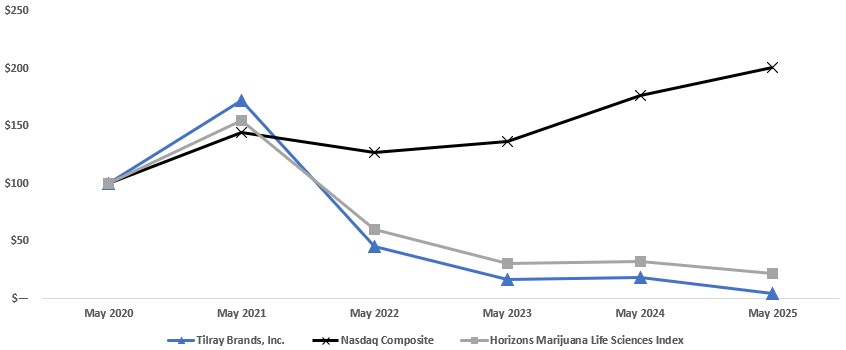
| May 31, |
||||||||||||||||||||||||
| 2020 |
2021 |
2022 |
2023 |
2024 |
2025 |
|||||||||||||||||||
| Tilray Brands, Inc. |
$ | 100.00 | $ | 172.39 | $ | 45.58 | $ | 16.95 | $ | 18.27 | $ | 4.37 | ||||||||||||
| Nasdaq Composite |
$ | 100.00 | $ | 144.88 | $ | 127.31 | $ | 136.31 | $ | 176.35 | $ | 201.41 | ||||||||||||
| Horizons Marijuana Life Sciences Index |
$ | 100.00 | $ | 154.83 | $ | 60.29 | $ | 30.33 | $ | 31.88 | $ | 21.95 | ||||||||||||
This information under “Stock Performance Graph” is not deemed filed with the Securities and Exchange Commission and is not to be incorporated by reference in any filing of Tilray under the Securities Act of 1933, as amended, or the Securities Exchange Act of 1934, as amended, whether made before or after the date of this Annual Report on Form 10-K and irrespective of any general incorporation language in those filings.
Repurchases
None.
Item 7. Management’s Discussion and Analysis of Financial Condition and Results of Operations.
The following Management’s Discussion and Analysis of Financial Condition and Results of Operations is intended to help the reader understand our results of operations and our present business environment from the perspective of management. You should read the following discussion and analysis of our financial condition and results of operations together with the “Cautionary Note Regarding Forward-Looking Statements”; the sections in Part I entitled “Item 1A. Risk Factors” and the financial information and the notes thereto included in Part II, Item 8 of this Form 10-K in this Annual Report for the fiscal year ended May 31, 2025 (“Annual Report”). We use certain non-GAAP measures that are more fully described below under the caption “—Use of Non-GAAP Measures,” which we believe are appropriate supplemental non-GAAP measures to evaluate our business and operations, measure our performance, identify trends affecting our business, project our future performance, and make strategic decisions.
Amounts are presented in thousands of United States dollars, except for shares, warrants, per share data and per warrant data or as otherwise noted.
Company Overview
Tilray Brands, Inc., a Delaware corporation (collectively, along with its subsidiaries, the “Company”, “Tilray”, “we”, “us” and “our”) is a leading global lifestyle consumer products company, which was incorporated on January 24, 2018 and is headquartered in Leamington and New York, with operations in Canada, the United States, Europe, Australia and Latin America that is leading as a transformative force at the nexus of cannabis, beverage, wellness, and entertainment, elevating lives through moments of connection. Tilray’s mission is to be a leading premium lifestyle company with a house of brands and innovative products that inspire joy, wellness and create memorable experiences.
Our overall strategy is to leverage our brands, infrastructure, expertise and capabilities to drive revenue growth in the industries in which we compete, achieve industry-leading profitability and build sustainable, long-term shareholder value. In order to ensure the long-term sustainable growth of our Company, we continue to focus on developing strong capabilities in data analytics and consumer insights, drive category management leadership and assess opportunities for the introduction of new categories, products and entries into new geographies. In addition, we are relentlessly focused on managing our cost structure and expenses in order to maintain our strong financial position. Finally, our experienced leadership team provides a strong foundation to accelerate our growth. Our management team is complemented by experienced operators, cannabis industry experts, veteran beer and beverage industry leaders and leaders that are well-established in wellness foods, all of whom apply an innovative and consumer-centric approach to our businesses.
Trends and Other Factors Affecting Our Business
Beverage market trends:
Within the beverage category, we expect the following key trends to shape the near-term outlook in this segment:
| - |
Beverage Distribution. In furtherance of our strategic vision, we remain focused on enhancing our relevance within home markets, focusing on growing our brands in their core markets. Through targeted efforts, we continue to strategically adjust our portfolio mix and distribution geography through our distributor consolidation program to refine our craft beer strategy, which we believe will allow us to enhance our relevance and focus resources on our core markets as part of our portfolio rationalization initiatives. Distributor chain spring product resets have indicated improvements of distribution for our core brands and key innovation initiatives, including Shock Top, Runner’s High Non-Alcoholic, and SweetWater’s newly launched Day Trip and Dive Beer. We expect to begin to see the impact of these gains during fiscal year 2026. |
| - |
Innovation. Recognizing the evolving consumer landscape and the burgeoning demand for alternative beverage options, we have prioritized innovation and portfolio diversification. Our recent endeavors include launching a lineup of Hemp Derived Delta-9 (HD-D9) products, non-alcoholic beverages, our Liquid Love water brand, flavored malt-based beverages, RTDs and energy drinks. These strategic innovations underscore our commitment to offering high-quality options across diverse beverage categories, positioning us for sustained growth and differentiation in the competitive beverage segment. |
| - |
Brew Pubs. Following our Craft Acquisition I on September 29, 2023 and the Craft Acquisition II effective September 1, 2024, we operate 16 brew pubs, and our Breckenridge Distillery restaurant and tasting room, in geographic regions across the U.S., all of which are located in close proximity to the production of our craft brands. An important part of our strategic plan for our beverage operations centers on brew pubs to promote and showcase the distinct, regional positioning of our craft beer brands and enhance brand recognition to help drive revenue growth. We believe that our brew pub strategy allows us to curate unique small batch product offerings in targeted test markets to help drive effective product innovation. |
In the spirits category, Breckenridge Distillery stands out as a beacon within the bourbon industry, making notable strides in vodka and gin markets while offering a comprehensive hospitality experience through its world-class restaurant and retail location. Our primary growth objective centers on expanding market share across the United States. To fuel future expansion, we prioritize showcasing our exceptional product quality and introducing innovative new product offerings. Recent accolades, including Double Gold awards at prestigious competitions such as Breckenridge Reserve Port Cask Finish being named the World’s best finished Bourbon at the 2024 World Whiskies Awards, we believe underscore our brand's growing recognition and appeal.
Canadian cannabis market trends.
The cannabis industry in Canada continues to evolve given how nascent the industry is with federal legalization of adult-use cannabis occurring just over five years ago. Through analysis of the current market conditions, the following key trends have emerged and are anticipated to influence the near-term future in the Canadian cannabis industry:
| - |
Market share. During the quarter, Tilray continued to lead the Canadian market with the highest cannabis revenue in Canada. During the quarter, we maintained our market share in Canada at 9.3% from the immediately preceding quarter as reported by Hifyre data for all provinces, excluding Quebec where Weedcrawler was deemed more accurate. Our current market share reflects our efforts to preserve margin in specific categories experiencing the most price compression and our shift in strategy to redirect certain inventories to international cannabis markets which provides for higher margin sales. We intend to enhance our global supply chain and increase our cultivation footprint to support this growing demand. |
| - |
Price compression. Historical price compression in specific categories is expected to persist in the market, intensified by fierce competition among the approximately 1,000 Licensed Producers in Canada. The fixed impact of excise per gram, notwithstanding the decline in average selling prices, further compounds these challenges, and has promoted ongoing industry lobbying efforts. |
International cannabis market trends.
We are a global leader in the development, production, distribution, marketing and sale of pharmaceutical-grade medical cannabis products. The cannabis industry in Europe is still in its early stages of development and countries within Europe are at different stages of medical and adult-use cannabis legalization. The most meaningful progress to date has been the legalization and regulation of cannabis for medical purposes, which has now taken place in more than 15 countries representing a population of more than 350 million people (Germany, UK, Italy, Poland, Netherlands, Czech Republic, Greece, Portugal, Austria, Switzerland, Denmark, Croatia, Malta, Luxembourg, Ukraine, and Ireland). Beyond this, some countries have expressed a clear political ambition to legalize adult-use cannabis (Germany, Portugal, Luxembourg and Czech Republic), some are engaging in experiments for adult-use legalization (Germany, Netherlands and Switzerland) and some are debating regulations for cannabinoid-based medicine (France and Spain). In Europe, we believe that, despite continuing recessionary economic conditions, political uncertainty in various countries and the continuing Russian conflict with Ukraine, cannabis legalization (both medicinal and adult-use) will continue to gain traction albeit more slowly than originally expected. This is evidenced by the cannabis regulations in Germany adopted on April 1, 2024, which we believe will serve as a catalyst for continued changes in drug policy throughout Europe. Outside of Europe and North America, the cannabis industry is also in its early stages of development with Australia representing one of the larger markets.
We continue to believe that Tilray remains uniquely positioned to maintain and gain significant market share in the markets in which we participate. We benefit from our end-to-end vertically-integrated infrastructure and well-placed investments, which are comprised of two EU-GMP cultivation facilities located in Portugal and Germany; our fully owned route-to-market encompassing sales, marketing and distribution infrastructure in Germany and Italy; a network of leading distributors who we work with in the various other countries in which we operate; and, our extensive genetics portfolio and demonstrated commitment and expertise related to the cultivation and production of high-quality, safe cannabis products. Tilray’s International business also benefits from the depth and breadth of knowledge, experience, relationships and infrastructure we have transferred from our leading participation and investment in the Canadian medical and adult-use markets. We believe that these assets and attributes, combined with our ability to navigate complex regulatory environments, will continue to drive our leadership in international medical markets and allow us to successfully enter new markets as they adopt medical cannabis and potentially adult-use regulations and may also serve to support a potential U.S. participation in the event of federal legalization.
Germany. Today, Germany remains the largest medical cannabis market in Europe.
On April 1, 2024, the Cannabis Act, consisting of two parts, the CanG and MedCanG, was signed into law by the Office of the Federal President and decriminalization and MedCanG portions of the Cannabis Act became effective. The MedCanG provides for several important medical cannabis reforms including the reclassification of medical cannabis from a narcotic to non-narcotic and the abolishment of the tender for domestic production, which has been replaced with a regular licensing scheme under the authority of the Federal Institute for Drugs and Medical Devices (the “BfArM”). Three licenses for domestic cultivation have been issued, with Tilray receiving the first one. The foreseen enhanced accessibility to medical cannabis due to non-narcotic prescriptions has had the desired effect. The prescription numbers have risen since April 1, 2024 and, accordingly, we have seen a significant increase in our business in Germany where we supply the market with a wide range of medical cannabis extracts and whole flower. In addition, the Federal Joint Committee (the “G-BA”) which issues directives for the German health insurance funds, enacted a resolution in July 2024 allowing for a significant reduction of reservation of approval. This is expected to have a positive market effect, allowing more doctors and specialists to be able to prescribe medical cannabis without receiving prior approval from statutory insurers. Tilray is well positioned to benefit from this change given our leading market share within the medical cannabis extracts segment that tends to have high levels of insurance coverage.
We continue to believe that Tilray is well-positioned in Germany, especially since the enactment of MedCanG benefits our medical leadership in the German market and given that we are one of only three cultivators of medical cannabis in Germany as our wholly owned subsidiary, Aphria RX, was awarded the first license for the cultivation of medical cannabis in Germany by the BfArM under the liberalized regime. We believe that this license will improve our ability to meet the needs of patients and provide cannabis of the utmost quality and enhanced availability to a broader market.
We continue to see increased differentiation between the physician-led and the patient-led channels. In response, we have launched the Tilray Craft, Broken Coast, Redecan and Good Supply brands and related medical cannabis products, which provides the patient with a segmented portfolio of products while we continue to deliver on the trust, safety and consistency that has become expected from our Tilray Medical brand.
Poland. In Poland, cannabis was legalized for medical use in 2018 and is prescribed to patients by a physician and dispensed by pharmacies. Today, all doctors in Poland are allowed to prescribe medical cannabis and it is a self-pay market as medical cannabis is not reimbursed by the Polish health service. In November 2024, Poland implemented strict restrictions on telemedicine, which have significantly impacted the growth of the market with prescription numbers decreasing from 68,000 in October 2024 to 28,000 in December 2024. Tilray is a leading supplier of medical cannabis in Poland through our network of distributor partnerships. We predominantly supply the market with whole flower medical cannabis products.
United Kingdom. Since November 2018, doctors in the UK have been able to prescribe medical cannabis for medicinal use for patients with medical conditions that had failed to respond to first-line medications. The market today is predominantly all self-pay and prescriptions are facilitated by private clinics. Today, we supply the UK market with mainly whole flower products through our distributor partners.
Ireland. In June 2019, the Minister for Health signed legislation allowing for the operation of the Medical Cannabis Access Programme (“MCAP”) on a pilot basis for five years. The MCAP allows a medical consultant to prescribe a cannabis-based treatment for a narrow set of specified medical conditions, where the patient has failed to respond to standard treatment. Reimbursement is available for products which have received the appropriate approval. Tilray was one of the first players to enter the Irish market and is one of a few suppliers which has received approval for its products to be prescribed and to have been granted reimbursement status. Today, we supply our approved extract product to Ireland through our distribution partner.
Italy. In May 2023, FL Group, a wholly-owned subsidiary of Tilray received authorization from Italy’s Ministry of Health to distribute three new medical cannabis compounds to pharmacies across Italy. With FL Group, we have an established broad national pharmaceutical distribution network in Italy, where medical cannabis is prescribed by doctors and reimbursed by the healthcare system to eligible patients.
Australia. In 2016, the Australian Government legalized medicinal cannabis, which is regulated by the Therapeutic Goods Administration. Medical cannabis is prescribed by a doctor but there is no coverage under the Pharmaceutical Benefits Scheme. Tilray Medical suppliers the market with wide portfolio of medical cannabis extracts as well as whole flower products. We see increased differentiation between the physician-led and the patient-led channels. In response, we launched the Broken Coast, Redecan and Good Supply brands and products, which provide the patient with a segmented portfolio of products while we continue to deliver on the trust, safety and consistency that has become expected from our Tilray Medical brand.
Wellness market trends.
Tilray Wellness’s branded business continues to grow across brick-and-mortar retail as well as ecommerce, further establishing its leading market share position in better for you categories. The Company continues to focus on value-added innovation within the wellness space with the launch of branded Whole Flaxseed and Ground Flaxseed and Superseed Snack Clusters in partnership with Whole Foods Market as well as continued emphasis on The Humble Seed, a seed-forward cracker brand which was purchased earlier this year.
Acquisitions, Strategic Transactions and Synergies
We strive to continue to expand our business, on a consolidated basis, through a combination of organic growth and acquisition. While we continue to execute against our strategic initiatives that we believe will result in long-term, sustainable growth and value to our stockholders, we continue to evaluate potential acquisitions and other strategic transactions of businesses that we believe complement our existing portfolio, infrastructure and capabilities or provide us with the opportunity to enter attractive new geographic markets and product categories as well as expand our existing capabilities. In addition, we have exited certain businesses and continue to evaluate certain businesses within our portfolio that are dilutive to profitability and cash flow. As a result, we incur transaction costs in connection with identifying and completing acquisitions and strategic transactions, as well as ongoing integration and restructuring costs as we combine acquired companies and continue to achieve synergies, which is offset by income generated in connection with the execution of these transactions. For the year ended May 31, 2025, we incurred $4.5 million of transaction costs (income), net, as discussed further below.
Effective September 1, 2024, Tilray acquired Craft Acquisition II a portfolio of four craft brands and breweries comprised of Atwater Brewery, Hop Valley Brewing Company, Terrapin Beer Co., and Revolver Brewing from Molson, see Note 9 (Business Acquisition). We expect this acquisition to further the execution of our beverage strategy, which we believe will have positive impacts on our beverage segment leading to increased revenues and whitespace penetration.
Beverage segment Project 420:
In November 2020, we entered the beverage category with the acquisition of SweetWater Brewing Company, one of the largest independent craft brewers in the U.S. by volume, with the vision of creating a larger and more diversified global lifestyle consumer products company.
This initial acquisition provided us with a foundation to pursue additional acquisitions in the beverage category and scale our business on a national basis. We acquired Alpine Beer Company, Green Flash and Breckenridge Distillery in December 2021, Montauk Brewing Company in November 2022, Craft Acquisition I in October 2023 and Craft Acquisition II in September 2024.
With Craft Acquisition I and Craft Acquisition II, we capitalized on opportunities to acquire additional beverage businesses that consisted of strong brands in decline and in need of investment in order to promote growth at a significantly reduced price. To support the growth of these acquired brands and establish a clear path to profitability, we implemented Project 420, which is a comprehensive plan covering (i) SKU rationalization; (ii) Geographic rationalization; (iii) Distributor rationalization; and (iv) synergy optimization plan through which we expect to invest in the acquired brands for growth and improve profitability:
| - |
SKU rationalization – In response to the declining growth in the craft beer industry and consolidation of distributors, we are working with our distributors in various markets to streamline our portfolio by eliminating duplicative and slower growth products, which had the immediate effect of reducing revenue. However, by eliminating these slower growing SKUs, we are able to focus our attention and resources on our higher growth SKUs and the introduction of new innovation, which we expect will accelerate our revenue growth in future quarters. Going forward, we will continue to manage SKU performance within our portfolio on a “one in and one out basis” to maximize SKU productivity. |
| - |
Geographic rationalization – Our brands generate sales in all states however, their results are significantly stronger in their home markets. For example, SweetWater is located in Georgia and, as a result, its revenues are stronger in Georgia, Alabama, North Carolina and Florida, while 10 Barrel, which is located in Oregon has stronger revenue in Oregon, Washington, Idaho and Wyoming. In away markets, like Oregon for SweetWater, and Georgia for 10 Barrel, the brands are not as strong in the away states. Our geographic rationalization works to concentrate our efforts in individual states with our strongest brands in those states. As we reduce the distribution of away markets brands in those states, we are working to increase the distribution and shelf space of home market brands. This initiative is consistent with our Regional Jewel strategy developed in conjunction with the Boston Consulting Group. |
| - |
Distributor rationalization – As a result of our various acquisitions in the last five years, we have over 750 distributors and 975 distributor shipping locations. As a result, we are shipping to multiple distributors in the same geography as well as splitting the allocation of local brands between multiple distributors. The goal of the distributor rationalization is to reduce our distributor footprint down to between 450 and 500 distributors concentrating those distributor’s effort on our brands and SKUs, while minimizing logistical complexities. |
| - |
Synergy optimization plan – We previously announced a $25 million synergy plan focused on optimizing our production footprint and eliminating redundancies in manufacturing and warehouse assets. By integrating the newly acquired facilities into our existing footprint, we are optimizing capacities, utilization and better absorbing fixed overheads. This in turn is improving our gross margins. During the year, we increased the synergy plan by $8 million to $33 million and have achieved $24.1 million of those savings to date. We expect to complete the synergy optimization plan in the third quarter of fiscal 2026. |
| - |
Brand and business investment – We have been and are continuing to increase our investment in the marketing, promotion and infrastructure of our recently acquired brands in order to reestablish their dominance in their core markets. Our intention is to fund this investment through the cost savings and synergies achieved through Project 420. |
For the year ended May 31, 2025, our SKU and geographic rationalization resulted in a reduction in net sales of approximately $20 million. We believe this temporary reduction will be offset by the growth of our new product innovation, including in new beverage categories, and brand extensions during the near term future. This revenue reduction has a corresponding decrease in our Adjusted EBITDA for the year ended May 31, 2025, of $6.0 million.
It is important to note, however, that there is a lag between the discontinuation of the SKUs and the associated reduction in revenue, which has an immediate effect, and the acceleration of the growth of our existing SKUs and the introduction of new innovation and the associated increase in revenue, which takes time due to retailer resets. We also expect these efforts will lead to improved sales and margins, with benefits realized through lower selling costs, as well as reduced requirements for working capital through inventory reductions and an improvement in our cash conversion cycle.
Political and Economic Environment
Our results of operations may continue to be affected by economic, political, legislative, regulatory, legal actions, global volatility and general market disruption resulting from geopolitical tensions, such as Russia's continued incursion into Ukraine, the ongoing events in the Middle East and political uncertainty in certain countries in Europe. Economic conditions, such as recessionary trends, inflation, supply chain disruptions, interest and monetary exchange rates, government fiscal policies, and the recent economic uncertainties resulting from certain changes in U.S. global economic policy, including changes on global trade policies can have a significant effect on operations. More specifically, there are no expected impacts on revenue from the recently enacted U.S. tariffs and foreign enacted retaliatory tariffs (“Tariffs”). From a cost perspective, we believe the recently enacted tariffs could impact input materials such as aluminum, hops, barley, malt and vape componentry which are partially imported but we intend to mitigate these impacts to the extent possible.
Results of Operations
Our consolidated results, in millions except for per share data, are as follows:
| For the year ended May 31, |
Change |
Change |
||||||||||||||||||||||||||
| (in thousands of U.S. dollars) |
2025 |
2024 |
2023 |
2025 vs. 2024 |
2024 vs. 2023 |
|||||||||||||||||||||||
| Net revenue |
$ | 821,309 | $ | 788,942 | $ | 627,124 | $ | 32,367 | 4 | % | $ | 161,818 | 26 | % | ||||||||||||||
| Cost of goods sold |
580,739 | 565,591 | 480,164 | 15,148 | 3 | % | 85,427 | 18 | % | |||||||||||||||||||
| Gross profit |
240,570 | 223,351 | 146,960 | 17,219 | 8 | % | 76,391 | 52 | % | |||||||||||||||||||
| Operating expenses: |
||||||||||||||||||||||||||||
| General and administrative |
167,324 | 167,358 | 165,159 | (34 | ) | (0 | )% | 2,199 | 1 | % | ||||||||||||||||||
| Selling |
56,039 | 37,233 | 34,840 | 18,806 | 51 | % | 2,393 | 7 | % | |||||||||||||||||||
| Amortization |
88,616 | 84,752 | 93,489 | 3,864 | 5 | % | (8,737 | ) | (9 | )% | ||||||||||||||||||
| Marketing and promotion |
37,048 | 41,933 | 30,937 | (4,885 | ) | (12 | )% | 10,996 | 36 | % | ||||||||||||||||||
| Research and development |
284 | 635 | 682 | (351 | ) | (55 | )% | (47 | ) | (7 | )% | |||||||||||||||||
| Change in fair value of contingent consideration |
— | (15,790 | ) | 855 | 15,790 | (100 | )% | (16,645 | ) | (1,947 | )% | |||||||||||||||||
| Impairment of intangible assets and goodwill |
2,096,139 | — | 934,000 | 2,096,139 | NM | (934,000 | ) | (100 | )% | |||||||||||||||||||
| Other than temporary change in fair value of convertible notes receivable |
21,661 | 42,681 | 246,330 | (21,020 | ) | (49 | )% | (203,649 | ) | (83 | )% | |||||||||||||||||
| Litigation costs, net of recoveries |
17,347 | 8,251 | (505 | ) | 9,096 | 110 | % | 8,756 | (1,734 | )% | ||||||||||||||||||
| Restructuring costs |
34,283 | 15,581 | 9,245 | 18,702 | 120 | % | 6,336 | 69 | % | |||||||||||||||||||
| Transaction costs (income), net |
4,534 | 15,462 | 1,613 | (10,928 | ) | (71 | )% | 13,849 | 859 | % | ||||||||||||||||||
| Total operating expenses |
2,523,275 | 398,096 | 1,516,645 | 2,125,179 | 534 | % | (1,118,549 | ) | (74 | )% | ||||||||||||||||||
| Operating loss |
(2,282,705 | ) | (174,745 | ) | (1,369,685 | ) | (2,107,960 | ) | 1,206 | % | 1,194,940 | (87 | )% | |||||||||||||||
| Interest expense, net |
(29,952 | ) | (36,433 | ) | (13,587 | ) | 6,481 | (18 | )% | (22,846 | ) | 168 | % | |||||||||||||||
| Non-operating (expense) income, net |
10,284 | (37,842 | ) | (66,909 | ) | 48,126 | (127 | )% | 29,067 | (43 | )% | |||||||||||||||||
| Loss before income taxes |
(2,302,373 | ) | (249,020 | ) | (1,450,181 | ) | (2,053,353 | ) | 825 | % | 1,201,161 | (83 | )% | |||||||||||||||
| Income tax expense |
(121,017 | ) | (26,616 | ) | (7,181 | ) | (94,401 | ) | 355 | % | (19,435 | ) | 271 | % | ||||||||||||||
| Net loss |
$ | (2,181,356 | ) | $ | (222,404 | ) | $ | (1,443,000 | ) | $ | (1,958,952 | ) | 881 | % | $ | 1,220,596 | (85 | )% | ||||||||||
Use of Non-GAAP Measures
The Company reports its financial results in accordance with U.S. GAAP. However, throughout this Management’s Discussion and Analysis of Financial Condition and Results of Operations in this Annual Report on Form 10-K, we discuss non-GAAP financial measures, including reference to:
| • |
adjusted gross profit (excluding purchase price allocation (“PPA”) step up and inventory valuation allowance) consolidated and for each reporting segment (Cannabis, Beverage, Distribution and Wellness), |
| • |
adjusted gross margin (excluding PPA step up and inventory valuation allowance) consolidated and for each reporting segment (Cannabis, Beverage, Distribution and Wellness), |
| • |
adjusted EBITDA, |
| • |
cash and marketable securities, and |
| • |
constant currency presentation of net revenue (by segment and consolidated). |
All these non-GAAP financial measures should be considered in addition to, and not in lieu of, the financial measures calculated and presented in accordance with accounting principles generally accepted in the United States of America, (“GAAP”). These measures are presented to help investors’ overall understanding of our financial performance and should not be considered in isolation or as a substitute for, or superior to, the financial information prepared and presented in accordance with GAAP. Because non-GAAP financial measures are not standardized, it may not be possible to compare these financial measures with other companies' non-GAAP financial measures having the same or similar names. These non-GAAP financial measures reflect an additional way of viewing aspects of operations that, when viewed with U.S. GAAP results, provide a more complete understanding of the business. The Company strongly encourages investors and shareholders to review Company financial statements and publicly filed reports in their entirety and not to rely on any single financial measure. Please see “Reconciliation of Non-GAAP Financial Measures to GAAP Measures” below for a reconciliation of such non-GAAP Measures to the most directly comparable GAAP financial measures, as well as a discussion of our adjusted gross margin, adjusted gross profit and adjusted EBITDA measures and the calculation of such measures.
Constant Currency Presentation
We believe that this measure provides useful information to investors because it provides transparency to underlying performance in our consolidated net sales by excluding the effect that foreign currency exchange rate fluctuations have on period-to-period comparability given the volatility in foreign currency exchange markets. To present this information for historical periods, current period net sales for entities reporting in currencies other than the U.S. Dollar are translated into U.S. Dollars at the average monthly exchange rates in effect during the corresponding period of the prior fiscal year rather than at the actual average monthly exchange rate in effect during the current period of the current fiscal year. As a result, the foreign currency impact is equal to the current year’s results in local currencies multiplied by the change in average foreign currency exchange rate between the current fiscal period and the corresponding period of the prior fiscal year.
Cash and Marketable Securities
The Company combines the Cash and cash equivalent financial statement line item with the Marketable securities financial statement line item as an aggregate total as reconciled in the liquidity and capital resource section below. The Company’s management believes that this presentation provides useful information to management, analysts and investors regarding certain additional financial and business trends relating to its short-term liquidity position by combing these two GAAP metrics.
Operating Metrics and Non-GAAP Measures
We use the operating metrics and non-GAAP measures set forth in the table below to evaluate our business and operations, measure our performance, identify trends affecting our business, project our future performance, and make strategic decisions. Other companies, including companies in our industry, may calculate operating metrics and non-GAAP measures with similar names differently which may reduce their usefulness as comparative measures. Certain variances are labeled as not meaningful (“NM”) throughout management's discussion and analysis.
| For the year ended May 31, |
||||||||||||
| (in thousands of U.S. dollars) |
2025 |
2024 |
2023 |
|||||||||
| Net beverage revenue |
$ | 240,595 | $ | 202,094 | $ | 95,093 | ||||||
| Net cannabis revenue |
249,001 | 272,798 | 220,430 | |||||||||
| Distribution revenue |
271,228 | 258,740 | 258,770 | |||||||||
| Wellness revenue |
60,485 | 55,310 | 52,831 | |||||||||
| Beverage costs |
147,591 | 113,522 | 48,770 | |||||||||
| Cannabis costs |
150,005 | 182,594 | 162,755 | |||||||||
| Distribution costs |
241,896 | 230,596 | 231,309 | |||||||||
| Wellness costs |
41,247 | 38,879 | 37,330 | |||||||||
| Adjusted gross profit (excluding PPA step-up) (1) |
242,180 | 235,581 | 206,442 | |||||||||
| Beverage adjusted gross margin (excluding PPA step-up) (1) |
39 | % | 46 | % | 53 | % | ||||||
| Cannabis adjusted gross margin (excluding PPA step-up) (1) |
40 | % | 36 | % | 51 | % | ||||||
| Distribution gross margin |
11 | % | 11 | % | 11 | % | ||||||
| Wellness gross margin |
32 | % | 30 | % | 29 | % | ||||||
| Adjusted EBITDA (1) |
$ | 55,035 | $ | 60,465 | $ | 58,679 | ||||||
| Cash and marketable securities (1) as at the year ended: |
256,363 | 260,522 | 448,529 | |||||||||
| Working capital as at the year ended: |
$ | 408,323 | $ | 378,540 | $ | 340,050 | ||||||
| (1) |
Adjusted EBITDA, adjusted gross profit, adjusted gross margin for each of our segments are non-GAAP financial measures, and cash and marketable securities. See “Reconciliation of Non-GAAP Financial Measures to GAAP Measures” below for a reconciliation of these Non-GAAP Measures to our most comparable GAAP measure and the discussion above captioned "Cash and Marketable Securities." |
Segment Reporting
Our reportable segments net revenue is primarily comprised of net revenues from our beverage, cannabis, distribution, and wellness operations, as follows:
| For the year ended May 31, |
Change |
Change |
||||||||||||||||||||||||||
| (in thousands of U.S. dollars) |
2025 |
2024 |
2023 |
2025 vs. 2024 |
2024 vs. 2023 |
|||||||||||||||||||||||
| Beverage business |
$ | 240,595 | $ | 202,094 | $ | 95,093 | $ | 38,501 | 19 | % | $ | 107,001 | 113 | % | ||||||||||||||
| Cannabis business |
249,001 | 272,798 | 220,430 | (23,797 | ) | (9 | )% | 52,368 | 24 | % | ||||||||||||||||||
| Distribution business |
271,228 | 258,740 | 258,770 | 12,488 | 5 | % | (30 | ) | (0 | )% | ||||||||||||||||||
| Wellness business |
60,485 | 55,310 | 52,831 | 5,175 | 9 | % | 2,479 | 5 | % | |||||||||||||||||||
| Total net revenue |
$ | 821,309 | $ | 788,942 | $ | 627,124 | $ | 32,367 | 4 | % | $ | 161,818 | 26 | % | ||||||||||||||
Our reportable segments net revenue reported in constant currency(1) are as follows:
| For the year ended May 31, |
Change |
|||||||||||||||
| as reported in constant currency |
Change |
% Change |
||||||||||||||
| (in thousands of U.S. dollars) |
2025 |
2024 |
2025 vs. 2024 |
|||||||||||||
| Beverage business |
240,595 | $ | 202,094 | $ | 38,501 | 19 | % | |||||||||
| Cannabis business |
254,584 | 272,798 | (18,214 | ) | (7 | )% | ||||||||||
| Distribution business |
277,187 | 258,740 | 18,447 | 7 | % | |||||||||||
| Wellness business |
61,370 | 55,310 | 6,060 | 11 | % | |||||||||||
| Total net revenue |
$ | 833,736 | $ | 788,942 | $ | 44,794 | 6 | % | ||||||||
Our geographic net revenue is, as follows:
| For the year ended May 31, |
Change |
Change |
||||||||||||||||||||||||||
| (in thousands of U.S. dollars) |
2025 |
2024 |
2023 |
2025 vs. 2024 |
2024 vs. 2023 |
|||||||||||||||||||||||
| USA |
$ | 273,695 | $ | 233,141 | $ | 123,284 | $ | 40,554 | 17 | % | $ | 109,857 | 89 | % | ||||||||||||||
| Canada |
212,860 | 243,722 | 201,361 | (30,862 | ) | (13 | )% | 42,361 | 21 | % | ||||||||||||||||||
| EMEA |
323,350 | 296,450 | 284,567 | 26,900 | 9 | % | 11,883 | 4 | % | |||||||||||||||||||
| Rest of World |
11,404 | 15,629 | 17,912 | (4,225 | ) | (27 | )% | (2,283 | ) | (13 | )% | |||||||||||||||||
| Total net revenue |
$ | 821,309 | $ | 788,942 | $ | 627,124 | $ | 32,367 | 4 | % | $ | 161,818 | 26 | % | ||||||||||||||
Our geographic net revenue in constant currency(1) is, as follows:
| For the year ended May 31, |
Change |
|||||||||||||||
| as reported in constant currency |
Change |
% Change |
||||||||||||||
| (in thousands of U.S. dollars) |
2025 |
2024 |
2025 vs. 2024 |
|||||||||||||
| USA |
$ | 273,695 | $ | 233,141 | $ | 40,554 | 17 | % | ||||||||
| Canada |
219,463 | 243,722 | (24,259 | ) | (10 | )% | ||||||||||
| EMEA |
322,960 | 296,450 | 26,510 | 9 | % | |||||||||||
| Rest of World |
17,618 | 15,629 | 1,989 | 13 | % | |||||||||||
| Total net revenue |
$ | 833,736 | $ | 788,942 | $ | 44,794 | 6 | % | ||||||||
Our geographic capital assets are, as follows:
| For the year ended May 31, |
Change |
|||||||||||||||
| (in thousands of U.S. dollars) |
2025 |
2024 |
2025 vs. 2024 |
|||||||||||||
| USA |
$ | 200,003 | $ | 141,314 | $ | 58,689 | 42 | % | ||||||||
| Canada |
267,458 | 313,359 | (45,901 | ) | (15 | )% | ||||||||||
| EMEA |
97,371 | 99,921 | (2,550 | ) | (3 | )% | ||||||||||
| Rest of World |
3,601 | 3,653 | (52 | ) | (1 | )% | ||||||||||
| Total capital assets |
$ | 568,433 | $ | 558,247 | $ | 10,186 | 2 | % | ||||||||
Beverage revenue
Net revenue from our Beverage operations increased to $240.6 million for the fiscal year ended May 31, 2025, compared to net revenue of $202.1 million for the prior fiscal year ended May 31, 2024. The increase in beverage revenue was primarily driven by our newly launched innovation in the HD-D9 product category and our Craft Acquisition II, which was effective as of September 1, 2024, and included the brands and breweries of Hop Valley Brewing Company, Terrapin Beer Company, Revolver Brewing, and Atwater Brewery. Further, the prior fiscal year period did not reflect a full period of revenue from Craft Acquisition I, which was completed on September 29, 2023. These impacts to beverage revenue were offset by the SKU rationalization implemented in connection with Project 420, which resulted in a reduction of net revenue by approximately $20 million for the fiscal year ended May 31, 2025.
Cannabis revenue
Cannabis revenue based on market channel is, as follows:
| For the year ended May 31, |
Change |
Change |
||||||||||||||||||||||||||
| (in thousands of US dollars) |
2025 |
2024 |
2023 |
2025 vs. 2024 |
2024 vs. 2023 |
|||||||||||||||||||||||
| Revenue from Canadian medical cannabis |
$ | 24,998 | $ | 25,211 | $ | 25,000 | $ | (213 | ) | (1 | )% | $ | 211 | 1 | % | |||||||||||||
| Revenue from Canadian adult-use cannabis |
224,048 | 266,846 | 214,319 | (42,798 | ) | (16 | )% | 52,527 | 25 | % | ||||||||||||||||||
| Revenue from wholesale cannabis |
18,207 | 25,340 | 1,436 | (7,133 | ) | (28 | )% | 23,904 | 1,665 | % | ||||||||||||||||||
| Revenue from international cannabis |
63,356 | 53,295 | 43,559 | 10,061 | 19 | % | 9,736 | 22 | % | |||||||||||||||||||
| Total cannabis revenue |
330,609 | 370,692 | 284,314 | (40,083 | ) | (11 | )% | 86,378 | 30 | % | ||||||||||||||||||
| Excise taxes |
(81,608 | ) | (97,894 | ) | (63,884 | ) | 16,286 | (17 | )% | (34,010 | ) | 53 | % | |||||||||||||||
| Total cannabis net revenue |
$ | 249,001 | $ | 272,798 | $ | 220,430 | $ | (23,797 | ) | (9 | )% | $ | 52,368 | 24 | % | |||||||||||||
Cannabis revenue based on market channel in constant currency(1) is, as follows:
| For the year ended May 31, |
Change |
|||||||||||||||
| as reported in constant currency |
Change |
% Change |
||||||||||||||
| (in thousands of US dollars) |
2025 |
2024 |
2025 vs. 2024 |
|||||||||||||
| Revenue from Canadian medical cannabis |
$ | 25,797 | $ | 25,211 | $ | 586 | 2 | % | ||||||||
| Revenue from Canadian adult-use cannabis |
230,953 | 266,846 | (35,893 | ) | (13 | )% | ||||||||||
| Revenue from wholesale cannabis |
18,779 | 25,340 | (6,561 | ) | (26 | )% | ||||||||||
| Revenue from international cannabis |
63,211 | 53,295 | 9,916 | 19 | % | |||||||||||
| Total cannabis revenue |
338,740 | 370,692 | (31,952 | ) | (9 | )% | ||||||||||
| Excise taxes |
(84,156 | ) | (97,894 | ) | 13,738 | (14 | )% | |||||||||
| Total cannabis net revenue |
$ | 254,584 | $ | 272,798 | $ | (18,214 | ) | (7 | )% | |||||||
| (1) |
The constant currency presentation of our Cannabis revenue based on market channel is a non-GAAP financial measure. See “Use of Non-GAAP Measures –Constant Currency Presentation” above for a discussion of these Non-GAAP Measures. |
Revenue from medical cannabis:
Gross revenue from Canadian medical cannabis decreased 1% to $25.0 million for the fiscal year ended May 31, 2025, compared to gross revenue of $25.2 million for the fiscal year ended May 31, 2024. On a constant currency basis, gross revenue from Canadian medical cannabis increased to $25.8 million from $25.2 million for the fiscal year ended May 31, 2025. This increase in gross revenue from medical cannabis on a constant currency basis was primarily driven by growth in the insured patient category exceeding the decline in uninsured patient attrition to the adult-use recreational market.
Revenue from adult-use cannabis:
During the fiscal year ended May 31, 2025 our gross revenue from Canadian adult-use cannabis product decreased 16% to $224.0 million compared to revenue of $266.8 million for the prior fiscal year. On a constant currency basis, our gross revenue from Canadian adult-use cannabis decreased 13% to $231.0 million for the fiscal year ended May 31, 2025. The decrease in gross adult-use revenue was driven by our renewed focus on preserving gross margin and maintaining a higher average selling price in growing categories such as vapes that have experienced a high degree of price compression. At the end of the fiscal year ended May 31, 2025, we began increasing our participation in these categories as a result of our capex investments to improve these trends in the near term future. Additionally, we have shifted our strategic focus to redirect 7.2 million grams of cannabis to international cannabis markets to take advantage of the higher margin sales available in these markets. While some of these products were sold during the fourth fiscal quarter, some inventories were deferred to fiscal year 2026. The resulting impact of this strategic decision caused a temporary decline in gross adult-use cannabis revenue and cannabis revenue overall until their eventual sale. We intend to enhance our global supply chain through Phase II of our accelerated growth plan and increase our cultivation footprint to support the growing demand in both the Canadian and international markets. Lastly, gross revenue from Canadian adult-use cannabis products also included $1.5 million of cannabis advisory services revenue in the fiscal year ended May 31, 2025, compared to $1.5 million in the fiscal year ended May 31, 2024.
Wholesale cannabis revenue:
Gross revenue from wholesale cannabis decreased to $18.2 million for the fiscal year ended May 31, 2025, compared to revenue of $25.3 million for the prior fiscal year ended May 31, 2024. On a constant currency basis, gross revenue from wholesale cannabis for the fiscal year ended May 31, 2025 was $18.8 million compared to $25.3 million for the prior fiscal year ended May 31, 2024. Due to the transition to asset-light business models, the Canadian cannabis industry has experienced a reduction in excess inventory resulting in price increases in the B2B market. This shift in market dynamics and demand enabled us to strategically sell inventory that was sought after in the wholesale market during the fiscal year but does not meet the high standards required for our branded product. In the near-term, we anticipate continued volatility and fluctuation in the wholesale market, and we will assess market conditions on a quarterly basis. Specifically, during the fourth quarter market conditions were less favorable and as a result we did not participate in the same volume of transactions when compared to the prior year fourth quarter.
International cannabis revenue:
Net revenue from international cannabis increased 19% to $63.4 million for the fiscal year ended May 31, 2025, compared to net revenue of $53.3 million for the fiscal year ended May 31, 2024. On a constant currency basis, net revenue from international cannabis increased 19% to $63.2 million, compared to the prior year period. The increase during the fiscal year was primarily driven by higher sales in Germany, attributed to the expanding German medical market where we maintained our leadership position in the reimbursed market and increased our sales in the self-pay market. This growth was partially offset by lower revenue in Poland when compared to the prior year period driven by the delay in the receipt of export/import permits and lower prescriptions due to restrictions placed on telemedicine in November 2024 as well as lower revenue in Australia and the strategic decision to exit the New Zealand medical market. International cannabis net revenue may fluctuate from quarter to quarter based upon the timing of the receipt of export/import permits as well as the timing of shipments from one quarter to the next. In the fourth quarter, we experienced extensive delays in the receipt of export permits from the Portugal authorities resulting in approximately 2.1 million grams of medical cannabis flowers that we had expected to ship to other markets instead of remaining in Portugal.
Distribution revenue
Net revenue from Distribution operations increased 5% to $271.2 million for the fiscal year ended May 31, 2025, compared to net revenue of $258.7 million for the prior fiscal year ended May 31, 2024. On a constant currency basis, given the change in the Euro and Argentine Peso against the U.S. Dollar during the fiscal year, net revenue from Distribution was $277.2 million for the fiscal year ended May 31, 2025, when compared to prior year period. The increase in distribution revenue, on a constant currency basis, for the fiscal year was driven by a change in product mix.
Wellness revenue
Our Wellness net revenue increased to $60.5 million for the fiscal year ended May 31, 2025 compared to $55.3 million for the fiscal year ended May 31, 2024. On a constant currency basis for the fiscal year ended May 31, 2025, Wellness net revenue increased to $61.4 million from $55.3 million. The increase in net revenue was primarily attributed to our strategic focus on expanding our product range, including the relaunch of HiBall energy drinks and organic growth within our branded hemp food business related to higher consumption.
Gross profit and gross margin
Our gross profit and gross margin for the fiscal years ended May 31, 2025, 2024 and 2023 were as follows for our each of our operating segments:
| (in thousands of U.S. dollars) |
For the year ended May 31, |
Change |
% Change |
Change |
% Change |
|||||||||||||||||||||||
| Beverage |
2025 |
2024 |
2023 |
2025 vs. 2024 |
2024 vs. 2023 |
|||||||||||||||||||||||
| Net revenue |
$ | 240,595 | $ | 202,094 | $ | 95,093 | $ | 38,501 | 19 | % | $ | 107,001 | 113 | % | ||||||||||||||
| Cost of goods sold |
147,591 | 113,522 | 48,770 | 34,069 | 30 | % | 64,752 | 133 | % | |||||||||||||||||||
| Gross profit |
93,004 | 88,572 | 46,323 | 4,432 | 5 | % | 42,249 | 91 | % | |||||||||||||||||||
| Gross margin |
39 | % | 44 | % | 49 | % | (5 | )% | (11 | )% | (5 | )% | (10 | )% | ||||||||||||||
| Purchase price accounting step-up |
1,610 | 4,602 | 4,482 | (2,992 | ) | (65 | )% | 120 | 3 | % | ||||||||||||||||||
| Adjusted gross profit (1) |
94,614 | 93,174 | 50,805 | 1,440 | 2 | % | 42,369 | 83 | % | |||||||||||||||||||
| Adjusted gross margin (1) |
39 | % | 46 | % | 53 | % | (7 | )% | (15 | )% | (7 | )% | (13 | )% | ||||||||||||||
| Cannabis |
||||||||||||||||||||||||||||
| Net revenue |
249,001 | 272,798 | 220,430 | (23,797 | ) | (9 | )% | 52,368 | 24 | % | ||||||||||||||||||
| Cost of goods sold |
150,005 | 182,594 | 162,755 | (32,589 | ) | (18 | )% | 19,839 | 12 | % | ||||||||||||||||||
| Gross profit |
98,996 | 90,204 | 57,675 | 8,792 | 10 | % | 32,529 | 56 | % | |||||||||||||||||||
| Gross margin |
40 | % | 33 | % | 26 | % | 7 | % | 21 | % | 7 | % | 27 | % | ||||||||||||||
| Purchase price accounting step-up |
— | 7,628 | — | (7,628 | ) | (100 | )% | 7,628 | — | |||||||||||||||||||
| Inventory valuation adjustments |
— | — | 55,000 | — | NM | (55,000 | ) | (100 | )% | |||||||||||||||||||
| Adjusted gross profit (1) |
98,996 | 97,832 | 112,675 | 1,164 | 1 | % | (14,843 | ) | (13 | )% | ||||||||||||||||||
| Adjusted gross margin (1) |
40 | % | 36 | % | 51 | % | 4 | % | 11 | % | (15 | )% | (29 | )% | ||||||||||||||
| Distribution |
||||||||||||||||||||||||||||
| Net revenue |
271,228 | 258,740 | 258,770 | 12,488 | 5 | % | (30 | ) | (0 | )% | ||||||||||||||||||
| Cost of goods sold |
241,896 | 230,596 | 231,309 | 11,300 | 5 | % | (713 | ) | (0 | )% | ||||||||||||||||||
| Gross profit |
29,332 | 28,144 | 27,461 | 1,188 | 4 | % | 683 | 2 | % | |||||||||||||||||||
| Gross margin |
11 | % | 11 | % | 11 | % | 0 | % | 0 | % | 0 | % | 0 | % | ||||||||||||||
| Wellness |
||||||||||||||||||||||||||||
| Net revenue |
60,485 | 55,310 | 52,831 | 5,175 | 9 | % | 2,479 | 5 | % | |||||||||||||||||||
| Cost of goods sold |
41,247 | 38,879 | 37,330 | 2,368 | 6 | % | 1,549 | 4 | % | |||||||||||||||||||
| Gross profit |
19,238 | 16,431 | 15,501 | 2,807 | 17 | % | 930 | 6 | % | |||||||||||||||||||
| Gross margin |
32 | % | 30 | % | 29 | % | 2 | % | 7 | % | 1 | % | 3 | % | ||||||||||||||
| Total |
||||||||||||||||||||||||||||
| Net revenue |
821,309 | 788,942 | 627,124 | 32,367 | 4 | % | 161,818 | 26 | % | |||||||||||||||||||
| Cost of goods sold |
580,739 | 565,591 | 480,164 | 15,148 | 3 | % | 85,427 | 18 | % | |||||||||||||||||||
| Gross profit |
240,570 | 223,351 | 146,960 | 17,219 | 8 | % | 76,391 | 52 | % | |||||||||||||||||||
| Gross margin |
29 | % | 28 | % | 23 | % | 1 | % | 4 | % | 5 | % | 22 | % | ||||||||||||||
| Inventory valuation adjustments |
— | — | 55,000 | — | 0 | % | (55,000 | ) | (100 | )% | ||||||||||||||||||
| Purchase price accounting step-up |
1,610 | 12,230 | 4,482 | (10,620 | ) | (87 | )% | 7,748 | 173 | % | ||||||||||||||||||
| Adjusted gross profit (1) |
242,180 | 235,581 | 206,442 | 6,599 | 3 | % | 29,139 | 14 | % | |||||||||||||||||||
| Adjusted gross margin (1) |
29 | % | 30 | % | 33 | % | (1 | )% | (3 | )% | (3 | )% | (9 | )% | ||||||||||||||
| (1) |
Adjusted gross profit is our Gross profit (adjusted to exclude inventory valuation adjustment and purchase price accounting valuation step-up) and adjusted gross margin is our Gross margin (adjusted to exclude inventory valuation adjustment and purchase price accounting valuation step-up) and are non-GAAP financial measures. See “Reconciliation of Non-GAAP Financial Measures to GAAP Measures” for additional discussion regarding these non-GAAP measures. The Company’s management believes that adjusted gross profit and adjusted gross margin are useful to our management to evaluate our business and operations, measure our performance, identify trends affecting our business, project our future performance, and make strategic decisions. We do not consider adjusted gross profit and adjusted gross margin in isolation or as an alternative to financial measures determined in accordance with GAAP. |
Adjusted Gross Profit and Adjusted Gross Margin
Adjusted gross profit and adjusted gross margin are non-GAAP financial measures and may not be comparable to similar measures presented by other companies. Adjusted gross profit is our Gross profit (adjusted to exclude inventory valuation adjustment and purchase price accounting valuation step-up) and adjusted gross margin is our Gross margin (adjusted to exclude inventory valuation adjustment and purchase price accounting valuation step-up) and are both non-GAAP financial measures. The Company’s management believes that adjusted gross profit and adjusted gross margin are useful to our management to evaluate our business and operations, measure our performance, identify trends affecting our business, project our future performance, and make strategic decisions without the impacts of the aforementioned adjusted items. We do not consider adjusted gross profit and adjusted gross margin percentage in isolation or as an alternative to financial measures determined in accordance with GAAP.
Beverage gross margin:
Gross margin of 39% for the fiscal year ended May 31, 2025 decreased from 44% when compared to the fiscal year ended May 31, 2024. Adjusted gross margin of 39% decreased in the fiscal year ended May 31, 2025, from 46% in the fiscal year ended May 31, 2024. The change in the adjusted beverage gross margin during the fiscal year ended May 31, 2025 was driven by several factors, including our continued integration efforts of our Craft Acquisition I. The increased utilization of our facilities and improvements in our product mix as part of our strategic initiatives under Project 420 had favorable impacts on our adjusted gross margin, however, these improvements were more than offset by the impacts from the Craft Acquisition II, which has lower margins than our existing business.
Cannabis gross margin:
Gross margin increased during the fiscal year ended May 31, 2025 to 40% from 33% when compared to the fiscal year ended May 31, 2024. Adjusted gross margin during the fiscal year ended May 31, 2025, increased to 40% from 36% when compared to the prior fiscal year ended May 31, 2024. The improvement in gross margin and adjusted gross margin for the year ended May 31, 2025 was driven by our increased international cannabis revenue as a proportion of total cannabis revenue, which has higher margins than our Canadian cannabis business, as well as a continued focus in our Canadian cannabis business on maintaining a higher average selling price and favorable product mix to improve gross margins.
Distribution gross margin:
Gross margin of 11% for the fiscal year ended May 31, 2025 remained consistent when compared to the fiscal year ended May 31, 2024, despite shortages in key pharmaceutical product lines as well as price reductions in certain key pharmaceutical lines of products.
Wellness gross margin:
Gross margin of 32% for the fiscal year ended May 31, 2025 increased from a gross margin of 30% when compared to the fiscal year ended May 31, 2024, resulting from strong operational efficiencies, lower input costs and the culmination of a change in sales mix towards higher margin product offerings including HiBall energy drinks.
Operating expenses
| For the year ended May 31, |
Change |
Change |
||||||||||||||||||||||||||
| (in thousands of US dollars) |
2025 |
2024 |
2023 |
2025 vs. 2024 |
2024 vs. 2023 |
|||||||||||||||||||||||
| General and administrative |
$ | 167,324 | $ | 167,358 | $ | 165,159 | $ | (34 | ) | (0 | )% | $ | 2,199 | 1 | % | |||||||||||||
| Selling |
56,039 | 37,233 | 34,840 | 18,806 | 51 | % | 2,393 | 7 | % | |||||||||||||||||||
| Amortization |
88,616 | 84,752 | 93,489 | 3,864 | 5 | % | (8,737 | ) | (9 | )% | ||||||||||||||||||
| Marketing and promotion |
37,048 | 41,933 | 30,937 | (4,885 | ) | (12 | )% | 10,996 | 36 | % | ||||||||||||||||||
| Research and development |
284 | 635 | 682 | (351 | ) | (55 | )% | (47 | ) | (7 | )% | |||||||||||||||||
| Change in fair value of contingent consideration |
— | (15,790 | ) | 855 | 15,790 | (100 | )% | (16,645 | ) | (1,947 | )% | |||||||||||||||||
| Impairment of intangible assets and goodwill |
2,096,139 | — | 934,000 | 2,096,139 | NM | (934,000 | ) | (100 | )% | |||||||||||||||||||
| Other than temporary change in fair value of convertible notes receivable |
21,661 | 42,681 | 246,330 | (21,020 | ) | (49 | )% | (203,649 | ) | (83 | )% | |||||||||||||||||
| Litigation costs, net of recoveries |
17,347 | 8,251 | (505 | ) | 9,096 | 110 | % | 8,756 | (1,734 | )% | ||||||||||||||||||
| Restructuring costs |
34,283 | 15,581 | 9,245 | 18,702 | 120 | % | 6,336 | 69 | % | |||||||||||||||||||
| Transaction costs (income), net |
4,534 | 15,462 | 1,613 | (10,928 | ) | (71 | )% | 13,849 | 859 | % | ||||||||||||||||||
| Total operating expenses |
$ | 2,523,275 | $ | 398,096 | $ | 1,516,645 | $ | 2,125,179 | 534 | % | $ | (1,118,549 | ) | (74 | )% |
|||||||||||||
Operating expenses are comprised of general and administrative; selling; amortization; marketing and promotion; research and development; change in fair value of contingent consideration; impairments; other than temporary change in fair value of convertible notes receivable; litigation costs; net of recoveries; restructuring costs; and transaction costs (income), net. These costs increased by $2,125.2 million to $2,523.3 million for the fiscal year ended May 31, 2025, compared to $398.1 million for the fiscal year ended May 31, 2024. This increase was primarily a result of the non-cash impairments recorded in the period as described in detail below. Additionally, $20.1 million of the increase year over year was attributed to the inclusion of expenses from our recent Craft Acquisition II, effective September 1, 2024, and that the prior year period did not reflect a full period of results from the Craft Acquisition I, which was completed on September 29, 2023. These changes, period over period, are described below.
General and administrative costs
| For the year ended May 31, |
Change |
Change |
||||||||||||||||||||||||||
| (in thousands of US dollars) |
2025 |
2024 |
2023 |
2025 vs. 2024 |
2024 vs. 2023 |
|||||||||||||||||||||||
| Salaries and wages |
$ | 88,015 | $ | 83,673 | $ | 70,883 | $ | 4,342 | 5 | % | $ | 12,790 | 18 | % | ||||||||||||||
| Office and general |
28,314 | 28,460 | 27,845 | (146 | ) | (1 | )% | 615 | 2 | % | ||||||||||||||||||
| Stock-based compensation |
24,289 | 31,769 | 39,595 | (7,480 | ) | (24 | )% | (7,826 | ) | (20 | )% | |||||||||||||||||
| Insurance |
11,843 | 12,586 | 12,033 | (743 | ) | (6 | )% | 553 | 5 | % | ||||||||||||||||||
| Professional fees |
4,765 | 5,345 | 7,166 | (580 | ) | (11 | )% | (1,821 | ) | (25 | )% | |||||||||||||||||
| Gain on sale of capital assets |
928 | (4,198 | ) | (48 | ) | 5,126 | (122 | )% | (4,150 | ) | 8,646 | % | ||||||||||||||||
| Travel and accommodation |
5,717 | 5,138 | 4,530 | 579 | 11 | % | 608 | 13 | % | |||||||||||||||||||
| Rent |
3,453 | 4,585 | 3,155 | (1,132 | ) | (25 | )% | 1,430 | 45 | % | ||||||||||||||||||
| Total general and administrative costs |
$ | 167,324 | $ | 167,358 | $ | 165,159 | $ | (34 | ) | (0 | )% | $ | 2,199 | 1 | % | |||||||||||||
Salaries and wages increased by 5% during the fiscal year ended May 31, 2025. The change was primarily due to the inclusion of employees from Craft Acquisition II, effective September 1, 2024, and the prior fiscal year period did not reflect a full period of results from Craft Acquisition I, completed on September 29, 2023. Additionally, included in the fiscal year ended May 31, 2025 was $4.7 million of retention payments that did not occur in the prior fiscal year period.
Office and general decreased by 1% during the fiscal year ended May 31, 2025. The decrease was primarily due to the inclusion of deposit recoveries of $5.6 million compared to of bad debt recoveries of $4.4 million in the prior fiscal year period ended May 31, 2024. Further, we incurred expenses related to the Craft Acquisition II, effective September 1, 2024, and the prior fiscal year period ended May 31, 2024 did not reflect a full period of results from Craft Acquisition I due to the fact that it was completed on September 29, 2023. These impacts were partially offset by our continued cost saving initiatives.
The Company recognized stock-based compensation expense of $24.3 million for the fiscal year ended May 31, 2025 compared to $31.8 million for the prior fiscal year period. Stock-based compensation expense is based on the time-based vesting schedules and varies according to the assumptions used in the vesting model. The decrease in stock-based compensation was driven by the vesting of previously issued stock options, restricted stock units (“RSUs”) and stock appreciation rights (“SARs”) during the year ended May 31, 2025. Additionally, the decrease for the year ended May 31, 2025 was driven by the cancellation of certain performance-based RSUs.
Insurance expense decreased by 6% for the fiscal year ended May 31, 2025 to $11.8 million from $12.6 million for the prior fiscal year period. The decrease in insurance expense for the fiscal year ended May 31, 2025 was driven by lower premiums on existing insurance policies, offset by premiums associated with new insurance policies that have been placed in connection with Craft Acquisition I and Craft Acquisition II. For the fiscal year ended May 31, 2025 as a percentage of revenue insurance was 1% compared to 2% in the prior fiscal year period, demonstrating our ability to manage our insurance policy cost despite growing the business.
Professional fees decreased by 11% to $4.8 million in the fiscal year ended May 31, 2025 from $5.3 million when compared to the prior fiscal year, which is a direct result of our cost savings initiatives.
The Company recognized a loss on the sale of capital assets in the amount of $0.9 million in the fiscal year ended May 31, 2025 primarily from the sale of our Avanti facility, compared to a gain of $4.2 million in the prior fiscal year which was predominantly from the sale of Truss Beverage Co.
Rent expense decreased by 25% for the fiscal year ended May 31, 2025 to $3.5 million from $4.6 million for the prior fiscal year period. Rent expense is predominantly comprised of operating lease expense for our brew pubs and office spaces. The decrease was driven by the exit from the Truss lease in the current fiscal year and a reduction in lease payments, which were previously included in the prior fiscal period results, offset by the expenses from Craft Acquisition II, effective September 1, 2024, and the prior fiscal year period did not reflect a full period of results from Craft Acquisition I due to the fact that it was completed on September 29, 2023.
Selling costs
For the fiscal year ended May 31, 2025, the Company incurred selling costs of $56.0 million or 6.8% of net revenue as compared to $37.2 or 4.7% of net revenue in the prior fiscal year. These costs relate to third-party shipping costs for all segments, in addition to distributor commission incurred by the cannabis segment, Health Canada cannabis fees, and patient acquisition and maintenance costs. The increase for the fiscal year ended May 31, 2025 is predominately due to the higher freight costs experienced in the beverage segment. Additionally, during the year ended May 31, 2024, the Company received a refund of $3.3 million related to cannabis selling fees related to an amended fee calculation and a commission refund that did not reoccur in the current fiscal period.
Amortization
The Company incurred non-production related amortization charges of $88.6 million for the fiscal year ended May 31, 2025 compared to $84.8 million in the prior fiscal year period based on depreciable capital and intangible assets useful lives.
Marketing and promotion cost
For the fiscal year ended May 31, 2025, the Company incurred marketing and promotion costs of $37.0 million, as compared to $41.9 in the prior fiscal year. This decrease was primarily due to the yearly variability in discretionary marketing expenses, offset by the inclusion of expenses from our recent Craft Acquisition II, effective September 1, 2024. Further, the prior fiscal year period did not reflect a full year of marketing and promotion costs from Craft Acquisition I as it was completed on September 29, 2023. Lastly, during the fiscal year ended May 31, 2025, we began to capitalize multi-year sponsorship licenses as outlined in Note 3 (Significant accounting policies).
Research and development
Research and development costs were $0.3 million in the fiscal year ended May 31, 2025, compared to $0.6 million in the prior fiscal year. These relate to external costs incurred in connection with the development of new products.
Change in fair value of contingent consideration
The Company measures contingent consideration at fair value classified as Level 3, as discussed in Note 29 (Financial risk management and financial instruments). During the fiscal year ended May 31, 2025, there were no changes in the fair value of contingent consideration due to the fact that there were no changes in the likelihood of achievement of certain financial metrics for Montauk Brewing Company. In the prior fiscal year period, we recognized a a gain of $15.8 million resulting from the conclusion of the SweetWater earnout period, the favorable cash settlement relating to the final determination and settlement of the contingent consideration related to the Truss acquisition, all of which was offset by an increase in the fair value of the contingent consideration driven by the increased probability of achieving the contingent consideration associated with the Montauk Brewing Company acquisition.
Impairment of intangible assets and goodwill
During the fiscal year ended May 31, 2025, based upon a combination of factors including a sustained decline in the Company’s market capitalization stemming from the uncertainty resulting from certain changes in U.S. global economic policy, including slower than anticipated progress in global cannabis legalization, overall declines in the craft beer industry sector, and a change in the Company's discount rate, the Company recognized the following impairment charges:
| - |
Intangible assets. Non-cash impairment charges of $334.2 million related to customer relationships & distribution channel, $186.6 million related to licenses, permits & applications, which were considered indefinite-lived intangible assets and $327.1 million related to intellectual property, trademarks, knowhow & brands. See Note 8 (Intangible assets) for additional details. |
| - |
Goodwill. Non-cash impairment charges of $1,070.0 million related to cannabis goodwill, $120.8 million related to beverage goodwill, $53.2 million related to wellness goodwill and $4.2 million related to distribution goodwill. See Note 10 (Goodwill) for additional details. |
| - |
Deferred tax liabilities. These non-cash impairment charges were offset by an income tax recovery of $121.4 million, resulting in the corresponding reduction in deferred tax liabilities. See Note 13 (Income taxes and deferred income taxes) for additional details. |
Intangible asset impairments
The Company performed the annual impairment test on its indefinite-life intangible assets, and for its finite-lived intangible assets, management assessed for asset specific indicators of impairment during the fourth quarter ended May 31, 2025, and based upon a combination of factors including a sustained decline in the Company’s market capitalization stemming from the uncertainty resulting from certain changes in U.S. global economic policy, including slower than anticipated progress in global cannabis legalization and overall declines in the craft beer industry sector, and a change in non-discretionary market inputs in the Company's discount rate, the Company recorded non-cash impairments of $334.2 million related to its finite-lived customer relationships & distribution channel, $186.6 million related to its licenses, permits & applications, which were considered indefinite-lived intangible assets and $327.1 million related to its finite-lived intellectual property, trademarks, knowhow & brands. This impairment charge resulted in a corresponding income tax recovery of $121.4 million, resulting in the corresponding reduction in deferred tax liabilities. In calculating the impairment charge, using an income approach, the Company used a discount rate of 10.00%-14.50%, a terminal growth rate of 2%, and an average revenue growth rate of 5%-30% over 5 years to correlate with the cash flows anticipated with the individual intangible assets that were assessed. A reasonably possible change in any of the inputs within the determination of fair value would not result in a material change to the impairment recorded.
During the fiscal year ended May 31, 2024, there were no impairments to indefinite-lived intangible assets or finite-lived intangible assets.
Goodwill impairments
During the preceding quarter ended February 28, 2025, based upon a combination of factors including a sustained decline in the Company’s market capitalization stemming from the uncertainty resulting from certain changes in U.S. global economic policy, including slower than anticipated progress in global cannabis legalization and overall declines in the craft beer industry sector, the Company concluded that it is more likely than not, that the fair value of our reporting units were less than their carrying amounts as of February 28, 2025. Accordingly, the Company utilized the income approach, which uses future discounted cash flows, to determine the fair value of each reporting unit. As a result, the Company recorded non-cash impairment charges of $570.0 million of cannabis goodwill, $100.0 million of beverage goodwill, $25.0 million of wellness goodwill and $4.2 million of distribution goodwill for the nine months ended February 28, 2025. In the Company's cannabis goodwill assessment, the Company used a discount rate of 12.00%, a terminal growth rate of 5%, and an average revenue growth rate of 34% over 5 years, based on an 88% and 40% average probability of anticipated EU and U.S. cannabis legalization, respectively and/or changes in drug policy in various countries within the next 5 years. In the Company's beverage goodwill assessment, the Company used a discount rate of 9.25%, a terminal growth rate of 2%, and an average revenue growth rate of 12% over 5 years. In the Company's wellness goodwill assessment, the Company used a discount rate of 10.50%, a terminal growth rate of 2%, and an average revenue growth rate of 7% over 5 years. In the Company's distribution goodwill assessment, the Company recorded $4,235 of impairments, which brought the remaining distribution goodwill balance to $nil.
The Company then performed the annual impairment test during the fourth quarter ended May 31, 2025, and determined that through a combination of factors including a further decline in the Company's market capitalization, an increase in the discount rate, and changes to the aforementioned probabilities resulting from continued delays in legalization of cannabis within the United States and internationally, culminating in an unfavorable impact on the estimated future cash flows, and ultimately concluded that it is more likely than not, that the fair value of our reporting units were less than their carrying amounts as of May 31, 2025. Accordingly, the Company utilized the income approach, which uses future discounted cash flows, to determine the fair value of each reporting unit. As a result, the Company recorded additional non-cash impairment charges of $500.0 million of cannabis goodwill, $20.8 million of beverage goodwill and $28.2 million of wellness goodwill during the quarter ended May 31, 2025.
In the Company's cannabis goodwill assessment, the Company used a discount rate of 14.50%, a terminal growth rate of 5%, and an average revenue growth rate of 34% over 5 years, based on an 65% and 25% average probability of anticipated EU and U.S. cannabis legalization, respectively and/or changes in drug policy in various countries within the next 5 years. A 1% increase in the discount rate would result in an additional $133.8 million in impairment, a 1% decrease in the terminal growth rate would result in an additional $93.5 million in impairment, a 5% decrease in the average growth rate would result in an additional $23.4 million in impairment, a 5% decrease in the probability of EU cannabis legalization would result in an additional $44.0 million in impairment and a 5% decrease in the probability of US cannabis legalization would result in an additional $17.1 million in impairment. Changes to those probabilities resulting in continued delays in or cessation of legalization of cannabis within the United States and internationally, or adverse regulatory changes to existing legislation, could have an unfavorable impact on the estimated future cash flows, and ultimately, the fair value of the cannabis reporting unit, which may result in a material impairment expense recognized in future reporting periods.
In the Company's beverage goodwill assessment, the Company used a discount rate of 10.00%, a terminal growth rate of 2%, and an average revenue growth rate of 2% over 5 years, which brought the remaining beverage goodwill balance to $nil.
In the Company's wellness goodwill assessment, the Company used a discount rate of 12.25%, a terminal growth rate of 2%, and an average revenue growth rate of 7% over 5 years, which brought the remaining beverage goodwill balance to $nil.
For the fiscal year ended May 31, 2024, the Company recognized $nil impairment expense.
Other than temporary write-down of convertible notes receivable
During the fiscal year ended May 31, 2025, the Company recognized an other-than-temporary change in fair value of convertible notes receivable, which resulted in a non-cash expense of $21.7 million compared to $42.7 million for the prior fiscal year period related to the MedMen Convertible Note. The MedMen Convertible Note was valued based upon the estimated fair value of the collateral assets net of estimated disposal costs and has been reduced to reflect recent developments in restructuring efforts. See Note 11 (Convertible notes receivable), for additional transactions related to the MedMen Convertible Note, which occurred during the fiscal year ended May 31, 2025.
Litigation costs
Litigation costs of $17.3 million were expensed during the fiscal year ended May 31, 2025 compared $8.3 million in the prior fiscal year. Litigation costs include fees and expenses incurred in connection with defending and settling ongoing legacy inherited litigation matters, net of any judgments or settlement recoveries received from third parties. See Note 28 (Commitments and contingencies) for additional details.
Restructuring costs
In connection with the execution of our acquisition strategy and strategic transactions, the Company incurred non-recurring restructuring and exit costs associated with the integration efforts of these transactions. In connection with these efforts, during the fiscal year ended May 31, 2025, the Company incurred $34.3 million of restructuring charges compared to $15.6 million for the prior fiscal year period. All restructuring plans are approved at the executive level, and their associated expenses are recognized in the fiscal period in which the plan is committed.
Within the Cannabis segment, our restructuring costs predominantly related to the HEXO acquisition, which were completed within 24 months from the acquisition, which occurred in June 2023. In the fiscal year ended May 31, 2025, we recognized $10.4 million of expenses related to employee termination severance and benefits and other costs related to the conversion of the HEXO Quebec cultivation facility from cannabis production to produce production, the optimization of our Redecan facilities, and $1.0 million of restructuring charges related to the exiting of the Truss facility following its sale to a third party in the fiscal year ended May 31, 2024. Additionally, the Company recognized $1.1 million of cost associated with the closure and sale of our Avanti facility, which occurred during the fiscal year ended May 31, 2025. The Company also recognized $2.1 million of exit cost in connection with the termination of its contract with its distribution partner in the Quebec adult-use cannabis market and the insourcing of the function. Lastly, the Company recognized $0.8 million of restructuring charges related to our decision to exit the New Zealand medical cannabis market during the fiscal year ended May 31, 2025.
Within the Beverage segment during the fiscal year ended May 31, 2025, the Company recognized $1.6 million of expenses related to employee severance and benefits and $4.2 million of costs associated with the consolidation of production sites through the integration of Craft Acquisition I and the Craft Acquisition II. Additionally, the Company recognized $8.5 million of restructuring charges related to the closure of the Hop Valley production facility, which was accrued, but not yet paid. Lastly, the Company recognized $1.6 million of restructuring charges related to terminating a legacy storage agreement from Craft Acquisition I. We expect to transition to a new storage facility in fiscal year 2026, consistent with our announced cost savings initiatives.
Within the Distribution segment during the fiscal year ended May 31, 2025, the Company recognized $0.5 million of restructuring charges related to the divestiture of its retail pharmacy location in Argentina.
Lastly, for the fiscal year ended May 31, 2025, the Company recognized $2.5 million of costs associated with the investment held in Superhero Acquisition Corp. as a result of MedMen’s ongoing restructuring and liquidation undertakings.
Transaction (income) costs, net
Transaction (income) costs, net, consists of acquisition related income and expenses, including legal fees, financial advisor and other third-party due diligence cost and expenses as well as any transaction related compensation. During the fiscal year ended May 31, 2025, transaction (income) costs, net decreased 71% from the prior fiscal year period as a result of lower transaction costs associated with Craft Acquisition II in the current fiscal year compared to the costs associated with the HEXO, Truss and the Craft Acquisition I in the prior fiscal year.
Non-operating income (expense), net
| For the year ended May 31, |
Change |
Change |
||||||||||||||||||||||||||
| (in thousands of US dollars) |
2025 |
2024 |
2023 |
2025 vs. 2024 |
2024 vs. 2023 |
|||||||||||||||||||||||
| Change in fair value of convertible debenture payable |
$ | — | $ | (19,736 | ) | $ | (43,651 | ) | $ | 19,736 | (100 | )% | $ | 23,915 | (55 | )% | ||||||||||||
| Change in fair value of warrant liability |
2,161 | (1,436 | ) | 12,438 | 3,597 | (250 | )% | (13,874 | ) | (112 | )% | |||||||||||||||||
| Foreign exchange (loss) gain |
9,639 | (4,086 | ) | (25,535 | ) | 13,725 | (336 | )% | 21,449 | (84 | )% | |||||||||||||||||
| Loss on long-term investments |
(5,550 | ) | (217 | ) | (2,190 | ) | (5,333 | ) | 2,458 | % | 1,973 | (90 | )% | |||||||||||||||
| Other non-operating (losses) gains, net |
4,034 | (12,367 | ) | (7,971 | ) | 16,401 | (133 | )% | (4,396 | ) | 55 | % | ||||||||||||||||
| Total non-operating income (expense) |
$ | 10,284 | $ | (37,842 | ) | $ | (66,909 | ) | $ | 48,126 | (127 | )% | $ | 29,067 | (43 | )% | ||||||||||||
For the fiscal year ended May 31, 2025, the Company recognized a change in fair value of its convertible debentures payable of $nil compared to $19.7 million in the prior fiscal year period as the instrument was fully settled upon maturity, and recognized a change in fair value of its warrants, resulting in a gain of $2.2 million compared to a loss of $1.4 million as a result of the change in our share price and the exercise price of the instrument. The Company recognized a gain of $9.6 million resulting from the changes in foreign exchange rates during the period compared to a loss of $4.1 million for the prior fiscal year period. The Company recognized a loss on long-term investments, resulting in a loss of $5.6 million as a result of a change in fair value of certain long-term investments compared to loss of $0.2 million for the prior period. The other non-operating (losses) gains, net were $4.0 million for the fiscal year ended May 31, 2025, which was mainly comprised of a gain of $5.8 million resulting from the exchange transaction of the TLRY 27 Notes, see Note 17 (Convertible debentures payable). The other non-operating (losses) gains, net for the fiscal year ended May 31, 2024 were $12.4 million and were mainly comprised of $2.3 million relating to the downside protection on the share issuance relating to the HTI note, $2.5 million to settle outstanding notes with non-controlling interest shareholders, $4.6 million related to the decrease in value of equity investee, Cannfections, and $3.1 million of loss on measurement at the lower of carrying amount and the fair value less costs to sell of Broken Coast’s former Duncan facility.
Reconciliation of Non-GAAP Financial Measures to GAAP Measures
Adjusted EBITDA
Adjusted EBITDA is a non-GAAP financial measure that does not have a standardized meaning prescribed by GAAP and may not be comparable to similar measures presented by other companies. The Company calculates adjusted EBITDA as net loss/net income before income taxes, net interest expense, depreciation and amortization, equity in net loss of equity-method investees, purchase price accounting step-up on inventory, stock-based compensation, inventory valuation adjustments, impairments, other than temporary change in fair value of convertible notes receivable, Project 420 business optimization, loss (gain) on sale of capital assets - non-operating facility, restructuring costs, transaction (income) costs, net, litigation costs net of recoveries, change in fair value of contingent consideration, unrealized currency gains and losses and other adjustments.
We believe that this presentation provides useful information to management, analysts and investors regarding certain additional financial and business trends relating to our results of operations and financial condition. In addition, management uses this measure for reviewing the financial results of the Company and as a component of performance-based executive compensation decisions.
We do not consider adjusted EBITDA in isolation or as an alternative to financial measures determined in accordance with GAAP. The principal limitation of adjusted EBITDA is that it excludes certain expenses and income that are required by U.S. GAAP to be recorded in our consolidated financial statements. In addition, adjusted EBITDA is subject to inherent limitations as this metric reflects the exercise of judgment by management about which expenses and income are excluded or included in determining adjusted EBITDA. In order to compensate for these limitations, management presents adjusted EBITDA in connection with GAAP results.
For the fiscal year ended May 31, 2025, adjusted EBITDA decreased by $5.4 million to $55.0 million compared to $60.5 in the prior fiscal year as we continue to integrate our recent craft beverage acquisitions.
| For the year ended May 31, | Change | Change | ||||||||||||||||||||||||||
| Adjusted EBITDA reconciliation: |
2025 |
2024 |
2023 |
2025 vs. 2024 |
2024 vs. 2023 |
|||||||||||||||||||||||
| Net loss |
$ | (2,181,356 | ) | $ | (222,404 | ) | $ | (1,443,000 | ) | $ | (1,958,952 | ) | 881 | % | $ | 1,220,596 | (85 | )% | ||||||||||
| Income tax (recovery) expense |
(121,017 | ) | (26,616 | ) | (7,181 | ) | (94,401 | ) | 355 | % | (19,435 | ) | 271 | % | ||||||||||||||
| Interest expense, net |
29,952 | 36,433 | 13,587 | (6,481 | ) | (18 | )% | 22,846 | 168 | % | ||||||||||||||||||
| Non-operating income (expense), net |
(10,284 | ) | 37,842 | 66,909 | (48,126 | ) | (127 | )% | (29,067 | ) | (43 | )% | ||||||||||||||||
| Amortization |
133,490 | 126,913 | 130,149 | 6,577 | 5 | % | (3,236 | ) | (2 | )% | ||||||||||||||||||
| Stock-based compensation |
24,289 | 31,769 | 39,595 | (7,480 | ) | (24 | )% | (7,826 | ) | (20 | )% | |||||||||||||||||
| Change in fair value of contingent consideration |
— | (15,790 | ) | 855 | 15,790 | (100 | )% | (16,645 | ) | (1,947 | )% | |||||||||||||||||
| Impairment of intangible assets and goodwill |
2,096,139 | — | 934,000 | 2,096,139 | NM | (934,000 | ) | (100 | )% | |||||||||||||||||||
| Other than temporary change in fair value of convertible notes receivable |
21,661 | 42,681 | 246,330 | (21,020 | ) | (49 | )% | (203,649 | ) | (83 | )% | |||||||||||||||||
| Project 420 business optimization |
2,600 | — | — | 2,600 | NM | — | NM | |||||||||||||||||||||
| Inventory valuation adjustments |
— | — | 55,000 | — | NM | (55,000 | ) | (100 | )% | |||||||||||||||||||
| Loss (gain) on sale of capital assets - non-operating facility |
1,787 | (3,987 | ) | — | 5,774 | (145 | )% | (3,987 | ) | NM | ||||||||||||||||||
| Purchase price accounting step-up |
1,610 | 12,230 | 4,482 | (10,620 | ) | (87 | )% | 7,748 | 173 | % | ||||||||||||||||||
| Facility start-up and closure costs |
— | 2,100 | 7,600 | (2,100 | ) | (100 | )% | (5,500 | ) | (72 | )% | |||||||||||||||||
| Litigation costs, net of recoveries |
17,347 | 8,251 | (505 | ) | 9,096 | 110 | % | 8,756 | (1,734 | )% | ||||||||||||||||||
| Restructuring costs |
34,283 | 15,581 | 9,245 | 18,702 | 120 | % | 6,336 | 69 | % | |||||||||||||||||||
| Transaction costs (income), net |
4,534 | 15,462 | 1,613 | (10,928 | ) | (71 | )% | 13,849 | 859 | % | ||||||||||||||||||
| Adjusted EBITDA |
$ | 55,035 | $ | 60,465 | $ | 58,679 | $ | (5,430 | ) | (9 | )% | $ | 1,786 | 3 | % | |||||||||||||
Adjusted EBITDA should not be considered in isolation from, or as a substitute for, net loss. There are a number of limitations related to the use of Adjusted EBITDA as compared to net loss, the closest comparable GAAP measure. Adjusted EBITDA adjusts for the following:
| • |
Non-cash amortization expenses and, although these are non-cash charges, the assets being depreciated and amortized may have to be replaced in the future; | |
| • |
Stock-based compensation expenses, a non-cash expenses and are an important part of our compensation strategy; | |
| • |
Non-cash impairment charges, as the charges are not expected to be a recurring business activity; | |
| • |
Non-cash inventory valuation adjustments; | |
| • |
Non-cash other than temporary write-down of convertible notes receivable, as the charges are not expected to be a recurring business activity; | |
| • |
Non-cash foreign exchange gains or losses, which accounts for the effect of both realized and unrealized foreign exchange transactions. Unrealized gains or losses represent foreign exchange revaluation of foreign denominated monetary assets and liabilities; | |
| • |
Non-cash change in fair value of warrant liability; | |
| • |
Interest expense, net; | |
| • |
Costs incurred to start up new facilities, and to fund emerging market operations; | |
| • |
Transaction (income) costs, net, which includes acquisition related income and expenses, related legal, financial advisor and due diligence cost and expenses and transaction related compensation, which vary significantly by transaction and are excluded to evaluate ongoing operating results; | |
| • | Project 420 business optimization costs; | |
| • | Loss (gain) on sale of capital assets - non-operating facility; | |
| • |
Restructuring charges; | |
| • |
Litigation costs, net of favorable recoveries and the third party fees associated with defending these claims, includes costs related to legacy and non-operational litigation matters, legal settlements and recoveries; | |
| • |
Amortization of purchase accounting fair value step-up in inventory value included in costs of goods sold; and | |
| • |
Current and deferred income tax expenses and recoveries, which could be a significant recurring expense or recovery in our business in the future and reduce or increase cash available to us. |
Adjusted Gross Profit and Adjusted Gross Margin
Adjusted gross profit and adjusted gross margin are non-GAAP financial measures and may not be comparable to similar measures presented by other companies. Adjusted gross profit is our Gross profit, adjusted to exclude purchase price accounting valuation step-up and adjusted gross margin is our Gross margin, adjusted to exclude purchase price accounting valuation step-up. Both are non-GAAP financial measures. The Company’s management believes that adjusted gross profit and adjusted gross margin are useful to our management to evaluate our business and operations, measure our performance, identify trends affecting our business, project our future performance, and make strategic decisions. We do not consider adjusted gross profit and adjusted gross margin percentage in isolation or as an alternative to financial measures determined in accordance with GAAP.
Critical Accounting Policies and Significant Judgments and Estimates
Our consolidated financial statements are prepared in accordance with accounting principles generally accepted in the United States of America (“GAAP”). A detailed discussion of our significant accounting policies can be found in Part II, Item 8, Note 3, “Summary of Significant Accounting Policies”, and the impact and risks associated with our accounting policies are discussed throughout this Form 10‑K and in the Notes to the Consolidated Financial Statements. We have identified certain policies and estimates as critical to our business operations and the understanding of our past or present results of operations related to (i) revenue recognition, (ii) valuation of inventory (iii) impairment of goodwill and indefinite-lived intangible assets, (iv) business combinations and goodwill, and (v) convertible debentures. These policies and estimates are considered critical because they had a material impact, or they have the potential to have a material impact, on our consolidated financial statements and because they require us to make significant judgments, assumptions or estimates. We believe that the estimates, judgments and assumptions made when accounting for the items described below were reasonable, based on information available at the time they were made. Actual results could differ materially from these estimates.
| (i) |
Revenue recognition |
Revenue is recognized when the control of the promised goods, through performance obligation, is transferred to the customer in an amount that reflects the consideration we expect to be entitled to in exchange for the performance obligations or as advisory services are provided. Payments received for the goods or services in advance of performance are recognized as a contract liability.
Excise taxes remitted to tax authorities are government-imposed excise taxes on cannabis and beer. Excise taxes are recorded as a reduction of sales in net revenue in the consolidated statements of operations and recognized as a current liability within accounts payable and other current liabilities on the consolidated balance sheets, with the liability subsequently reduced when the taxes are remitted to the tax authority.
In addition, amounts disclosed as net revenue are net of excise taxes, sales tax, duty tax, allowances, discounts and rebates.
In determining the transaction price for the sale of goods, the Company considers the effects of variable consideration and the existence of significant financing components, if any.
Some contracts for the sale of goods may provide customers with a right of return, volume discount, bonuses for volume/quality achievement, or sales allowance. In addition, the Company may provide in certain circumstances, a retrospective price reduction to a customer based primarily on inventory movement. These items give rise to variable consideration. The Company uses the expected value method to estimate the variable consideration because this method best predicts the amount of variable consideration to which the Company will be entitled. The Company uses historical evidence, current information and forecasts to estimate the variable consideration. The Company reduces revenue and recognizes a contract liability equal to the amount expected to be refunded to the customer in the form of a future rebate or credit for a retrospective price reduction, representing its obligation to return the customer’s consideration. The estimate is updated at each reporting period date.
| (ii) |
Valuation of inventory |
Refer to Part II, Item 8, Note 3, “Summary of Significant Accounting Policies” for further details on our inventory cost policy. At the end of each reporting period, the Company performs an assessment of inventory and records write-downs for excess and obsolete inventories based on the Company’s estimated forecast of product demand, production requirements, market conditions, regulatory environment, and spoilage. Actual inventory losses may differ from management’s estimates and such differences could be material to the Company’s statements of financial position, statements of loss and comprehensive loss and statements of cash flows. Changes in the regulatory structure, lack of retail distribution locations or lack of consumer demand could result in future inventory reserves.
| (iii) |
Impairment of goodwill and indefinite-lived intangible assets |
Goodwill and indefinite-lived intangible assets are tested for impairment annually, or more frequently when events or circumstances indicate that impairment may have occurred. As part of the impairment evaluation, we may elect to perform an assessment of qualitative factors. If this qualitative assessment indicates that it is more likely than not that the fair value of the indefinite-lived intangible asset or the reporting unit (for goodwill) is less than its carrying value, a quantitative impairment test to compare the fair value to the carrying value is performed. An impairment charge is recorded if the carrying value exceeds the fair value. The assessment of whether an indication of impairment exists is performed at the end of each reporting period and requires the application of judgment, historical experience, and external and internal sources of information. We make estimates in determining the future cash flows and discount rates in the quantitative impairment test to compare the fair value to the carrying value.
| (iv) |
Business combinations and goodwill |
We use judgement in applying the acquisition method of accounting for business combinations and estimates to value contingent consideration, identifiable assets and liabilities assumed at the acquisition date. Estimates are used to determine cash flow projections, including the period of future benefit, and future growth and discount rates, among other factors. The values allocated to the acquired assets and liabilities assumed affect the amount of goodwill recorded on acquisition. Fair value of assets acquired and liabilities assumed are typically estimated using an income approach, which is based on the present value of future discounted cash flows. Significant estimates in the discounted cash flow model include the discount rate, rate of future revenue growth and profitability of the acquired business and working capital effects. The discount rate considers the relevant risk associated with the business-specific characteristics and the uncertainty related to the ability to achieve projected cash flows. These estimates and the resulting valuations require significant judgment. Management engages third party experts to assist in the valuation of material acquisitions.
| (v) |
Convertible debentures |
The Company accounts for its convertible debentures in accordance with ASC 470-20 Debt with Conversion and Other Options, whereby the convertible instrument is initially accounted for as a single unit of account, unless it contains a derivative that must be bifurcated from the host contract in accordance with ASC 815-15 Derivatives and Hedging – Embedded Derivatives or the substantial premium model in ASC 470-20 Debt – Debt with Conversion and Other Options applies. Where the substantial premium model applies, the premium is recorded in additional paid-in capital. The resulting debt discount is amortized over the period during which the convertible notes are expected to be outstanding as additional non-cash interest expenses.
Upon repurchase of convertible debt instruments, ASC 470-20 requires the issuer to allocate total settlement consideration, inclusive of transaction costs, amongst the liability and equity components of the instrument based on the fair value of the liability component immediately prior to repurchase. The difference between the settlement consideration allocated to the liability component and the net carrying value of the liability component, including unamortized debt issuance costs, would be recognized as gain (loss) on extinguishment of debt in the statements of loss and comprehensive loss. The remaining settlement consideration allocated to the equity component would be recognized as a reduction of additional paid-in capital in the statements of financial position.
For convertible debentures with an embedded conversion feature that did not meet the equity scope exception from derivative accounting pursuant to ASC 815-15, the Company elected the fair value option under ASC 825 Fair Value Measurements. When the fair value option is elected, the convertible debenture is initially recognized at fair value on the statements of financial position and all subsequent changes in fair value, excluding the impact of the change in fair value related to instrument-specific credit risk are recorded in non-operating income (loss). The changes in fair value related to instrument-specific credit risk is recorded through other comprehensive income (loss). Transaction costs directly attributable to the issuance of the convertible debenture is immediately expensed in the statements of loss and comprehensive loss.
New Standards and Interpretations Applicable Effective June 1, 2024
Refer to Part II, Item 8, Note 3, Significant Accounting Policies, of this Form 10-K for additional information on changes in accounting policies. During the fiscal year ended May 31, 2025, the Company adopted ASU 2023-07: Segment Reporting (Topic 280) Improvements to Reportable Segment Disclosures, See Note 30 (Segments).
Liquidity and Capital Resources
We actively manage our cash and investments in order to internally fund operating needs, make scheduled interest and principal payments on our borrowings, and complete acquisitions. We believe that existing cash, cash equivalents, marketable securities and cash generated by operations, together with access to external sources of funds, will be sufficient to meet our domestic and foreign capital needs for the short and long term outlook.
For the Company's short-term liquidity requirements, we are focused on generating positive cash flows from operations and being free cash flow positive. As a result of delays in legalization across multiple markets, management continues to optimize our operating structure, headcount, as well as the elimination of other discretionary operational costs. Additionally, the Company continues to invest our excess cash in the short-term in marketable securities which are comprised of U.S. treasury bills and term deposits with major Canadian, European and Australian banks.
For the Company's long-term liquidity requirements, we are focused on funding operations through profitable organic and inorganic growth through acquisitions. We may need to take on additional debt or equity financing arrangements in order to achieve these ambitions on a long-term basis.
On May 17, 2024, the Company entered into an equity distribution agreement with TD Securities (USA) LLC and Jefferies LLC in connection with an aggregate offering value of up to $250 million through an at-the-market equity program (“ATM Program”). During the fiscal year ended May 31, 2025, the Company issued 135,938,741 shares under the ATM Program generating gross proceeds of $163.4 million. The Company paid $2.2 million in commissions and other fees associated with these issuances generating net proceeds of $161.2 million. The Company intends to use the net proceeds from the ATM Program to fund strategic and accretive acquisitions or investments in businesses and capital expenditures for acquired businesses, including potential acquisitions of assets in the U.S. and internationally in order to capitalize on expected regulatory advancements or expansion opportunities. As of May 31, 2025, $74.7 million of gross proceeds remain available through the ATM program. See Note 31 (Subsequent events), for additional transactions.
Additionally, we are committed to optimizing our capital structure and enhancing financial flexibility as we intend to continue to opportunistically purchase or exchange equity for the TLRY 27 Notes prior to their underlying maturity date in June 2027, subject to market conditions. See Note 31 (Subsequent events), for additional transactions.
The following table sets forth the major components of our statements of cash flows for the periods presented:
| For the year ended May 31, |
Change |
Change |
||||||||||||||||||||||||||
| 2025 |
2024 |
2023 |
2025 vs. 2024 |
2024 vs. 2023 |
||||||||||||||||||||||||
| Net cash provided by (used in) operating activities |
$ | (94,599 | ) | $ | (30,905 | ) | $ | 7,906 | $ | (63,694 | ) | 206 | % | $ | (38,811 | ) | (491 | )% | ||||||||||
| Net cash provided by (used in) investing activities |
(46,718 | ) | 128,349 | (285,111 | ) | (175,067 | ) | (136 | )% | 413,460 | (145 | )% | ||||||||||||||||
| Net cash (used in) provided by financing activities |
133,506 | (75,187 | ) | 70,158 | 208,693 | (278 | )% | (145,345 | ) | (207 | )% | |||||||||||||||||
| Effect on cash of foreign currency translation |
1,137 | (549 | ) | (2,230 | ) | 1,686 | (307 | )% | 1,681 | (75 | )% | |||||||||||||||||
| Cash and cash equivalents, beginning of period |
228,340 | 206,632 | 415,909 | 21,708 | 11 | % | (209,277 | ) | (50 | )% | ||||||||||||||||||
| Cash and cash equivalents, end of period |
$ | 221,666 | $ | 228,340 | $ | 206,632 | $ | (6,674 | ) | (3 | )% | $ | 21,708 | 11 | % | |||||||||||||
| Marketable securities |
34,697 | 32,182 | 241,897 | 2,515 | 8 | % | (209,715 | ) | (87 | )% | ||||||||||||||||||
| Cash and marketable securities(1) |
$ | 256,363 | $ | 260,522 | $ | 448,529 | $ | (4,159 | ) | (2 | )% | $ | (188,007 | ) | (42 | )% | ||||||||||||
| (1) |
The cash and marketable securities presentation of our cash flows is a non-GAAP financial measure. See “Use of Non-GAAP Measures –Cash and Marketable Securities” above for a discussion of these Non-GAAP Measures. |
Cash flows from operating activities
Net cash used in operating activities was ($94.6) million for the fiscal year ended May 31, 2025, compared to ($30.9) million for the prior fiscal year period, resulting from the additional working capital requirements in our beverage segment as we continued to scale and integrate our operations, including the Craft Acquisition II, which we completed in September 2024.
Cash flows from investing activities
Net cash used in investing activities was ($46.7) million for the fiscal year ended May 31, 2025 compared to net cash provided by investing activities of $128.3 million for the prior fiscal year period, resulting from the purchase of marketable securities in the current fiscal year compared to the sale of marketable securities in the prior period, and the differences in cash paid for the Craft Acquisition II in the current fiscal year compared to HEXO, Truss and Craft Acquisition I in the prior fiscal year period.
Cash flows from financing activities
Net cash provided by financing activities was $133.5 million for the fiscal year ended May 31, 2025 compared to net cash used in financing activities of ($75.2) million for the prior fiscal year period. In the current period, cash was provided by funds from the ATM Program that did not occur in the prior period. In the prior fiscal year period ended May 31, 2024, the Company received proceeds of $21.6 million for the overallotment issuance of the TLRY 27 Notes and proceeds from the delayed draw on the ABC credit facility, offset by the $107.3 million repayment of the TLRY 23 Notes and the APHA 24 Notes.
Cash resources and working capital requirements
The Company constantly monitors and manages its cash flows to assess the liquidity necessary to fund operations. As of May 31, 2025, the Company maintained $256.4 million of cash and cash equivalents on hand and marketable securities, compared to $260.5 million in cash and cash equivalents as of May 31, 2024.
Working capital provides funds for the Company to meet its operational and capital requirements. As of May 31, 2025, the Company maintained working capital of $408.3 million. We historically financed our operations through the issuance of common stock, sale of convertible notes and revenue generating activities. While we believe we have sufficient cash to meet existing working capital requirements in the short term, we may need additional sources of capital and/or financing to meet our U.S. growth ambitions, expansion of our international operations and other strategic transactions.
Contractual obligations
We lease various facilities, under non-cancelable operating leases, which expire on various dates through September 2040:
| Operating |
Finance |
|||||||
| leases |
leases |
|||||||
| 2026 |
$ | 7,171 | $ | 4,515 | ||||
| 2027 |
6,840 | 4,515 | ||||||
| 2028 |
5,786 | 4,515 | ||||||
| 2029 |
2,846 | 4,368 | ||||||
| Thereafter |
10,948 | 66,570 | ||||||
| Total minimum lease payments |
$ | 33,591 | $ | 84,483 | ||||
| Imputed interest |
(7,580 | ) | (38,628 | ) | ||||
| Obligations recognized |
$ | 26,011 | $ | 45,855 | ||||
Purchase and other commitments
The Company has payments on long-term debt, refer to Note 16 (Long-term debt), convertible notes, refer to Note 17 (Convertible debentures payable), material purchase commitments and construction commitments as follows:
| Total |
2026 |
2027 |
2028 |
2029 |
Thereafter |
|||||||||||||||||||
| Long-term debt repayment |
$ | 164,124 | 14,767 | 18,243 | 97,828 | 3,489 | 29,797 | |||||||||||||||||
| Convertible debentures payable |
105,000 | — | — | 105,000 | — | — | ||||||||||||||||||
| Material purchase obligations |
78,181 | 48,135 | 30,046 | — | — | — | ||||||||||||||||||
| Construction commitments |
528 | 528 | — | — | — | — | ||||||||||||||||||
| Total |
$ | 347,833 | $ | 63,430 | $ | 48,289 | $ | 202,828 | $ | 3,489 | $ | 29,797 | ||||||||||||
Except as disclosed elsewhere in this Part II, Item 7, Management’s Discussion and Analysis of Financial Condition and Results of Operations, there have been no material changes with respect to the contractual obligations of the Company during the year-to-date period except for those related to the Company’s acquisitions.
Contingencies
In the normal course of business, we may receive inquiries or become involved in legal disputes regarding various litigation matters. In the opinion of management, any potential liabilities resulting from such claims would not have a material adverse effect on our consolidated financial statements. See Note 28 (Commitments and contingencies) for additional details.
Item 7A. Quantitative and Qualitative Disclosures About Market Risk.
The Company has exposure to the following risks from its use of financial instruments: credit; liquidity; currency rate; and, interest rate price.
| (a) |
Credit risk |
Credit risk is the risk of financial loss to the Company if a customer or counterparty to a financial instrument fails to meet its contractual obligations. The maximum credit exposure as of May 31, 2025 is the carrying amount of cash and cash equivalents, accounts receivable, prepaids and other current assets and convertible notes receivable. All cash and cash equivalents are placed with major financial institutions in Canada, Australia, Portugal, Germany, Colombia, Argentina and the United States. To date, the Company has not experienced any losses on its cash deposits. Accounts receivable are unsecured, and the Company does not require collateral from its customers.
| (b) |
Liquidity risk |
As of May 31, 2025, the Company’s financial liabilities consist of bank indebtedness and accounts payable and accrued liabilities, which have contractual maturity dates within one-year, long-term debt, and convertible debentures which are due in June of 2027.
The Company maintains debt service charge and leverage covenants on certain loans secured by its Aphria Diamond facilities and ABC Group that are measured quarterly. The Company believes that it has sufficient operating room with respect to its financial covenants for the next fiscal year and does not anticipate being in breach of any of its financial covenants.
The Company manages its liquidity risk by reviewing its capital requirements on an ongoing basis. Based on the Company’s working capital position as of May 31, 2025, management regards liquidity risk to be low.
| (c) |
Currency rate risk |
As of May 31, 2025, a portion of the Company’s financial assets and liabilities held in Canadian dollars and Euros consist of cash and cash equivalents, convertible notes receivable, and long-term investments. The Company’s objective in managing its foreign currency risk is to minimize its net exposure to foreign currency cash flows by transacting, to the greatest extent possible, with third parties in the functional currency. The Company is exposed to currency rate risk in other comprehensive income, relating to foreign subsidiaries which operate in a foreign currency. As of the date of this Form 10-K, the Company does not use foreign exchange contracts to hedge its exposure of its foreign currency cash flows as management has determined that this risk is not significant at this point in time.
| (d) |
Interest rate risk |
The Company’s exposure to changes in interest rates relates primarily to the Company’s outstanding debt. The Company manages interest rate risk by restricting the type of investments and varying the terms of maturity and issuers of marketable securities. Varying the terms to maturity reduces the sensitivity of the portfolio to the impact of interest rate fluctuations.
Item 8. Financial Statements and Supplementary Data.
INDEX TO CONSOLIDATED FINANCIAL STATEMENTS
| Consolidated Statement of Financial Position as of May 31, 2025 and 2024 |
|
| Consolidated Statements of Changes in Equity for the Years ended May 31, 2025, 2024, and 2023 |
|
| Consolidated Statements of Cash Flows for the Years ended May 31, 2025, 2024, and 2023 |
|
| Report of Independent Registered Public Accounting Firm PCAOB ID |
|
| All financial statement schedules have been omitted, since the required information is not applicable or is not present in amounts sufficient to require submission of the schedule, or because the information required is included in the consolidated financial statements and accompanying notes. |
|
Consolidated Statements of Financial Position
(In thousands of U.S. dollars)
| May 31, | May 31, | |||||||
| 2025 | 2024 | |||||||
| Assets | ||||||||
| Current assets | ||||||||
| Cash and cash equivalents | $ | $ | ||||||
| Marketable securities | ||||||||
| Accounts receivable, net | ||||||||
| Inventory | ||||||||
| Prepaids and other current assets | ||||||||
| Assets held for sale | ||||||||
| Total current assets | ||||||||
| Capital assets | ||||||||
| Operating lease, right-of-use assets | ||||||||
| Intangible assets | ||||||||
| Goodwill | ||||||||
| Long-term investments | ||||||||
| Convertible notes receivable | ||||||||
| Other assets | ||||||||
| Total assets | $ | $ | ||||||
| Liabilities | ||||||||
| Current liabilities | ||||||||
| Bank indebtedness | $ | $ | ||||||
| Accounts payable and accrued liabilities | ||||||||
| Contingent consideration | ||||||||
| Warrant liability | ||||||||
| Current portion of lease liabilities | ||||||||
| Current portion of long-term debt | ||||||||
| Current portion of convertible debentures payable | ||||||||
| Total current liabilities | ||||||||
| Long - term liabilities | ||||||||
| Lease liabilities | ||||||||
| Long-term debt | ||||||||
| Convertible debentures payable | ||||||||
| Deferred tax liabilities, net | ||||||||
| Other liabilities | ||||||||
| Total liabilities | ||||||||
| Commitments and contingencies (refer to Note 28) | ||||||||
| Stockholders' equity | ||||||||
| Common stock ($ par value; common shares authorized; and common shares issued and outstanding, respectively) | ||||||||
| Treasury Stock ( and treasury shares issued and outstanding, respectively) | ||||||||
| Preferred shares ($ par value; preferred shares authorized; and preferred shares issued and outstanding, respectively) | ||||||||
| Additional paid-in capital | ||||||||
| Accumulated other comprehensive loss | ( | ) | ( | ) | ||||
| Accumulated Deficit | ( | ) | ( | ) | ||||
| Total Tilray Brands, Inc. stockholders' equity | ||||||||
| Non-controlling interests | ( | ) | ||||||
| Total stockholders' equity | ||||||||
| Total liabilities and stockholders' equity | $ | $ | ||||||
The accompanying notes are an integral part of these consolidated financial statements
Consolidated Statements of Loss and Comprehensive Loss
(In thousands of U.S. dollars, except share and per share amounts)
| For the year ended May 31, | ||||||||||||
| 2025 | 2024 | 2023 | ||||||||||
| Net revenue | $ | $ | $ | |||||||||
| Cost of goods sold | ||||||||||||
| Gross profit | ||||||||||||
| Operating expenses: | ||||||||||||
| General and administrative | ||||||||||||
| Selling | ||||||||||||
| Amortization | ||||||||||||
| Marketing and promotion | ||||||||||||
| Research and development | ||||||||||||
| Change in fair value of contingent consideration | ( | ) | ||||||||||
| Impairment of intangible assets and goodwill | ||||||||||||
| Other than temporary change in fair value of convertible notes receivable | ||||||||||||
| Litigation costs, net of recoveries | ( | ) | ||||||||||
| Restructuring costs | ||||||||||||
| Transaction costs (income), net | ||||||||||||
| Total operating expenses | ||||||||||||
| Operating loss | ( | ) | ( | ) | ( | ) | ||||||
| Interest expense, net | ( | ) | ( | ) | ( | ) | ||||||
| Non-operating income (expense), net | ( | ) | ( | ) | ||||||||
| Loss before income taxes | ( | ) | ( | ) | ( | ) | ||||||
| Income tax (recovery) expense | ( | ) | ( | ) | ( | ) | ||||||
| Net loss | $ | ( | ) | $ | ( | ) | $ | ( | ) | |||
| Total net income (loss) attributable to: | ||||||||||||
| Stockholders of Tilray Brands, Inc. | ( | ) | ( | ) | ( | ) | ||||||
| Non-controlling interests | ||||||||||||
| Other comprehensive gain (loss), net of tax | ||||||||||||
| Foreign currency translation gain (loss) | ( | ) | ||||||||||
| Unrealized gain (loss) on convertible notes receivable | ||||||||||||
| Total other comprehensive gain (loss), net of tax | ( | ) | ||||||||||
| Comprehensive loss | $ | ( | ) | $ | ( | ) | $ | ( | ) | |||
| Total comprehensive income (loss) attributable to: | ||||||||||||
| Stockholders of Tilray Brands, Inc. | ( | ) | ( | ) | ( | ) | ||||||
| Non-controlling interests | ||||||||||||
| Weighted average number of common shares - basic | ||||||||||||
| Weighted average number of common shares - diluted | ||||||||||||
| Net loss per share - basic | $ | ( | ) | $ | ( | ) | $ | ( | ) | |||
| Net loss per share - diluted | $ | ( | ) | $ | ( | ) | $ | ( | ) | |||
The accompanying notes are an integral part of these consolidated financial statements
Consolidated Statements of Changes in Equity
(In thousands of U.S. dollars, except share amounts)
| Accumulated | ||||||||||||||||||||||||||||||||
| Number of | Number of | Additional | other | Non- | ||||||||||||||||||||||||||||
| common | Common | treasury | paid-in | comprehensive | Accumulated | controlling | ||||||||||||||||||||||||||
| shares | stock | shares | capital | loss | Deficit | interests | Total | |||||||||||||||||||||||||
| Balance at May 31, 2022 | $ | $ | $ | $ | ( | ) | $ | ( | ) | $ | $ | |||||||||||||||||||||
| Share issuance -Montauk Acquisition | ||||||||||||||||||||||||||||||||
| Share issuance - equity financing | ||||||||||||||||||||||||||||||||
| Share issuance- purchase of HEXO convertible note receivable | ||||||||||||||||||||||||||||||||
| HTI Convertible Note - conversion feature | — | — | ||||||||||||||||||||||||||||||
| Share issuance - Double Diamond Holdings note | ( | ) | ||||||||||||||||||||||||||||||
| Share issuance - options exercised | ||||||||||||||||||||||||||||||||
| Share issuance - RSUs exercised | ||||||||||||||||||||||||||||||||
| Share issuance - convertible notes share lending agreement | ||||||||||||||||||||||||||||||||
| Equity component related to issuance of convertible debt, net of issuance costs | — | — | ||||||||||||||||||||||||||||||
| Shares effectively repurchased for employee withholding tax | — | — | ( | ) | ( | ) | ||||||||||||||||||||||||||
| Stock-based compensation | — | — | ||||||||||||||||||||||||||||||
| Dividends declared to non-controlling interests | — | — | ( | ) | ( | ) | ||||||||||||||||||||||||||
| Comprehensive income (loss) for the year | — | — | ( | ) | ( | ) | ( | ) | ||||||||||||||||||||||||
| Balance at year ended May 31, 2023 | ( | ) | ( | ) | ||||||||||||||||||||||||||||
| Share issuance - HEXO acquisition | ||||||||||||||||||||||||||||||||
| Share issuance - settlement of contractual change of control severance incurred from HEXO acquisition | ||||||||||||||||||||||||||||||||
| Share issuance - Double Diamond Holdings dividend settlement | ( | ) | ||||||||||||||||||||||||||||||
| Share issuance - HTI convertible note | ||||||||||||||||||||||||||||||||
| Shares effectively repurchased for employee withholding tax | — | — | ( | ) | ( | ) | ||||||||||||||||||||||||||
| Equity component related to issuance of convertible debt, net of issuance costs | — | — | ||||||||||||||||||||||||||||||
| Share issuance - Settlement of litigation claims from MediPharm Labs Inc | ||||||||||||||||||||||||||||||||
| Share issuance - Repurchase of TLRY 23 convertible note | ||||||||||||||||||||||||||||||||
| Share issuance - Settlement of equity component of TLRY 23 convertible note | — | — | ( | ) | ( | ) | ||||||||||||||||||||||||||
| Share issuance - Repurchase of APHA 24 convertible note | ||||||||||||||||||||||||||||||||
| Share issuance - At-the-Market (“ATM”) program | ||||||||||||||||||||||||||||||||
| Share issuance - options exercised | ||||||||||||||||||||||||||||||||
| Share issuance - RSUs exercised | ||||||||||||||||||||||||||||||||
| Stock-based compensation | — | — | ||||||||||||||||||||||||||||||
| Dividends declared to non-controlling interests | — | — | ( | ) | ( | ) | ||||||||||||||||||||||||||
| Comprehensive income (loss) for the period | — | — | ( | ) | ( | ) | ||||||||||||||||||||||||||
| Balance at year ended May 31, 2024 | ( | ) | ( | ) | ||||||||||||||||||||||||||||
| Share issuance - At-the-Market (“ATM”) program | ||||||||||||||||||||||||||||||||
| Share issuance - Repurchase of TLRY 27 convertible note | ( | ) | ||||||||||||||||||||||||||||||
| Share issuance - Settlement of TLRY 27 convertible note | — | — | ( | ) | ( | ) | ||||||||||||||||||||||||||
| Share issuance - Double Diamond Holdings dividend settlement | ( | ) | ( | ) | ||||||||||||||||||||||||||||
| Share issuance - RSUs exercised | ( | ) | ||||||||||||||||||||||||||||||
| Share issuance - options exercised | ||||||||||||||||||||||||||||||||
| Shares effectively repurchased for employee withholding tax | — | — | ( | ) | ( | ) | ||||||||||||||||||||||||||
| Stock-based compensation | — | — | ||||||||||||||||||||||||||||||
| Disposal of SH Acquisition non-controlling interests | — | — | ( | ) | ( | ) | ||||||||||||||||||||||||||
| Comprehensive income (loss) for the period | — | — | ( | ) | ( | ) | ||||||||||||||||||||||||||
| Balance at year ended May 31, 2025 | $ | ( | ) | $ | $ | ( | ) | $ | ( | ) | $ | ( | ) | $ | ||||||||||||||||||
The accompanying notes are an integral part of these consolidated financial statements
Consolidated Statements of Cash Flows
(In thousands of U.S. dollars, except share amounts)
| For the year ended May 31, | ||||||||||||
| 2025 | 2024 | 2023 | ||||||||||
| Cash provided by (used in) operating activities: | ||||||||||||
| Net loss | $ | ( | ) | $ | ( | ) | $ | ( | ) | |||
| Adjustments for: | ||||||||||||
| Deferred income tax recovery | ( | ) | ( | ) | ( | ) | ||||||
| Unrealized foreign exchange (gain) loss | ( | ) | ||||||||||
| Amortization | ||||||||||||
| Loss (gain) on sale of capital assets | ( | ) | ( | ) | ||||||||
| Accretion of convertible debt discount | ||||||||||||
| Inventory valuation write down | ||||||||||||
| Impairment of intangible assets and goodwill | ||||||||||||
| Other than temporary change in fair value of convertible notes receivable | ||||||||||||
| Other non-cash items | ( | ) | ||||||||||
| Stock-based compensation | ||||||||||||
| Loss on long-term investments & equity investments | ||||||||||||
| (Gain) loss on derivative instruments | ( | ) | ||||||||||
| Change in fair value of contingent consideration | ( | ) | ||||||||||
| Change in non-cash working capital: | ||||||||||||
| Accounts receivable | ( | ) | ( | ) | ||||||||
| Prepaids and other current assets | ( | ) | ||||||||||
| Inventory | ( | ) | ( | ) | ( | ) | ||||||
| Accounts payable and accrued liabilities | ( | ) | ||||||||||
| Net cash provided by (used in) operating activities | ( | ) | ( | ) | ||||||||
| Cash provided by (used in) investing activities: | ||||||||||||
| Investment in capital and intangible assets | ( | ) | ( | ) | ( | ) | ||||||
| Proceeds from disposal of capital and intangible assets | ||||||||||||
| Disposal (purchase) of marketable securities, net | ( | ) | ( | ) | ||||||||
| Business acquisitions, net of cash acquired | ( | ) | ( | ) | ( | ) | ||||||
| Net cash provided by (used in) investing activities | ( | ) | ( | ) | ||||||||
| Cash provided by (used in) financing activities: | ||||||||||||
| Share capital issued, net of cash issuance costs | ||||||||||||
| Shares effectively repurchased for employee withholding tax | ( | ) | ||||||||||
| Proceeds from long-term debt | ||||||||||||
| Repayment of long-term debt | ( | ) | ( | ) | ( | ) | ||||||
| Proceeds from convertible debt | ||||||||||||
| Repayment of convertible debt | ( | ) | ( | ) | ( | ) | ||||||
| Repayment of lease liabilities | ( | ) | ( | ) | ( | ) | ||||||
| Net increase (decrease) in bank indebtedness | ( | ) | ( | ) | ||||||||
| Dividend paid to NCI | ( | ) | ||||||||||
| Net cash provided by (used in) financing activities | ( | ) | ||||||||||
| Effect of foreign exchange on cash and cash equivalents | ( | ) | ( | ) | ||||||||
| Net decrease in cash and cash equivalents | ( | ) | ( | ) | ||||||||
| Cash and cash equivalents, beginning of year | ||||||||||||
| Cash and cash equivalents, end of year | $ | $ | $ | |||||||||
The accompanying notes are an integral part of these consolidated financial statements
Notes to the Consolidated Financial Statements
(In thousands of U.S. dollars, except share and per share amounts)
| 1. | Description of business |
Tilray Brands, Inc., and its wholly owned subsidiaries (collectively “Tilray”, the “Company”, “we”, or “us”) is a leading global lifestyle consumer products company headquartered in Leamington, Ontario, Canada, and New York, New York with operations in Canada, the United States, Europe, Australia, and Latin America. Tilray’s mission is to be the trusted partner for its patients and consumers by providing them with a cultivated experience and health and wellbeing through high-quality, differentiated brands and innovative products. A pioneer in cannabis research, cultivation and distribution, Tilray’s production platform supports over 20 brands in over 20 countries, including beverages, comprehensive cannabis offerings, and hemp-based foods.
| 2. | Basis of preparation |
The policies applied in these consolidated financial statements are prepared in accordance with accounting principles generally accepted in the United States of America (“GAAP”) and pursuant to the rules and regulations of the United States Securities and Exchange Commission (“SEC”).
These consolidated financial statements have been prepared on the going concern basis which assumes that the Company will continue in operation for the foreseeable future and, accordingly, will be able to realize its assets and discharge its liabilities in the normal course of operations as they come due, under the historical cost convention except for certain financial instruments that are measured at fair value, as detailed in the Company’s accounting policies.
Foreign currency
These consolidated financial statements are presented in U.S. dollars (“USD”), which is the Company’s reporting currency; however, the functional currency of the entities in these financial statements are their respective local currencies, including Canadian dollar, USD, Euro, Australian dollar, and British Pound Sterling.
Foreign currency transactions are remeasured to the respective functional currencies of the Company’s entities at the exchange rates in effect on the date of the transactions. Monetary assets and liabilities denominated in foreign currencies are remeasured to the functional currency at the foreign exchange rate applicable at the statement of financial position date. Non-monetary items carried at historical cost denominated in foreign currencies are remeasured to the functional currency at the date of the transactions. Non-monetary items carried at fair value denominated in foreign currencies are remeasured to the functional currency at the date when the fair value was determined. Realized and unrealized exchange gains and losses are recognized through profit and loss.
On consolidation, the assets and liabilities of foreign operations reported in their functional currencies are translated into USD, the Group’s presentation currency, at period-end exchange rates. Income and expenses, and cash flows of foreign operations are translated into USD using average exchange rates. Exchange differences resulting from translating foreign operations are recognized in other comprehensive income (loss) and accumulated in equity.
Basis of consolidation
Subsidiaries are entities controlled by the Company. Control exists when the Company either has a controlling voting interest or is the primary beneficiary of a variable interest entity. The financial statements of all subsidiaries are included in the Financial Statements from the date that control commences until the date that control ceases. All intercompany balances and transactions have been eliminated on consolidation. A complete list of our subsidiaries that existed as of our most recent fiscal year end is included in the Annual Report.
Equity method investments
In accordance with ASC 323, Investments – Equity Method and Joint Ventures, investments in entities over which the Company does not have a controlling financial interest but has significant influence are accounted for using the equity method, with the Company’s share of earnings or losses reported in earnings or losses from equity method investments on the statements of net loss and comprehensive loss. Equity method investments are recognized initially at cost, which includes transaction costs. After initial recognition, the consolidated financial statements include the Company’s share of undistributed earnings or losses, and impairment, if any, until the date on which significant influence ceases.
If the Company’s share of losses in an equity investment equals or exceeds its interest in the entity, including any net advances, the group does not recognize further losses, unless it has guaranteed obligations of the investee or is otherwise committed to provide further financial support for the investee.
Unrealized gains on transactions between the Company and its equity-method investees are eliminated only to the extent of the Company’s interest in these entities. Unrealized losses are also eliminated, except to the extent that the underlying asset is impaired.
| 3. | Significant accounting policies |
The significant accounting policies used by the Company are as follows:
Cash and cash equivalents
Cash and cash equivalents are comprised of cash and highly liquid investments that are both readily convertible into known amounts of cash with original maturities of months or less. Cash and cash equivalents include amounts held in United States dollar, Canadian dollar, Euro, Australian dollar, Colombian peso, Argentine peso, and corporate bonds, commercial paper, treasury bills and money market funds.
Marketable Securities
We classify term deposits and other investments that have maturities of greater than three months but less than one year as marketable securities. The fair value of marketable securities is based on quoted market prices for publicly traded securities. Marketable securities are carried at fair value with changes in fair value recorded in the consolidated statement of net loss and comprehensive loss within the line “Non-operating income (expense), net”.
Accounts receivable
The Company maintains an allowance for credit losses at an amount sufficient to absorb losses inherent in its accounts receivable portfolio as of the reporting dates based on the projection of expected credit losses. The Company applies the aging method to estimate the allowance for expected credit losses. The aging method is applied to accounts receivable at the business unit level to reflect shared risk characteristics, such as receivable type, customer type and geographical location. The aging method assigns accounts receivable to a level of delinquency and applies loss rates to each class based on historical loss experience. The Company also considers relevant qualitative and quantitative factors to assess whether historical loss experience should be adjusted to better reflect the risk characteristics of the current classes and the expected future loss. This assessment incorporates all available information relevant to considering the collectability of its current classes, including considering economic and business conditions, default trends, changes in its class composition, among other internal and external factors. The expected credit loss estimates are adjusted for current conditions and reasonable supportable forecasts.
As part of the Company’s analysis of expected credit losses, it may analyze contracts on an individual basis in situations where such accounts receivables exhibit unique risk characteristics and are not expected to experience similar losses to the rest of their class.
Inventory
Inventory is valued at the lower of cost and net realizable value, and determined by using the weighted average cost. All direct and indirect costs related to inventory are capitalized as they are incurred, and they are subsequently recorded in cost of goods sold on the consolidated statements of loss and comprehensive loss at the time inventory is sold. Net realizable value is defined as the estimated selling price in the ordinary course of business, less reasonably predictable costs of completion, disposal and transportation. At the end of each reporting period, the Company performs an assessment of inventory and records write-downs for excess and obsolete inventories based on the Company’s estimated forecast of product demand, production requirements, market conditions, regulatory environment, and spoilage. Actual inventory losses may differ from management’s estimates and such differences could be material to the Company’s consolidated statements of financial position, statements of loss and comprehensive loss and statements of cash flows.
Capital assets
Capital assets are recorded at cost and amortized on a straight-line basis over the estimated useful lives or lease term, whichever is shorter. The Company’s capital assets are reviewed when impairment indicators are present by analyzing the underlying cash flow projections. Maintenance and repairs are charged to expenses as incurred. The Company uses the following ranges of asset lives:
| Asset type | Depreciation method | Depreciation term (estimated useful life) |
| Production facility |
|
|
| Equipment |
|
|
| Leasehold improvements | Straight-line | Lesser of estimated useful life or lease term |
| Finance lease right-of-use assets | Straight-line | Lesser of the lease term and the useful life of the leased asset |
Assets held for sale
We classify capital assets that are available for immediate sale in their present condition, which the Company has approved the action or plan to sell, and the sale is probable within one year, as assets held for sale. As of May 31, 2025, the Company reported $
When there are changes in circumstances that were previously considered unlikely to occur, and it is decided not to proceed with a sale, an asset that was previously classified as assets held for sale is reclassified as held and used. The asset is then remeasured at the lower of its carrying amount before being classified as held for sale less the amortization that would have occurred and the fair value on the date the decision not to proceed with a sale was made. Changes in the carrying amount are recorded in the consolidated statement of net loss and comprehensive loss.
During the year ended May 31, 2025, due to a change in circumstance in the Company's intention to sell our Quebec cultivation facility, the asset was subsequently reclassified as capital assets as the Company has made alternative plans for its utilization. The asset was then remeasured at the lower of its carrying amount before being classified as held for sale less the amortization that would have occurred and the fair value on the date the decision not to proceed with a sale was made. Changes in the carrying amount were recorded in the consolidated statement of net loss and comprehensive loss as amortization in cost of goods sold.
Intangible assets
Intangible assets are recorded at cost and amortized on a straight-line basis over the estimated useful lives. The Company uses the following ranges of asset lives:
| Asset type | Amortization term |
|
|
|
|
| 12 months – indefinite |
|
|
|
| Non-compete agreements | Over term of non-compete |
| Know how |
|
During the year ended May 31, 2025, the Company began capitalizing multi-year sports sponsorships rights as a result of the recent Craft Acquisition I and Craft Acquisition II transactions where these rights were acquired. Multi-year sports sponsorships rights are capitalized in Licenses, permits & applications and are amortized over the life of the contract.
Impairment of long-lived assets
The Company reviews long-lived assets, including capital assets and definite life intangible assets for impairment whenever events or changes in circumstances indicate that the carrying value of an asset may not be recoverable. In order to determine if assets have been impaired, assets are grouped and tested at the lowest level for which identifiable independent cash flows are available (“asset group”). An impairment loss is recognized when the sum of projected undiscounted cash flows is less than the carrying value of the asset group. The measurement of the impairment loss to be recognized is based on the difference between the fair value and the carrying value of the asset group. Fair value may be determined using a market approach or income approach.
Business combinations and goodwill
The Company accounts for business combinations using the acquisition method in accordance with Accounting Standards Codification, ASC 805, Business Combinations which requires recognition of assets acquired and liabilities assumed, including contingent assets and liabilities, at their respective fair values on the date of acquisition.
Contingent consideration is measured at its acquisition-date fair value and included as part of the consideration transferred in a business combination. Contingent consideration that is classified as a liability is remeasured at subsequent reporting dates, with the corresponding gain or loss recognized in profit or loss.
Non-controlling interests in the acquiree are measured at fair value on acquisition date. Acquisition-related costs are recognized as expenses in the periods in which the costs are incurred and the services are received (except for the costs to issue debt or equity securities which are recognized according to specific requirements).
Purchase price allocations may be preliminary and, during the measurement period not to exceed one year from the date of acquisition, changes in assumptions and estimates that result in adjustments to the fair value of assets acquired and liabilities assumed are recorded in the period the adjustments are determined.
Goodwill represents the excess of the consideration transferred for the acquisition of subsidiaries over the net of the acquisition-date amounts of the identifiable assets acquired and the liabilities assumed. Following initial recognition, goodwill is measured at cost less any accumulated impairment losses.
Impairment of goodwill and indefinite-lived intangible assets
Goodwill is allocated to the reporting unit in which the business that created the goodwill resides. A reporting unit is an operating segment, or a business unit one level below that operating segment, for which discrete financial information is prepared and regularly reviewed by segment management. We operate in
Leases
Arrangements containing leases are evaluated as an operating or finance lease at lease inception. For operating leases, the Company recognizes an operating lease right-of-use ("ROU") asset and operating lease liability at lease commencement based on the present value of lease payments over the lease term. With the exception of certain finance leases, an implicit rate of return is not readily determinable for the Company's leases. For these leases, an incremental borrowing rate is used in determining the present value of lease payments and is calculated based on information available at the lease commencement date.
The incremental borrowing rate is determined using a portfolio approach based on the rate of interest the Company would have to pay to borrow funds on a collateralized basis over a similar term. The Company references market yield curves which are risk-adjusted to approximate a collateralized rate in the currency of the lease. These rates are updated on a quarterly basis for measurement of new lease obligations.
The Company’s lease terms may include options to extend or terminate the lease when it is reasonably certain that the option will be exercised. Leases with an initial term of 12 months or less are not recognized on the Company's consolidated statements of financial position. Operating lease assets are presented as right-of-use assets, and corresponding operating lease liabilities are presented within lease liabilities, on the Company’s consolidated statements of financial position. Finance lease assets are included in capital assets, and corresponding finance lease liabilities are included within current lease liabilities, on the Company’s consolidated statements of financial position.
Long-term investments
Investments in equity securities of entities over which the Company does not have a controlling financial interest or significant influence are classified as an equity investment and accounted for at fair value. Equity investments without readily determinable fair values are measured at cost with adjustments for observable changes in price or impairments (referred to as the “measurement alternative”). In applying the measurement alternative, the Company performs a qualitative assessment on a quarterly basis and recognizes an impairment if there are sufficient indicators that the fair value of an individual equity investment is less than its carrying value. Changes in value are recorded in the consolidated statement of net loss and comprehensive loss, within the line, “Non-operating income (expense), net”.
Equity method investments
Investments in entities over which the Company does not have a controlling financial interest but has significant influence, are accounted for using the equity method, with the Company’s share of losses reported in loss from equity method investments on the statements of loss and comprehensive loss in "Other non-operating (losses) gains, net". Equity method investments are recorded at cost, plus the Company’s share of undistributed earnings or losses, and impairment, if any, within interest in equity investees on the statements of financial position.
Convertible debentures
The Company accounts for its convertible debentures in accordance with ASC 470-20 Debt with Conversion and Other Options, whereby the convertible instrument is initially accounted for as a single unit of account, unless it contains a derivative that must be bifurcated from the host contract in accordance with ASC 815-15 Derivatives and Hedging – Embedded Derivatives or the substantial premium model in ASC 470-20 Debt – Debt with Conversion and Other Options applies. Where the substantial premium model applies, the premium is recorded in additional paid-in capital. The resulting debt discount is amortized over the period during which the convertible notes are expected to be outstanding as additional non-cash interest expenses.
Upon repurchase of convertible debt instruments, ASC 470-20 requires the issuer to allocate total settlement consideration, inclusive of transaction costs, amongst the liability and equity components of the instrument based on the fair value of the liability component immediately prior to repurchase. The difference between the settlement consideration allocated to the liability component and the net carrying value of the liability component, including unamortized debt issuance costs, would be recognized as gain (loss) on extinguishment of debt in the statements of loss and comprehensive loss. The remaining settlement consideration allocated to the equity component would be recognized as a reduction of additional paid-in capital in the statements of financial position.
For convertible debentures with an embedded conversion feature that did not meet the equity scope exception from derivative accounting pursuant to ASC 815-15, the Company elected the fair value option under ASC 825 Fair Value Measurements. When the fair value option is elected, the convertible debenture is initially recognized at fair value on the statements of financial position and all subsequent changes in fair value, excluding the impact of the change in fair value related to instrument-specific credit risk are recorded in non-operating income (loss). The changes in fair value related to instrument-specific credit risk is recorded through other comprehensive income (loss). Transaction costs directly attributable to the issuance of the convertible debenture is immediately expensed in the statements of loss and comprehensive loss.
Warrants
Warrants are accounted for in accordance with applicable accounting guidance provided in ASC 815 Derivatives and Hedging – Contracts in Entity's Own Equity, as either liabilities or as equity instruments depending on the specific terms of the warrant agreement. Warrants classified as liabilities are recorded at fair value and are remeasured at each reporting date until settlement. Changes in fair value are recognized as a component of the change in fair value of the warrant liability in the consolidated statements of loss and comprehensive loss. Transaction costs allocated to warrants that are presented as a liability are immediately expensed in the statements of loss and comprehensive loss. Warrants classified as equity instruments are initially recognized at fair value and are not subsequently remeasured.
Fair value measurements
Fair value is defined as the price that would be received to sell an asset or paid to transfer a liability in an orderly transaction between market participants at the measurement date. The carrying values of accounts receivable, prepaids and other current assets, bank indebtedness and accounts payable and accrued liabilities approximate their fair values due to their short periods to maturity. The Company calculates the estimated fair value of financial instruments, including convertible notes receivable, long-term investments, warrant liability, contingent consideration, and convertible debentures, using quoted market prices when available. When quoted market prices are not available, fair value is determined based on valuation techniques using the best information available and may include quoted market prices, market comparable, and discounted cash flow projections.
Income taxes
Income taxes are recognized in the consolidated statements of loss and comprehensive loss and are comprised of current and deferred taxes. Current tax is recognized in connection with income for tax purposes, unrealized tax benefits and the recovery of tax paid in a prior period and measured using enacted tax rates and laws applicable to the taxation period during which the income for tax purposes arose. Deferred tax assets and liabilities are determined based on the differences between the financial reporting and the tax basis of assets and liabilities and are measured using the enacted tax rates and laws that will be in effect when the differences are expected to reverse. Management makes an assessment of the likelihood that a deferred tax asset will be realized, and a valuation allowance is provided to the extent that it is more likely than not that all or a portion of a deferred tax asset will not be realized.
The Company recognizes uncertain income tax positions at the largest amount that is more likely than not to be sustained upon audit by the relevant tax authority. An uncertain income tax position will not be recognized if it has less than a 50% likelihood of being sustained. A change in the recognition or measurement of an unrealized tax benefit is reflected in the period during which the change occurs.
Revenue
Revenue is recognized when the control of the promised goods or services, through performance obligation, is transferred or provided to the customer in an amount that reflects the consideration we expect to be entitled to in exchange for the performance obligations.
Excise taxes remitted to tax authorities are government-imposed excise taxes on cannabis and beer. Excise taxes are recorded as a reduction of sales in net revenue in the consolidated statements of loss and comprehensive loss and recognized as a current liability within accounts payable and accrued liabilities on the consolidated balance sheets, with the liability subsequently reduced when the taxes are remitted to the tax authority.
In addition, amounts disclosed as net revenue are net of excise taxes, sales tax, duty tax, allowances, discounts and rebates.
In determining the transaction price for the sale of goods or services, the Company considers the effects of variable consideration and the existence of significant financing components, if any.
We may enter into certain contracts for the sale of goods or services, which provide customers with rights of return, volume discounts, bonuses for volume/quality achievement, and/or sales allowances. In addition, the Company may provide in certain circumstances, a retrospective price reduction to a customer based primarily on inventory movement. The inclusion of these items may give rise to variable consideration. The Company uses the expected value method to estimate the variable consideration because this method provides the most accurate estimation of the amount of variable consideration to which the Company will be entitled. The Company uses historical evidence, current information and forecasts to estimate the variable consideration. The Company reduces revenue and recognizes a contract liability, recorded in accounts receivable, net, equal to the amount expected to be refunded to the customer in the form of a future rebate or credit for a retrospective price reduction, representing its obligation to return the customer’s consideration. The estimate is updated at each reporting period date.
Cost of goods sold
Cost of goods sold represents costs directly related to manufacturing and distribution of the Company’s products. Primary costs include raw materials, packaging, direct labor, overhead, shipping and handling, the amortization of manufacturing equipment and production facilities and tariffs. Manufacturing overhead and related expenses include salaries, wages, employee benefits, utilities, maintenance and property taxes. Cost of goods sold also includes inventory valuation adjustments.
General and administrative
General and administrative expenses are comprised primarily of (i) personnel related costs such as salaries, benefits, annual employee bonus expense and stock-based compensation costs; (ii) legal, accounting, consulting and other professional fees; and (iii) corporate insurance and other facilities costs associated with our corporate and administrative locations.
Selling
Selling expenses are comprised of direct selling costs which primarily consist of (i) commissions paid to our third-party workforce, (ii) patient acquisition and maintenance fees, (iii) Health Canada’s cannabis fees and (iv) outbound freight.
Marketing and promotion
Marketing and promotion expenses are comprised primarily of marketing and advertising expenses.
Research and development
Research and development costs are expensed as incurred. Research and development are comprised primarily of costs for clinical study costs, contracted research, consulting services, materials, supplies and other expenses incurred to sustain our overall research and development programs.
Stock-based compensation
The Company has an omnibus plan which includes issuances of stock options, restricted stock units (“RSUs”) and stock appreciation rights (“SARs”). The Company estimates the fair value of stock options on the date of grant using the Black-Scholes option pricing model. The fair value of RSUs is based on the share price as at date of grant and
For performance-based stock options and RSUs, the Company records compensation expense over the estimated service period adjusted for a probability factor of achieving the performance-based milestones. At each reporting date, the Company assesses the probability factor and records compensation expense accordingly, net of estimated forfeitures.
Transaction (income) costs, net
The Company expenses costs net of any gains directly attributable to business acquisitions and classifies these items as transaction (income) costs, net. These items include among other things, legal fees to complete the acquisition, financial advisor and due diligence costs, and transaction related compensation. These items are recognized as incurred.
Earnings (loss) per share
Basic earnings (loss) per share is computed by dividing reported net income (loss) attributable to stockholders of Tilray Brands, Inc. by the weighted average number of common shares outstanding during the year. Diluted earnings (loss) per share is computed by dividing reported net income (loss) attributable to stockholders of Tilray Brands, Inc. by the sum of the weighted average number of common shares and the number of dilutive potential common share equivalents outstanding during the period. Potential dilutive common share equivalents consist of the incremental common shares issuable upon the exercise of vested share options, warrants, and RSUs and the incremental shares issuable upon conversion of the convertible debentures and similar instruments. Shares of common stock outstanding under the share lending arrangement entered into in conjunction with the TLRY 27 Notes, see Note 17 (Convertible debentures payable) are excluded from the calculation of basic and diluted earnings per share because the borrower of the shares is required to refund any dividends paid on the shares lent under the share lending arrangement.
In computing diluted earnings (loss) per share, common share equivalents are not considered in periods in which a net loss is reported, as the inclusion of the common share equivalents would be anti-dilutive. For the fiscal years ended May 31, 2025 and May 31, 2024, the dilutive potential common share equivalents outstanding consisted of the following:
Critical accounting estimates and judgments
The preparation of the Company’s financial statements requires management to make judgments, estimates and assumptions that affect the application of policies and reported amounts of assets, liabilities, revenues and expenses. These estimates and judgements are subject to change based on experience and new information which could result in outcomes that require a material adjustment to the carrying amounts of assets or liabilities affecting future periods. Actual results may differ from these estimates. The estimates and underlying assumptions are reviewed on an ongoing basis. Revisions to accounting estimates are recognized prospectively.
Financial statement areas that require significant judgement and estimates are as follows:
Estimated useful lives, impairment considerations and amortization of capital and intangible assets – Amortization of capital and intangible assets is dependent upon estimates of useful lives based on management’s judgment.
Goodwill and indefinite-lived intangible asset impairment testing require management to make estimates in the impairment testing model. On at least an annual basis, the Company tests whether goodwill and indefinite-lived intangible assets are impaired. Impairment of definite long-lived assets is influenced by judgment in defining a reporting unit and determining the indicators of impairment, and estimates used to measure impairment losses.
The reporting unit’s fair value is determined using discounted future cash flow models, which incorporate assumptions regarding future events, specifically future cash flows, growth rates, probability of anticipated EU and U.S. cannabis regulatory changes and discount rates.
Business combinations – Judgement is used in determining a) whether an acquisition is a business combination or an asset acquisition. We use judgement in applying the acquisition method of accounting for business combinations and estimates to value identifiable assets and liabilities at the acquisition date. Estimates are used to determine cash flow projections, including the period of future benefit, and future growth and discount rates, among other factors. The values allocated to the acquired assets and liabilities assumed affect the amount of goodwill recorded on acquisition. Fair value of assets acquired and liabilities assumed is typically estimated using an income approach, which is based on the present value of future discounted cash flows. Significant estimates in the discounted cash flow model include the discount rate, rate of future revenue growth and profitability of the acquired business and working capital effects. The discount rate considers the relevant risk associated with the business-specific characteristics and the uncertainty related to the ability to achieve projected cash flows. These estimates and the resulting valuations require significant judgment. Management engages third party experts to assist in the valuation of material acquisitions.
Convertible debentures – The fair value of Convertible Debentures where the Company had elected the fair value option are determined using the Black-Scholes option pricing model. Assumptions and estimates are made in determining an appropriate conversion price, volatility, dividend yield, and the fair value of common stock. There is judgement in assessing what portion of the gain or loss, if any, relates to the change in the instrument-specific credit risk.
New accounting pronouncements not yet adopted
In August 2023, the Financial Accounting Standards Board (“FASB”) issued Accounting Standards Update (“ASU”) 2023-05, Business Combination - Joint Venture Formations (Subtopic 805-60) Recognition and Initial Measurement (“ASU 2023-05”), which is intended to address the accounting for contributions made to a joint venture. ASU 2023-05 is effective for the Company beginning June 1, 2026. This update will be applied prospectively and the Company is currently evaluating the effect of adopting this ASU.
In October 2023, the FASB issued ASU 2023-06, Disclosure Improvements: Codification Amendments in Response to the SEC’s Disclosure Update and Simplification Initiative, which amends the disclosure or presentation requirements related to various subtopics in the FASB Accounting Standards Codification (the “Codification”). The effective date for each amendment will be the date on which the SEC’s removal of that related disclosure from Regulation S-X or Regulation S-K becomes effective, with early adoption prohibited. If by June 30, 2027, the SEC has not removed the applicable requirement from Regulation S-X or Regulation S-K, the pending content of the related amendment will be removed from the Codification and will not become effective for any entity. The Company is currently evaluating the effect of adopting this ASU.
In December 2023, the FASB issued ASU 2023-09, Income Taxes (Topic 740) Improvements to Income Tax Disclosures, which requires public entities to disclose specific categories in the rate reconciliation and provide additional information for reconciling items that meet a quantitative threshold on an annual basis. ASU 2023-09 is effective for the Company beginning June 1, 2025. The Company is currently evaluating the effect of adopting this ASU.
In November 2024, the FASB issued ASU 2024-03, Income Statement—Reporting Comprehensive Income—Expense Disaggregation Disclosures (Subtopic 220-40): Disaggregation of Income Statement Expenses, which requires disaggregated disclosure of income statement expenses for public business entities. ASU 2024-03 is effective for the Company beginning June 1, 2026. The Company is currently evaluating the effect of adopting this ASU.
In November 2024, the FASB issued ASU 2024-04, Debt with Conversion and Other Options (Subtopic 470-20): Induced Conversions of Convertible Debt Instruments, which seeks to clarify the requirements for determining whether certain settlements of convertible debt instruments should be accounted for as an induced conversion. ASU 2024-04 is effective for the Company beginning June 1, 2025. The Company is currently evaluating the effect of adopting this ASU.
New accounting pronouncements recently adopted
In November 2023, the FASB issued ASU 2023-07, Segment Reporting (Topic 280) Improvements to Reportable Segment Disclosures, which requires public entities to disclose information about their reportable segments’ significant expenses on an interim and annual basis. Refer to Note 30 for the incremental disclosures required under ASU 2023-07.
| 4. | Inventory |
Inventory is comprised of:
| May 31, | May 31, | |||||||
| 2025 | 2024 | |||||||
| Beverage inventory | $ | $ | ||||||
| Plants | ||||||||
| Dried cannabis | ||||||||
| Cannabis derivatives | ||||||||
| Cannabis vapes | ||||||||
| Packaging and other inventory items | ||||||||
| Distribution inventory | ||||||||
| Wellness inventory | ||||||||
| Total | $ | $ | ||||||
Included in cost of goods sold for the fiscal year ended May 31, 2025 are $
| 5. | Related party transactions |
In the normal course of business, the Company enters into related party transactions with certain entities under common control and joint ventures as detailed below.
RIKI Ventures, LLC
The Company entered into a strategic partnership on December 12, 2022 with RIKI Ventures, LLC. in which the Company had a joint venture arrangement with a
| 6. | Capital assets |
Capital assets consisted of the following:
| May 31, | May 31, | |||||||
| 2025 | 2024 | |||||||
| Land | $ | $ | ||||||
| Production facility | ||||||||
| Equipment | ||||||||
| Leasehold improvement | ||||||||
| Finance lease, right-of-use assets | ||||||||
| Construction in progress | ||||||||
| $ | $ | |||||||
| Less: accumulated amortization | ( | ) | ( | ) | ||||
| Total | $ | $ | ||||||
The Company performs ongoing impairment assessments whenever events or changes in circumstances indicate that the carrying amount of an asset group may not be recoverable. During the fiscal years ended May 31, 2025 and May 31, 2024, after completing an assessment for indicators of impairment, it was determined that the asset groups were recoverable and as a result there were impairments during the respective fiscal years.
Assets held for sale consisted of the following:
| May 31, | May 31, | |||||||
| 2025 | 2024 | |||||||
| Land | $ | $ | ||||||
| Production facilities | ||||||||
| Equipment | ||||||||
| $ | $ | |||||||
During the fiscal year ended May 31, 2024, the Company classified $
During the fiscal year ended May 31, 2025, the Company sold the former Broken Coast cultivation facility. Additionally, due to a change in circumstance in the Company's intention to sell our Quebec cultivation facility, the asset was subsequently reclassified as capital assets as the Company has made alternative plans for its utilization. The asset was then remeasured at the lower of its carrying amount before being classified as held for sale less the amortization that would have occurred and the fair value on the date the decision not to proceed with a sale was made. Changes in the carrying amount were recorded in the consolidated statement of net loss and comprehensive loss as amortization in cost of goods sold.
As of May 31, 2025, the Fort Collins, CO partially vacant warehouse facility is classified as held for sale.
| 7. | Leases |
The Company has operating leases for facilities, office spaces, production equipment and vehicles.
Leases have varying terms with remaining lease terms of up to approximately
The table below presents the lease-related assets and liabilities recorded on the balance sheet.
| May 31, | May 31, | ||||||||
| Classification on Balance Sheet | 2025 | 2024 | |||||||
| Assets | |||||||||
| Finance lease, right-of-use assets | Capital assets | $ | $ | ||||||
| Operating lease, right-of-use assets | Operating lease, right-of-use assets | ||||||||
| Total right-of-use asset | $ | $ | |||||||
| Liabilities | |||||||||
| Current: | |||||||||
| Current portion of finance lease liabilities |
| $ | $ | ||||||
| Current portion of operating lease liabilities |
| ||||||||
| Non-current: | |||||||||
| Finance lease liabilities |
| ||||||||
| Operating lease liabilities |
| ||||||||
| Total lease liabilities | $ | $ | |||||||
For the fiscal year ended May 31, 2025, the Company had $
The following table presents the future undiscounted payments associated with lease liabilities as of May 31, 2025:
| Operating | Finance | |||||||
| leases | leases | |||||||
| 2026 | $ | $ | ||||||
| 2027 | ||||||||
| 2028 | ||||||||
| 2029 | ||||||||
| Thereafter | ||||||||
| Total minimum lease payments | $ | $ | ||||||
| Imputed interest | ( | ) | ( | ) | ||||
| Obligations recognized | $ | $ | ||||||
| 8. | Intangible assets |
Intangible assets are comprised of the following:
| Customer relationships & distribution channel | Licenses, permits & applications | Non-compete agreements | Intellectual property, trademarks, knowhow & brands | May 31, | ||||||||||||||||
| 2025 | ||||||||||||||||||||
| Cost | $ | $ | $ | $ | $ | |||||||||||||||
| Accumulated amortization | ( | ) | ( | ) | ( | ) | ( | ) | ( | ) | ||||||||||
| Accumulated impairment losses | ( | ) | ( | ) | ( | ) | ( | ) | ||||||||||||
| Total | $ | $ | $ | $ | $ | |||||||||||||||
| Customer relationships & distribution channel | Licenses, permits & applications | Non-compete agreements | Intellectual property, trademarks, knowhow & brands | May 31, | ||||||||||||||||
| 2024 | ||||||||||||||||||||
| Cost | $ | $ | $ | $ | $ | |||||||||||||||
| Accumulated amortization | ( | ) | ( | ) | ( | ) | ( | ) | ( | ) | ||||||||||
| Accumulated impairment losses | ( | ) | ( | ) | ( | ) | ( | ) | ||||||||||||
| Total | $ | $ | $ | $ | $ | |||||||||||||||
The Company performed the annual impairment test on its indefinite-life intangible assets, and for its finite-lived intangible assets, management assessed for asset specific indicators of impairment during the fourth quarter ended May 31, 2025, and based upon a combination of factors including a sustained decline in the Company’s market capitalization stemming from the uncertainty resulting from certain changes in U.S. global economic policy, including slower than anticipated progress in global cannabis legalization and overall declines in the craft beer industry sector, and a change in non-discretionary market inputs in the Company's discount rate, the Company recorded non-cash impairments of $
During the fiscal year ended May 31, 2024, there were
For the fiscal year ended May 31, 2023, the Company recorded of $
As of May 31, 2025, included in licenses, permits & applications are multi-period sponsorship rights of $
Estimated amortization expense for each of the five succeeding fiscal years and thereafter is as follows:
| Amortization | ||||
| 2026 | $ | |||
| 2027 | ||||
| 2028 | ||||
| 2029 | ||||
| 2030 | ||||
| Total | $ | |||
| 9. | Business Acquisitions |
Acquisition of Craft Beverage Business Portfolio
On September 29, 2023, Tilray acquired a portfolio of craft brands, assets and businesses comprising beer and beverage brands from Anheuser-Busch Companies, LLC, ("AB") including breweries and brewpubs associated with them (the “Craft Acquisition I”). The acquired businesses/brands include Shock Top, Breckenridge Brewery, Blue Point Brewing Company, 10 Barrel Brewing Company, Redhook Brewery, Widmer Brothers Brewing, Square Mile Cider Company, and HiBall Energy. The Company paid a total purchase price equivalent of $
The table below summarizes the fair value of the assets acquired and liabilities assumed at the acquisition date:
| Amount | ||||
| Consideration | ||||
| Cash consideration | $ | |||
| Net assets acquired | ||||
| Current assets | ||||
| Cash and cash equivalents | ||||
| Inventory | ||||
| Prepaids and other current assets | ||||
| Long-term assets | ||||
| Capital assets | ||||
| Finance lease, right-of-use assets | ||||
| Operating lease, right-of-use assets | ||||
| Other assets | ||||
| Total assets | ||||
| Current liabilities | ||||
| Accounts payable and accrued liabilities | ||||
| Current portion of finance lease liabilities | ||||
| Current portion of operating lease liabilities | ||||
| Long - term liabilities | ||||
| Finance lease liabilities | ||||
| Operating lease liabilities | ||||
| Total liabilities | ||||
| Total net assets acquired | $ | |||
In the event that Craft Acquisition I had occurred on June 1, 2023, the Company would have had, on an unaudited proforma basis, additional revenue of approximately for the fiscal year ended May 31, 2025, and $
Acquisition of Craft Beverage Business Portfolio II
Effective September 1, 2024, the Company acquired craft beer brands and breweries from Molson Coors Beverage Company (“Molson”) including Atwater Brewery, Hop Valley Brewing Company, Terrapin Beer Co., and Revolver Brewing (the “Craft Acquisition II”). The purpose of the acquisition was to continue broadening Tilray's beverage brand strategy. In consideration for the acquisition, the Company paid a total purchase price of $
The Company is in the process of assessing the fair value of the net assets acquired and, as a result, the fair value may be subject to adjustments pending completion of final valuations and post-closing adjustments. During the period ended May 31, 2025, the Company decreased the cash consideration paid by $
| Amount | ||||
| Consideration | ||||
| Cash consideration | $ | |||
| Net assets acquired | ||||
| Current assets | ||||
| Cash and cash equivalents | ||||
| Accounts receivable | ||||
| Inventory | ||||
| Prepaids and other current assets | ||||
| Long-term assets | ||||
| Capital assets | ||||
| Finance lease, right-of-use assets | ||||
| Operating lease, right-of-use assets | ||||
| Total assets | ||||
| Current liabilities | ||||
| Accounts payable and accrued liabilities | ||||
| Current portion of finance lease liabilities | ||||
| Current portion of operating lease liabilities | ||||
| Long - term liabilities | ||||
| Finance lease liabilities | ||||
| Operating lease liabilities | ||||
| Total liabilities | ||||
| Total net assets acquired | ||||
In the event that the Craft Acquisition II had occurred on June 1, 2023, the Company would have had, on an unaudited proforma basis, additional net revenue of approximately $
| 10. | Goodwill |
The following tables shows the carrying amount of goodwill as of May 31, 2025 and as of May 31, 2024:
| Reporting Units | May 31, | |||||||||||||||||||
| Beverage | Cannabis | Wellness | Distribution | 2025 | ||||||||||||||||
| Goodwill | $ | $ | $ | $ | $ | |||||||||||||||
| Accumulated impairment losses | ( | ) | ( | ) | ( | ) | ( | ) | ( | ) | ||||||||||
| Effect of foreign exchange | ( | ) | ( | ) | ( | ) | ||||||||||||||
| Total | $ | $ | $ | $ | $ | |||||||||||||||
| Reporting Units | May 31, | |||||||||||||||||||
| Beverage | Cannabis | Wellness | Distribution | 2024 | ||||||||||||||||
| Goodwill | $ | $ | $ | $ | $ | |||||||||||||||
| Accumulated impairment losses | ( | ) | ( | ) | ( | ) | ||||||||||||||
| Effect of foreign exchange | ( | ) | ( | ) | ||||||||||||||||
| Total | $ | $ | $ | $ | $ | |||||||||||||||
During the preceding quarter ended February 28, 2025, based upon a combination of factors including a sustained decline in the Company’s market capitalization stemming from the uncertainty resulting from certain changes in U.S. global economic policy, including slower than anticipated progress in global cannabis legalization and overall declines in the craft beer industry sector, the Company concluded that it is more likely than not, that the fair value of our reporting units were less than their carrying amounts as of February 28, 2025. Accordingly, the Company utilized the income approach, which uses future discounted cash flows, to determine the fair value of each reporting unit. As a result, the Company recorded non-cash impairment charges of $
The Company then performed the annual impairment test during the fourth quarter ended May 31, 2025, and determined that through a combination of factors including a further decline in the Company's market capitalization, a change in non-discretionary market inputs in the Company's discount rate, and changes to the aforementioned probabilities resulting from continued delays in legalization of cannabis within the United States and internationally, culminating in an unfavorable impact on the estimated future cash flows, and ultimately concluded that it is more likely than not, that the fair value of our reporting units were less than their carrying amounts as of May 31, 2025. Accordingly, the Company utilized the income approach, which uses future discounted cash flows, to determine the fair value of each reporting unit. As a result, the Company recorded additional non-cash impairment charges of $
In the Company's cannabis goodwill assessment, the Company used a discount rate of
In the Company's beverage goodwill assessment, the Company used a discount rate of
In the Company's wellness goodwill assessment, the Company used a discount rate of
For the fiscal year ended May 31, 2024, the Company recognized impairment expense.
For the fiscal year ended May 31, 2023, the Company recognized the charges of $
| 11. | Convertible notes receivable |
Convertible notes receivable is comprised of the following investments:
| May 31, | May 31, | |||||||
| 2025 | 2024 | |||||||
| HEXO Convertible Note | $ | $ | ||||||
| MedMen Convertible Note | ||||||||
| Total convertible notes receivable | ||||||||
| Deduct - current portion | ||||||||
| Total convertible notes receivable, non current portion | $ | $ | ||||||
MedMen Convertible Note
On August 31, 2021, the Company issued
During the fiscal year ended May 31, 2025, the Company recognized an other-than-temporary change in fair value, which resulted in a non-cash expense of $
As previously disclosed, MedMen and certain of its subsidiaries commenced insolvency actions in April 2024. On January 16, 2025, MedMen exited receivership and substantially all of its remaining assets were transferred to a new entity owned by MedMen’s secured creditors, including SH Acquisition. In connection with the foregoing, the Company disposed of its MedMen Convertible Note in exchange for an option to acquire a
The Company did not derive any revenue or cash from MedMen's operations, and fully complies with all limitations imposed by applicable U.S. law and regulations in connection with its ownership of the MedMen Convertible Note and/or its option to acquire SH Acquisition. In addition, since the fiscal year ended May 31, 2024, the Company has recognized any interest income on the MedMen Convertible Note, nor did the Company recognize any interest income for the fiscal year ended May 31, 2025, which would have increased its value.
| 12. | Long-term investments |
Long-term investments are comprised of the following items:
| May 31, | May 31, | |||||||
| 2025 | 2024 | |||||||
| Equity investments measured at fair value | $ | $ | ||||||
| Equity investments under measurement alternative | ||||||||
| Total | $ | $ | ||||||
The Company’s equity investments at fair value consist of publicly traded shares, equity interest in non-traded companies and warrants held by the Company. As of May 31, 2025, included within equity investment under measurement alternative is an option to acquire a
For the fiscal year ended May 31, 2025, the Company received proceeds of $
For the fiscal years ended May 31, 2024 and 2023, the Company recognized fair value changes of $
| 13. | Income taxes and deferred income taxes |
Loss before income taxes includes the following components:
| For the year ended May 31, | ||||||||||||
| 2025 | 2024 | 2023 | ||||||||||
| United States | $ | ( | ) | $ | ( | ) | $ | ( | ) | |||
| Canada | ( | ) | ( | ) | ( | ) | ||||||
| Other countries | ( | ) | ( | ) | ( | ) | ||||||
| $ | ( | ) | $ | ( | ) | $ | ( | ) | ||||
The (recoveries) expense for income taxes consists of:
| For the year ended May 31, | ||||||||||||
| 2025 | 2024 | 2023 | ||||||||||
| Current: | ||||||||||||
| United States | $ | $ | $ | |||||||||
| Canada | ||||||||||||
| Other countries | ( | ) | ||||||||||
| $ | $ | $ | ||||||||||
| Deferred: | ||||||||||||
| United States | $ | ( | ) | $ | ( | ) | $ | ( | ) | |||
| Canada | ( | ) | ( | ) | ( | ) | ||||||
| Other countries | ( | ) | ( | ) | ( | ) | ||||||
| $ | ( | ) | $ | ( | ) | $ | ( | ) | ||||
| Income tax benefits, net | $ | ( | ) | $ | ( | ) | $ | ( | ) | |||
A reconciliation of income taxes at the statutory rate with the reported taxes is as follows:
| For the year ended May 31, | ||||||||||||
| 2025 | 2024 | 2023 | ||||||||||
| Loss before net income taxes: | $ | ( | ) | $ | ( | ) | $ | ( | ) | |||
| Income tax recovery at statutory rate | ( | ) | ( | ) | ( | ) | ||||||
| Tax impact of foreign operations | ( | ) | ( | ) | ( | ) | ||||||
| Foreign exchange and other | ( | ) | ( | ) | ||||||||
| Non-deductible expenses | ||||||||||||
| Non-deductible (taxable) losses | ( | ) | ||||||||||
| Changes in enacted rates | ( | ) | ( | ) | ||||||||
| Nondeductible Impairment | ||||||||||||
| Change in fair value of warrant liability | ( | ) | ( | ) | ||||||||
| Return to provision and other prior year items | ( | ) | ||||||||||
| State Provision, net of federal benefit | ( | ) | ( | ) | ||||||||
| Change in valuation allowance | ||||||||||||
| Impact on convertible debenture and other differences | ||||||||||||
| Income tax recovery, net | $ | ( | ) | $ | ( | ) | $ | ( | ) | |||
The following table summarizes the components of deferred tax:
| May 31, | ||||||||
| 2025 | 2024 | |||||||
| Deferred assets | ||||||||
| Operating loss carryforwards - United States | $ | $ | ||||||
| Operating loss carryforwards - Canada | ||||||||
| Operating loss carryforwards - Other Countries | ||||||||
| Capital loss carryforwards | ||||||||
| Intangible assets | ||||||||
| Property and equipment | ||||||||
| Investments and convertible notes receivable | ||||||||
| Investment tax credits and related pool balance | ||||||||
| Other | ||||||||
| Total Deferred tax assets | ||||||||
| Less valuation allowance | ( | ) | ( | ) | ||||
| Net deferred tax assets | ||||||||
| Deferred tax liabilities | ||||||||
| Property and equipment | ( | ) | ( | ) | ||||
| Intangible assets | ( | ) | ( | ) | ||||
| Convertible Debentures Payable | ( | ) | ( | ) | ||||
| Other Deferred Items | ( | ) | ( | ) | ||||
| Total deferred tax liabilities | ( | ) | ( | ) | ||||
| Net deferred tax liability | $ | ( | ) | $ | ( | ) | ||
The Tax Cuts and Jobs Act (TCJA) was enacted on December 22, 2017 and reduced the U.S. statutory federal corporate tax rate from
On July 4, 2025, the One Big Beautiful Bill Act (“OBBBA”) was enacted, which extended and modified certain provisions of the TCJA, including bonus depreciation and interest expense limitations. As the enactment occurred after the Company’s fiscal year-end, the impact of the OBBBA is not reflected in these Financial Statements. The Company is evaluating the potential impact of the new legislation on future periods but does not expect a material impact to the Financial Statements.
Deferred income taxes have not been recorded on the basis differences for investments in consolidated subsidiaries as these basis differences are indefinitely reinvested or will reverse in a non-taxable manner. Quantification of the deferred income tax liability, if any, associated with indefinitely reinvested basis differences is not practicable. Deferred income taxes have been recorded on the basis differences for investments in nonconsolidated entities.
As of May 31, 2025, the Company had generated net operating loss carry-forwards in the United States of approximately $
The Company recognizes the financial statement impact of a tax position only after determining that the relevant tax authority would more-likely-than-not sustain the position following an audit. For tax positions meeting the more-likely-than-not threshold, the amount recognized in the Financial Statements is the largest impact that has a greater than fifty percent likelihood of being realized upon ultimate settlement with the relevant tax authority.
The total amount of gross unrecognized tax benefits (“GUTB”) was and as of May 31, 2025, 2024 and 2023 respectively. There is a reasonable possibility that the Company’s unrecognized tax benefits will change within twelve months due to audit settlements or the expiration of statute of limitations, but the Company does not expect the change to be material to Financial Statements.
The Company recognizes interest and, if applicable, penalties for any uncertain tax positions. Interest and penalties are recorded as a component of income tax expenses. In the fiscal years ended May 31, 2025, 2024 and 2023, the Company recorded approximately and respectively, of interest and penalty expenses related to uncertain tax positions. As of May 31, 2025, and 2024, the Company had a cumulative balance of accrued interest and penalties on unrecognized tax positions of and respectively.
The Company and its subsidiaries are subject to United States federal income tax as well as the income tax of multiple state and foreign jurisdictions. Major jurisdictions where there are wholly owned subsidiaries of Tilray Brands, Inc. which require income tax filings include Canada, Portugal, Germany, and Australia. The earliest periods open for review by local taxing authorities are fiscal years for Canada, for Portugal, for Germany, for Australia, and for United States.
| 14. | Bank indebtedness |
Aphria Inc., a subsidiary of the Company, has an operating line of credit in the amount of which bears interest at the lender’s prime rate plus
CC Pharma GmbH, a subsidiary of the Company, has operating lines of credit for and each, which bear interest at Euro Short-Term Rate (“ESTR”) plus
American Beverage Crafts Group Inc. (“ABC Group”), formerly known as Four Twenty Corporation, a subsidiary of the Company, has a revolving credit facility of $
| 15. | Accounts payable and accrued liabilities |
Accounts payable and accrued liabilities comprised of:
| May 31, | May 31, | |||||||
| 2025 | 2024 | |||||||
| Trade payables | $ | $ | ||||||
| Accrued liabilities | ||||||||
| Litigation accrual | ||||||||
| Accrued payroll and employment related taxes | ||||||||
| Income taxes payable | ||||||||
| Accrued interest | ||||||||
| Sales taxes payable | ||||||||
| Total | $ | $ | ||||||
| 16. | Long-term debt |
The following table sets forth the net carrying amount of long-term debt instruments:
| May 31, | May 31, | |||||||
| 2025 | 2024 | |||||||
| Term loan - C$ - Canadian prime plus an applicable margin, -year term, with a -year amortization, repayable in equal quarterly payments due in | $ | $ | ||||||
| Term loan - C$ - Canadian prime plus %, compounded monthly, -year term, with a -year amortization, repayable in equal monthly installments of C$ including interest, due in | ||||||||
| Term loan - C$ - Canadian prime plus %, compounded monthly, -year term, with a -year amortization, repayable in equal monthly installments of C$ including interest, due in | ||||||||
| Term loan - C$ - Canadian prime plus %, -year term, with a -year amortization, repayable in equal monthly installments of C$ including interest, due in | ||||||||
| Mortgage payable - C$ - Canadian prime plus %, -year term, with a -year amortization, repayable in equal monthly installments of C$ including interest, due in | ||||||||
| Term loan ‐ € ‐ at %, ‐year term, repayable in quarterly installments of € plus interest, due in | ||||||||
| Term loan ‐ € ‐ at %, ‐year term, repayable in monthly installments of € plus interest, due in | ||||||||
| Mortgage payable - $ - EURIBOR rate plus %, -year term, repayable in monthly installments of $ to $, due in | ||||||||
| Term loan - $ - SOFR plus an applicable margin, -year term, repayable in quarterly installments of $ to $ due in | ||||||||
| Carrying amount of long-term debt | ||||||||
| Unamortized financing fees | ( | ) | ( | ) | ||||
| Net carrying amount | ||||||||
| Less principal portion included in current liabilities | ( | ) | ( | ) | ||||
| Total noncurrent portion of long-term debt | $ | $ | ||||||
The Company, entered into a secured credit agreement on November 28, 2022, for a credit facility through its
The term loan of was entered into on July 27, 2018 and is secured by the property at 223, 231, 239, 265, 269, 271 and 275 Talbot Street West, Leamington Ontario, a first position on a general security agreement, and an assignment of fire insurance to the lender.
The term loan of was entered into on May 9, 2017 and is secured by the property at 265 Talbot Street West, Leamington Ontario, a first position on a general security agreement, and an assignment of fire insurance to the lender.
The term loan of and mortgage payable of were entered into on July 22, 2016 and are secured by the property at 265 Talbot Street West, Leamington, Ontario and a first position on a general security agreement.
The Company entered into term loans in May 2020 and June 2023 for and through wholly owned subsidiary CC Pharma. These term loans are secured against the distribution inventory held by CC Pharma and by the land where the facility is located and the building.
On December 1, 2021, the Company acquired all the membership interests in Cheese Grits, LLC, a Georgia limited liability company that owns the SweetWater Brewing Company brewery and taproom in Atlanta, Georgia, which facility was previously leased to the Company. Cheese Grits, LLC, was owned by certain former equity holders of SweetWater and current employees. As part of this purchase, the Company, through subsidiary Cheese Grits, LLC, acquired the mortgage payable which is secured against the Sweetwater brewery and taproom.
The term loan of $
The Company maintains certain financial covenants or minimum balances in certain cash operating accounts, and as of May 31, 2025, the Company was in compliance with all the long-term debt covenants.
See Note 31 (Subsequent events) for additional transactions after the period.
| 17. | Convertible debentures payable |
The following table sets forth the net carrying amount of the convertible debentures:
| May 31, | May 31, | |||||||
| 2025 | 2024 | |||||||
| % Convertible Notes ("TLRY 27") | $ | $ | ||||||
| % Convertible Notes ("APHA 24") | ||||||||
| Total | ||||||||
| Deduct - current portion | ||||||||
| Total convertible debentures payable, non current portion | $ | $ | ||||||
TLRY 27
| May 31, | May 31, | |||||||
| 2025 | 2024 | |||||||
| % Contractual debenture | $ | $ | ||||||
| Debt settlement | ( | ) | ||||||
| Unamortized discount | ( | ) | ( | ) | ||||
| Net carrying amount | $ | $ | ||||||
The TLRY 27 convertible debentures were issued on May 30, 2023 and on June 9, 2023, by way of overallotment, in the principal amount of $
The TLRY 27 Notes will be redeemable, in whole and not in part, at Tilray’s option at any time on or after June 20, 2025 at a cash redemption price equal to the principal amount of the notes to be redeemed, plus accrued and unpaid interest, if any, to, but excluding, the redemption date, but only if the last reported sale price of Tilray’s Common Stock exceeds
During the fiscal year ended May 31, 2025, the Company exchanged an aggregate $
During the fiscal year ended May 31, 2025, the Company recognized interest expense of $
As of May 31, 2025, there was $
APHA 24
| May 31, | May 31, | |||||||
| 2025 | 2024 | |||||||
| % Contractual debenture | $ | — | $ | |||||
| Debt settlement | — | ( | ) | |||||
| Fair value adjustment | — | |||||||
| Net carrying amount | $ | — | $ | |||||
The APHA 24 convertible debentures were entered into in April 2019, in the principal amount of $
| 18. | Warrant Liability |
As of May 31, 2025 and May 31, 2024, there were
The warrants contain anti-dilution price protection features, which adjust the exercise price of the warrants if the Company subsequently issues common stock at a price lower than the exercise price of the warrants. In the event additional warrants or convertible debt are issued with a lower and/or variable exercise price, the exercise price of the warrants will be adjusted accordingly. During the fiscal year ended May 31, 2025, the Company issued shares which triggered the anti-dilution price protection feature lowering the exercise price to $
The Company estimated the fair value of the warrant liability as of May 31, 2025 at $
Expected volatility is based on both historical and implied volatility of the Company’s common stock.
| 19. | Stockholders’ equity |
Issued and outstanding
Pursuant to its Fifth Amended and Restated Certificate of Incorporation, the total number of shares that the Company is authorized to issue is
During the fiscal year ended May 31, 2025, the Company issued the following shares:
| a) |
| b) |
| c) |
| d) |
In aggregate, during the year ended May 31, 2025,
Stock-based compensation
The Company maintains stock-based compensation plans as disclosed in our Annual Financial Statements. For the fiscal year ended May 31, 2025, the total stock-based compensation was $
During the fiscal year-ended May 31, 2025, the Company granted
Tilray 2018 Equity Incentive Plan and Original Plan
The 2018 Equity Incentive Plan (EIP) authorizes the award of stock options, restricted stock units (“RSUs”) and stock appreciation rights (“SARs”) to employees, including officers, non-employee directors and consultants and the employees and consultants of our affiliates. Shares subject to awards granted under the EIP that expire or terminate without being exercised in full, or that are paid out in cash rather than in shares, do not reduce the number of shares available for issuance under the EIP. Additionally, shares become available for future grant under the EIP if they were issued under the EIP and if the Company repurchases them or they are forfeited. This includes shares used to pay the exercise price of an award or to satisfy the tax withholding obligations related to an award. The maximum number of shares of common stock subject to stock awards granted under the EIP or otherwise during any one calendar year to any non-employee director, taken together with any cash fees paid by the Company to such non-employee director during such calendar year for service on the Board of Directors, will not exceed dollars in total value, calculating the value of any such stock awards based on the grant date fair value of such stock awards for financial reporting purposes, or, with respect to the calendar year in which a nonemployee director is first appointed or elected to our Board of Directors, dollars.
Stock options represent the right to purchase shares of our common stock on the date of exercise at a stated exercise price. The exercise price of a stock option generally must be at least equal to the fair market value of our shares of common stock on the date of grant. The Company’s compensation committee may provide for stock options to be exercised only as they vest or to be immediately exercisable with any shares issued on exercise being subject to the Company’s right of repurchase that lapses as the shares vest. The maximum term of stock options granted under the EIP is ten years.
RSUs represent a right to receive common stock or their cash equivalent for each RSU that vests, which vesting may be based on time or achievement of performance conditions. Unless otherwise determined by our compensation committee at the time of grant, vesting will cease on the date the participant no longer provides services to the Company and unvested shares will be forfeited. If an RSU has not been forfeited, then on the date specified in the RSUs, the Company will deliver to the holder a number of whole shares of common stock, cash or a combination of shares of our common stock and cash. Additionally, dividend equivalents may be credited in respect of shares covered by the RSUs. Any additional shares covered by the RSU credited by reason of such dividend equivalents will be subject to all of the same terms and conditions of the underlying RSU agreement to which they relate. The RSUs generally vest over a
SARs provide for a payment, or payments, in cash or shares of common stock to the holder based upon the difference between the fair market value of shares of our common stock on the date of exercise and the stated exercise price. The maximum term of SARs granted under the EIP is years.
The EIP permits the grant of performance-based stock and cash awards. The performance goals may be based on Company-wide performance or performance of one or more business units, divisions, affiliates or business segments and may be either absolute or relative to the performance of one or more comparable companies or the performance of one or more relevant indices. The length of any performance period, the performance goals to be achieved during the performance period, and the measure of whether and to what degree such performance goals have been attained will be conclusively determined by the Board of Directors.
In conjunction with the reverse acquisition with Aphria Inc on April 30, 2021,
Certain employees and other service providers of the Company participate in the equity-based compensation plan of Privateer Holdings, Inc (the “Original Plan”) under the terms and valuation method detailed below. The expected life of the stock options represented the period of time stock options were expected to be outstanding and was estimated considering vesting terms and employees’ historical exercise and post-vesting employment termination behavior. Expected volatility was based on historical volatilities of public companies operating in a similar industry to Privateer Holdings. The risk-free rate is based on the United States Treasury yield curve in effect at the time of grant. The expected dividend yield was determined based on the stock option’s exercise price and expected annual dividend rate at the time of grant.
Stock-based activity under the EIP and Original Plan for the fiscal year ended May 31, 2025 is as follows:
| EIP Time-based stock option activity | ||||||||||||||||
| Weighted- | ||||||||||||||||
| Weighted- | average | |||||||||||||||
| average | remaining | |||||||||||||||
| Stock | exercise | contractual | Aggregate | |||||||||||||
| Options | price | term (years) | intrinsic value | |||||||||||||
| Balance, May 31, 2024 | $ | $ | ||||||||||||||
| Granted | — | |||||||||||||||
| Exercised | — | — | ||||||||||||||
| Forfeited | — | — | ||||||||||||||
| Cancelled | ( | ) | — | — | ||||||||||||
| Balance, May 31, 2025 | $ | $ | ||||||||||||||
| Original plan time-based stock option activity | ||||||||||||||||
| Weighted- | ||||||||||||||||
| Weighted- | average | |||||||||||||||
| average | remaining | |||||||||||||||
| Stock | exercise | contractual | Aggregate | |||||||||||||
| Options | price | term (years) | intrinsic value | |||||||||||||
| Balance, May 31, 2024 | $ | $ | ||||||||||||||
| Exercised | — | — | ||||||||||||||
| Forfeited | — | — | ||||||||||||||
| Cancelled | ( | ) | — | — | ||||||||||||
| Balance, May 31, 2025 | $ | $ | — | |||||||||||||
| Time-based and Performance-based RSU activity | ||||||||||||||||
| Weighted- | Weighted- | |||||||||||||||
| average | average | |||||||||||||||
| grant-date | remaining | |||||||||||||||
| Time-based | fair value | contractual | Aggregate | |||||||||||||
| RSUs | per share | term (years) | intrinsic value | |||||||||||||
| Balance, May 31, 2024 | $ | $ | ||||||||||||||
| Granted | — | |||||||||||||||
| Vested | ( | ) | — | ( | ) | |||||||||||
| Forfeited | ( | ) | — | ( | ) | |||||||||||
| Cancelled | ( | ) | — | ( | ) | |||||||||||
| Balance, May 31, 2025 | $ | $ | ||||||||||||||
Predecessor Plan - Aphria
Aphria had established the Aphria Omnibus Incentive Plan (the “Aphria Predecessor Plan”). Following stockholder approval of the EIP, no new awards have been granted under the Aphria Predecessor Plan. In connection with the reverse acquisition Aphria stock options, Aphria RSUs and DSUs issued under the Predecessor Plan were exchanged for options, RSUs under the EIP. As a result of the modification, all grantees were affected, and the Company recognized nil incremental compensation cost.
Stock option, RSU and DSU activity for the Company under the Predecessor Plan is as follows:
Time-based stock option activity
| Weighted | Weighted | |||||||||||||||||||
| Weighted | average | average | ||||||||||||||||||
| average | grant | remaining | Aggregate | |||||||||||||||||
| Number of | exercise | date fair | contractual | Intrinsic | ||||||||||||||||
| options | price | value | term (years) | Amount | ||||||||||||||||
| Outstanding, beginning of the year | $ | $ | ||||||||||||||||||
| Exercised during the year | — | — | N/A | |||||||||||||||||
| Granted during the year | — | — | N/A | |||||||||||||||||
| Forfeited during the year | — | N/A | ||||||||||||||||||
| Expired during the year | ( | ) | — | N/A | ||||||||||||||||
| Outstanding, end of the year | $ | $ | ||||||||||||||||||
| Vested and exercisable, end of the year | $ | $ | ||||||||||||||||||
Time-based and Performance-based RSU activity
| May 31, 2025 | ||||||||
| Weighted | ||||||||
| average | ||||||||
| grant - | ||||||||
| date fair | ||||||||
| Time- based | value per | |||||||
| RSUs | share | |||||||
| Non-vested, beginning of the year | $ | |||||||
| Granted during the year | ||||||||
| Vested during the year | ( | ) | ||||||
| Forfeited during the year | ||||||||
| Non-vested, end of the year | $ | |||||||
Predecessor Plan - HEXO
Prior to the acquisition of HEXO Corp, HEXO had established the Formal Plan and Omnibus Incentive Plan (the “HEXO Predecessor Plan”). In connection with the acquisition, HEXO stock options issued under these plans were exchanged at a rate of
| May 31, 2025 | ||||||||||||||||||||
| Weighted | Weighted | |||||||||||||||||||
| Weighted | average | average | ||||||||||||||||||
| average | grant | remaining | Aggregate | |||||||||||||||||
| Number of | exercise | date fair | contractual | Intrinsic | ||||||||||||||||
| options | price | value | term (years) | Amount | ||||||||||||||||
| Outstanding, beginning of the year | $ | $ | — | |||||||||||||||||
| Exercised during the year | — | — | — | — | — | |||||||||||||||
| Converted upon acquisition | — | — | ||||||||||||||||||
| Forfeited during the year | — | — | ||||||||||||||||||
| Expired during the year | ( | ) | — | — | ||||||||||||||||
| Outstanding, end of the year | $ | $ | $ | $ | ||||||||||||||||
| Vested and exercisable, end of the year | $ | $ | ||||||||||||||||||
| 20. | Accumulated other comprehensive loss |
Accumulated other comprehensive loss includes the following components:
| Unrealized | ||||||||||||
| Foreign | loss on | |||||||||||
| currency | convertible | |||||||||||
| translation | notes | |||||||||||
| gain (loss) | receivables | Total | ||||||||||
| Balance May 31, 2022 | $ | $ | ( | ) | $ | ( | ) | |||||
| Other comprehensive loss | ( | ) | ( | ) | ||||||||
| Balance May 31, 2023 | $ | ( | ) | $ | $ | ( | ) | |||||
| Other comprehensive (loss) reversal | ||||||||||||
| Balance May 31, 2024 | $ | ( | ) | $ | $ | ( | ) | |||||
| Other comprehensive (loss) reversal | ||||||||||||
| Balance May 31, 2025 | $ | ( | ) | $ | $ | ( | ) | |||||
| 21. | Non-controlling interests |
The following tables summarize the information relating to the Company’s majority-owned subsidiaries, Aphria Diamond (
On January 7, 2025, the Company dissolved its
On January 16, 2025, MedMen exited receivership and substantially all of its remaining assets were transferred to a new entity owned by MedMen’s secured creditors, including SH Acquisition. In connection with this restructuring, the Company disposed of its MedMen Convertible Note in exchange for on option to acquire a
Summarized balance sheet information of the entities in which there is a non-controlling interest as of May 31, 2025:
| SH | CC Pharma | Aphria | ColCanna | May 31, | ||||||||||||||||
| Acquisition | Nordic ApS | Diamond | S.A.S. | 2025 | ||||||||||||||||
| Current assets | $ | $ | $ | $ | $ | |||||||||||||||
| Non-current assets | ||||||||||||||||||||
| Current liabilities | ( | ) | ( | ) | ( | ) | ||||||||||||||
| Non-current liabilities | ( | ) | ( | ) | ( | ) | ||||||||||||||
| Net assets | $ | $ | $ | $ | ( | ) | $ | |||||||||||||
Summarized balance sheet information of the entities in which there is a non-controlling interest as of May 31, 2024:
| SH | CC Pharma | Aphria | ColCanna | May 31, | ||||||||||||||||
| Acquisition | Nordic ApS | Diamond | S.A.S. | 2024 | ||||||||||||||||
| Current assets | $ | $ | $ | $ | $ | |||||||||||||||
| Non-current assets | ||||||||||||||||||||
| Current liabilities | ( | ) | ( | ) | ( | ) | ( | ) | ||||||||||||
| Non-current liabilities | ( | ) | ( | ) | ( | ) | ||||||||||||||
| Net assets | $ | $ | $ | $ | ( | ) | $ | |||||||||||||
Summarized income statement information of the entities in which there is a non-controlling interest for the fiscal year ended May 31, 2025:
| SH | CC Pharma | Aphria | ColCanna | May 31, | ||||||||||||||||
| Acquisition | Nordic ApS | Diamond | S.A.S. | 2025 | ||||||||||||||||
| Revenue | $ | $ | $ | $ | $ | |||||||||||||||
| Total expenses | ||||||||||||||||||||
| Net (loss) income | ( | ) | ( | ) | ( | ) | ||||||||||||||
| Other comprehensive (loss) income | ( | ) | ( | ) | ( | ) | ||||||||||||||
| Net comprehensive (loss) income | $ | ( | ) | $ | ( | ) | $ | $ | ( | ) | $ | |||||||||
| Non-controlling interest % | % | % | % | % | NA | |||||||||||||||
| Comprehensive (loss) income attributable to NCI | ( | ) | ( | ) | ( | ) | ||||||||||||||
| Additional income attributable to NCI | ||||||||||||||||||||
| Net comprehensive (loss) income attributable to NCI | $ | ( | ) | $ | ( | ) | $ | $ | ( | ) | $ | |||||||||
Summarized income statement information of the entities in which there is a non-controlling interest for the fiscal year ended May 31, 2024:
| SH | CC Pharma | Aphria | ColCanna | May 31, | ||||||||||||||||
| Acquisition | Nordic ApS | Diamond | S.A.S. | 2024 | ||||||||||||||||
| Revenue | $ | $ | $ | $ | $ | |||||||||||||||
| Total expenses | ( | ) | ( | ) | ||||||||||||||||
| Net (loss) income | ( | ) | ||||||||||||||||||
| Other comprehensive (loss) income | ( | ) | ( | ) | ( | ) | ||||||||||||||
| Net comprehensive (loss) income | $ | ( | ) | $ | $ | $ | ( | ) | $ | |||||||||||
| Non-controlling interest % | % | % | % | % | NA | |||||||||||||||
| Comprehensive (loss) income attributable to NCI | ( | ) | ( | ) | ||||||||||||||||
| Additional income attributable to NCI | ||||||||||||||||||||
| Net comprehensive (loss) income attributable to NCI | $ | ( | ) | $ | $ | $ | ( | ) | $ | |||||||||||
Summarized income statement information of the entities in which there is a non-controlling interest for the fiscal year ended May 31, 2023:
| SH | CC Pharma | Aphria | ColCanna | May 31, | ||||||||||||||||
| Acquisition | Nordic ApS | Diamond | S.A.S. | 2023 | ||||||||||||||||
| Revenue | $ | $ | $ | $ | $ | |||||||||||||||
| Total expenses | ||||||||||||||||||||
| Net (loss) income | ( | ) | ( | ) | ( | ) | ( | ) | ||||||||||||
| Other comprehensive (loss) income | ( | ) | ( | ) | ( | ) | ||||||||||||||
| Net comprehensive (loss) income | $ | ( | ) | $ | ( | ) | $ | $ | ( | ) | $ | ( | ) | |||||||
| Non-controlling interest % | % | % | % | % | NA | |||||||||||||||
| Comprehensive (loss) income attributable to NCI | ( | ) | ( | ) | ( | ) | ||||||||||||||
| Additional income attributable to NCI | ||||||||||||||||||||
| Net comprehensive (loss) income attributable to NCI | $ | ( | ) | $ | ( | ) | $ | $ | ( | ) | $ | |||||||||
| 22. | Net revenue |
Net revenue is comprised of:
| For the year ended May 31, | ||||||||||||
| 2025 | 2024 | 2023 | ||||||||||
| Beverage revenue | $ | $ | $ | |||||||||
| Beverage excise taxes | ( | ) | ( | ) | ( | ) | ||||||
| Net beverage revenue | ||||||||||||
| Cannabis revenue | ||||||||||||
| Cannabis excise taxes | ( | ) | ( | ) | ( | ) | ||||||
| Net cannabis revenue | ||||||||||||
| Distribution revenue | ||||||||||||
| Wellness revenue | ||||||||||||
| Total | $ | $ | $ | |||||||||
Included in revenue from Canadian adult-use cannabis is $
| 23. | Cost of goods sold |
Cost of goods sold is comprised of:
| For the year ended May 31, | ||||||||||||
| 2025 | 2024 | 2023 | ||||||||||
| Beverage costs | $ | $ | $ | |||||||||
| Cannabis costs | ||||||||||||
| Distribution costs | ||||||||||||
| Wellness costs | ||||||||||||
| Total | $ | $ | $ | |||||||||
| 24. | General and administrative expenses |
General and administrative expenses are comprised of the following items:
| For the year ended May 31, | ||||||||||||
| 2025 | 2024 | 2023 | ||||||||||
| Salaries and wages | $ | $ | $ | |||||||||
| Office and general | ||||||||||||
| Stock-based compensation | ||||||||||||
| Insurance | ||||||||||||
| Professional fees | ||||||||||||
| (Gain) loss on sale of capital assets | ( | ) | ( | ) | ||||||||
| Travel and accommodation | ||||||||||||
| Rent | ||||||||||||
| Total | $ | $ | $ | |||||||||
Included in (Gain) loss on sale of capital assets for the fiscal year ended May 31, 2025 was a loss of $
| 25. | Restructuring |
In connection with the execution of our acquisition strategy and strategic transactions, the Company has incurred restructuring and exit costs associated with the integration efforts of these transactions. In connection with these efforts, the Company incurred $
Within the Cannabis segment, our restructuring costs predominantly related to the HEXO acquisition, which were completed within 24 months from the acquisition in June 2023. In the fiscal year ended May 31, 2025, we recognized $
Within the Beverage segment during the fiscal year ended May 31 2025, the Company recognized $
Within the Distribution segment during the fiscal year ended May 31 2025, the Company recognized $
Lastly, for the fiscal year ended May 31, 2025, the Company recognized $
| 26. | Interest expense, net |
Interest expense, net is comprised of:
| For the year ended May 31, | ||||||||||||
| 2025 | 2024 | 2023 | ||||||||||
| Interest income | $ | $ | $ | |||||||||
| Interest expense | ( | ) | ( | ) | ( | ) | ||||||
| $ | ( | ) | $ | ( | ) | $ | ( | ) | ||||
| 27. | Non-operating (expense) income |
Non-operating (expense) income is comprised of:
| For the year ended May 31, | ||||||||||||
| 2025 | 2024 | 2023 | ||||||||||
| Change in fair value of convertible debenture payable | $ | $ | ( | ) | $ | ( | ) | |||||
| Change in fair value of warrant liability | ( | ) | ||||||||||
| Foreign exchange (loss) gain | ( | ) | ( | ) | ||||||||
| Loss on long-term investments | ( | ) | ( | ) | ( | ) | ||||||
| Other non-operating (losses) gains, net | ( | ) | ( | ) | ||||||||
| $ | $ | ( | ) | $ | ( | ) | ||||||
Included in other non-operating (losses) gains, net for the fiscal year ended May 31, 2025, were gains of $
Included in other non-operating (losses) gains, net for the fiscal year ended May 31, 2024, were losses of $
| 28. | Commitments and contingencies |
Purchase and other commitments
The Company has payments on long-term debt (refer to Note 16 Long-term debt), convertible notes (refer to Note 17 Convertible Debentures), material purchase commitments and construction commitments as follows:
| Total | 2026 | 2027 | 2028 | 2029 | Thereafter | |||||||||||||||||||
| Long-term debt repayment | $ | |||||||||||||||||||||||
| Convertible debentures payable | ||||||||||||||||||||||||
| Material purchase obligations | ||||||||||||||||||||||||
| Construction commitments | ||||||||||||||||||||||||
| Total | $ | $ | $ | $ | $ | $ | ||||||||||||||||||
Legal proceedings
In the ordinary course of business, we are at times subject to various legal proceedings and disputes, including the proceedings specifically discussed below. We assess our liabilities and contingencies in connection with outstanding legal proceedings utilizing the latest information available. Where it is probable that we will incur a loss and the amount of the loss can be reasonably estimated, we record a liability in our consolidated financial statements. These legal reserves may be increased or decreased to reflect any relevant developments on a quarterly basis. Where a loss is not probable or the amount of loss is not estimable, we do not accrue legal reserves. While the outcome of legal proceedings is inherently uncertain, based on information currently available and available insurance coverage, our management believes that it has established appropriate legal reserves. Any incremental liabilities arising from pending legal proceedings are not expected to have a material adverse effect on our consolidated financial position, consolidated results of operations, or consolidated cash flows. However, it is possible that the ultimate resolution of these matters, if unfavorable, may be material to our consolidated financial position, consolidated results of operations, or consolidated cash flows.
Class Action Suits and Stockholder Derivative Suits
Settlement and Dismissal of Aphria Securities Class Action (Canada)
In February 2019, a putative securities class action was commenced in the Ontario Superior Court of Justice against Tilray’s wholly-owned subsidiary, Aphria, Inc. (“Aphria”), and certain of its former officers and directors (the “Aphria Canadian Class Action”). The Aphria Canadian Class Action was subsequently amended in September 2022 to proceed only against Aphria and two of its former officers and directors as named defendants.
The class plaintiff sought damages in the amount of CAD $
On February 5, 2025, Aphria and the individual defendants successfully reached an agreement with the class plaintiff to settle the Aphria Canadian Class Action. The settlement agreement provided for the complete dismissal of the Aphria Canadian Class Action, with prejudice, in exchange for an aggregate payment from all defendants equal to CAD $
The Aphria Settlement Amount was primarily funded by the outstanding balance under Aphria’s D&O Insurance Policy and by the individual defendants. Aphria paid the remaining unpaid portion of the Settlement Amount equal to approximately CAD $
Aphria Inc. Securities Litigation (New York, United States)
On December 5, 2018, a putative securities class action was commenced in SDNY against Aphria and certain current and former officers and directors. The action claims that the defendants misrepresented the value of three cannabis-producing properties Aphria acquired in Jamaica, Colombia, and Argentina (the “LATAM Assets”). On December 3, 2018, two notorious short-sellers issued a report about the acquisitions, claiming the LATAM Assets were non-functional or non-existent, which allegedly caused Aphria’s stock price to fall. On April 15, 2019, Aphria took impairment charges on the LATAM Assets, which also allegedly caused Aphria’s stock price to decline. The putative class action claims that Aphria artificially inflated the price of its publicly-traded stock by making false statements about the LATAM Assets, and, when the purported truth was revealed by a short-seller report and write-down, the stock price declined, harming investors.
On September 30, 2020, the Court denied the motion to dismiss the complaint as to Aphria, Vic Neufeld, and Carl Merton, and granted the motion as to Cole Cacciavillani, John Cervini, Andrew DeFrancesco, and SOL Global Investments. On October 1, 2020, Plaintiffs moved for reconsideration of the order dismissing DeFrancesco and SOL or, in the alternative, to amend their complaint. On October 14, 2020, Aphria, Neufeld, and Merton moved for reconsideration of the order denying their motion to dismiss. On September 28, 2021, the Court denied all motions for reconsideration and provided Plaintiffs with the opportunity to amend their complaint. Plaintiffs did not amend, and so the dismissals of Cacciavillani, Cervini, DeFrancesco, and SOL Investments became dismissals with prejudice.
On January 28, 2022, Plaintiffs moved for class certification, and briefing on the motion was complete as of June 28, 2022. The motion was granted, and a class was certified. On April 12, 2024, the parties filed a revised schedule for the remainder of the proceeding through trial. As of the date of this Form 10-K, the parties have completed fact discovery. There is currently no court-ordered timetable in place for the litigation. The Company and the individual defendants believe the claims are without merit and will continue to vigorously defend against them, but there can be no assurances as to the outcome.
Dismissal of Martin Dionne suit v. HEXO Corporation and Sebastien St. Louis
In November 2019, a Canadian securities class action was instituted against HEXO Corp. (“HEXO”) and its former CEO, Sebastien St. Louis. The plaintiff claims that between April 11, 2018 and March 30, 2020, the defendants misrepresented material facts, in both documents and oral statements and failed to disclose material changes in a timely manner as it relates to: (a) revenue certainty in the first year post-legalization (2018 supply agreement with the province of Québec); (b) additional revenue generation (acquisition of Newstrike); (c) HEXO inventory and internal controls; and (d) licensing at the Niagara facility.
On January 23, 2023, the class action was dismissed in its entirety at the certification stage in Quebec. On March 14, 2023, the plaintiff appealed this decision to the Quebec Court of Appeal. The appeal was heard on January 18, 2024 and the Quebec Court of Appeal dismissed this appeal on April 16, 2025. Following successful dismissal of plaintiff’s appeal, the Company intends to pursue recovery of D&O policy retention amounts following the successful outcome.
Legal Proceedings Related to Contractual Obligations
Settlement and Dismissal of 420 Investments Ltd. Litigation
On February 21, 2020, 420 Investments Ltd., as Plaintiff (“420 Investments”), filed a lawsuit against Tilray Brands, Inc. and High Park Shops Inc. (“High Park”), as Defendants, in Calgary, Alberta in the Court of Queen’s Bench of Alberta. In August 2019, Tilray and High Park entered into an Arrangement Agreement with 420 Investments and others (the “Agreement”). Pursuant to the Agreement, High Park was to acquire the securities of 420 Investments. In February 2020, Tilray and High Park gave notice of termination of the Agreement. 420 Investments alleged that the termination was unlawful and without merit. 420 Investments sought damages in the stated amount of CAD $
On February 7, 2024, the court granted summary judgment in favor of High Park on its counterclaim. The summary judgment order was equal to the amount of CAD $
On May 29, 2024, 420 Investments and others filed a Notice of Intention to Make a Proposal under subsection 50.4(1) of the Bankruptcy and Insolvency Act, RSC 1985, c. B-3. On September 19, 2024, the court directed 420 Investments to enter a strategic sales process under the Companies’ Creditors Arrangement Act, RSC 1985, c-36. In the course of the insolvency proceedings, Tilray purchased the claims of certain entities for a significant discount and with an aggregate approximate value of CAD $
On May 11, 2025, the parties successfully settled the 420 Investments proceedings. The terms of the settlement agreement, which were approved by the court, included payment by Tilray of a net amount equal to approximately Tilray’s waiver of any recovery on its acquired claims; and the assignment back to 420 investments of the CAD $
Fotmer Corporation S.A. v. Tilray Brands Inc. et al.
On January 4, 2023, Fotmer Corporation S.A. commenced an arbitration demanding $
On August 8, 2023, a final award was issued in the arbitration between the parties, ordering Tilray to pay Fotmer damages in the amount of $
Tilray has yet to pay Fotmer any amounts owed pursuant to the arbitral award on the basis that the facts and legal issues in the court action and the arbitration overlap, such that equitable setoff should be applied between the two proceedings. In the court action, Fotmer submitted its statement of defense on November 7, 2023. On May 21, 2024, Tilray filed its statement of reply and defense against counterclaims. Tilray believes that Fotmer’s claims are without merit and the Company intends to vigorously defend against these claims.
Summary of litigation accruals
As described in Note 15 (Accounts payable and accrued liabilities), the total estimated litigation expense accrual included in accrued liabilities as of May 31, 2025 was $
| 29. | Financial risk management and financial instruments |
Financial instruments
The Company has classified its financial instruments as described in Note 3 (Significant accounting policies).
The carrying values of marketable securities, accounts receivable, bank indebtedness and accounts payable and accrued liabilities approximate their fair values due to their short periods to maturity.
As of May 31, 2025 and May 31, 2024, the Company had long-term debt of $
Fair value hierarchy
Financial instruments recorded at fair value are classified using a fair value hierarchy that reflects the significance of inputs used in making the measurements. Cash and cash equivalents are Level 1. The hierarchy is summarized as follows:
| Level 1 | Quoted prices (unadjusted) in active markets for identical assets and liabilities |
| Level 2 | Inputs that are observable for the asset or liability, either directly (prices) or indirectly (derived from prices) from observable market data |
| Level 3 | Inputs for assets and liabilities not based upon observable market data |
The following tables present information about the Company’s assets and liabilities that are measured at fair value on a recurring basis as of May 31, 2025 and 2024 and indicates the fair value hierarchy of the valuation techniques the Company utilized to determine such fair value:
| May 31, | ||||||||||||||||
| Level 1 | Level 2 | Level 3 | 2025 | |||||||||||||
| Financial assets | ||||||||||||||||
| Cash and cash equivalents | $ | $ | $ | $ | ||||||||||||
| Marketable securities | ||||||||||||||||
| Convertible notes receivable | ||||||||||||||||
| Equity investments measured at fair value | ||||||||||||||||
| Financial liabilities | ||||||||||||||||
| Warrant liability | ( | ) | ( | ) | ||||||||||||
| Contingent consideration | ( | ) | ( | ) | ||||||||||||
| APHA 24 Convertible debenture | ||||||||||||||||
| Total recurring fair value measurements | $ | $ | $ | ( | ) | $ | ||||||||||
| May 31, | ||||||||||||||||
| Level 1 | Level 2 | Level 3 | 2024 | |||||||||||||
| Financial assets | ||||||||||||||||
| Cash and cash equivalents | $ | $ | $ | $ | ||||||||||||
| Marketable Securities | ||||||||||||||||
| Convertible notes receivable | ||||||||||||||||
| Equity investments measured at fair value | ||||||||||||||||
| Financial liabilities | ||||||||||||||||
| Warrant liability | ( | ) | ( | ) | ||||||||||||
| Contingent consideration | ( | ) | ( | ) | ||||||||||||
| APHA 24 Convertible debenture | ( | ) | ( | ) | ||||||||||||
| Total recurring fair value measurements | $ | $ | $ | $ | ||||||||||||
The Company’s financial assets and liabilities required to be measured on a recurring basis are its convertible notes receivable, equity investments measured at fair value, convertible debentures measured at fair value, acquisition-related contingent consideration, and warrant liability.
Convertible notes receivable and long-term investments are recorded at fair value. The estimated fair value is determined by assessing the collateral entitlement from the asset and is classified as Level 3. During the fiscal year ended May 31, 2025, an impairment to convertible notes receivable of $
Convertible debentures payable are recorded at fair value when elected or required under US GAAP. Specifically, the APHA 24 instrument's estimated fair value was determined using the Black-Scholes option pricing model and was classified as Level 3. There is no remaining principal balance outstanding of the APHA 24 notes as of May 31, 2025.
Certain equity investments recorded at fair value have quoted prices in active markets for identical assets and are classified as Level 1. The Company classified securities with observable inputs as Level 2 and without a quoted market price as Level 3.
The warrants associated with the warrant liability are classified as Level 3 derivatives. Consequently, the estimated fair value of the warrant liability is determined using the Black-Scholes pricing model. Until the warrants are exercised, expire, or other facts and circumstances lead the warrant liability to be reclassified to stockholders’ equity, the warrant liability (which relates to warrants to purchase shares of Common Stock) is marked-to-market each reporting period with the change in fair value recorded as the change in fair value of warrant liability within the consolidated statements of loss and comprehensive loss. Any significant adjustments to the unobservable inputs disclosed in the table below would have a direct impact on the fair value of the warrant liability.
A portion of the consideration to be paid in connection with the Company’s acquisition of Montauk Brewing Company (“Montauk”) is contingent upon the achievement of certain financial measures as of December 2025. If achieved, such contingent consideration is payable in cash. The contingent consideration amount was estimated by applying a probability of achievement of
During the fiscal year ended May 31, 2025, a decrease in fair value of was recognized compared to a decrease of fair value of $
The balances of assets and liabilities categorized within Level 3 of the fair value hierarchy measured at fair value on a recurring basis are reconciled, as follows:
| APHA 24 | ||||||||||||||||||||
| Convertible | Equity | Warrant | Contingent | Convertible | ||||||||||||||||
| notes receivable | Investments | Liability | Consideration | Debt | ||||||||||||||||
| Balance, May 31, 2024 | $ | $ | $ | ( | ) | $ | ( | ) | $ | ( | ) | |||||||||
| Additions/(Repayments) | ( | ) | ||||||||||||||||||
| Redemption | ||||||||||||||||||||
| Unrealized gain (loss) on fair value | ( | ) | ||||||||||||||||||
| Impairments | ( | ) | ||||||||||||||||||
| Balance, May 31, 2025 | $ | $ | $ | ( | ) | $ | ( | ) | $ | |||||||||||
| APHA 24 | ||||||||||||||||||||
| Convertible | Equity | Warrant | Contingent | Convertible | ||||||||||||||||
| notes receivable | Investments | Liability | Consideration | Debt | ||||||||||||||||
| Balance, May 31, 2023 | $ | $ | $ | ( | ) | $ | ( | ) | $ | ( | ) | |||||||||
| Additions/(Repayments) | ( | ) | ||||||||||||||||||
| Redemption | ( | ) | ||||||||||||||||||
| Unrealized gain (loss) on fair value | ( | ) | ( | ) | ( | ) | ||||||||||||||
| Impairments | ( | ) | ||||||||||||||||||
| Balance, May 31, 2024 | $ | $ | $ | ( | ) | $ | ( | ) | $ | ( | ) | |||||||||
The unrealized gain (loss) on fair value for the Convertible Debenture, warrant liability, contingent consideration and convertible notes payable are recognized in non-operating income (loss) and other comprehensive income for the convertible notes receivable using the following inputs:
| Significant | ||||||
| Valuation | unobservable | |||||
| Financial asset / financial liability | technique | input | Inputs | |||
| Warrant liability | Black-Scholes | Volatility, | | |||
| expected life (in years) | ||||||
| Contingent consideration | Discounted cash flows | Discount rate, | | |||
| Probability of achievement |
| |||||
| Equity investments | Discounted cash flows | Probability of achievement | |
Items measured at fair value on a non-recurring basis
The Company's prepayments and other current assets, long-lived assets, including property and equipment, goodwill and intangible assets are measured at fair value when there is an indicator of impairment and are recorded at fair value only when an impairment charge is recognized.
Financial risk management
The Company has exposure to the following risks from its use of financial instruments: credit; liquidity; currency rate; interest rate price; equity price risk; and capital management risk.
| (a) | Credit risk |
Credit risk is the risk of financial loss to the Company if a customer or counterparty to a financial instrument fails to meet its contractual obligations. The maximum credit exposure at May 31, 2025, is the carrying amount of cash and cash equivalents, accounts receivable, prepaids and other current assets and convertible notes receivable. All cash and cash equivalents are placed with major financial institutions in Canada, Australia, Portugal, Germany, Colombia, Argentina and the United States. To date, the Company has not experienced any losses on its cash deposits. Accounts receivable are unsecured, and the Company does not require collateral from its customers.
The Company evaluates the collectability of its accounts receivable and maintains an allowance for credit losses at an amount sufficient to absorb losses inherent in the existing accounts receivable portfolio as of the reporting dates based on the estimate of expected net credit losses.
Trade receivables included an allowance for doubtful accounts and credit loss provision of $
| Total | 0-30 days | 31-60 days | 61-90 days | 90+ days | ||||||||||||||||
| Accounts receivable, net | $ | $ | $ | $ | $ | |||||||||||||||
| % | % | % | % | % | ||||||||||||||||
| Balance at the beginning of period | Movement during the year(1) | Balance at end of period | ||||||||||
| Fiscal year ended May 31, 2025 | ||||||||||||
| Allowance for doubtful accounts and credit loss provision | $ | $ | ( | ) | $ | |||||||
| Fiscal year ended May 31, 2024 | ||||||||||||
| Allowance for doubtful accounts and credit loss provision | ||||||||||||
| Fiscal year ended May 31, 2023 | ||||||||||||
| Allowance for doubtful accounts and credit loss provision | ||||||||||||
| (1) | Included in movements for the period is the total movements for foreign exchange, additions to the provisions and utilization of the credit loss provision and allowance for doubtful accounts. |
| (b) | Liquidity risk |
As of May 31, 2025, the Company’s financial liabilities consisted of bank indebtedness and accounts payable and accrued liabilities, which have contractual maturity dates within one-year, as well as long-term debt and convertible debentures which have contractual maturities over the next five years.
The Company maintains a minimum deposit on certain cash operating accounts tied to loans secured by its Aphria One, SweetWater, and craft beverage facilities. The Company maintains debt service charge and leverage covenants on certain loans secured by its Aphria Diamond facilities and ABC Group that are measured quarterly. The Company believes that it has sufficient operating room with respect to its financial covenants for the next fiscal year and does not anticipate being in breach of any of its financial covenants.
The Company manages its liquidity risk by reviewing its capital requirements on an ongoing basis. Based on the Company’s working capital position as of May 31, 2025, management regards liquidity risk to be low.
| (c) | Currency rate risk |
As of May 31, 2025, a portion of the Company’s financial assets and liabilities held in Canadian dollars and Euros consist of cash and cash equivalents, convertible notes receivable, and long-term investments. The Company’s objective in managing its foreign currency risk is to minimize its net exposure to foreign currency cash flows by transacting, to the greatest extent possible, with third parties in the functional currency. The Company is exposed to currency rate risk in other comprehensive income, relating to foreign subsidiaries which operate in a foreign currency. The Company does not currently use foreign exchange contracts to hedge its exposure to its foreign currency cash flows as management has determined that this risk is not significant at this point in time.
| (d) | Interest rate risk |
The Company’s exposure to changes in interest rates relate primarily to the Company’s outstanding debt. The Company manages interest rate risk by restricting the type of investments and varying the terms of maturity and issuers of marketable securities. Varying the terms to maturity reduces the sensitivity of the portfolio to the impact of interest rate fluctuations.
| (e) | Capital management |
The Company’s objectives when managing its capital are to safeguard its ability to continue as a going concern, to meet its capital expenditures for its continued operations, and to maintain a flexible capital structure which optimizes the cost of capital within a framework of acceptable risk. The Company manages its capital structure and adjusts it in light of changes in economic conditions and the risk characteristics of the underlying assets. To maintain or adjust its capital structure, the Company may issue new shares, issue new debt, or acquire or dispose of assets. The Company is not subject to externally imposed capital requirements.
Management reviews its capital management approach on an ongoing basis and believes that this approach, given the relative size of the Company, is reasonable. There have been no changes to the Company’s capital management approach in the year. The Company considers its cash and cash equivalents and marketable securities as capital.
| 30. | Segment reporting |
Our Company’s Chief Operating Decision Maker (“CODM”) is the Chairman of the Board of Directors and Chief Executive Officer. The CODM uses segment gross profit for the purpose of resource allocation, assessment of segment performance against determined targets, and in deciding whether to implement cost saving targets. The Company operates in segments. 1) cannabis operations, which encompasses the production, distribution, sale, co-manufacturing and advisory services of both medical and adult-use cannabis, 2) beverage operations, which encompasses the production, marketing and sale of beverage products, 3) distribution operations, which encompasses the purchase and resale of pharmaceuticals products to customers, and 4) wellness products, which encompasses hemp foods and cannabidiol (“CBD”) products. This structure is in line with how our CODM assesses our performance and allocates resources.
Operating segments have not been aggregated and no asset information is provided for the segments because the Company’s CODM does not receive asset information by segment on a regular basis.
The following tables reconcile the Company’s segment gross profit to consolidated U.S. GAAP results:
| For the year ended May 31, | ||||||||||||
| 2025 | 2024 | 2023 | ||||||||||
| Beverage | ||||||||||||
| Net beverage revenue | $ | $ | $ | |||||||||
| Beverage costs | ||||||||||||
| Beverage gross profit | ||||||||||||
| Cannabis | ||||||||||||
| Net cannabis revenue | ||||||||||||
| Cannabis costs | ||||||||||||
| Cannabis gross profit | ||||||||||||
| Distribution | ||||||||||||
| Distribution revenue | ||||||||||||
| Distribution costs | ||||||||||||
| Distribution gross profit | ||||||||||||
| Wellness | ||||||||||||
| Wellness revenue | ||||||||||||
| Wellness costs | ||||||||||||
| Wellness gross profit | ||||||||||||
| Total | ||||||||||||
| Total revenue | ||||||||||||
| Total costs | ||||||||||||
| Total gross profit | $ | $ | $ | |||||||||
Segment costs are comprised of cost of goods sold which include product costs, salaries and an allocation of overhead costs.
The following table reconciles the total segment gross profit to the Company’s consolidated totals:
| For the year ended May 31, | ||||||||||||
| 2025 | 2024 | 2023 | ||||||||||
| Gross profit | $ | $ | $ | |||||||||
| Operating expenses: | ||||||||||||
| General and administrative | ||||||||||||
| Selling | ||||||||||||
| Amortization | ||||||||||||
| Marketing and promotion | ||||||||||||
| Research and development | ||||||||||||
| Change in fair value of contingent consideration | ( | ) | ||||||||||
| Impairment of intangible assets and goodwill | ||||||||||||
| Other than temporary change in fair value of convertible notes receivable | ||||||||||||
| Litigation costs, net of recoveries | ( | ) | ||||||||||
| Restructuring costs | ||||||||||||
| Transaction costs (income), net | ||||||||||||
| Total operating expenses | ||||||||||||
| Operating loss | ( | ) | ( | ) | ( | ) | ||||||
| Interest expense, net | ( | ) | ( | ) | ( | ) | ||||||
| Non-operating income (expense), net | ( | ) | ( | ) | ||||||||
| Loss before income taxes | ( | ) | ( | ) | ( | ) | ||||||
| Income tax (recovery) expense | ( | ) | ( | ) | ( | ) | ||||||
| Net loss | $ | ( | ) | $ | ( | ) | $ | ( | ) | |||
Channels of cannabis revenue were as follows:
| For the year ended May 31, | ||||||||||||
| 2025 | 2024 | 2023 | ||||||||||
| Revenue from Canadian medical cannabis | $ | $ | $ | |||||||||
| Revenue from Canadian adult-use cannabis | ||||||||||||
| Revenue from wholesale cannabis | ||||||||||||
| Revenue from international cannabis | ||||||||||||
| Less excise taxes | ( | ) | ( | ) | ( | ) | ||||||
| Total | $ | $ | $ | |||||||||
There was $
Geographic net revenue:
| For the year ended May 31, | ||||||||||||
| 2025 | 2024 | 2023 | ||||||||||
| USA | $ | $ | $ | |||||||||
| Canada | ||||||||||||
| EMEA | ||||||||||||
| Rest of World | ||||||||||||
| Total | $ | $ | $ | |||||||||
Geographic capital assets:
| May 31, | May 31, | |||||||
| 2025 | 2024 | |||||||
| USA | $ | $ | ||||||
| Canada | ||||||||
| EMEA | ||||||||
| Rest of World | ||||||||
| Total | $ | $ | ||||||
Major customers are defined as customers that each individually account for greater than 10% of the Company’s annual revenues. For the fiscal years ended May 31, 2025, 2024 and 2023, there were major customers representing greater than 10% of our annual revenues.
| 31. | Subsequent Events |
From June 2, 2025 to June 16, 2025, the Company issued an additional
On June 10, 2025, the Company held a special meeting of stockholders (the “Special Meeting”) related to the approval of an amendment to the Company’s Fifth Amended and Restated Certificate of Incorporation to effect a reverse stock split of its common stock by a ratio of not less than one-for-ten and not more than one-for-twenty, with the exact ratio to be set within this range by the board of directors in its sole discretion (without reducing the authorized number of shares of common stock) and with the Board of Directors able to elect to abandon such proposed amendment and not effect the reverse stock split authorized by stockholders in its sole discretion (the “Amendment Proposal”). At the Special Meeting, all of the matters voted on were approved. The Board of Directors will continue to consider whether and when to effect a reverse stock split that is in the best interest of the Company following such shareholder authorization on the Amendment Proposal at the Special Meeting.
On June 16, 2025, Tilray issued
On July 25, 2025, the Company’s wholly-owned subsidiary, ABC Group, finalized its fifth amendment (the “Amendment”) to that certain Credit Agreement dated as of June 30, 2023 (the “ABC Group Credit Agreement”) by and among the Borrower, Bank of America, N.A., in its capacity as Administrative Agent, and certain other guarantors and lenders party thereto. Specifically, the Amendment amended and restated the ABC Group Credit Agreement to provide for the contribution of the Manitoba Harvest entities’ equity to the Borrower as additional collateral. Additionally, the Amendment added financial covenants for (i) minimum consolidated trailing-twelve-months EBITDA for each of the four quarters beginning May 31, 2025 and (ii) minimum liquidity.
REPORT OF INDEPENDENT REGISTERED PUBLIC ACCOUNTING FIRM
To the Board of Directors and Shareholders of Tilray Brands, Inc.
Opinions on the Financial Statements and Internal Control over Financial Reporting
We have audited the accompanying consolidated statements of financial position of Tilray Brands, Inc. and its subsidiaries (together, the Company) as of May 31, 2025 and 2024, and the related consolidated statements of loss and comprehensive loss, of changes in equity and of cash flows for each of the three years in the period ended May 31, 2025, including the related notes (collectively referred to as the consolidated financial statements). We also have audited the Company's internal control over financial reporting as of May 31, 2025, based on criteria established in Internal Control – Integrated Framework (2013) issued by the Committee of Sponsoring Organizations of the Treadway Commission (COSO).
In our opinion, the consolidated financial statements referred to above present fairly, in all material respects, the financial position of the Company as of May 31, 2025 and 2024, and the results of its operations and its cash flows for each of the three years in the period ended May 31, 2025 in conformity with accounting principles generally accepted in the United States of America. Also in our opinion, the Company maintained, in all material respects, effective internal control over financial reporting as of May 31, 2025, based on criteria established in Internal Control – Integrated Framework (2013) issued by the COSO.
Basis for Opinions
The Company’s management is responsible for these consolidated financial statements, for maintaining effective internal control over financial reporting, and for its assessment of the effectiveness of internal control over financial reporting, included in Management’s Report on Internal Control over Financial Reporting appearing under Item 9A. Our responsibility is to express opinions on the Company’s consolidated financial statements and on the Company’s internal control over financial reporting based on our audits. We are a public accounting firm registered with the Public Company Accounting Oversight Board (United States) (PCAOB) and are required to be independent with respect to the Company in accordance with the U.S. federal securities laws and the applicable rules and regulations of the Securities and Exchange Commission and the PCAOB.
We conducted our audits in accordance with the standards of the PCAOB. Those standards require that we plan and perform the audits to obtain reasonable assurance about whether the consolidated financial statements are free of material misstatement, whether due to error or fraud, and whether effective internal control over financial reporting was maintained in all material respects.
Our audits of the consolidated financial statements included performing procedures to assess the risks of material misstatement of the consolidated financial statements, whether due to error or fraud, and performing procedures that respond to those risks. Such procedures included examining, on a test basis, evidence regarding the amounts and disclosures in the consolidated financial statements. Our audits also included evaluating the accounting principles used and significant estimates made by management, as well as evaluating the overall presentation of the consolidated financial statements. Our audit of internal control over financial reporting included obtaining an understanding of internal control over financial reporting, assessing the risk that a material weakness exists, and testing and evaluating the design and operating effectiveness of internal control based on the assessed risk. Our audits also included performing such other procedures as we considered necessary in the circumstances. We believe that our audits provide a reasonable basis for our opinions.
As described in Management's Report on Internal Control over Financial Reporting, management has excluded the acquired craft beer brands and breweries from Molson Coors Beverage Company which include Atwater Brewery, Hop Valley Brewing Company, Terrapin Beer Co., and Revolver Brewing (the Craft Acquisition II) from its assessment of internal control over financial reporting as of May 31, 2025, because they were acquired by the Company in purchase business combinations during the year ended May 31, 2025. The Craft Acquisition II are wholly-owned subsidiaries whose total assets and total revenues excluded from management’s assessment and our audit of internal control over financial reporting represent 0.9% of total assets and 3% of net revenues, respectively, of the related consolidated financial statement amounts as of and for the year ended May 31, 2025.
Definition and Limitations of Internal Control over Financial Reporting
A company’s internal control over financial reporting is a process designed to provide reasonable assurance regarding the reliability of financial reporting and the preparation of financial statements for external purposes in accordance with generally accepted accounting principles. A company’s internal control over financial reporting includes those policies and procedures that (i) pertain to the maintenance of records that, in reasonable detail, accurately and fairly reflect the transactions and dispositions of the assets of the company; (ii) provide reasonable assurance that transactions are recorded as necessary to permit preparation of financial statements in accordance with generally accepted accounting principles, and that receipts and expenditures of the company are being made only in accordance with authorizations of management and directors of the company; and (iii) provide reasonable assurance regarding prevention or timely detection of unauthorized acquisition, use, or disposition of the company’s assets that could have a material effect on the financial statements.
Because of its inherent limitations, internal control over financial reporting may not prevent or detect misstatements. Also, projections of any evaluation of effectiveness to future periods are subject to the risk that controls may become inadequate because of changes in conditions, or that the degree of compliance with the policies or procedures may deteriorate.
Critical Audit Matters
The critical audit matter communicated below is a matter arising from the current period audit of the consolidated financial statements that was communicated or required to be communicated to the audit committee and that (i) relates to accounts or disclosures that are material to the consolidated financial statements and (ii) involved our especially challenging, subjective, or complex judgments. The communication of critical audit matters does not alter in any way our opinion on the consolidated financial statements, taken as a whole, and we are not, by communicating the critical audit matter below, providing a separate opinion on the critical audit matter or on the accounts or disclosures to which it relates.
Impairment Assessments of Goodwill and Indefinite-lived Intangible Assets related to Cannabis and Beverage Reporting Units
As described in Notes 3, 8 and 10 to the consolidated financial statements, the Company’s goodwill and indefinite-lived intangible assets balances were $752.4 million and $nil respectively as at May 31, 2025. Management conducts an impairment assessment annually in the fourth quarter, or more frequently if events or circumstances indicate that the carrying value of goodwill or indefinite-lived intangible assets may not be recoverable. Any impairment charges are determined by comparing the fair value of the assets or reporting units to its carrying value. Fair value amounts are estimated by management using discounted future cash flow models. During the third quarter, management recorded a goodwill impairment charge of $699.2 million including $570.0 million related to the cannabis reporting unit and $100.0 million related to the beverage reporting unit. As at May 31, 2025, management performed the annual impairment tests which resulted in an additional impairment charge of $549.0 million of goodwill and $186.6 million of indefinite-lived intangible assets. The goodwill impairments included $500.0 million related to the cannabis reporting unit and $20.8 million related to the beverage reporting unit. Management's discounted future cash flow models included significant judgments and assumptions relating to future cash flows, growth rates, probability of anticipated EU and U.S. cannabis regulatory changes and discount rates.
The principal considerations for our determination that performing procedures relating to the impairment assessments of goodwill and indefinite-lived intangible assets related to cannabis and beverage reporting units is a critical audit matter are (i) the significant judgment required by management when estimating the fair values of the assets or reporting units; and (ii) a high degree of auditor judgment, subjectivity and effort in performing procedures and to evaluate management’s significant assumptions, including future cash flows, growth rates, probability of anticipated EU and U.S. cannabis regulatory changes and discount rates.
Addressing the matter involved performing procedures and evaluating audit evidence in connection with forming our overall opinion on the consolidated financial statements. These procedures included testing the effectiveness of controls relating to management’s goodwill and indefinite-lived intangible assets impairment assessments, including controls over the determination of the fair values of the assets or reporting units. These procedures also included, among others, (i) testing management’s process for developing the fair value estimates of the assets or reporting units; (ii) evaluating the appropriateness of the discounted future cash flow models used by management; (iii) testing the completeness and accuracy of underlying data used in the discounted future cash flow models; (iv) evaluating the reasonableness of the significant assumptions used by management, related to the future cash flows, growth rates and discount rates; and (v) evaluating the reasonableness of the probability of anticipated EU and U.S. cannabis regulatory changes used within the cannabis reporting unit discounted future cash flow model. Evaluating management’s significant assumptions related to future cash flows, growth rates, probability of anticipated EU and U.S. cannabis regulatory changes and the discount rates involved evaluating whether the assumptions used by management were reasonable considering (i) the current and past performance of the assets or reporting units; (ii) the consistency with external market and industry data; and (iii) whether these assumptions were consistent with evidence obtained in other areas of the audit, as applicable. Professionals with specialized skill and knowledge were used to assist in evaluating (i) the appropriateness of the discounted future cash flow models and (ii) the reasonableness of the discount rate assumption.
/s/
Chartered Professional Accountants, Licensed Public Accountants
July 28, 2025
We have served as the Company's auditor since 2017.
Item 9. Changes in and Disagreements With Accountants on Accounting and Financial Disclosure.
None.
Item 9A. Controls and Procedures.
Evaluation of Disclosure Controls and Procedures
We have established disclosure controls and procedures (as defined in Rules 13a-15(e) and 15d-15(e) under the Exchange Act) to ensure that material information relating to us, including our consolidated subsidiaries, is made known to the officers who certify our financial reports and to other members of senior management and the Board.
Our management, with the participation of our Chief Executive Officer (CEO) and Chief Financial Officer (CFO), conducted an evaluation of the effectiveness of our disclosure controls and procedures. Based on this evaluation, as of the end of the period covered by this Annual Report on Form 10-K, our CEO and CFO have concluded that our disclosure controls and procedures are effective to ensure that the information required to be disclosed by us in the reports that we file or submit under the Exchange Act is (1) recorded, processed, summarized, and reported within the time periods specified in the SEC rules and forms, and (2) accumulated and communicated to management, including our CEO and CFO, as appropriate, to allow timely decisions regarding required disclosure.
Management's Report on Internal Control over Financial Reporting
Our management is responsible for establishing and maintaining adequate internal control over financial reporting as defined in Rules 13a-15(f) and 15d-15(f) under the Securities Exchange Act of 1934. The Company's internal control over financial reporting is designed to provide reasonable assurance regarding the reliability of financial reporting and the preparation of financial statements for external purposes in accordance with accounting principles generally accepted in the United States. Internal control over financial reporting includes policies and procedures that:
| • |
pertain to the maintenance of records that in reasonable detail accurately and fairly reflect the transactions and dispositions of the Company's assets; |
| • |
provide reasonable assurance that transactions are recorded as necessary to permit preparation of financial statements in accordance with generally accepted accounting principles, and that receipts and expenditures are being made only in accordance with the authorization of management and directors of the Company; and |
| • |
provide reasonable assurance regarding prevention or timely detection of unauthorized acquisition, use or disposition of the Company's assets that could have a material effect on the financial statements. |
It is important to understand that there are inherent limitations on effectiveness of internal controls as stated within COSO. Internal controls, no matter how well designed and operated, may not prevent or detect misstatements and can only provide reasonable assurance to management and the Board of Directors regarding achievement of an entity’s objectives. Also, projections of any evaluation of effectiveness to future periods are subject to the risk that controls may become inadequate because of changes in conditions, or that the degree of compliance with the policies or procedures may deteriorate. These inherent limitations include the following:
| • |
Judgments in decision-making can be faulty, and control and process breakdowns can occur because of simple errors or mistakes; |
| • |
Controls can be circumvented by individuals, acting alone or in collusion with each other, or by management override; |
| • |
The design of any system of controls is based in part on certain assumptions about the likelihood of future events, and there can be no assurance that any design will succeed in achieving its stated goals under all potential future conditions; and |
| • |
Over time, controls may become inadequate because of changes in conditions or deterioration in the degree of compliance with policies or procedures. |
Under the supervision and with the participation of our management, including our CEO and CFO, we conducted an evaluation of the effectiveness of our internal control over financial reporting as of May 31, 2025, based on the criteria set forth by the Committee of Sponsoring Organizations of the Treadway Commission (COSO) in Internal Control - Integrated Framework (2013) issued. Based on this evaluation, our management concluded that our internal control over financial reporting was effective as of May 31, 2025.
The effectiveness of the Company’s internal control over financial reporting as of May 31, 2025 has been audited by PricewaterhouseCoopers LLP, an independent registered public accounting firm, as stated in their report which accompanies the consolidated financial statements.
During our fiscal year ended May 31, 2025, we acquired four craft beer brands and breweries from Molson Coors Beverage Company (“Molson”) including Atwater Brewery, Hop Valley Brewing Company, Terrapin Beer Co., and Revolver Brewing (the “Craft Acquisition II”). As a result of the acquisition, the Craft brands became wholly-owned subsidiaries of Tilray. In accordance with guidance issued by the SEC, companies are permitted to exclude acquisitions from their final assessment of internal control over financial reporting for the first fiscal year in which the acquisition occurred. Our management, with the participation of our CEO and CFO, has limited the evaluation of internal controls over our financial reporting to exclude controls, policies and procedures and internal controls over financial reporting of the recently acquired companies. The operations of the Craft brands represent approximately 0.9%, of our total assets and 3% of our net revenue for the year ended May 31, 2025.
Changes in Internal Control Over Financial Reporting
There were no changes in our internal control over financial reporting (as such term is defined in Rules 13a-15(f) and 15d-15(f) under the Exchange Act) that occurred during our most recent quarter, that has materially affected, or is reasonably likely to materially affect, our internal control over financial reporting.
On February 21, 2025, Aphria Diamond Inc. (the “Borrower”), a majority-owned subsidiary of Tilray, refinanced its existing term loan by entering into a new Credit Agreement (the “Credit Agreement”), by and among Tilray and certain other affiliates of the Borrower and Canadian Imperial Bank of Commerce, as Lender and Administrative Agent (the “Lender”). The Credit Agreement provides for term loans in an aggregate principal amount equal to CAD $53,000,000 (the “Term Loans”). The Borrower used CAD $48,171,221 of the proceeds from the Credit Agreement to repay in full all outstanding obligations under that certain Amended and Restated Credit Agreement, dated as of November 28, 2022, by and among the Borrower, Bank of Montreal, as agent, and a syndicate of lenders (the “Prior Credit Agreement”).
On March 25, 2025, the Company received written notice (the “Notice”) from the Nasdaq Listing Qualifications Department of the Nasdaq Stock Market, LLC (“Nasdaq”) notifying the Company that it is not in compliance with the minimum bid price requirement set forth in Nasdaq Listing Rule 5450(a)(1) for continued listing on The Nasdaq Global Select Market. Nasdaq Listing Rule 5450(a)(1) requires listed securities to maintain a minimum bid price of $1.00 per share, and Listing Rule 5810(c)(3)(A) provides that a failure to meet the minimum bid price requirement exists if the deficiency continues for a period of 30 consecutive business days. The Notice does not impact the listing of the Company’s common stock on The Nasdaq Global Select Market at this time. In accordance with Nasdaq Listing Rule 5810(c)(3)(A), the Company has 180 calendar days to regain compliance with the minimum bid price requirement. To regain compliance, the closing bid price of the Company’s common stock must be at least $1.00 per share for a minimum of ten consecutive business days before September 21, 2025. The Company is actively monitoring the closing bid price of its common stock and evaluating available options to regain compliance with the minimum bid price requirement.
On July 24, 2025, the Board of Directors of the Company (the “Board”) approved fiscal year 2026 retention payments to be made on or about August 15, 2025 (the “Payment Date”) for the following executives (the “Executives”) in the amount set forth opposite each Executive’s name pursuant to an Executive Retention Agreement (the “Executive Retention Agreement”) entered into with each Executive. Pursuant to the terms of each Executive Retention Agreement, such retention payments require continued employment from the Payment Date through August 31, 2026 (the “Repayment Period”). If the Executive terminates employment without Good Reason or is terminated by the Company for Cause (both terms as defined in the Executive’s employment agreements) prior to August 31, 2026, then such Executive must repay a pro-rated portion of the retention payment based on the number of days not employed by the Company during the Repayment Period. A copy of the form of Executive Retention Agreement is filed as an exhibit to this Form10-K.
| Executives | Retention Payment | |||
| Irwin Simon | $ | 950,000 | ||
| Carl Merton | 160,000 | |||
| Denise Faltischek | 130,000 | |||
| Mitchell Gendel | 160,000 | |||
| Roger Savell | 105,000 | |||
Item 9C. Disclosure Regarding Foreign Jurisdictions that Prevent Inspections.
None.
This Part III incorporates certain information by reference from the definitive proxy statement to be filed in connection with our 2025 Annual Meeting of Stockholders (the “2025 Proxy Statement”). We will file the Proxy Statement with the Securities and Exchange Commission pursuant to Regulation 14A not later than 120 days after the end of the fiscal year ended May 31, 2025. If our Proxy Statement is not filed within 120 days of May 31, 2025, the omitted information will be included in an amendment to this Annual Report on Form 10‑K filed not later than the end of such 120-day period.
Item 10. Directors, Executive Officers and Corporate Governance.
| (1) | The by this Item concerning our executive officers and our directors and nominees for director, including information with respect to our audit committee and audit committee financial expert, may be found under the section entitled “Proposal No. 1 Election of Directors,” “Information Regarding the Board of Directors and Corporate Governance,” and “Executive Officers” appearing in the 2025 Proxy Statement. Such information is incorporated herein by reference. |
| (2) | The information required by this Item concerning our code of ethics may be found under the section entitled “Information Regarding the Board of Directors and Corporate Governance” appearing in the 2025 Proxy Statement. Such information is incorporated herein by reference. |
| (3) | The information required by this Item concerning compliance with Section 16(a) of the Securities Exchange Act of 1934 may be found in the section entitled “Delinquent Section 16(a) Reports” appearing in the 2025 Proxy Statement. Such information is incorporated herein by reference. |
Item 11. Executive Compensation.
The information required by this Item may be found under the sections entitled “Director Compensation”, “Executive Compensation” and “Equity Compensation Plan Information” appearing in the 2025 Proxy Statement. Such information is incorporated herein by reference.
Item 12. Security Ownership of Certain Beneficial Owners and Management and Related Stockholder Matters.
| (1) |
The information required by this Item with respect to security ownership of certain beneficial owners and management may be found under the section entitled “Security Ownership of Certain Beneficial Owners and Management” appearing in the 2025 Proxy Statement. Such information is incorporated herein by reference. |
| (2) |
The information required by this Item with respect to securities authorized for issuance under our equity compensation plans may be found under the sections entitled “Equity Compensation Plan Information” appearing in the 2025 Proxy Statement. Such information is incorporated herein by reference. |
Item 13. Certain Relationships and Related Transactions, and Director Independence.
| (1) |
The information required by this Item concerning related party transactions may be found under the section entitled “Transactions with Related Persons” appearing in the 2025 Proxy Statement. Such information is incorporated herein by reference. |
| (2) |
The information required by this Item concerning director independence may be found under the sections entitled “Information Regarding the Board of Directors and Corporate Governance—Independence of the Board of Directors” and “Information Regarding the Board of Directors and Corporate Governance—Information Regarding Committees of the Board of Directors” appearing in the 2025 Proxy Statement. Such information is incorporated herein by reference. |
Item 14. Principal Accounting Fees and Services.
The information required by this Item may be found under the section entitled “Proposal No. 3 - Ratification of Appointment of Independent Registered Public Accounting Firm” appearing in the 2025 Proxy Statement. Such information is incorporated herein by reference.
Item 15. Exhibits, Financial Statement Schedules.
| (a) |
The following documents are filed as part of this report: |
| (1) |
Financial Statements and Report of Independent Registered Public Accounting Firm |
| (2) |
Financial Statement Schedules |
Financial Statement Schedules have been omitted because the information required to be set forth therein is not applicable or is shown in the financial statements or notes thereto.
| (3) |
Exhibits are incorporated herein by reference or are filed with this report as indicated below (numbered in accordance with Item 601 of Regulation S-K). |
| (b) |
Exhibits |
The exhibits listed below on the Exhibit Index are filed herewith or are incorporated by reference to exhibits previously filed with the SEC.
| Incorporated by Reference |
||||||
| Exhibit No. |
Description of Document |
Schedule Form |
File Number |
Exhibit |
Filing Date |
Filed Herewith |
| 3.1 |
Fifth Amended and Restated Certificate of Incorporation of Tilray Brands, Inc., dated as of December 19, 2024, as currently in effect | 10-Q |
001-38594 |
3.1 |
1/10/2025 |
|
| 3.2 |
Amended and Restated Bylaws, as of January 10, 2022, as currently in effect |
8-K |
001-38594 |
3.2 |
1/10/2022 |
|
| Incorporated by Reference | ||||||
| Exhibit No. |
Description of Document |
Schedule Form |
File Number |
Exhibit |
Filing Date |
Filed Herewith |
| 4.1 |
8-K |
001-38594 |
4.1 |
5/4/2021 |
||
| 4.2 |
8-K |
001-38594 |
4.2 |
5/4/2021 |
||
| 4.3 |
X |
|||||
| 4.4 |
8-K |
001-38594 |
4.1 |
03/17/2020 |
||
| 4.5 |
8-K |
001-38594 |
4.2 |
03/17/2020 |
||
| 4.6 |
8-K |
001-38594 |
4.1 |
1/28/2022 |
||
| 4.7 |
8-K |
001-38594 |
4.2 |
1/28/2022 |
||
| 10.1+ |
S-1 |
333-225741 |
10.2 |
7/9/2018 |
||
| 10.2+ |
S-1 |
333-225741 |
10.4 |
7/9/2018 |
||
| 10.3 |
Form of Indemnity Agreement by and between the Registrant and its directors and officers |
8-K |
001-38594 |
10.5 |
8/10/2020 |
|
| 10.4 |
10-K |
001-38594 |
10.39 |
7/28/2021 |
||
| Incorporated by Reference | ||||||
| Exhibit No. |
Description of Document |
Schedule Form |
File Number |
Exhibit |
Filing Date |
Filed Herewith |
| 10.5 | Employment Agreement by and between the Registrant and Irwin Simon, dated August 28, 2021 | 10-Q | 001-38594 | 10.1 | 10/7/2021 |
| 10.6 |
Employment Agreement by and between the Registrant and Denise Faltischek, dated August 28, 2021 |
10-Q |
001-38594 |
10.2 |
10/7/2021 |
|
| 10.7 |
Employment Agreement by and between the Registrant and Carl Merton, dated August 28, 2021 |
10-Q |
001-38594 |
10.4 |
10/7/2021 |
|
| 10.8 |
Employment Agreement by and between the Registrant and Mitchell Gendel, dated July 26, 2021 |
10-K | 001-38594 | 10.14 | 7/28/2022 |
|
| Incorporated by Reference |
||||||
| Exhibit No. |
Description of Document |
Schedule Form |
File Number |
Exhibit |
Filing Date |
Filed Herewith |
| 10.9 | 8-K |
001-38594 |
10.7 |
7/12/2022 |
|
|
| 10.10 | 8-K |
001-38594 |
10.1 |
8/7/2023 |
|
|
| 10.11 | 8-K |
001-38594 |
10.1 |
10/2/2023 |
|
|
|
|
|
|
|
|
|
|
| 10.12 | 10-Q |
001-38594 |
10.4 |
10/4/2023 |
|
|
|
|
|
|
|
|
|
|
| 10.13 | 10-Q |
001-38594 |
10.1 |
1/9/2024 |
|
|
|
|
|
|
|
|
|
|
| 10.14 | 10-Q |
001-38594 |
10.4 |
4/9/2024 |
|
|
|
|
|
|
|
|
|
|
| 10.15 | 8-K |
001-38594 |
10.1 |
8/31/2023 |
|
|
| 10.16 | 8-K |
001-38594 |
10.2 |
10/2/2023 |
|
|
| 10.17 | 10-Q |
001-38594 |
10.2 |
1/9/2024 |
|
|
| 10.18 | 10-Q |
001-38594 |
10.5 |
4/9/2024 |
|
|
| 10.19 | Fourth Amendment and Consent to Credit Agreement, dated as of October 30, 2024. |
8-K |
001-38594 |
10.1 |
11/1/2024 |
|
| 10.20 | Fifth Amendment to Credit Agreement, dated as of July 25, 2025. | X | ||||
| 10.21 | 8-K |
001-38594 |
10,1 |
2/26/2025 |
|
|
| 10.22 | 8-K |
001-38594 |
1.1 |
5/17/2024 |
|
|
| 10.23 | Amended and Restated 2025 Form of Executive Retention Agreement |
X |
||||
| 10.24 | Promissory note in the amount of $23,791,657 payable by Aphria Diamond Inc. | 10-Q | 001-38594 | 10.2 | 10/10/2024 | |
| 19 | Insider Trading and Trading Window Policy | X | ||||
| 21.1 |
X |
|||||
| 23.1 |
Consent of PricewaterhouseCoopers LLP, Independent Registered Public Accounting Firm |
X |
||||
| 31.1 |
X |
|||||
| 31.2 |
X |
|||||
| 32.1 |
X |
|||||
| 97.1 | Policy for Recovery of Erroneously Awarded Incentive Compensation | X | ||||
| Incorporated by Reference |
||||||
| Exhibit No. |
Description of Document |
Schedule Form |
File Number |
Exhibit |
Filing Date |
Filed Herewith |
| 101 |
The following financial statements from the Company's Annual Report on Form 10-K for the year ended May 31, 2025, formatted in Inline XBRL: (i) Consolidated Statements of Financial Position, (ii) Consolidated Statements of Loss and Comprehensive Loss, (iii) Consolidated Statements of Changes in Equity, (iv) Consolidated Statements of Cash Flows, and (v) Notes to Consolidated Financial Statements, tagged as blocks of text and including detailed tags. |
|||||
| 104 |
Cover Page Interactive Data File (embedded within the Inline XBRL document) |
|||||
| + |
Indicates management contract or compensatory plan. |
| * |
Schedules and certain other information have been omitted pursuant to Item 601(b)(2) of Regulations S-K. The registrant will furnish copies of any such schedules to the Securities and Exchange Commission upon request. |
| † |
Registrant has omitted portions of the referenced exhibit pursuant to a request for confidential treatment under Rule 406 promulgated under the Securities Act. |
None.
Pursuant to the requirements of Section 13 or 15(d) of the Securities Exchange Act of 1934, as amended, the Registrant has duly caused this Report to be signed on its behalf by the undersigned, thereunto duly authorized.
| Tilray Brands, Inc. |
|||
| Date: July 28, 2025 |
By: |
/s/ Irwin D. Simon |
|
| Irwin D. Simon |
|||
| Chief Executive Officer and Chairman |
|||
Pursuant to the requirements of the Securities Exchange Act of 1934, as amended, this Report has been signed below by the following persons on behalf of the Registrant in the capacities and on the dates indicated.
| Name |
Title |
Date |
||
| /s/ Irwin D. Simon |
Chief Executive Officer and Chairman (Principal Executive Officer) |
July 28, 2025 |
||
| Irwin D. Simon |
||||
| Chief Financial Officer (Principal Financial and Accounting Officer) |
||||
| /s/ Carl Merton |
July 28, 2025 | |||
| Carl Merton |
||||
| /s/ Renah Persofsky |
Director |
July 28, 2025 |
||
| Renah Persofsky |
||||
| /s/ Steven Cohen |
Director |
July 28, 2025 |
||
| Steven Cohen |
||||
| /s/ David Clanachan |
Director |
July 28, 2025 |
||
| David Clanachan |
||||
| /s/ John M. Herhalt |
Director |
July 28, 2025 |
||
| John M. Herhalt |
||||
| /s/ David Hopkinson |
Director |
July 28, 2025 |
||
| David Hopkinson |
||||
| /s/ Tom Looney |
Director |
July 28, 2025 |
||
| Tom Looney |
||||
EXHIBIT 4.3
DESCRIPTION OF SECURITIES REGISTERED
UNDER SECTION 12(b) OF THE EXCHANGE ACT OF 1934
Tilray, Brands Inc. (“Tilray,” “we,” “us,” “our”) has one class of securities registered under Section 12(b) of the Securities Exchange Act of 1934, as amended: our common stock.
The following summary of the terms of the capital stock of Tilray is not meant to be complete and is qualified entirely by reference to the relevant provisions of the General Corporation Law of the State of Delaware (the “Delaware General Corporation Law”) and the complete text of Tilray’s Amended and Restated Certificate of Incorporation (the “amended and restated certificate of incorporation”) and Amended and Restated By-Laws (the “by-laws”). Both our certificate of incorporation and by-laws are exhibits to our Annual Report on Form 10-K, of which this Exhibit 4.3 is a part.
Except as otherwise specified below, references to voting by our stockholders contained in this “Description of Capital Stock” are references to voting by holders of capital stock entitled to attend and vote generally at general meetings of our stockholders.
Capital Stock
Our authorized capital stock is divided into:
• 1,416,000,000 shares of common stock with a par value of $0.0001 per share; and
• 10,000,000 undesignated shares of preferred stock with a par value of $0.0001 per share.
On October 1, 2020, we filed a certificate with the Secretary of State of the State of Delaware effecting the retirement and cancellation of the shares of Class 1 common stock that were issued but not outstanding following the conversion (the “Certificate of Retirement”). Effective upon the filing of the Certificate of Retirement, the obsolete references to Class 1 common stock in the Certificate were eliminated. The reissuance of all shares of Class 1 common stock is prohibited.
The rights and restrictions to which the Class 2 common stock are prescribed in our amended and restated certificate of incorporation. Our amended and restated certificate of incorporation entitles our board of directors, without stockholder approval, to determine the terms of the undesignated shares of preferred stock issued by us.
Common Stock
Voting Rights
Each holder of common stock is entitled to one vote for each share of common stock held by such holder.
Dividends and Distributions
Subject to preferences that may apply to any shares of preferred stock outstanding at the time, the holders of outstanding shares of Class 2 common stock are entitled to receive dividends out of funds legally available at the times and in the amounts that our board of directors may determine. We do not anticipate paying any cash dividends in the foreseeable future.
Liquidation Rights
Upon our liquidation, dissolution or winding-up, the assets legally available for distribution to our stockholders would be distributable ratably among the holders of common stock and any participating preferred stock outstanding at that time after payment of liquidation preferences, on any outstanding shares of preferred stock and payment of other claims of creditors.
The rights, preferences and privileges of holders of common stock are subject to, and may be adversely affected by, the rights of holders of shares of any series of preferred stock that we may designate and issue in the future.
Rights of Repurchase
We currently have no rights to repurchase shares of our common stock, except as described in “—Options and Restricted Stock Units” below.
Preemptive or Similar Rights
Our common stock is not entitled to preemptive rights and is not subject to redemption.
Preferred Stock
Pursuant to our amended and restated certificate of incorporation, our board of directors has the authority, without further action by the stockholders, to issue shares of preferred stock in one or more series. Our board of directors also has the authority to determine or alter the designation, rights, preferences, privileges and restrictions granted to or imposed upon any unissued series of preferred stock, any or all of which may be greater than the rights of the common stock. Our board of directors, without stockholder approval, may issue preferred stock with voting, conversion or other rights that are superior to the voting and other rights of the holders of common stock. The issuance of preferred stock may have the effect of delaying, deferring or preventing a change of control of Tilray without further action by the stockholders, and may have the effect of delaying or preventing changes in management of Tilray. In addition, the issuance of preferred stock may have the effect of decreasing the market price of the common stock and may adversely affect the voting power of holders of common stock and reduce the likelihood that common stockholders will receive dividend payments and payments upon liquidation.
Our board of directors will determine the rights, preferences, privileges and restrictions of the preferred stock of each series. This description will include:
• the title and stated value;
• the number of shares we are offering;
• the liquidation preference per share;
• the purchase price per share;
• the dividend rate per share, dividend period and payment dates and method of calculation for dividends;
• whether dividends will be cumulative or non-cumulative and, if cumulative, the date from which dividends will accumulate;
• our right, if any, to defer payment of dividends and the maximum length of any such deferral period;
• the procedures for any auction and remarketing, if any;
• the provisions for a sinking fund, if any;
• the provisions for redemption or repurchase, if applicable, and any restrictions on our ability to exercise those redemption and repurchase rights;
• any listing of the preferred stock on any securities exchange or market;
• whether the preferred stock will be convertible into our common stock or other securities of ours, including warrants, and, if applicable, the conversion period, the conversion price, or how it will be calculated, and under what circumstances it may be adjusted;
• whether the preferred stock will be exchangeable for debt securities, and, if applicable, the exchange period, the exchange price, or how it will be calculated, and under what circumstances it may be adjusted;
• voting rights, if any, of the preferred stock;
• preemption rights, if any;
• restrictions on transfer, sale or other assignment, if any;
• a discussion of any material or special U.S. federal income tax considerations applicable to the preferred stock;
• the relative ranking and preferences of the preferred stock as to dividend rights and rights if we liquidate, dissolve or wind up our affairs;
• any limitations on issuances of any class or series of preferred stock ranking senior to or on a parity with the series of preferred stock being issued as to dividend rights and rights if we liquidate, dissolve or wind up our affairs; and
• any other specific terms, rights, preferences, privileges, qualifications or restrictions of the preferred stock.
When we issue shares of preferred stock, the shares will be fully paid and nonassessable.
Unless we specify otherwise, the preferred stock will rank, with respect to dividends and upon our liquidation, dissolution or winding up:
• senior to all classes or series of our common stock and to all of our equity securities ranking junior to the preferred stock;
• on a parity with all of our equity securities the terms of which specifically provide that the equity securities rank on a parity with the preferred stock; and
• junior to all of our equity securities the terms of which specifically provide that the equity securities rank senior to the preferred stock.
The term “equity securities” does not include convertible debt securities.
The General Corporation Law of the State of Delaware, the state of our incorporation, provides that the holders of preferred stock will have the right to vote separately as a class on any proposal involving fundamental changes in the rights of holders of that preferred stock. This right is in addition to any voting rights that may be provided for in the applicable certificate of designation.
Anti-Takeover Provisions
Amended and Restated Certificate of Incorporation and Amended and Restated Bylaws
Among other things, our amended and restated certificate of incorporation and amended and restated bylaws:
• permits our board of directors to issue up to 10,000,000 shares of preferred stock, with any rights, preferences and privileges as they may designate, including the right to approve an acquisition or other change of control;
• provides that the authorized number of directors may be changed only by resolution of our board of directors;
• provides that, subject to the rights of any series of preferred stock to elect directors, directors may be removed with or without cause, by the holders of a majority of our then-outstanding shares of capital stock entitled to vote generally at an election of directors by the holders of at least 66 2/3% of all of our then-outstanding shares of the capital stock entitled to vote generally at an election of directors;
• provides that all vacancies, including newly created directorships, may, except as otherwise required by law, be filled by the affirmative vote of a majority of directors then in office, even if less than a quorum;
• provides that stockholders seeking to present proposals before a meeting of stockholders or to nominate candidates for election as directors at a meeting of stockholders must provide advance notice in writing and also specify requirements as to the form and content of a stockholder’s notice;
• provides that special meetings of our stockholders may be called by the chairperson of our board of directors, our chief executive officer, by our board of directors pursuant to a resolution adopted by a majority of the total number of authorized directors;;
• provides that our board of directors will be divided into three classes of directors, with the classes to be as nearly equal as possible and with the directors serving three-year terms, therefore making it more difficult for stockholders to change the composition of our board of directors; and
• does not provide for cumulative voting rights, unless required by law, therefore allowing the holders of a majority of the shares of common stock entitled to vote in any election of directors to elect all of the directors standing for election, if they should so choose. The amendment of any of these provisions would require approval by the holders of at least 66 2/3% of all of our then-outstanding capital stock entitled to vote generally in the election of directors.
The combination of these provisions will make it more difficult for our existing stockholders to replace our board of directors as well as for another party to obtain control of us by replacing our board of directors. Because our board of directors has the power to retain and discharge our officers, these provisions could also make it more difficult for existing stockholders or another party to effect a change in management. In addition, the authorization of undesignated preferred stock makes it possible for our board of directors to issue preferred stock with voting or other rights or preferences that could impede the success of any attempt to change our control.
These provisions are intended to enhance the likelihood of continued stability in the composition of our board of directors and its policies and to discourage coercive takeover practices and inadequate takeover bids. These provisions are also designed to reduce our vulnerability to hostile takeovers and to discourage certain tactics that may be used in proxy fights. However, such provisions could have the effect of discouraging others from making tender offers for our shares and may have the effect of delaying changes in our control or management. As a consequence, these provisions may also inhibit fluctuations in the market price of our stock.
EXHIBIT 10.20
Portions of this exhibit have been redacted in compliance with Regulation S-K Item 601(b)(10)(iv). The omitted information is not material and is the type that the registrant treats as private or confidential. The Company agrees to furnish an unredacted copy to the SEC upon its request. [***] indicates that information has been omitted.
FIFTH AMENDMENT TO CREDIT AGREEMENT
THIS FIFTH AMENDMENT TO CREDIT AGREEMENT (this “Amendment”), dated as of July 25, 2025 (the “Fifth Amendment Effectiveness Date”), to the Credit Agreement referenced below is by and among AMERICAN BEVERAGE CRAFTS GROUP, INC. (formerly known as Four Twenty Corporation), a Delaware corporation (the “Borrower”), the Guarantors identified on the signature pages hereto, the Lenders identified on the signature pages hereto and BANK OF AMERICA, N.A., in its capacity as Administrative Agent (in such capacity, the “Administrative Agent”), Swingline Lender and L/C Issuer.
W I T N E S S E T H
WHEREAS, a credit facility has been extended to the Borrower pursuant to the Credit Agreement (as amended, modified, supplemented, restated and extended from time to time, the “Credit Agreement”) dated as of June 30, 2023 by and among the Borrower, the Guarantors identified therein, the Lenders identified therein and Bank of America, N.A., as Administrative Agent, Swingline Lender and L/C Issuer;
WHEREAS, as of the Fifth Amendment Effectiveness Date, the outstanding amount of the Term Loans is $78,750,000 being comprised of $61,250,000 funded Term Loans and $17,500,000 funded Delayed Draw Term Loans;
WHEREAS, the Borrower has requested that the Administrative Agent and the Required Lenders amend the Credit Agreement as set forth in this Amendment; and
WHEREAS, the Required Lenders are willing to agree to the requested modifications, in accordance with and subject to the terms and conditions set forth herein.
NOW, THEREFORE, IN CONSIDERATION of the premises and other good and valuable consideration, the receipt and sufficiency of which are hereby acknowledged, the parties hereto agree as follows:
|
1. |
Defined Terms. Capitalized terms used herein but not otherwise defined herein shall have the meanings provided to such terms in the Credit Agreement as amended hereby. |
|
2. |
Amendments to Credit Agreement. |
|
a. |
The Credit Agreement (excluding the Exhibits and Schedules thereto) is hereby amended and restated in its entirety to read in the form attached hereto as Exhibit A. |
|
b. |
The Revolving Commitments in Schedule 2.01 to the Credit Agreement are hereby amended to read as the Revolving Commitments attached hereto in Schedule 2.01. The Term Loan Commitments and Delayed Draw Term Loan Commitments have terminated pursuant to the terms of the Credit Agreement. |
|
3. |
Conditions Precedent. This Amendment shall be and become effective as of the date hereof when the following conditions precedent have been satisfied: |
|
a. |
The Administrative Agent shall have received counterparts of this Amendment, which collectively shall have been duly executed on behalf of each of the Borrower, the Guarantors, the Administrative Agent, the Required Lenders, the Swingline Lender and the L/C Issuer; |
|
b. |
The Administrative Agent shall have received evidence that not less than $10,000,000 shall have been loaned to the Borrower by Holdings or an affiliate of Holdings and that such loan complies with Section 7.12 of the Credit Agreement; |
|
c. |
Upon the reasonable request of any Lender, the Borrower shall have provided to such Lender, and such Lender shall be reasonably satisfied with, the documentation and other information so requested in connection with applicable “know your customer” and anti-money-laundering rules and regulations, including, without limitation, the Patriot Act, and any Loan Party that qualifies as a “legal entity customer” under the Beneficial Ownership Regulation shall have delivered to each Lender that so requests, a Beneficial Ownership Certification in relation to such Loan Party; |
|
d. |
The Administrative Agent shall have received, for the account of the Lenders (including Bank of America) approving this Amendment, an amendment fee (the “Amendment Fee”) in an amount equal to 0.075% of the Total Credit Exposure (payable pro rata on such Lender’s credit exposure) as of the Fifth Amendment Effective Date (after giving effect to this Amendment); and |
|
e. |
The Borrower shall have paid all fees and expenses required to be paid to the Administrative Agent and the Lenders in connection with this Amendment and the transactions contemplated hereby. |
Without limiting the generality of the provisions of Section 9.03 of the Credit Agreement, for purposes of determining compliance with the conditions specified in this Section 3, each Lender that has signed this Amendment shall be deemed to have consented to, approved or accepted or to be satisfied with, each document or other matter required thereunder to be consented to or approved by or acceptable or satisfactory to a Lender unless the Administrative Agent shall have received notice from such Lender prior to the proposed Fifth Amendment Effectiveness Date specifying its objection thereto.
|
4. |
Expenses. The Loan Parties agree to reimburse the Administrative Agent for all reasonable out-of-pocket expenses incurred by the Administrative Agent and its Affiliates (including, but not limited to, (A) the reasonable fees, charges and disbursements of one (1) counsel (and one (1) special counsel or one (1) local counsel in any relevant jurisdiction and, in the case of an actual or potential conflict of interest, one (1) additional counsel of each group of similarly situated affected persons subject to such conflict) for the Administrative Agent and its Affiliates and (B) due diligence expenses) in connection with the preparation, execution and delivery of this Amendment. |
|
5. |
Amendment is a “Loan Document”. This Amendment is a Loan Document and all references to a “Loan Document” in the Credit Agreement and the other Loan Documents (including, without limitation, all such references in the representations and warranties in the Credit Agreement and the other Loan Documents) shall be deemed to include this Amendment. |
|
6. |
Authorization; Enforceability. Each Loan Party represents and warrants as follows: |
|
a. |
It has taken all necessary corporate or other organizational action to authorize the execution, delivery and performance of this Amendment. |
|
b. |
This Amendment has been duly executed and delivered by such Loan Party and constitutes its legal, valid and binding obligations, enforceable in accordance with its terms, subject to applicable bankruptcy, insolvency, reorganization, moratorium or other laws affecting creditors’ rights generally and subject to general principles of equity. |
|
c. |
No approval, consent, exemption, authorization, or other action by, or notice to, or filing with, any Governmental Authority or any other Person is necessary or required in connection with the execution, delivery or performance by, or enforcement against, such Loan Party of this Amendment, other than authorizations, approvals, actions, notices and filings which have been duly obtained, taken or made. |
|
d. |
The execution, delivery and performance by such Loan Party of this Amendment does not and will not (i) contravene the terms of any of such Loan Party’s Organization Documents; (ii) conflict with or result in any breach or contravention of, or the creation of (or the requirement to create) any Lien under, or require any payment to be made under (1) any Contractual Obligation to which such Loan Party is a party or affecting such Loan Party or the properties of such Loan Party or any of its Subsidiaries or (2) any order, injunction, writ or decree of any Governmental Authority or any arbitral award to which such Loan Party or its property is subject; or (iii) violate any Applicable Law. |
|
7. |
Representations and Warranties; No Default. Each Loan Party represents and warrants to the Administrative Agent and each Lender that, after giving effect to this Amendment, (a) the representations and warranties of the Borrower and each Loan Party contained in Article II or Article V of the Credit Agreement or any other Loan Document or which are contained in any document furnished at any time under or in connection therewith, shall (i) with respect to representations and warranties that contain a materiality qualification, be true and correct and (ii) with respect to representations and warranties that do not contain a materiality qualification, be true and correct in all material respects, in each case, on and as of the date hereof, and except that for purposes of this Section 7(a), the representations and warranties contained in Sections 5.05(a) and (b) of the Credit Agreement shall be deemed to refer to the most recent statements furnished pursuant to Sections 6.01(a) and (b), respectively, of the Credit Agreement, and (b) no Default exists. |
|
8. |
Reaffirmation of Obligations. Each Loan Party (a) acknowledges and consents to all of the terms and conditions of this Amendment, (b) affirms all of its obligations under the Loan Documents, as modified hereby, and (c) agrees that this Amendment and all documents, agreements and instruments executed in connection with this Amendment do not operate to reduce or discharge such Loan Party’s obligations under the Loan Documents. |
|
9. |
Reaffirmation of Security Interests. Each Loan Party (a) ratifies and affirms that each of the Liens granted in or pursuant to the Loan Documents and confirms and agrees that such Liens are valid and subsisting and (b) agrees that this Amendment and all documents, agreements and instruments executed in connection with this Amendment do not in any manner impair or otherwise adversely affect any of the Liens granted in or pursuant to the Loan Documents. Without limiting the foregoing, each Loan Party confirms and agrees that each of the Liens granted in or pursuant to the Loan Documents by such Loan Party secure all of the Obligations as amended hereby and hereby re-grants a security interest and liens in all of its right, title and interest in the Collateral, as defined in, and on the terms set forth in, the Security Agreement, to secure all of the Obligations as amended hereby and, further, ratifies and reaffirms as of the date hereof that the security constituted by the Collateral Documents continue to secure the payment of liabilities and obligations of the Loan Parties under the Loan Documents. |
|
10. |
No Other Changes. Except as modified hereby, all of the terms and provisions of the Loan Documents shall remain in full force and effect. |
|
11. |
Counterparts; Electronic Record. This Amendment may be in the form of an Electronic Record, may be executed using Electronic Signatures and may be executed in as many counterparts as necessary or convenient, including both paper and electronic counterparts, but all such counterparts are one and the same instrument. For the avoidance of doubt, the authorization under this paragraph may include, without limitation, use or acceptance of a manually signed paper Communication which has been converted into electronic form (such as scanned into PDF format), or an electronically signed Communication converted into another format, for transmission, delivery and/or retention. |
|
12. |
Governing Law. THIS AMENDMENT AND ANY CLAIMS, CONTROVERSY, DISPUTE OR CAUSE OF ACTION (WHETHER IN CONTRACT OR TORT OR OTHERWISE) BASED UPON, ARISING OUT OF OR RELATING TO THIS AMENDMENT AND THE TRANSACTIONS CONTEMPLATED HEREBY SHALL BE GOVERNED BY, AND CONSTRUED IN ACCORDANCE WITH, THE LAW OF THE STATE OF NEW YORK. |
[***]
EXHIBIT A
Conformed Credit Agreement including First Amendment, Second Amendment, Third Amendment, Fourth Amendment and Fifth Amendment
CREDIT AGREEMENT
dated as of June 30, 2023
among
FOUR TWENTY CORPORATION,
as the Borrower,
and
CERTAIN SUBSIDIARIES AND AFFILIATES OF THE BORROWER PARTY HERETO,
as the Guarantors,
BANK OF AMERICA, N.A.,
as Administrative Agent, Swingline Lender and L/C Issuer,
CITY NATIONAL BANK
as Documentation Agent
and
THE LENDERS PARTY HERETO
BOFA SECURITIES, INC.,
as Sole Lead Arranger and Sole Bookrunner
TABLE OF CONTENTS
Page
I. DEFINITIONS AND ACCOUNTING TERMS........... 5
1.01..... Defined Terms................................................. 5
1.02..... Other Interpretive Provisions........................ 46
1.03..... Accounting Terms......................................... 47
1.04..... Rounding....................................................... 48
1.05..... Times of Day................................................. 48
1.06..... Letter of Credit Amounts.............................. 48
1.07..... UCC Terms................................................... 48
1.08..... Rates............................................................. 48
1.09..... Limited Condition Acquisition...................... 49
1.10..... Treatment of Holdings................................... 50
II. COMMITMENTS AND CREDIT EXTENSIONS.... 50
2.01..... Loans............................................................. 50
2.02..... Borrowings, Conversions and Continuations of Loans............................................................. 51
2.03..... Letters of Credit............................................ 52
2.04..... Swingline Loans............................................ 61
2.05..... Prepayments.................................................. 64
2.06..... Termination or Reduction of Commitments.. 66
2.07..... Repayment of Loans...................................... 67
2.08..... Interest and Default Rate.............................. 68
2.09..... Fees............................................................... 69
2.10..... Computation of Interest and Fees; Retroactive Adjustments of Applicable Rate.................... 70
2.11..... Evidence of Debt........................................... 70
2.12..... Payments Generally; Administrative Agent’s Clawback...................................................... 71
2.13..... Sharing of Payments by Lenders................... 72
2.14..... Cash Collateral.............................................. 73
2.15..... Defaulting Lenders........................................ 74
III. TAXES, YIELD PROTECTION AND ILLEGALITY................................................................................... 77
3.01..... Taxes............................................................. 77
3.02..... Illegality........................................................ 80
3.03..... Inability to Determine Rates.......................... 81
3.04..... Increased Costs............................................. 83
3.05..... Compensation for Losses............................... 84
3.06..... Mitigation Obligations; Replacement of Lenders......................................................... 85
3.07..... Survival......................................................... 85
IV. CONDITIONS PRECEDENT TO CREDIT EXTENSIONS........................................................... 85
4.01..... Conditions of Initial Credit Extension........... 85
4.02..... Conditions to all Credit Extensions............... 88
4.03..... Conditions to all Delayed Draw Term Loan Borrowings.................................................... 88
V. REPRESENTATIONS AND WARRANTIES........... 89
5.01..... Existence, Qualification and Power............... 89
5.02..... Authorization; No Contravention.................. 89
5.03..... Governmental Authorization; Other Consents...................................................................... 89
5.04..... Binding Effect............................................... 90
5.05..... Financial Statements; No Material Adverse Effect............................................................. 90
5.06..... Litigation and Environmental Matters.......... 90
5.07..... No Default..................................................... 90
5.08..... Ownership of Property/Insurance................. 90
5.09..... Labor Matters............................................... 91
5.10..... Responsible Officers...................................... 91
5.11..... Taxes............................................................. 91
5.12..... ERISA Compliance....................................... 91
5.13..... Margin Regulations; Investment Company Act....................................................................... 92
5.14..... Disclosure...................................................... 93
5.15..... Compliance with Laws and Agreements........ 93
5.16..... Solvency........................................................ 93
5.17..... Intellectual Property..................................... 93
5.18..... Sanctions Concerns and Anti-Corruption Laws....................................................................... 94
5.19..... Subsidiaries; Loan Parties............................. 94
5.20..... Collateral Representations............................ 95
5.21..... Affected Financial Institutions...................... 95
5.22..... Covered Entities............................................ 95
5.23..... Beneficial Ownership Certification................ 95
5.24..... Outbound Investment.................................... 95
VI. AFFIRMATIVE COVENANTS................................ 95
6.01..... Financial Statements and Other Information 95
6.02..... [Reserved]..................................................... 98
6.03..... Notices........................................................... 98
6.04..... Payment of Obligations................................. 99
6.05..... Existence, Conduct of Business.................... 100
6.06..... Maintenance of Properties; Insurance......... 100
6.07..... [Reserved]................................................... 100
6.08..... Compliance with Laws; Etc......................... 100
6.09..... Books and Records...................................... 100
6.10..... Visitation, Inspection, Etc............................ 101
6.11..... Use of Proceeds; Margin Regulations.......... 101
6.12..... Material Contracts...................................... 102
6.13..... Additional Guarantors................................ 102
6.14..... Pledged Assets............................................. 102
6.15..... Anti-Corruption Laws; Sanctions................ 103
6.16..... Fifth Amendment Post-Closing Covenants.. 103
VII. NEGATIVE COVENANTS..................................... 104
7.01..... Liens............................................................ 104
7.02..... Indebtedness................................................ 105
7.03..... Investments, Loans, Etc............................... 107
7.04..... Fundamental Changes; Conduct of Business..................................................................... 108
7.05..... Dispositions................................................. 109
7.06..... Restricted Payments.................................... 109
7.07..... Payment of Holdings Note........................... 109
7.08..... Transactions with Affiliates......................... 109
7.09..... Burdensome Agreements............................. 110
7.10..... Use of Proceeds............................................ 111
7.11..... Financial Covenants.................................... 111
7.12..... Restricted Activities..................................... 112
7.13..... Amendments of Organization Documents; Fiscal Year; Legal Name, State of Formation; Form of Entity and Accounting Changes..... 112
7.14..... Sale and Leaseback Transactions................ 112
7.15..... Sanctions..................................................... 112
7.16..... Anti-Corruption Laws................................. 113
7.17..... [Reserved]................................................... 113
7.18..... Grower Basket............................................. 113
7.19..... Outbound Investment.................................. 113
VIII. EVENTS OF DEFAULT AND REMEDIES............ 113
8.01..... Events of Default......................................... 113
8.02..... Remedies upon Event of Default.................. 115
8.03..... Application of Funds................................... 116
IX. ADMINISTRATIVE AGENT................................. 117
9.01..... Appointment and Authority........................ 117
9.02..... Rights as a Lender....................................... 118
9.03..... Exculpatory Provisions................................ 118
9.04..... Reliance by Administrative Agent............... 119
9.05..... Delegation of Duties..................................... 120
9.06..... Resignation of Administrative Agent........... 120
9.07..... Non-Reliance on Administrative Agent and Other Lenders............................................. 121
9.08..... No Other Duties, Etc................................... 122
9.09..... Administrative Agent May File Proofs of Claim; Credit Bidding............................................. 122
9.10..... Collateral and Guaranty Matters................ 123
9.11..... Secured Cash Management Agreements and Secured Hedge Agreements......................... 124
9.12..... Certain ERISA Matters............................... 125
9.13..... Recovery of Erroneous Payments................ 126
9.14..... Holdings Guaranty and Holdings Pledge Agreement................................................... 126
9.15..... Specified Declining Secured Parties............. 127
X. CONTINUING GUARANTY.................................. 127
10.01... Guaranty..................................................... 127
10.02... Rights of Lenders........................................ 127
10.03... Certain Waivers.......................................... 128
10.04... Obligations Independent............................. 128
10.05... Subrogation................................................. 128
10.06... Termination; Reinstatement........................ 128
10.07... Stay of Acceleration..................................... 129
10.08... Condition of Borrower................................ 129
10.09... Appointment of Borrower........................... 129
10.10... Right of Contribution.................................. 129
10.11... Keepwell...................................................... 129
XI. MISCELLANEOUS................................................ 129
11.01... Amendments, Etc........................................ 129
11.02... Notices; Effectiveness; Electronic Communications.......................................... 132
11.03... No Waiver; Cumulative Remedies; Enforcement................................................ 134
11.04... Expenses; Indemnity; Damage Waiver........ 135
11.05... Payments Set Aside...................................... 137
11.06... Successors and Assigns................................ 137
11.07... Treatment of Certain Information; Confidentiality............................................. 143
11.08... Right of Setoff............................................. 144
11.09... Interest Rate Limitation.............................. 145
11.10... Integration; Effectiveness............................ 145
11.11... Survival of Representations and Warranties 145
11.12... Severability.................................................. 145
11.13... Replacement of Lenders.............................. 146
11.14... Governing Law; Jurisdiction; Etc............... 147
11.15... Waiver of Jury Trial.................................... 148
11.16... Subordination.............................................. 149
11.17... No Advisory or Fiduciary Responsibility..... 149
11.18... Electronic Execution; Electronic Records; Counterparts............................................... 149
11.19... USA Patriot Act Notice................................ 150
11.20... Acknowledgement and Consent to Bail-In of Affected Financial Institutions..................... 151
11.21... Acknowledgement Regarding Any Supported QFCs........................................................... 151
Conformed Credit Agreement including First Amendment, Second Amendment, Third Amendment, Fourth Amendment and Fifth Amendment
CREDIT AGREEMENT
This CREDIT AGREEMENT is entered into as of June 30, 2023, among FOUR TWENTY CORPORATION, a Delaware corporation (the “Borrower”), the Guarantors (defined herein), the Lenders (defined herein), and BANK OF AMERICA, N.A., as Administrative Agent, Swingline Lender and L/C Issuer.
PRELIMINARY STATEMENTS:
WHEREAS, the Loan Parties (as hereinafter defined) have requested that the Lenders, the Swingline Lender and the L/C Issuer make loans and other financial accommodations to the Loan Parties.
WHEREAS, the Lenders, the Swingline Lender and the L/C Issuer have agreed to make such loans and other financial accommodations to the Loan Parties on the terms and subject to the conditions set forth herein.
NOW THEREFORE, in consideration of the mutual covenants and agreements herein contained, the parties hereto covenant and agree as follows:
|
I. |
DEFINITIONS AND ACCOUNTING TERMS. |
|
1. |
Defined Terms |
. As used in this Agreement, the following terms shall have the meanings set forth below:
“Acquisition” means the acquisition, whether through a single transaction or a series of related transactions, of (a) a majority of the Voting Stock or other controlling ownership interest in another Person (including the purchase of an option, warrant or convertible or similar type security to acquire such a controlling interest at the time it becomes exercisable by the holder thereof), whether by purchase of such equity or other ownership interest or upon the exercise of an option or warrant for, or conversion of securities into, such equity or other ownership interest, or (b) assets of another Person which constitute all or substantially all of the assets of such Person or of a division, line of business or other business unit of such Person.
“Additional Secured Obligations” means (a) all obligations arising under Secured Cash Management Agreements and Secured Hedge Agreements and (b) all costs and expenses incurred in connection with enforcement and collection of the foregoing, including the fees, charges and disbursements of counsel, in each case whether direct or indirect (including those acquired by assumption), absolute or contingent, due or to become due, now existing or hereafter arising and including interest, expenses and fees that accrue after the commencement by or against any Loan Party or any Affiliate thereof of any proceeding under any Debtor Relief Laws naming such Person as the debtor in such proceeding, regardless of whether such interest, expenses and fees are allowed claims in such proceeding; provided that Additional Secured Obligations of a Guarantor shall exclude any Excluded Swap Obligations with respect to such Guarantor.
“Administrative Agent” means Bank of America in its capacity as administrative agent under any of the Loan Documents, or any successor administrative agent.
“Administrative Agent’s Office” means the Administrative Agent’s address and, as appropriate, account as set forth on Schedule 11.02, or such other address or account as the Administrative Agent may from time to time notify the Borrower and the Lenders.
“Administrative Questionnaire” means an Administrative Questionnaire in substantially the form of Exhibit 11.06(b)(iv) or any other form approved by the Administrative Agent.
“Affected Financial Institution” means (a) any EEA Financial Institution or (b) any UK Financial Institution.
“Affiliate” means, with respect to a specified Person, another Person that directly, or indirectly through one (1) or more intermediaries, Controls or is Controlled by or is under common Control with the Person specified.
“Agents” means the Administrative Agent and the Documentation Agent.
“Aggregate Delayed Draw Term Loan Commitments” means the Delayed Draw Term Loan Commitments of all the Lenders. The Aggregate Delayed Draw Term Loan Commitments of all of the Delayed Draw Term Loan Lenders on the Fifth Amendment Effective Date shall be $0.
“Aggregate Revolving Commitments” means the Revolving Commitments of all the Lenders. The Aggregate Revolving Commitments of all of the Revolving Lenders shall be $25,000,000.
“Agreement” means this Credit Agreement.
“All-In Yield” means, as to any Indebtedness, the yield thereof, whether in the form of interest rate, margin, original issue discount, upfront fees, a Term SOFR or Base Rate floor or otherwise, in each case, incurred or payable by the Borrower generally to all lenders of such Indebtedness; provided that original issue discount and upfront fees shall be equated to interest rate assuming a four (4)-year life to maturity (or, if less, the stated life to maturity at the time of incurrence of the applicable Indebtedness); and provided, further, that “All-In Yield” shall not include arrangement, structuring, commitment, underwriting or other similar fees (regardless of whether paid in whole or in part to any lenders) not paid generally to all lenders of such Indebtedness.
“Applicable Law” means, as to any Person, all applicable Laws binding upon such Person or to which such a Person is subject.
“Applicable Percentage” means (a) in respect of the Term Facility, with respect to any Term Lender at any time, the percentage (carried out to the ninth decimal place) of the Term Facility represented by (i) on or prior to the Closing Date, such Term Lender’s Term Commitment at such time and (ii) thereafter, the outstanding principal amount of such Term Lender’s Term Loans at such time, (b) in respect of the Delayed Draw Term Facility, with respect to any Delayed Draw Term Loan Lender at any time, (i) with respect to any funding of Delayed Draw Term Loans or the payment of the Ticking Fee, the percentage (carried out to the ninth decimal place) of the Aggregate Delayed Draw Term Loan Commitments then outstanding represented by such Delayed Draw Term Lender’s Delayed Draw Term Loan Commitment at such time and (ii) with respect to any payments in respect of Delayed Draw Term Loans, the percentage (carried out to the ninth decimal place) of the Total Delayed Draw Term Loan Outstandings represented by such Delayed Draw Term Loan Lender’s Delayed Draw Term Loans at such time and (c) in respect of the Revolving Facility, with respect to any Revolving Lender at any time, the percentage (carried out to the ninth decimal place) of the Revolving Facility represented by such Revolving Lender’s Revolving Commitment at such time, subject to adjustment as provided in Section 2.15. If the Commitment of all of the Revolving Lenders to make Revolving Loans and the obligation of the L/C Issuer to make L/C Credit Extensions have been terminated pursuant to Section 8.02, or if the Revolving Commitments have expired, then the Applicable Percentage of each Revolving Lender in respect of the Revolving Facility shall be determined based on the Applicable Percentage of such Revolving Lender in respect of the Revolving Facility most recently in effect, giving effect to any subsequent assignments and to any Lender’s status as a Defaulting Lender at the time of determination. The Applicable Percentage of each Lender in respect of each Facility is set forth opposite the name of such Lender on Schedule 2.01 or in the Assignment and Assumption pursuant to which such Lender becomes a party hereto or in any documentation executed by such Lender pursuant to Section 2.16, as applicable.
“Applicable Rate” means, for any day, the rate per annum set forth below opposite the applicable Level then in effect (based on the Consolidated Leverage Ratio):
|
Pricing Level |
Consolidated Leverage Ratio |
Term SOFR Loans & Letter of Credit Fee |
Base Rate Loans |
Commitment Fee |
Ticking Fee |
|
1 |
< 2.50:1.00 |
1.75% |
0.75% |
0.30% |
0.30% |
|
2 |
> 2.50:1.00, but < 3.00:1.00 |
2.00% |
1.00% |
0.35% |
0.35% |
|
3 |
> 3.00:1.00, but < 3.50 |
2.25% |
1.25% |
0.40% |
0.40% |
|
4 |
> 3.50:1.00 |
2.50% |
1.50% |
0.45% |
0.45% |
Any increase or decrease in the Applicable Rate resulting from a change in the Consolidated Leverage Ratio shall become effective as of the first Business Day immediately following the date a Compliance Certificate is delivered pursuant to Section 6.01(c); provided, however, that if a Compliance Certificate is not delivered when due in accordance with Section 6.01(c), then, upon the request of the Required Lenders, Pricing Level 4 shall apply, in each case as of the first Business Day after the date on which such Compliance Certificate was required to have been delivered and in each case shall remain in effect until the first Business Day following the date on which such Compliance Certificate is delivered. In addition, at all times while the Default Rate is in effect, the highest rate set forth in each column of the Applicable Rate shall apply.
Notwithstanding anything to the contrary contained in this definition, (i) the determination of the Applicable Rate for any period shall be subject to the provisions of Section 2.10(b), (ii) the initial Applicable Rate shall be set at Pricing Level 4 until the first Business Day immediately following the date a Compliance Certificate is delivered pursuant to Section 6.02(b) for the first full Fiscal Quarter to occur following the Closing Date to the Administrative Agent, and (iii) during the Minimum TTM EBITDA Testing Period, the Applicable Rate shall be the rate per annum set for below:
|
Term SOFR Loans & Letter of Credit Fee |
Base Rate Loans |
Commitment Fee |
|
2.75% |
1.75% |
0.45% |
Any adjustment in the Applicable Rate shall be applicable to all Credit Extensions then existing or subsequently made or issued.
“Approved Fund” means any Fund that is administered or managed by (a) a Lender, (b) an Affiliate of a Lender or (c) an entity or an Affiliate of an entity that administers or manages a Lender.
“Arranger” means BofA Securities, Inc., in its capacity as sole lead arranger and sole bookrunner.
“Assignment and Assumption” means an assignment and assumption entered into by a Lender and an Eligible Assignee (with the consent of any party whose consent is required by Section 11.06(b)), and accepted by the Administrative Agent, in substantially the form of Exhibit 11.06(b) or any other form (including an electronic documentation form generated by use of an electronic platform) approved by the Administrative Agent.
“Attributable Indebtedness” means, on any date, (a) in respect of any Capitalized Lease of any Person, the capitalized amount thereof that would appear on a balance sheet of such Person prepared as of such date in accordance with GAAP, (b) in respect of any Synthetic Lease Obligation, the capitalized amount of the remaining lease or similar payments under the relevant lease or other applicable agreement or instrument that would appear on a balance sheet of such Person prepared as of such date in accordance with GAAP if such lease or other agreement or instrument were accounted for as a Capitalized Lease, (c) all Synthetic Debt of such Person, (d) in respect of any Securitization Transaction, the outstanding principal amount of such financing, after taking into account reserve accounts and making appropriate adjustments, determined by the Administrative Agent in its reasonable judgment and (e) in respect of any Sale and Leaseback Transaction, the present value (discounted in accordance with GAAP at the debt rate implied in the applicable lease) of the obligations of the lessee for rental payments during the term of such lease.
“Auto-Extension Letter of Credit” has the meaning specified in Section 2.03(b).
“Availability Period” means in respect of the Revolving Facility, the period from and including the Closing Date to the earliest of (i) the Maturity Date for the Revolving Facility, (ii) the date of termination of the Revolving Commitments pursuant to Section 2.06, and (iii) the date of termination of the Commitment of each Revolving Lender to make Revolving Loans and of the obligation of the L/C Issuer to make L/C Credit Extensions pursuant to Section 8.02.
“Bail-In Action” means the exercise of any Write-Down and Conversion Powers by the applicable Resolution Authority in respect of any liability of an Affected Financial Institution.
“Bail-In Legislation” means, (a) with respect to any EEA Member Country implementing Article 55 of Directive 2014/59/EU of the European Parliament and of the Council of the European Union, the implementing law, rule, regulation or requirement for such EEA Member Country from time to time which is described in the EU Bail-In Legislation Schedule, and (b) with respect to the United Kingdom, Part I of the United Kingdom Banking Act 2009 (as amended from time to time) and any other law, regulation or rule applicable in the United Kingdom relating to the resolution of unsound or failing banks, investment firms or other financial institutions or their affiliates (other than through liquidation, administration or other insolvency proceedings).
“Bank of America” means Bank of America, N.A. and its successors.
“Base Rate” means for any day a fluctuating rate of interest per annum equal to the highest of (a) the Federal Funds Rate plus 0.50%, (b) the rate of interest in effect for such day as publicly announced from time to time by Bank of America as its “prime rate,” and (c) Term SOFR plus 1.00%, subject to the interest rate floors set forth therein; provided that if the Base Rate shall be less than zero (0), such rate shall be deemed zero (0) for purposes of this Agreement. The “prime rate” is a rate set by Bank of America based upon various factors including Bank of America’s costs and desired return, general economic conditions and other factors, and is used as a reference point for pricing some loans, which may be priced at, above, or below such announced rate. Any change in such prime rate announced by Bank of America shall take effect at the opening of business on the day specified in the public announcement of such change. If the Base Rate is being used as an alternate rate of interest pursuant to Section 3.03 hereof, then the Base Rate shall be the greater of clauses (a) and (b) above and shall be determined without reference to clause (c) above.
“Base Rate Loan” means a Loan that bears interest based on the Base Rate.
“Beneficial Ownership Certification” means a certification regarding beneficial ownership required by the Beneficial Ownership Regulation.
“Beneficial Ownership Regulation” means 31 C.F.R. §1010.230.
“Benefit Plan” means any of (a) an “employee benefit plan” (as defined in ERISA) that is subject to Title I of ERISA, (b) a “plan” as defined in and subject to Section 4975 of the Code or (c) any Person whose assets include (for purposes of ERISA Section 3(42) or otherwise for purposes of Title I of ERISA or Section 4975 of the Code) the assets of any such “employee benefit plan” or “plan”.
“Beverage License” means a license or permit that is required by Law to permit the brewing, distilling, packaging and sale of Beverage Products by any Loan Party in accordance with its customary business operations and in accordance with the requirements of all applicable alcohol beverage control laws.
“Beverage Products” means spirits, beer, wine, wine cooler products, champagne, soft-drinks, and other alcoholic or non-alcoholic beverages, and related products for the promotion, use or consumption thereof.
“BHC Act Affiliate” of a party means an “affiliate” (as such term is defined under, and interpreted in accordance with, 12 U.S.C. 1841(k)) of such party.
“Borrower” has the meaning specified in the introductory paragraph hereto.
“Borrower Materials” has the meaning specified in Section 6.02.
“Borrowing” means a borrowing consisting of simultaneous Loans of the same Type and, in the case of Term SOFR Loans, having the same Interest Period made by each of the applicable Lenders pursuant to Section 2.01.
“Business Day” means any day other than a Saturday, Sunday or other day on which commercial banks are authorized to close under the Laws of, or are in fact closed in, the state where the Administrative Agent’s Office is located.
“Cannabis” means (a) any plant or seed, whether live or dead, from any species or subspecies of genus Cannabis, including Cannabis sativa, Cannabis indica and Cannabis ruderalis, and any part, whether live or dead, of the plant or seed thereof, including any stalk, branch, root, leaf, flower, or trichome; (b) any material obtained, extracted, isolated, or purified from the plant or seed or the parts contemplated by clause (a) of this definition, including any oil, cannabinoid, terpene, genetic material or any combination thereof; (c) any organism engineered to biosynthetically produce the material contemplated by clause (b) of this definition, including any micro-organism engineered for such purpose; (d) any biologically or chemically synthesized version of the material contemplated by clause (b) of this definition or any analog thereof, including any product made by any organism contemplated by clause (c) of this definition, and (e) any other meaning ascribed to the term “cannabis” under the Controlled Substances Act.
“Capital Expenditures” means, with respect to any Person for any period, any expenditure in respect of the purchase or other acquisition of any fixed or capital asset (excluding normal replacements and maintenance which are properly charged to current operations).
“Capitalized Lease” means any lease that has been or is required to be, in accordance with GAAP, recorded, classified and accounted for as a capitalized lease or financing lease.
“Cash Collateral” shall have a meaning correlative to the foregoing and shall include the proceeds of such Cash Collateral and other credit support.
“Cash Collateralize” means to pledge and deposit with or deliver to the Administrative Agent, for the benefit of the L/C Issuer or Swingline Lender (as applicable) or the Lenders, as Collateral for L/C Obligations, the Obligations in respect of Swingline Loans, or obligations of the Revolving Lenders to fund participations in respect of L/C Obligations or Swingline Loans (as the context may require), (a) cash or deposit account balances, (b) backstop letters of credit entered into on terms, from issuers and in amounts satisfactory to the Administrative Agent and the L/C Issuer, and/or (c) if the Administrative Agent and the L/C Issuer or Swingline Lender shall agree, in their sole discretion, other credit support, in each case, in Dollars and pursuant to documentation in form and substance satisfactory to the Administrative Agent and the L/C Issuer or the Swingline Lender (as applicable).
“Cash Equivalents” means any of the following types of Investments, to the extent owned by a Loan Party or any of its Subsidiaries free and clear of all Liens (other than Permitted Liens):
(a) readily marketable obligations issued or directly and fully guaranteed or insured by the United States or any agency or instrumentality thereof having maturities of not more than three hundred sixty days (three hundred sixty (360)) days from the date of acquisition thereof; provided that the full faith and credit of the United States is pledged in support thereof;
(b) time deposits with, or insured certificates of deposit or bankers’ acceptances of, any commercial bank that (i)(A) is a Lender or (B) is organized under the laws of the United States, any state thereof or the District of Columbia or is the principal banking subsidiary of a bank holding company organized under the laws of the United States, any state thereof or the District of Columbia, and is a member of the Federal Reserve System, (ii) issues (or the parent of which issues) commercial paper rated as described in clause (c) of this definition and (iii) has combined capital and surplus of at least $1,000,000,000, in each case with maturities of not more than one hundred eighty (180) days from the date of acquisition thereof;
(c) commercial paper issued by any Person organized under the laws of any state of the United States and rated at least “Prime-1” (or the then equivalent grade) by Moody’s or at least “A-1” (or the then equivalent grade) by S&P, in each case with maturities of not more than one hundred eighty (180) days from the date of acquisition thereof; and
(d) Investments, classified in accordance with GAAP as current assets of any Loan Party Group Company, in money market investment programs registered under the Investment Company Act of 1940, which are administered by financial institutions that have the highest rating obtainable from either Moody’s or S&P, and the portfolios of which are limited solely to Investments of the character, quality and maturity described in clauses (a), (b) and (c) of this definition.
“Cash Management Agreement” means any agreement that is not prohibited by the terms hereof to provide treasury or cash management services, including deposit accounts, overnight draft, credit cards, debit cards, p-cards (including purchasing cards and commercial cards), funds transfer, automated clearinghouse, zero (0) balance accounts, returned check concentration, controlled disbursement, lockbox, account reconciliation and reporting and trade finance services and other cash management services.
“Cash Management Bank” means any Person in its capacity as a party to a Cash Management Agreement that, (a) at the time it enters into a Cash Management Agreement with a Loan Party or any Subsidiary, is a Lender or an Affiliate of a Lender, or (b) at the time it (or its Affiliate) becomes a Lender, is a party to a Cash Management Agreement with a Loan Party or any Subsidiary, in each case in its capacity as a party to such Cash Management Agreement (even if such Person ceases to be a Lender or such Person’s Affiliate ceased to be a Lender); provided, however, that for any of the foregoing to be included as a “Secured Cash Management Agreement” on any date of determination by the Administrative Agent, the applicable Cash Management Bank (other than the Administrative Agent or an Affiliate of the Administrative Agent) must have delivered a Secured Party Designation Notice to the Administrative Agent prior to such date of determination.
“Cash Reserve Collateral” means cash or Cash Equivalents held at the Administrative Agent as Collateral subject to the Control Agreement.
“CERCLA” means the Comprehensive Environmental Response, Compensation and Liability Act of 1980.
“CERCLIS” means the Comprehensive Environmental Response, Compensation and Liability Information System maintained by the U.S. Environmental Protection Agency.
“CFC” means a Person that is a controlled foreign corporation under Section 957 of the Code in which the Borrower or any Loan Party is a United States shareholder within the meaning of Section 951(b) of the Code.
“Change in Law” means the occurrence, after the Closing Date, of any of the following: (a) the adoption or taking effect of any law, rule, regulation or treaty, (b) any change in any law, rule, regulation or treaty or in the administration, interpretation, implementation or application thereof by any Governmental Authority or (c) the making or issuance of any request, rule, guideline or directive (whether or not having the force of law) by any Governmental Authority; provided that notwithstanding anything herein to the contrary, (i) the Dodd-Frank Wall Street Reform and Consumer Protection Act and all requests, rules, guidelines or directives thereunder or issued in connection therewith or in the implementation thereof and (ii) all requests, rules, guidelines or directives promulgated by the Bank for International Settlements, the Basel Committee on Banking Supervision (or any successor or similar authority) or the United States or foreign regulatory authorities, in each case pursuant to Basel III, shall in each case be deemed to be a “Change in Law”, regardless of the date enacted, adopted, issued or implemented.
“Change of Control” means an event or series of events by which:
(a) any “person” or “group” (as such terms are used in Sections 13(d) and 14(d) of the Securities Exchange Act of 1934, but excluding any employee benefit plan of such person or its subsidiaries, and any person or entity acting in its capacity as trustee, agent or other fiduciary or administrator of any such plan) becomes the “beneficial owner” (as defined in Rules 13d-3 and 13d-5 under the Securities Exchange Act of 1934, except that a person or group shall be deemed to have “beneficial ownership” of all securities that such person or group has the right to acquire, whether such right is exercisable immediately or only after the passage of time (such right, an “option right”)), directly or indirectly, of 25% or more of the equity securities of Holdings entitled to vote for members of the board of directors or equivalent governing body of Holdings on a fully-diluted basis (and taking into account all such securities that such “person” or “group” has the right to acquire pursuant to any option right);
(b) (i) Holdings shall cease to own and control, of record and beneficially, directly or indirectly, 100% of the aggregate ordinary voting power represented by the issued and outstanding Equity Interests of the Borrower on a fully diluted basis (which for this purpose shall exclude all Equity Interests that have not yet vested) or (ii) Holdings or the Borrower shall cease to own and control, of record and beneficially, directly or indirectly, 100% of the aggregate ordinary voting power represented by the issued and outstanding Equity Interests of Montauk on a fully diluted basis (which for this purpose shall exclude all Equity Interests that have not yet vested);
(c) Holdings shall cease to have the ability to elect (either through share ownership or contractual voting rights) a majority of the board of directors or equivalent governing body of the Borrower.
“Civil Asset Forfeiture Reform Act” means the Civil Asset Forfeiture Reform Act of 2000 (18 U.S.C. Sections 983 et seq.), as amended from time to time, and any successor statute.
“Class”, when used in reference to any Loan or Borrowing, refers to whether such Loan, or the Loans comprising such Borrowing, are Revolving Loans, Term Loans or Delayed Draw Term Loans and, when used in reference to any Commitment, refers to whether such Commitment is a Revolving Commitment, Term Commitment or Delayed Draw Term Loan Commitment.
“Closing Date” means June 30, 2023.
“CME” means CME Group Benchmark Administration Limited.
“Code” means the Internal Revenue Code of 1986.
“Collateral” means a collective reference to all property with respect to which Liens in favor of the Administrative Agent, for the benefit of the Secured Parties, are purported to be granted pursuant to and in accordance with the terms of the Collateral Documents.
“Collateral Documents” means a collective reference to the Security Agreement, the Holdings Pledge Agreement, each Mortgage, the Control Agreement and other security documents as may be executed and delivered by any Loan Party pursuant to the terms of Section 6.14 or any of the Loan Documents.
“Commitment” means a Term Commitment, a Delayed Draw Term Loan Commitment or a Revolving Commitment, as the context may require.
“Commitment Fee” has the meaning specified in Section 2.09(a).
“Commodity Exchange Act” means the Commodity Exchange Act (7 U.S.C. §1 et seq.), as amended from time to time, and any successor statute.
“Communication” means this Agreement, any Loan Document and any document, any amendment, approval, consent, information, notice, certificate, request, statement, disclosure or authorization related to any Loan Document.
“Compliance Certificate” means a certificate substantially in the form of Exhibit 6.02.
“Conforming Changes” means, with respect to the use, administration of or any conventions associated with SOFR or any proposed Successor Rate or Term SOFR, as applicable, any conforming changes to the definitions of “Base Rate”, “SOFR”, “Term SOFR” and “Interest Period”, timing and frequency of determining rates and making payments of interest and other technical, administrative or operational matters (including, for the avoidance of doubt, the definitions of “Business Day” and “U.S. Government Securities Business Day”, timing of borrowing requests or prepayment, conversion or continuation notices and length of lookback periods) as may be appropriate, in the discretion of the Administrative Agent, to reflect the adoption and implementation of such applicable rate(s) and to permit the administration thereof by the Administrative Agent in a manner substantially consistent with market practice (or, if the Administrative Agent determines that adoption of any portion of such market practice is not administratively feasible or that no market practice for the administration of such rate exists, in such other manner of administration as the Administrative Agent determines is reasonably necessary in connection with the administration of this Agreement and any other Loan Document).
“Connection Income Taxes” means Other Connection Taxes that are imposed on or measured by net income (however denominated) or that are franchise Taxes or branch profits Taxes.
“Consolidated Capital Expenditures” shall mean, for the Loan Party Group Companies for any period, Capital Expenditures other than (a) Capital Expenditures financed with Indebtedness (other than revolving Indebtedness), the proceeds of an issuance of Equity Interests or the proceeds of any Disposition or Recovery Event, (b) the portion of Capital Expenditures incurred as a result of purchase accounting adjustments related to, or purchase price paid for, Permitted Acquisition, (c) Capital Expenditures that are paid for, or reimbursed to, any Loan Party Group Company in cash or Cash Equivalents, by a Person other than a Loan Party Group Company and for which no Loan Party Group Company has provided or is required to provide or incur, directly or indirectly, any consideration or obligation (other than rent and obligations ancillary thereto) in respect of such expenditures to such Person or any other Person (whether before, during or after such period) or (d) Capital Expenditures to the extent such expenditures are part of the aggregate amounts payable in connection with, or other consideration for, any Permitted Acquisition consummated during or prior to such period.
“Consolidated EBITDA” means, for any period, the sum of the following determined on a consolidated basis, without duplication, for the Loan Party Group Companies in accordance with GAAP, (a) Consolidated Net Income for such period plus (b) the following to the extent deducted in calculating such Consolidated Net Income for such period (without duplication):
(i) Consolidated Interest Charges;
(ii) the provision for federal, state, local and foreign income taxes payable;
(iii) depreciation and amortization expense;
(iv) non-cash charges and expenses such as unrealized foreign exchange losses and charges relating to the impairment of goodwill and other intangible assets;
(v) transaction costs incurred in such period to the extent approved by the Required Lenders in writing;
(vi) non-cash share-based compensation;
(vii) non-cash share of loss from investments in associates and unrealized loss on changes in fair value of contingent consideration and investments;
(viii) extraordinary or non-recurring expenses or losses to the extent approved by the Required Lenders in writing;
(ix) Expansion Costs and Restructuring Costs in an amount not to exceed 10% of Consolidated EBITDA in any Fiscal Year of the Borrower (as shown in the Compliance Certificate delivered with the financial statements delivered under Section 6.01(c) for the Fiscal Year immediately preceding the Fiscal Year in which such calculation is made);
(x) [reserved;]
(xi) to the extent Consolidated EBITDA of the Mack Entities (taken as a whole) is less than $0 with respect to the Fiscal Quarters ended November 31, 2024 and February 28, 2025, a one-time addback in an amount equal to the lesser of (a) with respect to such Fiscal Quarters, $2,000,000 and $1,750,000, respectively, and (b) actual negative Consolidated EBITDA of the Mack Entities for such Fiscal Quarter; provided that in no event, shall the addback under this clause (xi) for such Fiscal Quarters exceed $2,000,000 and $1,750,000, respectively; and
(xi) any other expenses approved in writing by the Required Lenders in their discretion
less (c) without duplication and to the extent reflected as a gain or otherwise included in the calculation of Consolidated Net Income for such period;
(i) non-cash gains (excluding any such non-cash gains to the extent (y) there were cash gains with respect to such gains in past accounting periods or (z) there is a reasonable expectation that there will be cash gains with respect to such gains in future accounting periods);
(ii) non-cash share of gains from investments in associates and unrealized loss on changes in fair value of contingent consideration and investments; and
(iii) extraordinary or non-recurring gains;
provided that for purposes of this Agreement, (a) Consolidated EBITDA of the Tilray Beverage Entities shall be $1,653,961 for the quarter ending November 30, 2022, ($3,241,493) for the quarter ending February 28, 2023, $2,456,211 for the quarter ending May 31, 2023, and $3,247,153 and (b) Consolidated EBITDA of the Mack Entities shall be excluded from Consolidated EBITDA for all periods prior to August 31, 2024.
“Consolidated Fixed Charge Coverage Ratio” means, as of any date of determination for the most recently completed four (4) Fiscal Quarters of the Borrower, the ratio of (a)(i) Consolidated EBITDA for such period less (ii) the aggregate amount of all Consolidated Capital Expenditures paid in cash during such period, less (iii) income tax expense paid in cash for such period, including, without limitation, federal, state, local, franchise and similar taxes paid during such period including penalties and interest related to such taxes or arising from any tax examinations (including, without duplication, Permitted Tax Distributions) for such period to (b) Consolidated Fixed Charges for such period.
“Consolidated Fixed Charges” means, as of any date of determination for the most recently completed four (4) Fiscal Quarters of the Borrower, the sum, without duplication, of (a) Consolidated Interest Charges paid in cash for such period, and (b) scheduled principal payments made in cash on Consolidated Funded Indebtedness during such period (provided that for purposes of calculating the Consolidated Fixed Charge Coverage Ratio, scheduled principal payments shall not be reduced by voluntary prepayments of Consolidated Funded Indebtedness). For purposes of calculating the Consolidated Fixed Charge Coverage Ratio until completion of four (4) full Fiscal Quarters after the Closing Date, clauses (a) and (b) of the foregoing sentence shall (i) for the Fiscal Quarter ended August 31, 2023, such amount for the measurement period then ended shall equal such item for such Fiscal Quarter multiplied by four (4); (ii) the Fiscal Quarter ended November 30, 2023, such amount for the measurement period then ended shall equal such item for the two (2) consecutive Fiscal Quarters then ended multiplied by two (2); and (iii) the Fiscal Quarter ended February 28, 2024, such amount for the measurement period then ended shall equal such item for the three (3) consecutive Fiscal Quarters then ended multiplied by four-thirds (4/3).
“Consolidated Funded Indebtedness” means, as of any date of determination, for the Loan Party Group Companies on a consolidated basis, the sum of: (a) the outstanding principal amount of all obligations, whether current or long-term, for borrowed money (including Obligations hereunder) and all obligations evidenced by bonds, debentures, notes, loan agreements or other similar instruments; (b) all purchase money Indebtedness; (c) the maximum amount available to be drawn under issued and outstanding letters of credit (including standby and commercial), bankers’ acceptances, bank guaranties, surety bonds and similar instruments; (d) all obligations in respect of the deferred purchase price of property or services, including earn-out obligations (other than trade accounts payable in the ordinary course of business); provided that (i) any earn-out obligation shall be calculated as the liability (if any) on the balance sheet of such Person in accordance with GAAP and (ii) Consolidated Funded Indebtedness shall exclude any Holdings Paid Earnout; (e) all Attributable Indebtedness; (f) all obligations to purchase, redeem, retire, defease or otherwise make any payment prior to the Maturity Date in respect of any Equity Interests or any warrant, right or option to acquire such Equity Interest, valued, in the case of a redeemable preferred interest, at the greater of its voluntary or involuntary liquidation preference plus accrued and unpaid dividends; (g) without duplication, all Guarantees with respect to outstanding Indebtedness of the types specified in clauses (a) through (f) above of Persons other than a Loan Party or any Subsidiary; and (h) all Indebtedness of the types referred to in clauses (a) through (g) above of any partnership or joint venture (other than a joint venture that is itself a corporation or limited liability company) in which a Loan Party or a Subsidiary is a general partner or joint venturer, unless such Indebtedness is expressly made non-recourse to such Loan Party or such Subsidiary; provided that, the Borrower may net up to $10,000,000 of the cash and Cash Equivalents held in the Cash Reserve Collateral Account against the outstanding principal amount of the Holdings Note in determining Consolidated Funded Indebtedness.
“Consolidated Interest Charges” means, for any period, the sum of (a) all interest, premium payments, debt discount, fees, charges and related expenses in connection with borrowed money (including capitalized interest) or in connection with the deferred purchase price of assets, in each case to the extent treated as interest in accordance with GAAP and (b) the portion of rent expense under Capitalized Leases that is treated as interest in accordance with GAAP, in each case, of or by the Loan Party Group Companies on a consolidated basis.
“Consolidated Leverage Ratio” means, as of any date of determination, the ratio of (a) Consolidated Funded Indebtedness as of such date to (b) Consolidated EBITDA for the most recently completed four (4) Fiscal Quarters of the Borrower.
“Consolidated Net Income” means, at any date of determination, the net income (or loss) of the Loan Party Group Companies on a consolidated basis for the most recently completed four (4) Fiscal Quarters of the Borrower; provided that Consolidated Net Income shall exclude (a) unusual and infrequent gains and unusual and infrequent losses for such period, (b) the net income of any Subsidiary during such period to the extent that the declaration or payment of dividends or similar distributions by such Subsidiary of such income is not permitted by operation of the terms of its Organization Documents or any agreement, instrument or Law applicable to such Subsidiary during such period, and (c) any income (or loss) for such period of any Person if such Person is not a Subsidiary, except that any Loan Party Group Company’s equity in the net income of any such Person for such period shall be included in Consolidated Net Income up to the aggregate amount of cash actually distributed by such Person during such period to a Loan Party Group Company as a dividend or other distribution.
“Contractual Obligation” means, as to any Person, any provision of any security issued by such Person or of any agreement, instrument or other undertaking to which such Person is a party or by which it or any of its property is bound.
“Control” means the possession, directly or indirectly, of the power to direct or cause the direction of the management or policies of a Person, whether through the ability to exercise voting power, by contract or otherwise. “Controlling” and “Controlled” have meanings correlative thereto. Without limiting the generality of the foregoing, a Person shall be deemed to be Controlled by another Person if such other Person possesses, directly or indirectly, power to vote 10% or more of the securities having ordinary voting power for the election of directors, managing general partners or the equivalent.
“Control Agreement” means a deposit account control agreement among the Borrower, Bank of America, N.A., as depository bank, and the Administrative Agent in form and substance reasonably acceptable to the Administrative Agent, as the same may be amended, supplemented or modified from time to time.
“Controlled Substances Act” means the Controlled Substances Act (21 U.S.C. Section 801 et seq.).
“Covered Entity” means any of the following: (a) a “covered entity” as that term is defined in, and interpreted in accordance with, 12 C.F.R. §252.82(b); (b) a “covered bank” as that term is defined in, and interpreted in accordance with, 12 C.F.R. §47.3(b); or (c) a “covered FSI” as that term is defined in, and interpreted in accordance with, 12 C.F.R. §382.2(b).
“Credit Extension” means each of the following: (a) a Borrowing and (b) an L/C Credit Extension.
“Daily Simple SOFR” with respect to any applicable determination date means the SOFR published on such date on the Federal Reserve Bank of New York’s website (or any successor source).
“Debt Issuance” means the issuance by any Loan Party or any Subsidiary of any Indebtedness other than Indebtedness permitted under Section 7.02.
“Debtor Relief Laws” means the Bankruptcy Code of the United States, and all other liquidation, conservatorship, bankruptcy, assignment for the benefit of creditors, moratorium, rearrangement, receivership, insolvency, reorganization, or similar debtor relief Laws of the United States or other applicable jurisdictions from time to time in effect.
“Declining Party” has the meaning specified in Section 9.15.
“Default” means any event or condition that constitutes an Event of Default or that, with the giving of any notice, the passage of time, or both, would be an Event of Default.
“Default Rate” means (a) with respect to any Obligation for which a rate is specified, a rate per annum equal to 2% in excess of the rate otherwise applicable thereto and (b) with respect to any Obligation for which a rate is not specified or available, a rate per annum equal to the Base Rate plus the Applicable Rate for Revolving Loans that are Base Rate Loans plus 2%, in each case, to the fullest extent permitted by Applicable Law.
“Default Right” has the meaning assigned to that term in, and shall be interpreted in accordance with, 12 C.F.R. §§252.81, 47.2 or 382.1, as applicable.
“Defaulting Lender” means, subject to Section 2.15(b), any Lender that (a) has failed to (i) fund all or any portion of its Loans within two (2) Business Days of the date such Loans were required to be funded hereunder unless such Lender notifies the Administrative Agent and the Borrower in writing that such failure is the result of such Lender’s determination that one (1) or more conditions precedent to funding (each of which conditions precedent, together with any applicable default, shall be specifically identified in such writing) has not been satisfied, or (ii) pay to the Administrative Agent, the L/C Issuer, the Swingline Lender or any other Lender any other amount required to be paid by it hereunder (including in respect of its participation in Letters of Credit or Swingline Loans) within two (2) Business Days of the date when due, (b) has notified the Borrower, the Administrative Agent, the L/C Issuer or the Swingline Lender in writing that it does not intend to comply with its funding obligations hereunder, or has made a public statement to that effect (unless such writing or public statement relates to such Lender’s obligation to fund a Loan hereunder and states that such position is based on such Lender’s determination that a condition precedent to funding (which condition precedent, together with any applicable default, shall be specifically identified in such writing or public statement) cannot be satisfied), (c) has failed, within three (3) Business Days after written request by the Administrative Agent or the Borrower, to confirm in writing to the Administrative Agent and the Borrower that it will comply with its prospective funding obligations hereunder (provided that such Lender shall cease to be a Defaulting Lender pursuant to this clause (c) upon receipt of such written confirmation by the Administrative Agent and the Borrower), or (d) has, or has a direct or indirect parent company that has, (i) become the subject of a proceeding under any Debtor Relief Law, (ii) had appointed for it a receiver, custodian, conservator, trustee, administrator, assignee for the benefit of creditors or similar Person charged with reorganization or liquidation of its business or assets, including the Federal Deposit Insurance Corporation or any other state or federal regulatory authority acting in such a capacity or (iii) become the subject of a Bail-In Action; provided that a Lender shall not be a Defaulting Lender solely by virtue of the ownership or acquisition of any Equity Interest in that Lender or any direct or indirect parent company thereof by a Governmental Authority so long as such ownership interest does not result in or provide such Lender with immunity from the jurisdiction of courts within the United States or from the enforcement of judgments or writs of attachment on its assets or permit such Lender (or such Governmental Authority) to reject, repudiate, disavow or disaffirm any contracts or agreements made with such Lender. Any determination by the Administrative Agent that a Lender is a Defaulting Lender under any one (1) or more of clauses (a) through (d) above, and the effective date of such status, shall be conclusive and binding absent manifest error, and such Lender shall be deemed to be a Defaulting Lender (subject to Section 2.15(b)) as of the date established therefor by the Administrative Agent in a written notice of such determination, which shall be delivered by the Administrative Agent to the Borrower, the L/C Issuer, the Swingline Lender and each other Lender promptly following such determination.
“Delayed Draw Term Loan” has the meaning specified in Section 2.01(b).
“Delayed Draw Term Loan Availability Period” means in respect of the Delayed Draw Term Loan Facility, the period from and including the Closing Date to the earliest of (i) December 31, 2024, (ii) the date of termination of the Delayed Draw Term Loan Commitments pursuant to Section 2.06, and (iii) the date of termination of the Commitment of each Delayed Draw Term Loan Lender to make Delayed Draw Term Loans pursuant to Section 8.02.
“Delayed Draw Term Loan Commitment” shall mean, with respect to each Lender, the obligation of such Lender to make a Delayed Draw Term Loan pursuant to Section 2.01(b) in a principal amount not exceeding the amount set forth with respect to such Lender on Schedule 2.01 under the column titled “Delayed Draw Term Loan Commitment Amount”.
“Delayed Draw Term Loan Facility” means the delayed draw term loan credit facility described in Section 2.01(b).
“Delayed Draw Term Loan Lender” means any Lender that has a Delayed Draw Term Loan Commitment and, after a Borrowing under the Delayed Draw Term Loan Commitment, any Lender that holds Delayed Draw Term Loans at such time.
“Designated Jurisdiction” means any country or territory to the extent that such country or territory is the subject of any Sanction.
“Disposition” or “Dispose” means the sale, transfer, license, lease or other disposition (including any Sale and Leaseback Transaction) of any property by any Loan Party or Subsidiary, including any sale, assignment, transfer or other disposal, with or without recourse, of any notes or accounts receivable or any rights and claims associated therewith.
“Disqualified Institution” shall mean (a) competitors of any Loan Party Group Company that are in the same or a similar line of business and, in each case, identified in writing to the Administrative Agent from time to time, which identification shall not apply retroactively for any purpose, including to disqualify any Persons that have previously acquired an assignment or participation interest in any Loans and/or Commitments (each such entity, a “Competitor”), (b) each Person which was designated by the Borrower as a “Disqualified Institution” by written notice delivered to the Administrative Agent prior to the Closing Date and (c) Affiliates of any such Persons under clauses (a) and (b) hereof to the extent such Affiliates (i) are clearly identifiable on the basis of such Affiliates’ names or designated in writing by the Borrower from time to time and (ii) solely with respect to Affiliates of Competitors, are not bona fide debt funds or investment vehicles that are engaged in making, purchasing, holding or otherwise investing in commercial loans and similar extensions of credit in the ordinary course of business with appropriate information barriers in place; provided, however, that a list of Disqualified Institutions identified above shall be made available to any Lender on a confidential basis upon request to the Administrative Agent; provided, further, that “Disqualified Institutions” shall exclude any Person that the Borrower has designated as no longer being a “Disqualified Institution” by written notice delivered to the Administrative Agent from time to time.
“Documentation Agent” means City National Bank and its successors (but not assigns).
“Dollar” and “$” mean lawful money of the United States.
“Domestic Subsidiary” means any Subsidiary that is organized under the laws of the United States, any state thereof or the District of Columbia.
“DQ List” has the meaning specified in Section 11.06(g)(iv).
“EEA Financial Institution” means (a) any credit institution or investment firm established in any EEA Member Country which is subject to the supervision of an EEA Resolution Authority, (b) any entity established in an EEA Member Country which is a parent of an institution described in clause (a) of this definition, or (c) any financial institution established in an EEA Member Country which is a Subsidiary of an institution described in clauses (a) or (b) of this definition and is subject to consolidated supervision with its parent.
“EEA Member Country” means any of the member states of the European Union, Iceland, Liechtenstein, and Norway.
“EEA Resolution Authority” means any public administrative authority or any Person entrusted with public administrative authority of any EEA Member Country (including any delegee) having responsibility for the resolution of any EEA Financial Institution.
“Electronic Record” and “Electronic Signature” shall have the meanings assigned to them, respectively, by 15 USC §7006, as it may be amended from time to time.
“Eligible Assignee” means any Person that meets the requirements to be an assignee under Section 11.06 (subject to such consents, if any, as may be required under Section 11.06(b)(iii)). For the avoidance of doubt, any Disqualified Institution is subject to Section 11.06(g).
“Environment” means ambient air, indoor air, surface water, groundwater, drinking water, soil, surface and subsurface strata, and natural resources such as wetland, flora and fauna.
“Environmental Laws” means any and all federal, state, local, and foreign statutes, laws (including common law), regulations, standards, ordinances, rules, judgments, interpretations, orders, decrees, permits, agreements or governmental restrictions relating to pollution or the protection of the Environment or human health (to the extent related to exposure to hazardous materials), including those relating to the manufacture, generation, handling, transport, storage, treatment, Release or threat of Release of Hazardous Materials, air emissions and discharges to waste or public systems.
“Environmental Liability” means any liability, contingent or otherwise (including any liability for damages, costs of environmental remediation, fines, penalties or indemnities) whether based in contract, tort, implied or express warranty, strict liability, criminal or civil statute or common law, directly or indirectly relating to (a) any Environmental Law, (b) the generation, use, handling, transportation, storage, treatment or disposal of any Hazardous Materials, (c) exposure to any Hazardous Materials, (d) Release or threatened Release of any Hazardous Materials or (e) any contract, agreement or other consensual arrangement pursuant to which liability is assumed or imposed with respect to any of the foregoing.
“Environmental Permit” means any permit, certification, registration, approval, identification number, license or other authorization required under any Environmental Law.
“Equity Interests” means, with respect to any Person, all of the shares of capital stock of (or other ownership or profit interests in) such Person, all of the warrants, options or other rights for the purchase or acquisition from such Person of shares of capital stock of (or other ownership or profit interests in) such Person, all of the securities convertible into or exchangeable for shares of capital stock of (or other ownership or profit interests in) such Person or warrants, rights or options for the purchase or acquisition from such Person of such shares (or such other interests), and all of the other ownership or profit interests in such Person (including partnership, member or trust interests therein), whether voting or nonvoting, and whether or not such shares, warrants, options, rights or other interests are outstanding on any date of determination.
“ERISA” means the Employee Retirement Income Security Act of 1974, as amended, and the rules and regulations promulgated thereunder.
“ERISA Affiliate” means any trade or business (whether or not incorporated) under common control with the Borrower within the meaning of Section 414(b) or (c) of the Code (and Sections 414(m) and (o) of the Code for purposes of provisions relating to Section 412 of the Code).
“ERISA Event” means (a) a Reportable Event with respect to a Pension Plan; (b) the withdrawal of the Borrower or any ERISA Affiliate from a Pension Plan subject to Section 4063 of ERISA during a plan year in which such entity was a “substantial employer” as defined in Section 4001(a)(2) of ERISA or a cessation of operations that is treated as such a withdrawal under Section 4062(e) of ERISA; (c) a complete or partial withdrawal by the Borrower or any ERISA Affiliate from a Multiemployer Plan or notification that a Multiemployer Plan is insolvent; (d) the filing of a notice of intent to terminate, the treatment of a Pension Plan amendment as a termination under Section 4041 or 4041A of ERISA; (e) the institution by the PBGC of proceedings to terminate a Pension Plan; (f) any event or condition which constitutes grounds under Section 4042 of ERISA for the termination of, or the appointment of a trustee to administer, any Pension Plan; (g) the determination that any Pension Plan is considered an at-risk plan or a plan in endangered or critical status within the meaning of Sections 430, 431 and 432 of the Code or Sections 303, 304 and 305 of ERISA; (h) the imposition of any liability under Title IV of ERISA, other than for PBGC premiums due but not delinquent under Section 4007 of ERISA, upon the Borrower or any ERISA Affiliate or (i) a failure by the Borrower or any ERISA Affiliate to meet all applicable requirements under the Pension Funding Rules in respect of a Pension Plan, whether or not waived, or the failure by the Borrower or any ERISA Affiliate to make any required contribution to a Multiemployer Plan.
“EU Bail-In Legislation Schedule” means the EU Bail-In Legislation Schedule published by the Loan Market Association (or any successor person), as in effect from time to time.
“Event of Default” has the meaning specified in Section 8.01.
“Excluded Property” means, with respect to any Loan Party, (a) any Intellectual Property for which a perfected Lien thereon is not effected either by filing of a UCC financing statement or by appropriate evidence of such Lien being filed in either the United States Copyright Office or the United States Patent and Trademark Office, (b) any personal property (other than personal property described in clause (a) above or clause (c) below) for which the attachment or perfection of a Lien thereon is not governed by the UCC, (c) the Equity Interests of any Foreign Subsidiary of any Loan Party to the extent not required to be pledged to secure the Secured Obligations pursuant to the Collateral Documents and (d) any property which, subject to the terms of Section 7.02(c), is subject to a Lien of the type described in Section 7.01(d) pursuant to documents that prohibit such Loan Party from granting any other Liens in such property.
“Excluded Swap Obligation” means, with respect to any Guarantor, any Swap Obligation if, and to the extent that, all or a portion of the Guaranty of such Guarantor of, or the grant by such Guarantor of a Lien to secure, such Swap Obligation (or any Guarantee thereof) is or becomes illegal under the Commodity Exchange Act or any rule, regulation or order of the Commodity Futures Trading Commission (or the application or official interpretation thereof) by virtue of such Guarantor’s failure for any reason to constitute an “eligible contract participant” as defined in the Commodity Exchange Act (determined after giving effect to Section 10.11 and any other “keepwell”, support or other agreement for the benefit of such Guarantor and any and all guarantees of such Guarantor’s Swap Obligations by other Loan Parties) at the time the Guaranty of such Guarantor, or grant by such Guarantor of a Lien, becomes effective with respect to such Swap Obligation. If a Swap Obligation arises under a Master Agreement governing more than one (1) Swap Contract, such exclusion shall apply only to the portion of such Swap Obligation that is attributable to Swap Contracts for which such Guaranty or Lien is or becomes excluded in accordance with the first sentence of this definition.
“Excluded Taxes” means any of the following Taxes imposed on or with respect to any Recipient or required to be withheld or deducted from a payment to a Recipient, (a) Taxes imposed on or measured by net income (however denominated), franchise Taxes, and branch profits Taxes, in each case, (i) imposed as a result of such Recipient being organized under the laws of, or having its principal office or, in the case of any Lender, its Lending Office located in, the jurisdiction imposing such Tax (or any political subdivision thereof) or (ii) that are Other Connection Taxes, (b) in the case of a Lender, U.S. federal withholding Taxes imposed on amounts payable to or for the account of such Lender with respect to an applicable interest in a Loan or Commitment pursuant to a law in effect on the date on which (i) such Lender acquires such interest in the Loan or Commitment (other than pursuant to an assignment request by the Borrower under Section 11.13) or (ii) such Lender changes its Lending Office, except in each case to the extent that, pursuant to Sections 3.01(b) or (d), amounts with respect to such Taxes were payable either to such Lender’s assignor immediately before such Lender became a party hereto or to such Lender immediately before it changed its Lending Office, (c) Taxes attributable to such Recipient’s failure to comply with Section 3.01(f) and (d) any U.S. federal withholding Taxes imposed pursuant to FATCA.
“Existing Credit Agreement” means that certain Credit Agreement dated as of December 8, 2020 among the Borrower, the guarantors named therein, Bank of Montreal, as agent, and a syndicate of lenders.
“Expansion Costs” shall mean any non-recurring operating expenses (i.e., consulting, marketing, promotional) incurred by any Loan Party Group Company to expand business activities from geographical areas of the United States of America where such Person carried on business at the Closing Date to geographical areas of the United States of America where it did not carry on material business at the Closing Date.
“Extraordinary Receipt” means any proceeds of insurance (other than proceeds of business interruption insurance to the extent such proceeds constitute compensation for lost earnings and proceeds of Recovery Events) and any purchase price adjustments; provided, however, that an Extraordinary Receipt shall not include cash receipts from proceeds of insurance or indemnity payments to the extent that such proceeds, awards or payments are received by any Person in respect of any third party claim against such Person and applied to pay (or to reimburse such Person for its prior payment of) such claim and the costs and expenses of such Person with respect thereto.
“Facility” means the Term Facility, the Delayed Draw Term Loan Facility or the Revolving Facility, as the context may require.
“Facility Termination Date” means the date as of which all of the following shall have occurred: (a) all Commitments have terminated, (b) all Obligations have been paid in full (other than contingent indemnification obligations), and (c) all Letters of Credit have terminated or expired (other than Letters of Credit as to which other arrangements with respect thereto satisfactory to the Administrative Agent and the L/C Issuer shall have been made).
“FASB ASC” means the Accounting Standards Codification of the Financial Accounting Standards Board.
“FATCA” means Sections 1471 through 1474 of the Code, as of the date of this Agreement (or any amended or successor version that is substantively comparable and not materially more onerous to comply with), any current or future regulations or official interpretations thereof and any agreements entered into pursuant to Section 1471(b)(1) of the Code, as of the date of this Agreement (or any amended or successor version described above) and any intergovernmental agreement (and related fiscal or regulatory legislation, or related official rules or practices) implementing the foregoing.
“FDA” shall mean the United States Food and Drug Administration or its successor agency in the United States.
“Federal Funds Rate” means, for any day, the rate per annum calculated by the Federal Reserve Bank of New York based on such day’s federal funds transactions by depository institutions (as determined in such manner as the Federal Reserve Bank of New York shall set forth on its public website from time to time) and published on the next succeeding Business Day by the Federal Reserve Bank of New York as the federal funds effective rate; provided that if the Federal Funds Rate as so determined would be less than zero (0), such rate shall be deemed to be zero (0) for the purposes of this Agreement.
“Fee Letter” means the letter agreement, dated April 20, 2023, between the Borrower, the Administrative Agent and the Arranger (as the same may be amended, restated, amended and restated, supplemented, or otherwise modified from time to time).
“Fifth Amendment Effective Date” means July 25, 2025.
“Fiscal Quarter” shall, unless the context shall otherwise require, mean any Fiscal Quarter of the Borrower.
“Fiscal Year” shall, unless the context shall otherwise require, mean any Fiscal Year of the Borrower.
“Flood Insurance Laws” means, collectively, (a) National Flood Insurance Reform Act of 1994 (which comprehensively revised the National Flood Insurance Act of 1968 and the Flood Disaster Protection Act of 1973) as now or hereafter in effect or any successor statute thereto, (b) the Flood Insurance Reform Act of 2004 as now or hereafter in effect or any successor statute thereto and (c) the Biggert-Waters Flood Insurance Reform Act of 2012 as now or hereafter in effect or any successor statute thereto.
“Food Safety Laws” means, collectively, to the extent applicable to the Loan Parties and their Subsidiaries, (i) the United States Federal Food, Drug, and Cosmetic Act, as amended; (ii) the Federal Alcohol Administration Act, as amended; (iii) the Federal Trade Commission Act, as amended; and (iv) any other applicable federal, state and municipal, domestic and foreign law governing the import, export, procurement, holding, distribution, sale, manufacturing, processing, packing, packaging, safety, purity, taxation, labeling, and/or advertising of food (including wine, spirits and other alcohol-related laws) as amended and in effect from time to time; and, in respect to all such laws, all rules, regulations, standards, guidelines, policies and orders administered by the FDA, USDA, TTB, FTC and any other Governmental Authority, in each case, having the force of law.
“Foreign Lender” means (a) if the Borrower is a U.S. Person, a Lender that is not a U.S. Person, and (b) if the Borrower is not a U.S. Person, a Lender that is resident or organized under the laws of a jurisdiction other than that in which the Borrower is resident for tax purposes. For purposes of this definition, the United States, each State thereof and the District of Columbia shall be deemed to constitute a single jurisdiction.
“Foreign Subsidiary” means any Subsidiary that is not a Domestic Subsidiary.
“FRB” means the Board of Governors of the Federal Reserve System of the United States.
“Fronting Exposure” means, at any time there is a Defaulting Lender that is a Revolving Lender, (a) with respect to the L/C Issuer, such Defaulting Lender’s Applicable Percentage of the outstanding L/C Obligations other than L/C Obligations as to which such Defaulting Lender’s participation obligation has been reallocated to other Revolving Lenders or Cash Collateralized in accordance with the terms hereof, and (b) with respect to the Swingline Lender, such Defaulting Lender’s Applicable Percentage of Swingline Loans other than Swingline Loans as to which such Defaulting Lender’s participation obligation has been reallocated to other Revolving Lenders in accordance with the terms hereof.
“FSHCO” means any Subsidiary substantially all of the assets of which constitute the Equity Interests of CFCs.
“Fund” means any Person (other than a natural Person) that is (or will be) engaged in making, purchasing, holding or otherwise investing in commercial loans and similar extensions of credit in the ordinary course of its activities.
“GAAP” means generally accepted accounting principles in the United States set forth from time to time in the opinions and pronouncements of the Accounting Principles Board and the American Institute of Certified Public Accountants and statements and pronouncements of the Financial Accounting Standards Board (or agencies with similar functions of comparable stature and authority within the accounting profession) including, without limitation, the FASB Accounting Standards Codification, that are applicable to the circumstances as of the date of determination, consistently applied and subject to Section 1.03.
“Governmental Authority” means the government of the United States or any other nation, or of any political subdivision thereof, whether state or local, and any agency, authority, instrumentality, regulatory body, court, central bank or other entity exercising executive, legislative, judicial, taxing, regulatory or administrative powers or functions of or pertaining to government (including any supra-national bodies such as the European Union or the European Central Bank).
“Guarantee” means, as to any Person, (a) any obligation, contingent or otherwise, of such Person guaranteeing or having the economic effect of guaranteeing any Indebtedness or other obligation payable or performable by another Person (the “primary obligor”) in any manner, whether directly or indirectly, and including any obligation of such Person, direct or indirect, (i) to purchase or pay (or advance or supply funds for the purchase or payment of) such Indebtedness or other obligation, (ii) to purchase or lease property, securities or services for the purpose of assuring the obligee in respect of such Indebtedness or other obligation of the payment or performance of such Indebtedness or other obligation, (iii) to maintain working capital, equity capital or any other financial statement condition or liquidity or level of income or cash flow of the primary obligor so as to enable the primary obligor to pay such Indebtedness or other obligation, or (iv) entered into for the purpose of assuring in any other manner the obligee in respect of such Indebtedness or other obligation of the payment or performance thereof or to protect such obligee against loss in respect thereof (in whole or in part), or (b) any Lien on any assets of such Person securing any Indebtedness or other obligation of any other Person, whether or not such Indebtedness or other obligation is assumed or expressly undertaken by such Person (or any right, contingent or otherwise, of any holder of such Indebtedness to obtain any such Lien). The amount of any Guarantee shall be deemed to be an amount equal to the stated or determinable amount of the related primary obligation, or portion thereof, in respect of which such Guarantee is made or, if not stated or determinable, the maximum reasonably anticipated liability in respect thereof as determined by the guaranteeing Person in good faith. The term “Guarantee” as a verb has a corresponding meaning.
“Guaranteed Obligations” has the meaning set forth in Section 10.01.
“Guarantors” means, collectively, (a) the Subsidiaries of the Borrower as are or may from time to time become parties to this Agreement pursuant to Section 6.13, and (b) with respect to Additional Secured Obligations owing by any Loan Party or any of its Subsidiaries and any Swap Obligation of a Specified Loan Party (determined before giving effect to Sections 10.01 and 10.11) under the Guaranty, the Borrower. For the avoidance of doubt, for purposes of this Agreement (i) Holdings is not, and shall not be required to become, a “Guarantor” and (ii) Holdings shall not be permitted to be a “Guarantor” except, in the case of this clause (ii), in compliance with Section 11.01(c)(i).
“Hazardous Materials” means all explosive or radioactive substances or wastes and all hazardous or toxic substances, wastes or other pollutants, including petroleum or petroleum distillates, natural gas, natural gas liquids, asbestos or asbestos-containing materials, polychlorinated biphenyls, radon gas, toxic mold, infectious or medical wastes and all other substances, wastes, chemicals, pollutants, contaminants or compounds of any nature in any form regulated pursuant to any Environmental Law.
“Hedge Bank” means any Person in its capacity as a party to a Swap Contract that, (a) at the time it enters into a Swap Contract not prohibited under Articles VI or VII, is a Lender or an Affiliate of a Lender, or (b) at the time it (or its Affiliate) becomes a Lender, is a party to a Swap Contract not prohibited under Articles VI or VII, in each case, in its capacity as a party to such Swap Contract (even if such Person ceases to be a Lender or such Person’s Affiliate ceased to be a Lender); provided, in the case of a Secured Hedge Agreement with a Person who is no longer a Lender (or Affiliate of a Lender), such Person shall be considered a Hedge Bank only through the stated termination date (without extension or renewal) of such Secured Hedge Agreement and provided further that for any of the foregoing to be included as a “Secured Hedge Agreement” on any date of determination by the Administrative Agent, the applicable Hedge Bank (other than the Administrative Agent or an Affiliate of the Administrative Agent) must have delivered a Secured Party Designation Notice to the Administrative Agent prior to such date of determination.
“Hemp” means the plant Cannabis sativa L. and any part of that plant, including the seeds thereof and all derivatives, extracts, cannabinoids, isomers, acids, salts, and salts of isomers, whether growing or not, with a delta-9 tetrahydrocannabinol concentration of not more than 0.3 percent on a dry weight basis.
“Hemp Contribution” means the contribution of all of the Equity Interests of the Hemp Entities to the Borrower or another Subsidiary of the Borrower that is a Loan Party whereby the Hemp Entities shall be direct or indirect wholly-owned Subsidiaries of the Borrower.
“Hemp Entities” means Fresh Hemp Foods Ltd., a British Columbia limited partnership and Manitoba Harvest USA LLC, a Delaware limited liability company.
“Holdings” means Tilray Brands, Inc., a Delaware corporation together with any successor entity thereto.
“Holdings Guaranty” means that certain Continuing Guaranty dated as of June 30, 2023 made by Holdings in favor of the Administrative Agent, for the benefit of the Secured Parties, as such agreement may be amended, restated, amended and restated, supplemented or otherwise modified from time to time.
“Holdings Note” means that certain subordinated promissory note in the amount of $10,000,000 with the Borrower as debtor and Holdings as lender as in effect on the Fifth Amendment Effective Date with subordination terms reasonable acceptable to the Administrative Agent.
“Holdings Paid Earnout” means (a) any and all payments due under Section 2.15 of that certain Acquisition Agreement between, among others, Holdings and SWBC Blocker Seller, L.P., a Delaware limited partnership, dated November 4, 2020 and (b) any other earnout or similar payment owed in connection with a Permitted Acquisition that has been assumed in writing by Holdings.
“Holdings Pledge Agreement” means that certain Pledge Agreement dated as of June 30, 2023 by and between Holdings and the Administrative Agent, for the benefit of the Secured Parties, as such agreement may be amended, restated, amended and restated, supplemented or otherwise modified from time to time.
“Holdings Related Remedial Action”: has the meaning specified in Section 9.14(a).
“Impacted Lender” has the meaning specified in Section 2.01(c).
“Impacted Payment” has the meaning specified in Section 2.01(c).
“Indebtedness” means, as to any Person at a particular time, without duplication, all of the following, whether or not included as indebtedness or liabilities in accordance with GAAP:
(a) all obligations of such Person for borrowed money and all obligations of such Person evidenced by bonds, debentures, notes, loan agreements or other similar instruments;
(b) all direct or contingent obligations of such Person arising under standby letters of credit (including standby and commercial), bankers’ acceptances, bank guaranties, surety bonds and similar instruments;
(c) net obligations of such Person under any Swap Contract;
(d) all obligations of such Person to pay the deferred purchase price of property or services (other than trade accounts payable in the ordinary course of business and not past due for more than sixty (60) days after the date on which such trade account was created) including the amount of earn-out obligation shown as the liability (if any) on the balance sheet of such Person in accordance with GAAP (other than any Holdings Paid Earnout);
(e) indebtedness (excluding prepaid interest thereon) secured by a Lien on property owned or being purchased by such Person (including indebtedness arising under conditional sales or other title retention agreements), whether or not such indebtedness shall have been assumed by such Person or is limited in recourse (but limited to the extent such Indebtedness is not recourse to such Person, to the lesser of the fair market value of such property and the outstanding principal balance of such Indebtedness);
(f) all Attributable Indebtedness in respect of Capitalized Leases and Synthetic Lease Obligations of such Person and all Synthetic Debt of such Person;
(g) all obligations of such Person to purchase, redeem, retire, defease or otherwise make any payment in respect of any Equity Interest in such Person or any other Person or any warrant, right or option to acquire such Equity Interest, valued, in the case of a redeemable preferred interest, at the greater of its voluntary or involuntary liquidation preference plus accrued and unpaid dividends;
(h) all obligations under PACE Financings; and
(i) all Guarantees of such Person in respect of any of the foregoing.
For all purposes hereof, the Indebtedness of any Person shall include the Indebtedness of any partnership or joint venture (other than a joint venture that is itself a corporation or limited liability company) in which such Person is a general partner or a joint venturer, unless such Indebtedness is expressly made non-recourse to such Person. The amount of any net obligation under any Swap Contract on any date shall be deemed to be the Swap Termination Value thereof as of such date.
“Indemnified Taxes” means all (a) Taxes, other than Excluded Taxes, imposed on or with respect to any payment made by or on account of any obligation of any Loan Party under any Loan Document and (b) to the extent not otherwise described in clause (a), Other Taxes.
“Indemnitee” has the meaning specified in Section 11.04(b).
“Information” has the meaning specified in Section 11.07(a).
“Intellectual Property” has the meaning specified in Section 5.17.
“Internally Generated Cash” means, with respect to any Loan Party or its Subsidiaries (a) cash and Cash Equivalents not constituting (x) any Investments by a Person into the Loan Parties or their Subsidiaries, (y) proceeds of the incurrence of Indebtedness by the Loan Parties or any of its Subsidiaries (other than under this Agreement) or (z) proceeds of Dispositions and Recovery Events and (b) proceeds of the issuance of (or contributions in respect of) Equity Interests of such Person so long as such proceeds (x) were generated in the United States, (y) are held in deposit or securities accounts in the United States at all times and (z) are not used, held or derived in any manner that would result in a violation of Section 7.12 or applicable Law.
“Interest Payment Date” means, (a) as to any Term SOFR Loan, the last day of each Interest Period applicable to such Loan and the Maturity Date of the Facility under which such Loan was made; provided, however, that if any Interest Period for a Term SOFR Loan exceeds three (3) months, the respective dates that fall every three (3) months after the beginning of such Interest Period shall also be Interest Payment Dates; and (b) as to any Base Rate Loan or Swingline Loan, the last Business Day of each March, June, September and December and the Maturity Date of the Facility under which such Loan was made (with Swingline Loans being deemed made under the Revolving Facility for purposes of this definition).
“Interest Period” means, as to each Term SOFR Loan, the period commencing on the date such Term SOFR Loan is disbursed or converted to or continued as a Term SOFR Loan and ending on the date one (1) or three (3) months thereafter (in each case, subject to availability), as selected by the Borrower in its Loan Notice; provided that:
(a) any Interest Period that would otherwise end on a day that is not a Business Day shall be extended to the next succeeding Business Day unless such Business Day falls in another calendar month, in which case such Interest Period shall end on the next preceding Business Day;
(b) any Interest Period that begins on the last Business Day of a calendar month (or on a day for which there is no numerically corresponding day in the calendar month at the end of such Interest Period) shall end on the last Business Day of the calendar month at the end of such Interest Period; and
(c) no Interest Period shall extend beyond the Maturity Date of the Facility under which such Loan was made.
“Interim Financial Statements” shall mean the consolidated unaudited financial statements of (a) the Borrower and its Subsidiaries and (b) Tilray Holdco M, LLC and its Subsidiaries, in each case, on a consolidated basis for the year-to-date period ended February 28, 2023, including balance sheets and statements of income or operations, members’ equity and cash flows.
“Investment” means, as to any Person, any direct or indirect acquisition or investment by such Person, whether by means of (a) the purchase or other acquisition of Equity Interests of another Person, (b) a loan, advance or capital contribution to, Guarantee or assumption of debt of, or purchase or other acquisition of any other debt or interest in, another Person (including any partnership or joint venture interest in such other Person and any arrangement pursuant to which the investor guaranties Indebtedness of such other Person), or (c) an Acquisition. For purposes of covenant compliance, the amount of any Investment shall be the amount actually invested, without adjustment for subsequent increases or decreases in the value of such Investment.
“IP Rights” shall mean all of the trademarks, service marks, trade names, copyrights, patents, patent rights and other intellectual property rights that are reasonably necessary for the operation of their respective businesses that any Loan Party Group Company owns, or possesses the legal right to use; excluding any intent-to-use trademark applications filed in the United States Trademark Office, unless and until a “Statement of Use” or “Amendment to Allege Use” has been filed in and accepted by the United States Trademark Office.
“IRS” means the United States Internal Revenue Service.
“ISP” means the International Standby Practices, International Chamber of Commerce Publication No. 590 (or such later version thereof as may be in effect at the applicable time).
“Issuer Documents” means with respect to any Letter of Credit, the Letter of Credit Application, and any other document, agreement and instrument entered into by the L/C Issuer and the Borrower (or any Subsidiary) or in favor of the L/C Issuer and relating to such Letter of Credit.
“Joinder Agreement” means a joinder agreement substantially in the form of Exhibit 6.13 executed and delivered in accordance with the provisions of Section 6.13.
“L/C Advance” means, with respect to each Revolving Lender, such Lender’s funding of its participation in any L/C Borrowing in accordance with its Applicable Percentage.
“L/C Borrowing” means an extension of credit resulting from a drawing under any Letter of Credit which has not been reimbursed on the date when made or refinanced as a Borrowing of Revolving Loans.
“L/C Commitment” means, with respect to the L/C Issuer, the commitment of the L/C Issuer to issue Letters of Credit hereunder. The initial amount of the L/C Issuer’s Letter of Credit Commitment is set forth on Schedule 2.03. The Letter of Credit Commitment of the L/C Issuer may be modified from time to time by agreement between the L/C Issuer and the Borrower, and notified to the Administrative Agent.
“L/C Credit Extension” means, with respect to any Letter of Credit, the issuance thereof or extension of the expiry date thereof, or the increase of the amount thereof.
“L/C Disbursement” means a payment made by the L/C Issuer pursuant to a Letter of Credit.
“L/C Issuer” means Bank of America, in its capacity as issuer of Letters of Credit hereunder, or any successor issuer of Letters of Credit hereunder.
“L/C Obligations” means, as at any date of determination, the aggregate amount available to be drawn under all outstanding Letters of Credit plus the aggregate of all Unreimbursed Amounts (including all L/C Borrowings). For purposes of computing the amount available to be drawn under any Letter of Credit, the amount of such Letter of Credit shall be determined in accordance with Section 1.06. For all purposes of this Agreement, if on any date of determination, a Letter of Credit has expired by its terms but any amount may still be drawn thereunder by reason of the operation of Rule 3.14 of the ISP, such Letter of Credit shall be deemed to be “outstanding” in the amount so remaining available to be drawn.
“Laws” means, collectively, all international, foreign, federal, state and local statutes, treaties, rules, guidelines, regulations, ordinances, codes and administrative or judicial precedents or authorities, including the interpretation or administration thereof by any Governmental Authority charged with the enforcement, interpretation or administration thereof, and all applicable administrative orders, directed duties, requests, licenses (including Beverage Licenses), authorizations and permits of, and agreements with, any Governmental Authority, in each case whether or not having the force of law.
“LCA Election” shall have the meaning set forth in Section 1.09.
“LCA Test Date” shall have the meaning set forth in Section 1.09.
“Lender” means each of the Persons identified as a “Lender” on the signature pages hereto, each other Person that becomes a “Lender” in accordance with this Agreement and, their successors and assigns and, unless the context requires otherwise, includes the Swingline Lender.
“Lender Parties” and “Lender Recipient Parties” mean collectively, the Lenders, the Swingline Lender and the L/C Issuer.
“Lending Office” means, as to the Administrative Agent, the L/C Issuer or any Lender, the office or offices of such Person described as such in such Person’s Administrative Questionnaire, or such other office or offices as such Person may from time to time notify the Borrower and the Administrative Agent; which office may include any Affiliate of such Person or any domestic or foreign branch of such Person or such Affiliate.
“Letter of Credit” means any standby letter of credit issued hereunder providing for the payment of cash upon the honoring of a presentation thereunder.
“Letter of Credit Application” means an application and agreement for the issuance or amendment of a Letter of Credit in the form from time to time in use by the L/C Issuer.
“Letter of Credit Fee” has the meaning specified in Section 2.03(l).
“Letter of Credit Sublimit” means, as of any date of determination, an amount equal to the lesser of (a) $1,000,000 and (b) the Revolving Facility; provided that the L/C Issuer’s Letter of Credit Sublimit shall not exceed its L/C Commitment. The Letter of Credit Sublimit is part of, and not in addition to, the Revolving Facility.
“Lien” means any mortgage, pledge, hypothecation, assignment, deposit arrangement, encumbrance, lien (statutory or otherwise), charge, or preference, priority or other security interest or preferential arrangement in the nature of a security interest of any kind or nature whatsoever (including any conditional sale or other title retention agreement, any easement, right of way or other encumbrance on title to real property and any financing lease having substantially the same economic effect as any of the foregoing).
“Limited Condition Acquisition” shall have the meaning set forth in Section 1.09.
“Loan” means an extension of credit by a Lender to the Borrower under Article II in the form of a Term Loan, a Delayed Draw Term Loan, a Revolving Loan or a Swingline Loan.
“Loan Documents” means this Agreement, each Note, each Issuer Document, each Joinder Agreement, the Collateral Documents, the Holdings Guaranty, the Fee Letter and any amendments, modifications or supplements hereto or to any other Loan Document or waivers hereof or to any other Loan Document; provided that “Loan Documents” shall specifically exclude Secured Hedge Agreements and any Secured Cash Management Agreements.
“Loan Notice” means a notice of (a) a Borrowing, (b) a conversion of Loans from one (1) Type to the other, or (c) a continuation of Term SOFR Loans, pursuant to Section 2.02(a), which shall be substantially in the form of Exhibit 2.02 or such other form as may be approved by the Administrative Agent (including any form on an electronic platform or electronic transmission system as shall be approved by the Administrative Agent), appropriately completed and signed by a Responsible Officer of the Borrower.
“Loan Parties” means, collectively, the Borrower, each Guarantor and so long as the Borrower has complied with Section 6.16(b), the Hemp Entities. For the avoidance of doubt, (i) Holdings is not, and shall not be required to become, a “Loan Party” and (ii) Holdings shall not be permitted to be a “Loan Party” except, in the case of this clause (ii), in compliance with Section 11.01(c)(i).
“Loan Party Group Company” means, collectively, (a) the Borrower, any of its Subsidiaries, and (b) so long as the Borrower has complied with Section 6.16(b), the Hemp Entities.
“Mack Acquisition” means the acquisition of the Mack Entities in connection with the consummation of the Mack Acquisition Agreements.
“Mack Acquisition Agreements” means (x) that certain Membership Interest Purchase Agreement dated as of August 6, 2024, by and among Molson Coors Beverage Company USA LLC, Tilray Brands, Inc. and the Borrower and (y) that certain Membership Interest Purchase Agreement dated as of September 1, 2024, by and among Molson Coors Beverage Company USA LLC, Tilray Brands, Inc. and the Borrower.
“Mack Entities” means each of Terrapin Beer Company, LLC, a Georgia limited liability company, McKenzie River Brewing Company, LLC d/b/a Hop Valley Brewing Co., an Oregon limited liability company, Revolver Brewing, LLC, a Texas limited liability company, Detroit Rivertown Brewing Company, LLC, a Michigan limited liability company, Park Brewing, L.L.C., a Michigan limited liability company, Liquid GR, L.L.C., a Michigan limited liability company.
“Master Agreement” has the meaning set forth in the definition of “Swap Contract.”
“Material Adverse Effect” means (a) a material adverse change in, or a material adverse effect upon, the operations, business, properties, liabilities (actual or contingent), or financial condition of Holdings, or the Loan Parties and their Subsidiaries taken as a whole; or (b) a material adverse effect on (i) the ability of Holdings or any Loan Party to perform its Obligations under any Loan Document to which it is a party, (ii) the legality, validity, binding effect or enforceability against Holdings or any Loan Party of any Loan Document to which it is a party or (iii) the rights, remedies and benefits available to, or conferred upon, the Administrative Agent or any Lender under any Loan Documents.
“Material Contract” means that certain (a) Distribution Agreement between the Borrower and United Distributors, Inc. of Savannah dated January 1, 2001, (b) Distribution Agreement between the Borrower and United Distributors, Inc. of Smyrna dated January 1, 2001 and (c) Distribution Agreement between United Beverages of North Carolina and Company dated March 18, 2014, in each case of clauses (a) through and including (c), as may be amended, restated, supplemented or otherwise modified from time to time.
“Maturity Date” means June 30, 2028; provided, however, that, in each case, if such date is not a Business Day, the Maturity Date shall be the next preceding Business Day.
“Minimum Collateral Amount” means, at any time, (a) with respect to Cash Collateral consisting of cash or deposit account balances, an amount equal to 105% of the Fronting Exposure of the L/C Issuer with respect to Letters of Credit issued and outstanding at such time and (b) otherwise, an amount determined by the Administrative Agent and the L/C Issuer in their sole discretion.
“Minimum TTM EBITDA Testing Period” means the period from and including the Fifth Amendment Effective Date until the date that the Borrower has delivered a Compliance Certificate signed by the principal executive officer or the principal financial officer of Borrower setting forth in reasonable detail calculations demonstrating compliance with the financial covenants set forth in Sections 7.11(a) and 7.11(b); provided that such end date may not occur prior to the date that the audited financial statements are delivered for the Fiscal Year ending May 31, 2026.
“Montauk” means Montauk Brewing Company, Inc., a Delaware corporation.
“Montauk Contribution” means the contribution of all of the Equity Interests of Montauk to the Borrower or another Subsidiary of the Borrower that is a Loan Party whereby Montauk shall be a direct or indirect wholly-owned Subsidiary of the Borrower.
“Moody’s” means Moody’s Investors Service, Inc. and any successor thereto.
“Mortgage” or “Mortgages” means, individually and collectively, as the context requires, each of the fee or leasehold mortgages, deeds of trust, deeds and other similar security documents executed by a Loan Party that purport to grant a Lien to the Administrative Agent (or a trustee for the benefit of the Administrative Agent) for the benefit of the Secured Parties in any Mortgaged Properties, in form and substance satisfactory to the Administrative Agent.
“Mortgaged Property Support Documents” means, with respect to any real property subject to a Mortgage, the Administrative Agent shall have received, in form and substance satisfactory to the Administrative Agent and the Lenders a Mortgage, duly executed by the appropriate Loan Party, together with:
|
a. |
evidence that counterparts of such Mortgage has been duly executed, acknowledged and delivered and is in form suitable for filing or recording in all filing or recording offices that the Administrative Agent may deem necessary or desirable in order to create a valid first and subsisting Lien on the property described therein in favor of the Administrative Agent for the benefit of the Secured Parties and that all filing, documentary, stamp, intangible and recording taxes and other fees in connection therewith have been paid; |
|
b. |
a fully paid American Land Title Association Lender’s Extended Coverage title insurance policy (the “Mortgage Policy”), with endorsements and in amounts acceptable to the Administrative Agent, issued, coinsured and reinsured by title insurers acceptable to the Administrative Agent, insuring the Mortgages to be valid first and subsisting Liens on the property described therein, free and clear of all Liens, other than Permitted Encumbrances, and providing for such other affirmative insurance and such coinsurance (or reinsurance with direct access) as the Administrative Agent may deem necessary or desirable; |
|
c. |
an American Land Title Association/National Society of Professional Engineers form survey, for which all necessary fees (where applicable) have been paid, and dated no more than thirty (30) days before the day of the initial Credit Extension, certified to the Administrative Agent and the issuer of the Mortgage Policy in a manner satisfactory to the Administrative Agent by a land surveyor duly registered and licensed in the jurisdiction in which the Material Real Property is located and acceptable to the Administrative Agent, showing all buildings and other improvements, any off-site improvements, the location of any easements, parking spaces, rights of way, building set-back lines and other dimensional regulations and the absence of encroachments, either by such improvements or on to such property, and other defects, other than encroachments and other defects acceptable to the Administrative Agent; |
|
d. |
on the request of the Administrative Agent, an engineering, environmental, soils or similar report from professional firms acceptable to the Administrative Agent; |
|
e. |
evidence of the insurance required by the terms of Section 6.06; |
|
f. |
a completed “Life-of-Loan” Federal Emergency Management Agency Standard Flood Hazard Determination, and, if such Material Real Property is located in a special flood hazard area, (1) a notice to (and confirmations of receipt by) the Borrower as to the existence of a special flood hazard and, if applicable, the availability of flood hazard insurance under the National Flood Insurance Program and (2) evidence of applicable flood insurance, if available, in each case in such form, on such terms and in such amounts as required by the Flood Insurance Laws or as otherwise required by the Lenders; |
|
g. |
an appraisal of such real property complying with the requirements of the Federal Financial Institutions Reform, Recovery and Enforcement Act of 1989, which appraisals shall be from a Person acceptable to the Lenders; |
|
h. |
an opinion of local counsel as to the enforceability of the Mortgage and such other matters reasonably requested by the Administrative Agent; and |
|
a. |
evidence that all other action that the Administrative Agent may deem necessary or desirable in order to create valid first and subsisting Liens on such real property has been taken. |
“Multiemployer Plan” means any employee benefit plan of the type described in Section 4001(a)(3) of ERISA, to which the Borrower or any ERISA Affiliate makes or is obligated to make contributions, or during the preceding five (5) plan years, has made or been obligated to make contributions.
“Multiple Employer Plan” means a Plan which has two (2) or more contributing sponsors (including the Borrower or any ERISA Affiliate) at least two (2) of whom are not under common control, as such a plan is described in Section 4064 of ERISA.
“Net Assets” shall mean, as of any date, the total shareholders’ equity in the Loan Party Group Companies calculated as (a) the total assets of the Loan Party Group Companies, minus (b) the total liabilities of the Loan Party Group Companies, each as set forth on the consolidated balance sheet of the Loan Party Group Companies most recently delivered before that date under Section 5.01(b).
“Net Cash Proceeds” means the aggregate cash or Cash Equivalents proceeds received by any Loan Party or any Subsidiary in respect of any Disposition, Debt Issuance or Recovery Event, net of (a) direct costs incurred in connection therewith (including, without limitation, legal, accounting and investment banking fees and sales commissions), (b) taxes paid or payable as a result thereof, (c) in the case of any Disposition or any Recovery Event, the amount necessary to retire any Indebtedness secured by a Permitted Lien on the related property and (d) any reserve for adjustment in respect of (x) the sale price of the property that is subject to a Disposition established in accordance with GAAP and (y) any liabilities associated with such property and retained by any Loan Party Group Company after such Disposition, including pension and other post-employment benefit liabilities and liabilities related to environmental matters or against any indemnification obligations associated with such transaction; it being understood that “Net Cash Proceeds” shall include, without limitation, any cash or Cash Equivalents received upon the sale or other disposition of any non-cash consideration received by any Loan Party or any Subsidiary in any Disposition, Debt Issuance or Recovery Event.
“Non-Consenting Lender” means any Lender that does not approve any consent, waiver or amendment that (a) requires the approval of all Lenders or all affected Lenders in accordance with the terms of Section 11.01 and (b) has been approved by the Required Lenders.
“Non-Defaulting Lender” means, at any time, each Lender that is not a Defaulting Lender at such time.
“Non-Extension Notice Date” has the meaning specified in Section 2.03(b).
“Note” has the meaning specified in Section 2.11(a).
“Notice of Loan Prepayment” means a notice of prepayment with respect to a Loan, which shall be substantially in the form of Exhibit 2.05 or such other form as may be approved by the Administrative Agent (including any form on an electronic platform or electronic transmission system as shall be approved by the Administrative Agent), appropriately completed and signed by a Responsible Officer of the Borrower.
“NPL” means the National Priorities List under CERCLA.
“Obligations” means (a) all advances to, and debts, liabilities, obligations, covenants and duties of, any Loan Party arising under any Loan Document or otherwise with respect to any Loan, or Letter of Credit and (b) all costs and expenses incurred in connection with enforcement and collection of the foregoing, including the fees, charges and disbursements of counsel, in each case whether direct or indirect (including those acquired by assumption), absolute or contingent, due or to become due, now existing or hereafter arising and including interest, expenses and fees that accrue after the commencement by or against any Loan Party or any Affiliate thereof pursuant to any proceeding under any Debtor Relief Laws naming such Person as the debtor in such proceeding, regardless of whether such interest, expenses and fees are allowed claims in such proceeding; provided that, without limiting the foregoing, the Obligations of a Loan Party shall exclude any Excluded Swap Obligations with respect to such Loan Party.
“OFAC” means the Office of Foreign Assets Control of the United States Department of the Treasury.
“Organization Documents” means, (a) with respect to any corporation, the charter or certificate or articles of incorporation and the bylaws (or equivalent or comparable constitutive documents with respect to any non-U.S. jurisdiction); (b) with respect to any limited liability company, the certificate or articles of formation or organization and operating agreement or limited liability company agreement (or equivalent or comparable documents with respect to any non-U.S. jurisdiction); (c) with respect to any partnership, joint venture, trust or other form of business entity, the partnership, joint venture or other applicable agreement of formation or organization (or equivalent or comparable documents with respect to any non-U.S. jurisdiction) and (d) with respect to all entities, any agreement, instrument, filing or notice with respect thereto filed in connection with its formation or organization with the applicable Governmental Authority in the jurisdiction of its formation or organization (or equivalent or comparable documents with respect to any non-U.S. jurisdiction).
“Other Connection Taxes” means, with respect to any Recipient, Taxes imposed as a result of a present or former connection between such Recipient and the jurisdiction imposing such Tax (other than connections arising from such Recipient having executed, delivered, become a party to, performed its obligations under, received payments under, received or perfected a security interest under, engaged in any other transaction pursuant to or enforced any Loan Document, or sold or assigned an interest in any Loan or Loan Document).
“Other Taxes” means all present or future stamp, court or documentary, intangible, recording, filing or similar Taxes that arise from any payment made under, from the execution, delivery, performance, enforcement or registration of, from the receipt or perfection of a security interest under, or otherwise with respect to, any Loan Document, except any such Taxes that are Other Connection Taxes imposed with respect to an assignment (other than an assignment made pursuant to Section 3.06).
“Other Term Loans” has the meaning specified in Section 2.16.
“Outbound Investment Rules” means the regulations administered and enforced, together with any related public guidance issued, by the United States Treasury Department under U.S. Executive Order 14105 of August 9, 2023, or any similar law or regulation; as of the Fifth Amendment Effective Date, and as codified at 31 C.F.R. § 850.101 et seq.
“Outstanding Amount” means (a) with respect to any Loans on any date, the aggregate outstanding principal amount thereof after giving effect to any Borrowings and prepayments or repayments of thereof occurring on such date; and (b) with respect to any L/C Obligations on any date, the amount of such L/C Obligations on such date after giving effect to any L/C Credit Extension occurring on such date and any other changes in the aggregate amount of the L/C Obligations as of such date, including as a result of any reimbursements by the Borrower of Unreimbursed Amounts.
“PACE Financing” means any property assessed clean energy financing or similar energy efficiency or renewable energy financing repaid through assessments against property (without regard to the name given to such financing).
“Parent Document Notice Period” has the meaning specified in Section 9.14(a).
“Participant” has the meaning specified in Section 11.06(d).
“Participant Register” has the meaning specified in Section 11.06(d).
“Patriot Act” has the meaning specified in Section 11.19.
“PBGC” means the Pension Benefit Guaranty Corporation.
“Pension Funding Rules” means the rules of the Code and ERISA regarding minimum funding standards with respect to Pension Plans and set forth in Sections 412, 430, 431, 432 and 436 of the Code and Sections 302, 303, 304 and 305 of ERISA.
“Pension Plan” means any employee pension benefit plan (including a Multiple Employer Plan or a Multiemployer Plan) that is maintained or is contributed to by the Borrower and any ERISA Affiliate or with respect to which the Borrower or any ERISA Affiliate has any liability and is either covered by Title IV of ERISA or is subject to the minimum funding standards under Section 412 of the Code.
“Permitted Acquisition” means an Investment with Internally Generated Cash consisting of an Acquisition by any Loan Party, with respect to which all of the following criteria are satisfied (except to the extent (I) otherwise agreed in writing by the Required Lenders in their discretion, or (II) Acquisitions in respect of which (A) the aggregate consideration for all such Acquisitions in any Fiscal Year of the Borrower does not exceed $[***], and (B) the conditions in clauses (b), (c), (d), (e), (f), (g) and (h) below are satisfied), and, where applicable, subject to Section 1.09 with respect to a Limited Condition Acquisition:
(a) The Borrower shall have furnished to the Administrative Agent and Lenders at least ten (10) Business Days (or such shorter period as the Administrative Agent may agree in its sole discretion) prior to the consummation of such Acquisition (i) a summary setting forth in reasonable detail the terms and conditions of such Acquisition and, notwithstanding the ten (10) Business Day requirement set forth above, when to the extent available, draft copies of the primary documents related to such Acquisition is to be consummated and, as soon as available, signed acquisition documents (including, without limitation, any related management, non-compete, employment, option or other material agreements), any schedules to such agreements, documents or instruments and all other material ancillary agreements, instruments and documents executed or delivered in connection therewith, (ii) pro forma financial statements of the Loan Party Group Companies after giving effect to the consummation of such Acquisition, (iii) a certificate of a Responsible Officer of the Borrower demonstrating compliance with the financial covenants set forth in Section 7.11 on a Pro Forma Basis after giving effect to the consummation of such Acquisition and any Credit Extension in connection therewith, and (iv) within the time period required by Section 6.13, the Loan Documents required by Section 6.13, including a collateral assignment of the seller’s representations, warranties and indemnities any Loan Party or any Subsidiary under the Acquisition Documents (such collateral assignment to be provided on a commercially reasonable efforts basis if the consideration for such Acquisition is not satisfied wholly or partly, directly or indirectly, by Borrowings);
(b) such Person and each of its Subsidiaries (i) is engaged in the craft alcohol or spirits and beverage production or distribution business and other business reasonably related thereto; provided such related business (y) does not violate any Laws of the United States and (z) is not in violation of Section 7.12, and (ii) constituted and has its principal place of business in the United States;
(c) such Acquisition shall not be an Acquisition of the Equity Interests of a Person through a tender offer or similar solicitation of the owners of such Equity Interests which has not been approved (prior to such Acquisition) by resolutions of the board of directors of such Person (or by similar action if such Person is not a corporation) or if such approval has been withdrawn;
(d) in the case of a share purchase, (i) immediately thereafter such Person will be a wholly-owned Subsidiary of or merged with a Loan Party Group Company in accordance with this Agreement, and (ii) upon the completion of such Acquisition (A) all Indebtedness (except Indebtedness permitted by this Agreement) of such Person shall be repaid and all Liens (except Liens that will constitute Permitted Liens hereunder) affecting the assets of such Person shall be released and discharged;
(e) in the case of an asset purchase, (i) upon the completion of such transaction, all Indebtedness (except Indebtedness permitted by this Agreement) secured by the acquired assets shall be repaid and all Liens (except Liens that will constitute Permitted Liens hereunder) affecting such assets shall be released and discharged; and (ii) and within forty-five (45) days following the completion of such transaction (or such later date as the Administrative Agent shall agree) all Collateral required herein to be provided to the Administrative Agent in respect of such assets (including registrations, searches, legal opinions and ancillary documentation) shall be provided;
(f) the aggregate cash and non-cash consideration (including any assumption of Indebtedness, deferred purchase price and any earn-out obligations, but excluding any equity consideration) paid by any Loan Party shall not exceed (i) with respect to any individual Acquisition $[***], and (ii) with respect to all Acquisitions consummated during the term of this Agreement, $[***];
(g) such Acquisition does not involve the assumption of any material environmental liabilities, and all representations and warranties contained herein with respect to environmental matters shall be true and correct both immediately before and immediately after such Acquisition the Borrower shall deliver a Compliance Certificate evidencing that it is in compliance in all material respects with all covenants and representations and warranties under this Agreement and will remain in compliance in all material respects after giving effect to such acquisition; and
(h) no Default or Event of Default is continuing on the closing date of the Acquisition or would occur as a result of the acquisition.
“Permitted Encumbrances” shall mean:
(a) Liens for taxes, assessments or governmental charges or levies which are not required to be paid pursuant to Section 6.04;
(b) Liens imposed by law, which do not secure Indebtedness for borrowed money, such as carriers,’ warehousemen’s, materialmen’s and mechanics’ liens and other similar Liens, in each case, arising in the ordinary course of business, and (i) which do not in the aggregate materially detract from the value of any Loan Party’s or such Subsidiary’s property or assets or materially impair the use thereof in the operation of the business of the Loan Parties or such Subsidiary or (ii) which are being contested in good faith by appropriate proceedings, which proceedings have the effect of preventing the forfeiture or sale of the property or assets subject to any such Lien and with respect to which adequate reserves are being maintained in accordance with GAAP;
(c) Liens (other than Liens imposed under ERISA) incurred in the ordinary course of business in connection with workers compensation claims, unemployment insurance and social security benefits and Liens securing the performance of bids, tenders, public utilities or private utilities, leases and contracts in the ordinary course of business, statutory obligations, surety or appeal bonds, performance bonds and other obligations of a like nature incurred in the ordinary course of business (exclusive of obligations in respect of the payment for borrowed money), and obligations in respect of letters of credit or bank guaranties that have been posted to support payment of the Liens described in this clause (c);
(d) attachment and judgment Liens in respect of decrees and judgments to the extent, and for so long as, such judgments and decrees do not, individually or in the aggregate constitute an Event of Default under Section 8.01(h);
(e) any interest or title of a lessor or sublessor under any lease of real estate or personal property permitted hereunder, in each case, only to such real estate or personal property;
(f) non-exclusive licenses or sublicenses of patents, trademarks, copyrights and other intellectual property rights granted by the Loan Parties in the ordinary course of business and not interfering in any material respect with the ordinary conduct of the business of the Loan Parties;
(g) (i) bankers’ Liens, rights of setoff and other similar Liens existing solely with respect to cash and Cash Equivalents on deposit in one (1) or more accounts maintained by any Loan Party Group Company, in each case granted in the ordinary course of business in favor of the bank or banks with which such accounts are maintained, (ii) Liens of a collection bank arising under Section 4-210 of the UCC on items in the course of collection and (iii) Liens that are contractual rights of setoff or rights of pledge relating to purchase orders and other agreements entered into by any Loan Party Group Company in the ordinary course of business;
(h) purported Liens evidenced by the filing of precautionary UCC financing statements relating solely to operating leases of personal property entered into the ordinary course of business;
(i) Liens arising out of any conditional sale, title retention, consignment or other similar arrangements for the sale of goods entered into by any Loan Party or any Subsidiary in the ordinary course of business to the extent such Liens do not attach to any assets other than the goods subject to such arrangements;
(j) other Liens or matters approved by the Administrative Agent in any policy of title insurance issued in connection with any mortgage;
(k) easements, zoning restrictions, rights-of-way, licenses, covenants, other imperfections of title and similar encumbrances on real property imposed by Law or arising in the ordinary course of business that do not secure any monetary obligations and do not materially detract from the value of the affected property or materially interfere with the ordinary conduct of business of the Loan Party Group Companies taken as a whole;
(l) Liens placed upon or suffered by the landlord with respect to the underlying fee estate of any leasehold real property;
(m) Liens on specific items of inventory or other goods and proceeds thereof securing obligations in respect of documentary letters of credit or banker’s acceptances issued or created to facilitate the purchase, shipment or storage of such inventory or such other goods;
(n) Liens that are contractual rights of set-off; and
(o) any pledge or deposit securing any settlement of litigation, in an aggregate amount not to exceed $[***].
“Permitted Liens” has the meaning set forth in Section 7.01.
“Permitted Tax Distributions” shall mean tax distributions by a Loan Party (so long as such Loan Party is treated as a pass-through or disregarded entity) to its members for the immediately preceding fiscal quarter in an amount not to exceed the lesser of (i) available cash as reasonably determined by such Loan Party in good faith, and (ii) the product of (x) the net taxable income of such Loan Party, if positive, for such immediately preceding fiscal quarter, determined by taking into account any basis adjustments under Sections 734, 743 or 754 of the Code and (y) the sum of the maximum federal, state and local income tax rates (including pursuant to Section 1411 of the Code), reduced by any deduction or credit allowable for state and local taxes and the amount of federal, state or local taxes withheld by such Loan Party on behalf of its members, and reflecting any reduced rate applicable to any special class of income that is in effect for such immediately preceding fiscal quarter.
“Permitted Transfers” means (a) Dispositions of inventory in the ordinary course of business; (b) Dispositions of property to a Loan Party or any Subsidiary; provided, that if the transferor of such property is a Loan Party then the transferee thereof must be a Loan Party; (c) Dispositions of accounts receivable in connection with the collection or compromise thereof; (d) licenses, sublicenses, leases or subleases granted to others not interfering in any material respect with the business of the Loan Parties and their Subsidiaries; (e) the sale or disposition of Cash Equivalents for fair market value in the ordinary course of business; (f) the disposition of shares of Equity Interests of any Subsidiary in order to qualify members of the governing body of such Subsidiary if required by applicable Law; (g) the abandonment of IP Rights in the ordinary course of business which, in the reasonable good faith determination of the Borrower, are no longer used or useful to the business of Loan Parties and their Subsidiaries; (h) any termination of any lease in the ordinary course of business, and (i) any expiration of any option agreement in respect of real or personal property.
“Person” means any natural person, corporation, limited liability company, trust, joint venture, association, company, partnership, Governmental Authority or other entity.
“Plan” means any employee benefit plan within the meaning of Section 3(3) of ERISA (including a Pension Plan), maintained for employees of the Borrower or any ERISA Affiliate or any such Plan to which the Borrower or any ERISA Affiliate is required to contribute on behalf of any of its employees.
“Platform” has the meaning specified in Section 6.01.
“Pro Forma Basis” and “Pro Forma Effect” means, for any Disposition of all or substantially all of a division or a line of business or for any Acquisition, whether actual or proposed, for purposes of determining compliance with the financial covenants set forth in Section 7.11, each such transaction or proposed transaction shall be deemed to have occurred on and as of the first day of the relevant four Fiscal Quarter period, and the following pro forma adjustments shall be made:
(a) in the case of an actual or proposed Disposition, all income statement items (whether positive or negative) attributable to the line of business or the Person subject to such Disposition shall be excluded from the results of the Loan Parties and their Subsidiaries for such period;
(b) in the case of an actual or proposed Acquisition, income statement items (whether positive or negative) attributable to the property, line of business or the Person subject to such Acquisition shall be included in the results of the Loan Parties and their Subsidiaries for such period;
(c) interest accrued during the relevant period on, and the principal of, any Indebtedness repaid or to be repaid or refinanced in such transaction shall be excluded from the results of the Loan Parties and their Subsidiaries for such period; and
(d) any Indebtedness actually or proposed to be incurred or assumed in such transaction shall be deemed to have been incurred as of the first day of the applicable period, and interest thereon shall be deemed to have accrued from such day on such Indebtedness at the applicable rates provided therefor (and in the case of interest that does or would accrue at a formula or floating rate, at the rate in effect at the time of determination) and shall be included in the results of the Loan Parties and their Subsidiaries for such period.
“Property Licenses” means (a) that certain License Agreement dated as of January 31, 2024 by and among ABC Beverages Properties, LLC and American Beverage Crafts, LLC regarding the use of leased real property currently used by 10 Barrell Brewing, LLC, (b) that certain License Agreement dated as of January 31, 2024 by and among ABC Beverages Properties, LLC and American Beverage Crafts, LLC regarding the use of leased real property currently used by Blue Point Brewing Company, Inc. and (c) that certain License Agreement dated as of January 31, 2024 by and among ABC Beverages Properties, LLC and American Beverage Crafts, LLC regarding the use of leased real property located at 714 East Pike Street, Seattle, Washington.
“PTE” means a prohibited transaction class exemption issued by the U.S. Department of Labor, as any such exemption may be amended from time to time.
“Public Lender” has the meaning specified in Section 6.01.
“QFC” has the meaning assigned to the term “qualified financial contract” in, and shall be interpreted in accordance with, 12 U.S.C. 5390(c)(8)(D).
“QFC Credit Support” has the meaning specified in Section 11.21.
“Qualified ECP Guarantor” means, at any time, each Loan Party with total assets exceeding $10,000,000 or that qualifies at such time as an “eligible contract participant” under the Commodity Exchange Act and can cause another Person to qualify as an “eligible contract participant” at such time under Section 1a(18)(A)(v)(II) of the Commodity Exchange Act.
“Recipient” means the Administrative Agent, any Lender, the L/C Issuer or any other recipient of any payment to be made by or on account of any obligation of any Loan Party hereunder.
“Recovery Event” means any loss of, damage to or destruction of, or any condemnation or other taking for public use of, any property of any Loan Party or any Subsidiary.
“Register” has the meaning specified in Section 11.06(c).
“Regulation U” means Regulation U of the FRB, as in effect from time to time and all official rulings and interpretations thereunder or thereof.
“Related Parties” means, with respect to any Person, such Person’s Affiliates and the partners, directors, officers, employees, agents, trustees, administrators, managers, advisors, consultants, service providers and representatives of such Person and of such Person’s Affiliates.
“Release” means any release, spill, emission, discharge, deposit, disposal, leaking, pumping, pouring, dumping, emptying, injection or leaching into the Environment, or into, from or through any building, structure or facility.
“Remedial Actions Declining Lender” has the meaning specified in Section 9.14(d).
“Reportable Event” means any of the events set forth in Section 4043(c) of ERISA, other than events for which the thirty (30) day notice period has been waived.
“Request for Credit Extension” means (a) with respect to a Borrowing, conversion or continuation of Loans (other than Swingline Loans), a Loan Notice, (b) with respect to an L/C Credit Extension, a Letter of Credit Application, and (c) with respect to a Swingline Loan, a Swingline Loan Notice.
“Required Lenders” means, at any time, at least two (2) Lenders having Total Credit Exposures representing more than 50% of the Total Credit Exposures of all Lenders. The Total Credit Exposure of any Defaulting Lender shall be disregarded in determining Required Lenders at any time; provided that, the amount of any participation in any Swingline Loan and Unreimbursed Amounts that such Defaulting Lender has failed to fund that have not been reallocated to and funded by another Lender shall be deemed to be held by the Lender that is the Swingline Lender or the L/C Issuer, as the case may be, in making such determination.
“Rescindable Amount” has the meaning as defined in Section 2.12(b)(i).
“Resignation Effective Date” has the meaning set forth in Section 9.06.
“Resolution Authority” means an EEA Resolution Authority or, with respect to any UK Financial Institution, a UK Resolution Authority.
“Responsible Officer” means the chief executive officer, president, chief financial officer, treasurer, assistant treasurer or controller of a Loan Party, solely for purposes of the delivery of incumbency certificates pursuant to Section 4.01(b), the secretary or any assistant secretary of a Loan Party. Any document delivered hereunder that is signed by a Responsible Officer of a Loan Party shall be conclusively presumed to have been authorized by all necessary corporate, partnership and/or other action on the part of such Loan Party and such Responsible Officer shall be conclusively presumed to have acted on behalf of such Loan Party. To the extent requested by the Administrative Agent, each Responsible Officer will provide an incumbency certificate and to the extent requested by the Administrative Agent, appropriate authorization documentation, in form and substance satisfactory to the Administrative Agent.
“Restricted Payment” means (a) any dividend or other distribution, direct or indirect, on account of any shares (or equivalent) of any class of Equity Interests of any Loan Party or any of its Subsidiaries, now or hereafter outstanding, (b) any redemption, retirement, sinking fund or similar payment, purchase or other acquisition for value, direct or indirect, of any shares (or equivalent) of any class of Equity Interests of any Loan Party or any of its Subsidiaries, now or hereafter outstanding, and (c) any payment made to retire, or to obtain the surrender of, any outstanding warrants, options or other rights to acquire shares of any class of Equity Interests of any Loan Party or any of its Subsidiaries, now or hereafter outstanding.
“Restructuring Costs” all customary one-time fees, losses, charges, expenses, costs, legal fees and expenses, accruals and reserves related to operating expense reductions, restructurings, integration, transition, insourcing initiatives, operating improvements, cost savings initiatives and other business optimization initiatives, actions or events incurred in connection with Permitted Acquisitions in each case, reasonably identifiable, in process, factually supportable, and incurred within nine months following the applicable Permitted Acquisition consummation date.
“Revolving Availability” means the amount available to be drawn under the Aggregate Revolving Commitments (subject to any limitation thereof during the Minimum TTM EBITDA Testing Period) minus the aggregate Revolving Exposure.
“Revolving Commitment” means, as to each Revolving Lender, its obligation to (a) make Revolving Loans to the Borrower pursuant to Section 2.01(c), (b) purchase participations in L/C Obligations, and (c) purchase participations in Swingline Loans, in an aggregate principal amount at any one (1) time outstanding not to exceed the amount set forth opposite such Lender’s name on Schedule 2.01 under the caption “Revolving Commitment” or opposite such caption in the Assignment and Assumption pursuant to which such Lender becomes a party hereto, as applicable, as such amount may be adjusted from time to time in accordance with this Agreement.
“Revolving Exposure” means, as to any Lender at any time, the aggregate principal amount at such time of its outstanding Revolving Loans and such Lender’s participation in L/C Obligations and Swingline Loans at such time.
“Revolving Facility” means the revolving credit facility described in Section 2.01(c).
“Revolving Lender” means, at any time, (a) so long as any Revolving Commitment is in effect, any Lender that has a Revolving Commitment at such time or (b) if the Revolving Commitments have terminated or expired, any Lender that has a Revolving Loan or a participation in L/C Obligations or Swingline Loans at such time.
“Revolving Loan” has the meaning specified in Section 2.01(c).
“S&P” means Standard & Poor’s Financial Services LLC, a subsidiary of S&P Global Inc., and any successor thereto.
“Sale and Leaseback Transaction” means, with respect to any Loan Party or any Subsidiary, any arrangement, directly or indirectly, with any Person whereby such Loan Party or such Subsidiary shall sell or transfer any property used or useful in its business, whether now owned or hereafter acquired, and thereafter rent or lease such property or other property that it intends to use for substantially the same purpose or purposes as the property being sold or transferred.
“Sanctioned Country” shall mean, at any time, a country or territory that is, or whose government is, the subject or target of any Sanctions.
“Sanctioned Person” shall mean, at any time, (a) any Person listed in any Sanctions-related list of designated Persons maintained by OFAC, the U.S. Department of State, the United Nations Security Council, the European Union or any European Union member state, (b) any Person located, organized or resident in a Sanctioned Country or (c) any Person controlled by any such Person.
“Sanction(s)” means any sanction administered or enforced by the United States Government (including, without limitation, OFAC), the United Nations Security Council, the European Union, Her Majesty’s Treasury (“HMT”) or other relevant sanctions authority.
“SEC” means the Securities and Exchange Commission, or any Governmental Authority succeeding to any of its principal functions.
“Second Amendment Effective Date” means September 29, 2023.
“Secured Cash Management Agreement” means any Cash Management Agreement between the any Loan Party and any of its Subsidiaries and any Cash Management Bank.
“Secured Hedge Agreement” means any interest rate, currency, foreign exchange, or commodity Swap Contract not prohibited under Article VI or VII between any Loan Party and any of its Subsidiaries and any Hedge Bank.
“Secured Obligations” means all Obligations and all Additional Secured Obligations.
“Secured Parties” means, collectively, the Administrative Agent, the Lenders, the L/C Issuer, the Hedge Banks, the Cash Management Banks, the Indemnitees and each co-agent or sub-agent appointed by the Administrative Agent from time to time pursuant to Section 9.05.
“Secured Party Designation Notice” means a notice from any Lender or an Affiliate of a Lender substantially in the form of Exhibit 1.01.
“Securitization Transaction” means, with respect to any Person, any financing transaction or series of financing transactions (including factoring arrangements) pursuant to which such Person or any Subsidiary of such Person may sell, convey or otherwise transfer, or grant a security interest in, accounts, payments, receivables, rights to future lease payments or residuals or similar rights to payment to a special purpose subsidiary or affiliate of such Person.
“Security Agreement” means the security and pledge agreement, dated as of the Closing Date, executed in favor of the Administrative Agent by each of the Loan Parties.
“SOFR” means the Secured Overnight Financing Rate as administered by the Federal Reserve Bank of New York (or a successor administrator).
“SOFR Adjustment” with respect to Term SOFR means 0.10% (10 basis points).
“Solvent” and “Solvency” mean, with respect to any Person on any date of determination, that on such date (a) the fair value of the property of such Person is greater than the total amount of liabilities, including contingent liabilities, of such Person, (b) the present fair saleable value of the assets of such Person is not less than the amount that will be required to pay the probable liability of such Person on its debts as they become absolute and matured, (c) such Person does not intend to, and does not believe that it will, incur debts or liabilities beyond such Person’s ability to pay such debts and liabilities as they mature, (d) such Person is not engaged in business or a transaction, and is not about to engage in business or a transaction, for which such Person’s property would constitute an unreasonably small capital, and (e) such Person is able to pay its debts and liabilities, contingent obligations and other commitments as they mature in the ordinary course of business. The amount of contingent liabilities at any time shall be computed as the amount that, in the light of all the facts and circumstances existing at such time, represents the amount that can reasonably be expected to become an actual or matured liability.
“Specified Financial Statements” means (a) the audited consolidated balance sheet of the Borrower and its Subsidiaries for the Fiscal Year ended May 31, 2022, and the related consolidated statements of income or operations, shareholders’ Equity Interests and cash flows for such Fiscal Year of the Borrower and its Subsidiaries, including the notes thereto and (b) the company prepared consolidated balance sheet of Tilray Holdco M, LLC and its Subsidiaries for the nine-month period ended September 30, 2022 and the related consolidated statements of income or operations for such Fiscal Year of Tilray Holdco M, LLC and its Subsidiaries, including the notes thereto.
“Specified Loan Party” means any Loan Party that is not then an “eligible contract participant” under the Commodity Exchange Act (determined prior to giving effect to Section 10.11).
“Subsidiary” of a Person means a corporation, partnership, joint venture, limited liability company or other business entity of which a majority of the shares of Voting Stock is at the time beneficially owned, or the management of which is otherwise controlled, directly, or indirectly through one (1) or more intermediaries, or both, by such Person. Unless otherwise specified, all references herein to a “Subsidiary” or to “Subsidiaries” shall refer to a Subsidiary or Subsidiaries of the Borrower.
“Successor Rate” has the meaning specified in Section 3.03(b).
“Supported QFC” has the meaning specified in Section 11.21.
“SW Brewing” shall mean SW Brewing Company, LLC a Delaware corporation.
“Swap Contract” means (a) any and all rate swap transactions, basis swaps, credit derivative transactions, forward rate transactions, commodity swaps, commodity options, forward commodity contracts, equity or equity index swaps or options, bond or bond price or bond index swaps or options or forward bond or forward bond price or forward bond index transactions, interest rate options, forward foreign exchange transactions, cap transactions, floor transactions, collar transactions, currency swap transactions, cross-currency rate swap transactions, currency options, spot contracts, or any other similar transactions or any combination of any of the foregoing (including any options to enter into any of the foregoing), whether or not any such transaction is governed by or subject to any master agreement, and (b) any and all transactions of any kind, and the related confirmations, which are subject to the terms and conditions of, or governed by, any form of master agreement published by the International Swaps and Derivatives Association, Inc., any International Foreign Exchange Master Agreement, or any other master agreement (any such master agreement, together with any related schedules, a “Master Agreement”), including any such obligations or liabilities under any Master Agreement.
“Swap Obligations” means with respect to any Guarantor, any obligation to pay or perform under any agreement, contract or transaction that constitutes a “swap” within the meaning of Section 1a(47) of the Commodity Exchange Act.
“Swap Termination Value” means, in respect of any one (1) or more Swap Contracts, after taking into account the effect of any legally enforceable netting agreement relating to such Swap Contracts, (a) for any date on or after the date such Swap Contracts have been closed out and termination value(s) determined in accordance therewith, such termination value(s), and (b) for any date prior to the date referenced in clause (a), the amount(s) determined as the mark-to-market value(s) for such Swap Contracts, as determined based upon one (1) or more mid-market or other readily available quotations provided by any recognized dealer in such Swap Contracts (which may include a Lender or any Affiliate of a Lender).
“Swingline Commitment” means, as to any Lender (a) the amount set forth opposite such Lender’s name on Schedule 2.01 hereof or (b) if such Lender has entered into an Assignment and Assumption or has otherwise assumed a Swingline Commitment after the Closing Date, the amount set forth for such Lender as its Swingline Commitment in the Register maintained by the Administrative Agent pursuant to Section 11.06(c).
“Swingline Lender” means Bank of America, in its capacity as provider of Swingline Loans, or any successor swingline lender hereunder.
“Swingline Loan” has the meaning specified in Section 2.04(a).
“Swingline Loan Notice” means a notice of a Borrowing of Swingline Loans pursuant to Section 2.04(b), which shall be substantially in the form of Exhibit 2.04 or such other form as approved by the Administrative Agent (including any form on an electronic platform or electronic transmission system as shall be approved by the Administrative Agent), appropriately completed and signed by a Responsible Officer of the Borrower.
“Swingline Sublimit” means an amount equal to the lesser of (a) $1,000,000 and (b) the Revolving Facility. The Swingline Sublimit is part of, and not in addition to, the Revolving Facility.
“Synthetic Debt” means, with respect to any Person as of any date of determination thereof, all obligations of such Person in respect of transactions entered into by such Person that are intended to function primarily as a borrowing of funds but are not otherwise included in the definition of “Indebtedness” or as a liability on the consolidated balance sheet of such Person and its Subsidiaries in accordance with GAAP.
“Synthetic Lease Obligation” means the monetary obligation of a Person under (a) a so-called synthetic, off-balance sheet or tax retention lease, or (b) an agreement for the use or possession of property (including Sale and Leaseback Transactions), in each case, creating obligations that do not appear on the balance sheet of such Person but which, upon the application of any Debtor Relief Laws to such Person, would be characterized as the indebtedness of such Person (without regard to accounting treatment).
“Taxes” means all present or future taxes, levies, imposts, duties, deductions, withholdings (including backup withholding), assessments, fees or other charges imposed by any Governmental Authority, including any interest, additions to tax or penalties applicable thereto.
“Term Commitment” means, as to each Term Lender, its obligation to make Term Loans to the Borrower pursuant to Section 2.01(a) in an aggregate principal amount at any one (1) time outstanding not to exceed the amount set forth opposite such Term Lender’s name on Schedule 2.01 under the caption “Term Commitment” or opposite such caption in the Assignment and Assumption pursuant to which such Term Lender becomes a party hereto, as applicable, as such amount may be adjusted from time to time in accordance with this Agreement. The Term Commitments of all of the Term Lenders on the Fifth Amendment Effective Date shall be $0.
“Term Facility” means, at any time, (a) on or prior to the Fifth Amendment Effective Date, the aggregate amount of the Term Commitments at such time and (b) thereafter, the aggregate principal amount of the Term Loans of all Term Lenders outstanding at such time.
“Term Lender” means (a) at any time on or prior to the Fifth Amendment Effective Date, any Lender that has a Term Commitment at such time and (b) at any time after the Fifth Amendment Effective Date, any Lender that holds Term Loans at such time.
“Term Loan” means the Term Loan and any Delayed Draw Term Loan. The Outstanding Amount of Term Loans on the Fifth Amendment Effective Date is $78,750,000.
“Term SOFR” means:
(a) for any Interest Period with respect to a Term SOFR Loan, the rate per annum equal to the Term SOFR Screen Rate two (2) U.S. Government Securities Business Days prior to the commencement of such Interest Period with a term equivalent to such Interest Period; provided that if the rate is not published prior to 11:00 a.m. on such determination date then Term SOFR means the Term SOFR Screen Rate on the first U.S. Government Securities Business Day immediately prior thereto, in each case, plus the SOFR Adjustment; and
(b) for any interest calculation with respect to a Base Rate Loan on any date, the rate per annum equal to the Term SOFR Screen Rate with a term of one (1) month commencing that day;
provided that if the Term SOFR determined in accordance with either of the foregoing provisions (a) or (b) of this definition would otherwise be less than zero (0), the Term SOFR shall be deemed zero (0) for purposes of this Agreement.
“Term SOFR Loan” means a Loan that bears interest at a rate based on clause (a) of the definition of Term SOFR.
“Term SOFR Screen Rate” means the forward-looking SOFR term rate administered by CME (or any successor administrator satisfactory to the Administrative Agent) and published on the applicable Reuters screen page (or such other commercially available source providing such quotations as may be designated by the Administrative Agent from time to time).
“Third Amendment Effective Date” means March 29, 2024.
“Threshold Amount” means $1,500,000.
“Ticking Fee” has the meaning specified in Section 2.09(b).
“Tilray Beverage Contribution” means, the contribution by Holdings of all of the Equity Interests of Tilray Beverages to the Borrower or another Subsidiary of the Borrower that is a Loan Party whereby Tilray Beverages shall be a direct or indirect wholly-owned Subsidiary of the Borrower.
“Tilray Beverage Entities” means, Tilray Beverages, Tilray ABC, LLC, American Beverage Crafts, LLC, Hi-Ball, Inc., Breckenridge Holdings Company, Breckenridge Wynkoop 2, LLC, BBI Acquisition Company, Breckenridge Brewery, LLC, Blue Point Brewing Company, Inc., 10 Barrel Brewing, LLC and 10 Barrel Brewing Idaho, LLC.
“Tilray Beverages” means Tilray Beverages, LLC, a Delaware limited liability company.
“Tilray Holdco M” means Tilray Holdco M, LLC, a Delaware limited liability company.
“Total Credit Exposure” means, as to any Lender at any time, the unused Commitments, Revolving Exposure and Outstanding Amount of all Term Loans (including all Delayed Draw Term Loans) of such Lender at such time.
“Total Delayed Draw Term Loan Outstandings” means the aggregate Outstanding Amount of all Delayed Draw Term Loans.
“Total Revolving Exposure” means, as to any Revolving Lender at any time, the unused Commitments and Revolving Exposure of such Revolving Lender at such time.
“Total Revolving Outstandings” means the aggregate Outstanding Amount of all Revolving Loans, Swingline Loans and L/C Obligations.
“Trade Date” has the meaning specified in Section 11.06(g)(i).
“Transferred Lease Obligations” means, any and all lease or similar payments made in cash by any Loan Party under the Transferred Leases. For the avoidance of doubt, commencing March 1, 2024, there shall be no expenses or costs attributable to the Transferred Lease Obligations so long as, with respect to each subject location, the applicable Property License remains in full force and effect for the applicable period.
“Transferred Leases” means, (a) that certain Commercial Lease dated February 29, 2016 between 10 Barrell Brewing, LLC and Basalt Lot 5, LLC, (b) that certain Commercial Lease dated February 29, 2016 between Blue Point Brewing Company, Inc. and Bud and Brewery, LLC and (c) that certain Lease Agreement dated as of January 14, 2016 between Craft Brew Alliance, Inc. and TA Pike Motorworks, LLC.
“TTB” means the Alcohol and Tobacco Tax and Trade Bureau.
“Type” means, with respect to a Loan, its character as a Base Rate Loan or a Term SOFR Loan.
“UCC” means the Uniform Commercial Code as in effect in the State of New York; provided that, if perfection or the effect of perfection or non-perfection or the priority of any security interest in any Collateral is governed by the Uniform Commercial Code as in effect in a jurisdiction other than the State of New York, “UCC” means the Uniform Commercial Code as in effect from time to time in such other jurisdiction for purposes of the provisions hereof relating to such perfection, effect of perfection or non-perfection or priority.
“UCP” means the Uniform Customs and Practice for Documentary Credits, International Chamber of Commerce Publication No. 600 (or such later version thereof as may be in effect at the applicable time).
“UK Financial Institution” means any BRRD Undertaking (as such term is defined under the PRA Rulebook (as amended form time to time) promulgated by the United Kingdom Prudential Regulation Authority) or any person subject to IFPRU 11.6 of the FCA Handbook (as amended from time to time) promulgated by the United Kingdom Financial Conduct Authority, which includes certain credit institutions and investment firms, and certain affiliates of such credit institutions or investment firms.
“UK Resolution Authority” means the Bank of England or any other public administrative authority having responsibility for the resolution of any UK Financial Institution.
“United States” and “U.S.” mean the United States of America.
“Unreimbursed Amount” has the meaning specified in Section 2.03(f).
“Unrestricted Cash” means, at any time, (a) the aggregate amount of cash and Cash Equivalents of the Loan Parties at such time that are not subject to any pledge, Lien or control agreement (other than (i) Liens in favor of the Administrative Agent and (ii) statutory Liens in favor of any depositary bank where such cash and Cash Equivalents are maintained) and held by the Administrative Agent or any Lender, minus (b) amounts included in the foregoing clause (a) that are held by a Person other than the Borrower or any of its Subsidiaries as a deposit or security for Contractual Obligations.
“U.S. Government Securities Business Day” means any Business Day, except any Business Day on which any of the Securities Industry and Financial Markets Association, the New York Stock Exchange or the Federal Reserve Bank of New York is not open for business because such day is a legal holiday under the federal laws of the United States or the laws of the State of New York, as applicable.
“U.S. Person” means any Person that is a “United States Person” as defined in Section 7701(a)(30) of the Code.
“U.S. Outbound Investment Person” means any United States citizen, lawful permanent resident, entity organized under the laws of the United States or any jurisdiction within the United States, including any foreign branch of any such entity, or any person in the United States.
“U.S. Special Resolution Regimes” has the meaning specified in Section 11.21.
“U.S. Tax Compliance Certificate” has the meaning specified in Section 3.01(f)(ii)(B)(3).
“Voting Stock” means, with respect to any Person, Equity Interests issued by such Person the holders of which are ordinarily, in the absence of contingencies, entitled to vote for the election of directors (or persons performing similar functions) of such Person, even though the right to so vote has been suspended by the happening of such contingency.
“Weighted Average Life to Maturity” means, when applied to any Indebtedness at any date, the number of years (and/or portion thereof) obtained by dividing: (a) the sum of the products obtained by multiplying (i) the amount of each then remaining installment, sinking fund, serial maturity or other required payments of principal, including payment at final maturity, in respect thereof, by (ii) the number of years (calculated to the nearest 1/12) that will elapse between such date and the making of such payment; by (b) the then outstanding principal amount of such Indebtedness.
“Withholding Agent” means the Borrower and the Administrative Agent.
“Write-Down and Conversion Powers” means, (a) with respect to any EEA Resolution Authority, the write-down and conversion powers of such EEA Resolution Authority from time to time under the Bail-In Legislation for the applicable EEA Member Country, which write-down and conversion powers are described in the EU Bail-In Legislation Schedule, and (b) with respect to the United Kingdom, any powers of the applicable Resolution Authority under the Bail-In Legislation to cancel, reduce, modify or change the form of a liability of any UK Financial Institution or any contract or instrument under which that liability arises, to convert all or part of that liability into shares, securities or obligations of that person or any other person, to provide that any such contract or instrument is to have effect as if a right had been exercised under it or to suspend any obligation in respect of that liability or any of the powers under that Bail-In Legislation that are related to or ancillary to any of those powers.
|
2. |
Other Interpretive Provisions |
. With reference to this Agreement and each other Loan Document, unless otherwise specified herein or in such other Loan Document:
|
a. |
The definitions of terms herein shall apply equally to the singular and plural forms of the terms defined. Whenever the context may require, any pronoun shall include the corresponding masculine, feminine and neuter forms. The words “include,” “includes” and “including” shall be deemed to be followed by the phrase “without limitation.” The word “will” shall be construed to have the same meaning and effect as the word “shall.” Unless the context requires otherwise, (i) any definition of or reference to any agreement, instrument or other document (including the Loan Documents and any Organization Document) shall be construed as referring to such agreement, instrument or other document as from time to time amended, amended and restated, modified, extended, restated, replaced or supplemented from time to time (subject to any restrictions on such amendments, supplements or modifications set forth herein or in any other Loan Document), (ii) any reference herein to any Person shall be construed to include such Person’s successors and assigns, (iii) the words “hereto,” “herein,” “hereof” and “hereunder,” and words of similar import when used in any Loan Document, shall be construed to refer to such Loan Document in its entirety and not to any particular provision thereof, (iv) all references in a Loan Document to Articles, Sections, Preliminary Statements, Exhibits and Schedules shall be construed to refer to Articles and Sections of, and Preliminary Statements, Exhibits and Schedules to, the Loan Document in which such references appear, (v) any reference to any law shall include all statutory and regulatory rules, regulations, orders and provisions consolidating, amending, replacing or interpreting such law and any reference to any law, rule or regulation shall, unless otherwise specified, refer to such law, rule or regulation as amended, modified, extended, restated, replaced or supplemented from time to time, and (vi) the words “asset” and “property” shall be construed to have the same meaning and effect and to refer to any and all tangible and intangible assets and properties, including cash, securities, accounts and contract rights. |
|
b. |
In the computation of periods of time from a specified date to a later specified date, the word “from” means “from and including;” the words “to” and “until” each mean “to but excluding;” and the word “through” means “to and including.” |
|
c. |
Section headings herein and in the other Loan Documents are included for convenience of reference only and shall not affect the interpretation of this Agreement or any other Loan Document. |
|
d. |
Any reference herein to a merger, transfer, consolidation, amalgamation, assignment, sale, disposition or transfer, or similar term, shall be deemed to apply to a division of or by a limited liability company, or an allocation of assets to a series of a limited liability company (or the unwinding of such a division or allocation), as if it were a merger, transfer, consolidation, amalgamation, assignment, sale, disposition or transfer, or similar term, as applicable, to, of or with a separate Person. Any division of a limited liability company shall constitute a separate Person hereunder (and each division of any limited liability company that is a Subsidiary, joint venture or any other like term shall also constitute such a Person or entity). |
|
3. |
Accounting Terms. |
|
a. |
Generally. All accounting terms not specifically or completely defined herein shall be construed in conformity with, and all financial data (including financial ratios and other financial calculations) required to be submitted pursuant to this Agreement shall be prepared in conformity with, GAAP applied on a consistent basis, as in effect from time to time, applied in a manner consistent with that used in preparing the Specified Financial Statements, except as otherwise specifically prescribed herein. Notwithstanding the foregoing, for purposes of determining compliance with any covenant (including the computation of any financial covenant) contained herein, (i) Indebtedness of the Loan Parties and their Subsidiaries shall be deemed to be carried at 100% of the outstanding principal amount thereof, and the effects of FASB ASC 825 and FASB ASC 470-20 on financial liabilities shall be disregarded and (ii) all terms of an accounting or financial nature used herein shall be construed, and all computations of amounts and ratios referred to herein shall be made, without giving effect to any election under FASB ASC Topic 825 “Financial Instruments” (or any other financial accounting standard having a similar result or effect) to value any Indebtedness of any Loan Party or any Subsidiary at “fair value”, as defined therein. For purposes of determining the amount of any outstanding Indebtedness, no effect shall be given to (x) any election by the Borrower to measure an item of Indebtedness using fair value (as permitted by Financial Accounting Standards Board Accounting Standards Codification 825‑10-25 (formerly known as FASB 159) or any similar accounting standard) or (y) any change in accounting for leases pursuant to GAAP resulting from the implementation of Financial Accounting Standards Board ASU No. 2016-02, Leases (Topic 842), to the extent such adoption would require recognition of a lease liability where such lease (or similar arrangement) would not have required a lease liability under GAAP as in effect on December 31, 2015. |
|
b. |
Changes in GAAP. If at any time any change in GAAP would affect the computation of any financial ratio or requirement set forth in any Loan Document, and either the Borrower or the Required Lenders shall so request, the Administrative Agent, the Lenders and the Borrower shall negotiate in good faith to amend such ratio or requirement to preserve the original intent thereof in light of such change in GAAP (subject to the approval of the Required Lenders); provided that, until so amended, (i) such ratio or requirement shall continue to be computed in accordance with GAAP prior to such change therein and (ii) the Borrower shall provide to the Administrative Agent and the Lenders financial statements and other documents required under this Agreement or as reasonably requested hereunder setting forth a reconciliation between calculations of such ratio or requirement made before and after giving effect to such change in GAAP. |
|
c. |
Consolidation of Variable Interest Entities. All references herein to consolidated financial statements of the Loan Party Group Companies or to the determination of any amount for the Loan Party Group Companies on a consolidated basis or any similar reference shall, in each case, be deemed to include each variable interest entity that the Borrower is required to consolidate pursuant to FASB ASC 810 as if such variable interest entity were a Subsidiary as defined herein. |
|
d. |
Pro Forma Treatment. Each Disposition of all or substantially all of a line of business, each Acquisition and the Hemp Contribution, by any Loan Party and its Subsidiaries that is consummated during any four Fiscal Quarter period shall, for purposes of determining compliance with the financial covenants set forth in Section 7.11 and for purposes of determining the Applicable Rate, be given Pro Forma Effect as of the first day of such four Fiscal Quarter period. |
|
4. |
Rounding |
. Any financial ratios required to be maintained by the Borrower pursuant to this Agreement shall be calculated by dividing the appropriate component by the other component, carrying the result to one (1) place more than the number of places by which such ratio is expressed herein and rounding the result up or down to the nearest number (with a rounding-up if there is no nearest number).
|
5. |
Times of Day |
. Unless otherwise specified, all references herein to times of day shall be references to Eastern time (daylight or standard, as applicable).
|
6. |
Letter of Credit Amounts |
. Unless otherwise specified herein, the amount of a Letter of Credit at any time shall be deemed to be the stated amount of such Letter of Credit in effect at such time; provided, however, that with respect to any Letter of Credit that, by its terms or the terms of any Issuer Document related thereto, provides for one (1) or more automatic increases in the stated amount thereof, the amount of such Letter of Credit shall be deemed to be the maximum stated amount of such Letter of Credit after giving effect to all such increases, whether or not such maximum stated amount is in effect at such time.
|
7. |
UCC Terms |
. Terms defined in the UCC in effect on the Closing Date and not otherwise defined herein shall, unless the context otherwise indicates, have the meanings provided by those definitions. Subject to the foregoing, the term “UCC” refers, as of any date of determination, to the UCC then in effect.
|
8. |
Rates |
. The Administrative Agent does not warrant, nor accept responsibility, nor shall the Administrative Agent have any liability with respect to the administration, submission or any other matter related to any reference rate referred to herein or with respect to any rate (including, for the avoidance of doubt, the selection of such rate and any related spread or other adjustment) that is an alternative or replacement for or successor to any such rate (including, without limitation, any Successor Rate) (or any component of any of the foregoing) or the effect of any of the foregoing, or of any Conforming Changes. The Administrative Agent and its affiliates or other related entities may engage in transactions or other activities that affect any reference rate referred to herein, or any alternative, successor or replacement rate (including, without limitation, any Successor Rate) (or any component of any of the foregoing) or any related spread or other adjustments thereto, in each case, in a manner adverse to the Borrower. The Administrative Agent may select information sources or services in its reasonable discretion to ascertain any reference rate referred to herein or any alternative, successor or replacement rate (including, without limitation, any Successor Rate) (or any component of any of the foregoing), in each case pursuant to the terms of this Agreement, and shall have no liability to the Borrower, any Lender or any other person or entity for damages of any kind, including direct or indirect, special, punitive, incidental or consequential damages, costs, losses or expenses (whether in tort, contract or otherwise and whether at law or in equity), for any error or other action or omission related to or affecting the selection, determination, or calculation of any rate (or component thereof) provided by any such information source or service.
|
9. |
Limited Condition Acquisition. |
|
a. |
Notwithstanding anything to the contrary in this Agreement but subject to Section 1.09(c), for purposes of (i) determining compliance with any provision of this Agreement that requires the calculation of the Consolidated Leverage Ratio or the Consolidated Fixed Charge Coverage Ratio, determining compliance with representations, warranties, defaults or events of default or (ii) testing availability under baskets set forth herein (including, in each case with respect to the incurrence of debt pursuant to Section 2.16), in each case, in connection with a Permitted Acquisition or Investment by the Loan Parties, in each case whose consummation is not conditioned on the availability of, or on obtaining, third party financing (any such acquisition, a “Limited Condition Acquisition”), at the irrevocable option of the Borrower (the Borrower’s election to exercise such option in connection with any Limited Condition Acquisition, an “LCA Election”), the date of determination of whether any such Limited Condition Acquisition is permitted hereunder shall be deemed to be the date the definitive agreements for such Limited Condition Acquisition are entered into (the “LCA Test Date”), and if, after giving pro forma effect to the Limited Condition Acquisition and the other transactions to be entered into in connection therewith as if they had occurred at the beginning of the most recent Fiscal Quarter ending before the LCA Test Date, the Borrower could have taken such action on the relevant LCA Test Date in compliance with such ratio or basket, such ratio or basket shall be deemed to have been complied with for such Limited Condition Acquisition; provided that, no LCA Test Date may occur more than 120 days before consummation of the applicable Limited Condition Acquisition or Investment. |
|
b. |
Subject to Section 1.09(c), to avoid doubt, if the Borrower has made an LCA Election and any of the ratios or baskets for which compliance was determined or tested as of the LCA Test Date (including with respect to the incurrence of any Indebtedness) are exceeded as a result of fluctuations in any such ratio or basket (including due to fluctuations of the target of any Limited Condition Acquisition) at or before consummation of the relevant transaction or action, such ratios or baskets will not be deemed to have been exceeded as a result of such fluctuations. If the Borrower has made an LCA Election for any Limited Condition Acquisition, then in connection with any subsequent calculation of any ratio or basket (other than maintenance testing of the financial covenants in Section 7.11) on or following the relevant LCA Test Date and before the earlier of (i) the date on which such Limited Condition Acquisition is consummated or (ii) the date that the definitive agreement for such Limited Condition Acquisition is terminated or expires without consummation of such Limited Condition Acquisition, any such ratio or basket shall be (x) calculated on a Pro Forma Basis assuming such Limited Condition Acquisition and other transactions in connection therewith (including any incurrence of debt and the use of proceeds thereof) have been consummated, and (y) calculated (and tested) on a Pro Forma Basis assuming such Limited Condition Acquisition and other transactions in connection therewith (including any incurrence of Indebtedness and the use of proceeds thereof) have not been consummated, as applicable; provided that (other than solely with respect to the incurrence test under which such Limited Condition Acquisition is being made and the test set forth in the immediately preceding clause (x)) Consolidated EBITDA of any target of such Limited Condition Acquisition can only be used in the determination of the relevant ratio and baskets if and when such Limited Condition Acquisition has closed. |
|
c. |
Notwithstanding any other provision of this Section 1.09, (a) the aggregate consideration for (i) each Limited Condition Acquisition may not exceed $[***], and (ii) all Limited Condition Acquisitions in any Fiscal Year of the Borrower may not exceed $[***], and (b) this Section 1.09 is subject to Section 7.18. |
|
10. |
Treatment of Holdings. |
For the avoidance of doubt, (i) Holdings shall not be deemed a Loan Party for any purposes of this Agreement or any other Loan Document, (ii) Holdings shall not be deemed to be subject to, or covered by, any of the representations or warranties set forth in Article V hereof, (iii) Holdings shall not be deemed to be subject to, or covered by, any of the covenants set forth on Article VI or VII, and (iv) in no event shall the operations, financial results, liabilities or Indebtedness of Holdings or any of its Subsidiaries (other than the Loan Party Group Companies) be included in the calculations of Consolidated EBITDA, Consolidated Fixed Charge Coverage Ratio, Consolidated Fixed Charges, Consolidated Funded Indebtedness, Consolidated Interest Charges, Consolidated Leverage Ratio, or Consolidated Net Income hereunder. For the avoidance of doubt, any representations, warranties or covenants of Holdings, shall be specifically set forth in the Holdings Guaranty and/or the Holdings Pledge Agreement.
|
II. |
COMMITMENTS AND CREDIT EXTENSIONS. |
|
1. |
Loans. |
|
a. |
Term A Loan. Subject to the terms and conditions set forth herein, each Term Lender severally agrees to make a single loan to the Borrower, in Dollars, on the Closing Date in an amount not to exceed such Term Lender’s Applicable Percentage of the Term Facility. Such Borrowing shall consist of Term Loans made simultaneously by the Term Lenders in accordance with their respective Applicable Percentage of the Term Facility. The Term Loan may be repaid or prepaid but may not be reborrowed. Term Loans may be Base Rate Loans or Term SOFR Loans, as further provided herein; provided, however, any Borrowing made on the Closing Date shall be made as Base Rate Loans. |
|
b. |
Delayed Draw Term Loan. Subject to the terms and conditions set forth herein, each Delayed Draw Term Loan Lender severally agrees to make loans (each such loan, a “Delayed Draw Term Loan”) to the Borrower, in Dollars, from time to time (but in any event limited to a maximum of four (4) drawings, each in a minimum aggregate principal amount of $5,000,000), on any Business Day during the Delayed Draw Term Loan Availability Period, in an aggregate amount not to exceed at any time outstanding the amount of such Lender’s Delayed Draw Term Loan Commitment; provided, however, that after giving effect to any such Borrowing, the Total Delayed Draw Term Loan Outstandings shall not exceed the Delayed Draw Term Loan Facility. Once funded, Delayed Draw Term Loans shall be deemed to be an increase to the amount of Term Loans for all purposes hereunder and shall be part of the same Class as, and treated in all respects as, Term Loans. The Delayed Draw Term Loan may be repaid or prepaid but may not be reborrowed. Delayed Draw Term Loan may be Base Rate Loans or Term SOFR Loans, as further provided herein; provided, however, any Borrowings made on the Closing Date shall be made as Base Rate Loans. |
|
c. |
Revolving Loans. Subject to the terms and conditions set forth herein, each Revolving Lender severally agrees to make loans (each such loan, a “Revolving Loan”) to the Borrower, in Dollars, from time to time, on any Business Day during the Availability Period, in an aggregate amount not to exceed at any time outstanding the amount of such Lender’s Revolving Commitment; provided, however, that after giving effect to any such Borrowing, (i) the Total Revolving Outstandings shall not exceed the Aggregate Revolving Commitment, (ii) during the Minimum TTM EBITDA Testing Period, the Total Revolving Outstandings shall not exceed $15,000,000, and (iii) the Revolving Exposure of any Lender shall not exceed such Revolving Lender’s Revolving Commitment. Within the limits of each Revolving Lender’s Revolving Commitment, and subject to the other terms and conditions hereof, the Borrower may borrow Revolving Loans, prepay under Section 2.05, and reborrow under this Section 2.01(c). Revolving Loans may be Base Rate Loans or Term SOFR Loans, as further provided herein; provided, however, any Borrowings made on the Closing Date shall be made as Base Rate Loans. |
|
2. |
Borrowings, Conversions and Continuations of Loans. |
|
a. |
Notice of Borrowing. Each Borrowing, each conversion of Loans from one (1) Type to the other, and each continuation of Term SOFR Loans shall be made upon the Borrower’s irrevocable notice to the Administrative Agent, which may be given by: (i) telephone or (ii) a Loan Notice; provided that any telephonic notice must be confirmed immediately by delivery to the Administrative Agent of a Loan Notice. Each such Loan Notice must be received by the Administrative Agent not later than 11:00 a.m. (A) two (2) Business Days prior to the requested date of any Borrowing of, conversion to or continuation of Term SOFR Loans or of any conversion of Term SOFR Loans to Base Rate Loans, and (B) on the requested date of any Borrowing of Base Rate Loans. Each Borrowing of, conversion to or continuation of Term SOFR Loans shall be in a principal amount of $5,000,000 or a whole multiple of $1,000,000 in excess thereof (or, if less, the entire principal thereof then outstanding). Except as provided in Sections 2.03(c) and 2.04(c), each Borrowing of or conversion to Base Rate Loans shall be in a principal amount of $500,000 or a whole multiple of $100,000 in excess thereof (or, if less, the entire principal thereof then outstanding). Each Loan Notice and each telephonic notice shall specify (I) the applicable Facility and whether the Borrower is requesting a Borrowing, a conversion of Loans from one (1) Type to the other, or a continuation of Loans, as the case may be, under such Facility, (II) the requested date of the Borrowing, conversion or continuation, as the case may be (which shall be a Business Day), (III) the principal amount of Loans to be borrowed, converted or continued, (IV) the Type of Loans to be borrowed or to which existing Loans are to be converted, and (V) if applicable, the duration of the Interest Period with respect thereto. If the Borrower fails to specify a Type of Loan in a Loan Notice or if the Borrower fails to give a timely notice requesting a conversion or continuation, then the applicable Loans shall be made as, or converted to, Base Rate Loans. Any such automatic conversion to Base Rate Loans shall be effective as of the last day of the Interest Period then in effect with respect to the applicable Term SOFR Loans. If the Borrower requests a Borrowing of, conversion to, or continuation of Term SOFR Loans in any such Loan Notice, but fails to specify an Interest Period, it will be deemed to have specified an Interest Period of one (1) month. |
|
b. |
Advances. Following receipt of a Loan Notice, the Administrative Agent shall promptly notify each applicable Lender of the amount of its Applicable Percentage of the applicable Loans, and if no timely notice of a conversion or continuation is provided by the Borrower, the Administrative Agent shall notify each applicable Lender of the details of any automatic conversion to Base Rate Loans described in Section 2.02(a). In the case of a Borrowing, each applicable Lender shall make the amount of its Loan available to the Administrative Agent in immediately available funds at the Administrative Agent’s Office not later than 1:00 p.m. on the Business Day specified in the applicable Loan Notice. Upon satisfaction of the applicable conditions set forth in Section 4.02 (and, if such Borrowing is the initial Credit Extension, Section 4.01), the Administrative Agent shall make all funds so received available to the Borrower in like funds as received by the Administrative Agent either by (i) crediting the account of the Borrower on the books of Bank of America with the amount of such funds or (ii) wire transfer of such funds, in each case in accordance with instructions provided to (and reasonably acceptable to) the Administrative Agent by the Borrower; provided, however, that if, on the date a Loan Notice with respect to a Borrowing of Revolving Loans is given by the Borrower, there are L/C Borrowings outstanding, then the proceeds of such Borrowing, first, shall be applied to the payment in full of any such L/C Borrowings, and second, shall be made available to the Borrower as provided above. |
|
c. |
Term SOFR Loans. Except as otherwise provided herein, a Term SOFR Loan may be continued or converted only on the last day of an Interest Period for such Term SOFR Loan. During the existence of a Default, no Loans may be requested as, converted to or continued as Term SOFR Loans without the consent of the Required Lenders, and the Required Lenders may demand that any or all of the outstanding Term SOFR Loans be converted immediately to Base Rate Loans. |
|
d. |
Interest Rates. Each determination of an interest rate by the Administrative Agent pursuant to any provision of this Agreement shall be conclusive and binding on the Borrower and the Lenders in the absence of manifest error. |
|
e. |
Interest Periods. After giving effect to all Borrowings, all conversions of Loans from one (1) Type to the other, and all continuations of Loans as the same Type, there shall not be more than eight (8) Interest Periods in effect. |
|
f. |
Cashless Settlement Mechanism. Notwithstanding anything to the contrary in this Agreement, any Lender may exchange, continue or rollover all or the portion of its Loans in connection with any refinancing, extension, loan modification or similar transaction permitted by the terms of this Agreement, pursuant to a cashless settlement mechanism approved by the Borrower, the Administrative Agent and such Lender. |
|
g. |
SOFR/Term SOFR. With respect to SOFR or Term SOFR, the Administrative Agent will have the right to make Conforming Changes from time to time and, notwithstanding anything to the contrary herein or in any other Loan Document, any amendments implementing such Conforming Changes will become effective without any further action or consent of any other party to this Agreement or any other Loan Document; provided that, with respect to any such amendment effected, the Administrative Agent shall post each such amendment implementing such Conforming Changes to the Borrower and the Lenders reasonably promptly after such amendment becomes effective. |
|
h. |
Not Applicable to Swingline Loans. This Section 2.02 shall not apply to Swingline Loans. |
|
3. |
Letters of Credit. |
|
a. |
The Letter of Credit Commitment. Subject to the terms and conditions set forth herein, in addition to the Loans provided for in Section 2.01, the Borrower may request that the L/C Issuer, in reliance on the agreements of the Revolving Lenders set forth in this Section 2.03, issue, at any time and from time to time during the Availability Period, Letters of Credit denominated in Dollars for its own account or the account of any of a Loan Party in such form as is acceptable to the L/C Issuer in its reasonable determination. Letters of Credit issued hereunder shall constitute utilization of the Revolving Commitments. |
|
b. |
Notice of Issuance, Amendment, Extension, Reinstatement or Renewal. |
|
i. |
To request the issuance of a Letter of Credit (or the amendment of the terms and conditions, extension of the terms and conditions, extension of the expiration date, or reinstatement of amounts paid, or renewal of an outstanding Letter of Credit), the Borrower shall deliver (or transmit by electronic communication, if arrangements for doing so have been approved by the L/C Issuer) to the L/C Issuer and to the Administrative Agent not later than 11:00 a.m. at least two (2) Business Days (or such later date and time as the Administrative Agent and the L/C Issuer may agree in a particular instance in their sole discretion) prior to the proposed issuance date or date of amendment, as the case may be a notice requesting the issuance of a Letter of Credit, or identifying the Letter of Credit to be amended, extended, reinstated or renewed, and specifying the date of issuance, amendment, extension, reinstatement or renewal (which shall be a Business Day), the date on which such Letter of Credit is to expire (which shall comply with this Section 2.03(d)), the amount of such Letter of Credit, the name and address of the beneficiary thereof, the purpose and nature of the requested Letter of Credit and such other information as shall be necessary to prepare, amend, extend, reinstate or renew such Letter of Credit. If requested by the L/C Issuer, the Borrower also shall submit a letter of credit application and reimbursement agreement on the L/C Issuer’s standard form in connection with any request for a Letter of Credit. In the event of any inconsistency between the terms and conditions of this Agreement and the terms and conditions of any form of letter of credit application and reimbursement agreement or other agreement submitted by the Borrower to, or entered into by the Borrower with, the L/C Issuer relating to any Letter of Credit, the terms and conditions of this Agreement shall control. |
|
ii. |
If the Borrower so requests in any applicable Letter of Credit Application (or the amendment of an outstanding Letter of Credit), the L/C Issuer may, in its sole discretion, agree to issue a Letter of Credit that has automatic extension provisions (each, an “Auto-Extension Letter of Credit”); provided that any such Auto-Extension Letter of Credit shall permit the L/C Issuer to prevent any such extension at least once in each twelve (12)-month period (commencing with the date of issuance of such Letter of Credit) by giving prior notice to the beneficiary thereof not later than a day (the “Non-Extension Notice Date”) in each such twelve (12)-month period to be agreed upon by the Borrower and the L/C Issuer at the time such Letter of Credit is issued. Unless otherwise directed by the L/C Issuer, the Borrower shall not be required to make a specific request to the L/C Issuer for any such extension. Once an Auto-Extension Letter of Credit has been issued, the Revolving Lenders shall be deemed to have authorized (but may not require) the L/C Issuer to permit the extension of such Letter of Credit at any time to an expiration date not later than the date permitted pursuant to Section 2.03(d); provided, that the L/C Issuer shall not (A) permit any such extension if (1) the L/C Issuer has determined that it would not be permitted, or would have no obligation, at such time to issue such Letter of Credit in its extended form under the terms hereof (except that the expiration date may be extended to a date that is no more than one (1) year from the then-current expiration date) or (2) it has received notice (which may be in writing or by telephone (if promptly confirmed in writing)) on or before the day that is seven (7) Business Days before the Non-Extension Notice Date from the Administrative Agent that the Lenders holding a majority of the Revolving Commitments have elected not to permit such extension or (B) be obligated to permit such extension if it has received notice (which may be in writing or by telephone (if promptly confirmed in writing)) on or before the day that is seven (7) Business Days before the Non-Extension Notice Date from the Administrative Agent, any Revolving Lender or the Borrower that one (1) or more of the applicable conditions set forth in Section 4.02 is not then satisfied, and in each such case directing the L/C Issuer not to permit such extension. |
|
c. |
Limitations on Amounts, Issuance and Amendment. A Letter of Credit shall be issued, amended, extended, reinstated or renewed only if (and upon issuance, amendment, extension, reinstatement or renewal of each Letter of Credit the Borrower shall be deemed to represent and warrant that), after giving effect to such issuance, amendment, extension, reinstatement or renewal (w) the aggregate amount of the outstanding Letters of Credit issued by the L/C Issuer shall not exceed its L/C Commitment, (x) the aggregate L/C Obligations shall not exceed the L/C Sublimit, (y) the Revolving Exposure of any Lender shall not exceed its Revolving Commitment and (z) the Total Revolving Exposure shall not exceed the Aggregate Revolving Commitments. |
|
i. |
The L/C Issuer shall not be under any obligation to issue any Letter of Credit if: |
|
A. |
any order, judgment or decree of any Governmental Authority or arbitrator shall by its terms purport to enjoin or restrain the L/C Issuer from issuing the Letter of Credit, or any Law applicable to the L/C Issuer or any request or directive (whether or not having the force of law) from any Governmental Authority with jurisdiction over the L/C Issuer shall prohibit, or request that the L/C Issuer refrain from, the issuance of letters of credit generally or the Letter of Credit in particular or shall impose upon the L/C Issuer with respect to the Letter of Credit any restriction, reserve or capital requirement (for which the L/C Issuer is not otherwise compensated hereunder) not in effect on the Closing Date, or shall impose upon the L/C Issuer any unreimbursed loss, cost or expense which was not applicable on the Closing Date and which the L/C Issuer in good faith deems material to it; |
|
B. |
the issuance of such Letter of Credit would violate one (1) or more policies of the L/C Issuer applicable to letters of credit generally; |
|
C. |
except as otherwise agreed by the Administrative Agent and the L/C Issuer, the Letter of Credit is in an initial stated amount less than $100,000, in the case of a commercial Letter of Credit, or $500,000, in the case of a standby Letter of Credit; |
|
D. |
any Revolving Lender is at that time a Defaulting Lender, unless the L/C Issuer has entered into arrangements, including the delivery of Cash Collateral, satisfactory to the L/C Issuer (in its sole discretion) with the Borrower or such Lender to eliminate the L/C Issuer’s actual or potential Fronting Exposure (after giving effect to Section 2.15(a)(iv)) with respect to the Defaulting Lender arising from either the Letter of Credit then proposed to be issued or that Letter of Credit and all other L/C Obligations as to which the L/C Issuer has actual or potential Fronting Exposure, as it may elect in its sole discretion. |
|
ii. |
The L/C Issuer shall be under no obligation to amend any Letter of Credit if (A) the L/C Issuer would have no obligation at such time to issue the Letter of Credit in its amended form under the terms hereof, or (B) the beneficiary of the Letter of Credit does not accept the proposed amendment to the Letter of Credit. |
|
d. |
Expiration Date. Each Letter of Credit shall have a stated expiration date no later than the earlier of (i) the date twelve (12) months after the date of the issuance of such Letter of Credit (or, in the case of any extension of the expiration date thereof, whether automatic or by amendment, twelve months after the then current expiration date of such Letter of Credit) and (ii) the date that is five (5) Business Days prior to the Maturity Date. |
|
e. |
Participations. |
|
i. |
By the issuance of a Letter of Credit (or an amendment to a Letter of Credit increasing the amount or extending the expiration date thereof), and without any further action on the part of the L/C Issuer or the Lenders, the L/C Issuer hereby grants to each Revolving Lender, and each Revolving Lender hereby acquires from the L/C Issuer, a participation in such Letter of Credit equal to such Lender’s Applicable Percentage of the aggregate amount available to be drawn under such Letter of Credit. Each Revolving Lender acknowledges and agrees that its obligation to acquire participations pursuant to this clause (e) in respect of Letters of Credit is absolute, unconditional and irrevocable and shall not be affected by any circumstance whatsoever, including any amendment, extension, reinstatement or renewal of any Letter of Credit or the occurrence and continuance of a Default or reduction or termination of the Revolving Commitments. |
|
ii. |
In consideration and in furtherance of the foregoing, each Revolving Lender hereby absolutely, unconditionally and irrevocably agrees to pay to the Administrative Agent, for account of the L/C Issuer, such Lender’s Applicable Percentage of each L/C Disbursement made by the L/C Issuer not later than 1:00 p.m. on the Business Day specified in the notice provided by the Administrative Agent to the Revolving Lenders pursuant to Section 2.03(f) until such L/C Disbursement is reimbursed by the Borrower or at any time after any reimbursement payment is required to be refunded to the Borrower for any reason, including after the Maturity Date. Such payment shall be made without any offset, abatement, withholding or reduction whatsoever. Each such payment shall be made in the same manner as provided in Section 2.02 with respect to Loans made by such Lender (and Section 2.02 shall apply, mutatis mutandis, to the payment obligations of the Revolving Lenders pursuant to this Section 2.03), and the Administrative Agent shall promptly pay to the L/C Issuer the amounts so received by it from the Lenders. Promptly following receipt by the Administrative Agent of any payment from the Borrower pursuant to Section 2.03(f), the Administrative Agent shall distribute such payment to the L/C Issuer or, to the extent that the Revolving Lenders have made payments pursuant to this clause (e) to reimburse the L/C Issuer, then to such Lenders and the L/C Issuer as their interests may appear. Any payment made by a Lender pursuant to this clause (e) to reimburse the L/C Issuer for any L/C Disbursement shall not constitute a Loan and shall not relieve the Borrower of its obligation to reimburse such L/C Disbursement. |
|
iii. |
Each Revolving Lender further acknowledges and agrees that its participation in each Letter of Credit will be automatically adjusted to reflect such Lender’s Applicable Percentage of the aggregate amount available to be drawn under such Letter of Credit at each time such Lender’s Commitment is amended (including pursuant to the operation of Sections 2.14 or 2.15), as a result of an assignment in accordance with Section 11.06 or otherwise pursuant to this Agreement. |
|
iv. |
If any Revolving Lender fails to make available to the Administrative Agent for the account of the L/C Issuer any amount required to be paid by such Lender pursuant to the foregoing provisions of this Section 2.03(e), then, without limiting the other provisions of this Agreement, the L/C Issuer shall be entitled to recover from such Lender (acting through the Administrative Agent), on demand, such amount with interest thereon for the period from the date such payment is required to the date on which such payment is immediately available to the L/C Issuer at a rate per annum equal to the greater of the Federal Funds Rate and a rate determined by the L/C Issuer in accordance with banking industry rules on interbank compensation, plus any administrative, processing or similar fees customarily charged by the L/C Issuer in connection with the foregoing. If such Lender pays such amount (with interest and fees as aforesaid), the amount so paid shall constitute such Lender’s Revolving Loan included in the relevant Borrowing or L/C Advance in respect of the relevant L/C Borrowing, as the case may be. A certificate of the L/C Issuer submitted to any Revolving Lender (through the Administrative Agent) with respect to any amounts owing under this clause (e)(iv) shall be conclusive absent manifest error. |
|
f. |
Reimbursement. If the L/C Issuer shall make any L/C Disbursement in respect of a Letter of Credit, the Borrower shall reimburse the L/C Issuer in respect of such L/C Disbursement by paying to the Administrative Agent an amount equal to such L/C Disbursement not later than 12:00 noon on (i) the Business Day that the Borrower receives notice of such L/C Disbursement, if such notice is received prior to 10:00 a.m. or (ii) the Business Day immediately following the day that the Borrower receives such notice, if such notice is not received prior to such time, provided that, if such L/C Disbursement is not less than $1,000,000, the Borrower may, subject to the conditions to borrowing set forth herein, request in accordance with Section 2.02 or Section 2.04 that such payment be financed with a Borrowing of Revolving Loans that are Base Rate Loans or a Swingline Loan in an equivalent amount and, to the extent so financed, the Borrower’s obligation to make such payment shall be discharged and replaced by the resulting Borrowing. If the Borrower fails to make such payment when due, the Administrative Agent shall notify each Revolving Lender of the applicable L/C Disbursement, the payment then due from the Borrower in respect thereof (the “Unreimbursed Amount”) and such Lender’s Applicable Percentage thereof. Promptly upon receipt of such notice, each Revolving Lender shall pay to the Administrative Agent its Applicable Percentage of the Unreimbursed Amount pursuant to Section 2.03(e)(ii), subject to the amount of the unutilized portion of the aggregate Revolving Commitments. Any notice given by the L/C Issuer or the Administrative Agent pursuant to this Section 2.03(f) may be given by telephone if immediately confirmed in writing; provided that the lack of such an immediate confirmation shall not affect the conclusiveness or binding effect of such notice. |
|
g. |
Obligations Absolute. The Borrower’s obligation to reimburse L/C Disbursements as provided in Section 2.03(f) shall be absolute, unconditional and irrevocable, and shall be performed strictly in accordance with the terms of this Agreement under any and all circumstances whatsoever and irrespective of: |
|
i. |
any lack of validity or enforceability of this Agreement, any other Loan Document or any Letter of Credit, or any term or provision herein or therein; |
|
ii. |
the existence of any claim, counterclaim, setoff, defense or other right that any Loan Party or any Subsidiary may have at any time against any beneficiary or any transferee of such Letter of Credit (or any Person for whom any such beneficiary or any such transferee may be acting), the L/C Issuer or any other Person, whether in connection with this Agreement, the transactions contemplated hereby or by such Letter of Credit or any agreement or instrument relating thereto, or any unrelated transaction; |
|
iii. |
any draft, demand, certificate or other document presented under such Letter of Credit proving to be forged, fraudulent, invalid or insufficient in any respect or any statement in such draft or other document being untrue or inaccurate in any respect; or any loss or delay in the transmission or otherwise of any document required in order to make a drawing under such Letter of Credit; |
|
iv. |
waiver by the L/C Issuer of any requirement that exists for the L/C Issuer’s protection and not the protection of the Borrower or any waiver by the L/C Issuer which does not in fact materially prejudice the Borrower; |
|
v. |
honor of a demand for payment presented electronically even if such Letter of Credit requires that demand be in the form of a draft; |
|
vi. |
any payment made by the L/C Issuer in respect of an otherwise complying item presented after the date specified as the expiration date of, or the date by which documents must be received under such Letter of Credit if presentation after such date is authorized by the UCC, the ISP or the UCP, as applicable; |
|
vii. |
payment by the L/C Issuer under a Letter of Credit against presentation of a draft or other document that does not comply strictly with the terms of such Letter of Credit; or any payment made by the L/C Issuer under such Letter of Credit to any Person purporting to be a trustee in bankruptcy, debtor-in-possession, assignee for the benefit of creditors, liquidator, receiver or other representative of or successor to any beneficiary or any transferee of such Letter of Credit, including any arising in connection with any proceeding under any Debtor Relief Law; or |
|
viii. |
any other event or circumstance whatsoever, whether or not similar to any of the foregoing, that might, but for the provisions of this Section 2.03, constitute a legal or equitable discharge of, or provide a right of setoff against, the Borrower’s obligations hereunder. |
|
h. |
Examination. The Borrower shall promptly examine a copy of each Letter of Credit and each amendment thereto that is delivered to it and, in the event of any claim of noncompliance with the Borrower’s instructions or other irregularity, the Borrower will immediately notify the L/C Issuer. The Borrower shall be conclusively deemed to have waived any such claim against the L/C Issuer and its correspondents unless such notice is given as aforesaid. |
|
a. |
Liability. None of the Administrative Agent, the Lenders, the L/C Issuer, or any of their Related Parties shall have any liability or responsibility by reason of or in connection with the issuance or transfer of any Letter of Credit by the L/C Issuer or any payment or failure to make any payment thereunder (irrespective of any of the circumstances referred to in the preceding sentence), or any error, omission, interruption, loss or delay in transmission or delivery of any draft, notice or other communication under or relating to any Letter of Credit (including any document required to make a drawing thereunder), any error in interpretation of technical terms, any error in translation or any consequence arising from causes beyond the control of the L/C Issuer; provided that the foregoing shall not be construed to excuse the L/C Issuer from liability to the Borrower to the extent of any direct damages (as opposed to consequential damages, claims in respect of which are hereby waived by the Borrower to the extent permitted by Applicable Law) suffered by the Borrower that are caused by the L/C Issuer’s failure to exercise care when determining whether drafts and other documents presented under a Letter of Credit comply with the terms thereof. The parties hereto expressly agree that, in the absence of gross negligence or willful misconduct on the part of the L/C Issuer (as finally determined by a court of competent jurisdiction), the L/C Issuer shall be deemed to have exercised care in each such determination, and that: |
|
i. |
the L/C Issuer may replace a purportedly lost, stolen, or destroyed original Letter of Credit or missing amendment thereto with a certified true copy marked as such or waive a requirement for its presentation; |
|
ii. |
the L/C Issuer may accept documents that appear on their face to be in substantial compliance with the terms of a Letter of Credit without responsibility for further investigation, regardless of any notice or information to the contrary, and may make payment upon presentation of documents that appear on their face to be in substantial compliance with the terms of such Letter of Credit and without regard to any non-documentary condition in such Letter of Credit; |
|
iii. |
the L/C Issuer shall have the right, in its sole discretion, to decline to accept such documents and to make such payment if such documents are not in strict compliance with the terms of such Letter of Credit; and |
|
iv. |
this sentence shall establish the standard of care to be exercised by the L/C Issuer when determining whether drafts and other documents presented under a Letter of Credit comply with the terms thereof (and the parties hereto hereby waive, to the extent permitted by Applicable Law, any standard of care inconsistent with the foregoing). |
Without limiting the foregoing, none of the Administrative Agent, the Lenders, the L/C Issuer, or any of their Related Parties shall have any liability or responsibility by reason of (A) any presentation that includes forged or fraudulent documents or that is otherwise affected by the fraudulent, bad faith, or illegal conduct of the beneficiary or other Person, (B) the L/C Issuer declining to take-up documents and make payment, (C) against documents that are fraudulent, forged, or for other reasons by which that it is entitled not to honor, (D) following the Borrower’s waiver of discrepancies with respect to such documents or request for honor of such documents or (E) the L/C Issuer retaining proceeds of a Letter of Credit based on an apparently applicable attachment order, blocking regulation, or third-party claim notified to the L/C Issuer.
|
j. |
Applicability of ISP and UCP. Unless otherwise expressly agreed by the L/C Issuer and the Borrower when a Letter of Credit is issued by it, (i) the rules of the ISP shall apply to each standby Letter of Credit, and (ii) the rules of the UCP shall apply to each commercial Letter of Credit. Notwithstanding the foregoing, the L/C Issuer shall not be responsible to the Borrower for, and the L/C Issuer’s rights and remedies against the Borrower shall not be impaired by, any action or inaction of the L/C Issuer required or permitted under any law, order, or practice that is required or permitted to be applied to any Letter of Credit or this Agreement, including the Law or any order of a jurisdiction where the L/C Issuer or the beneficiary is located, the practice stated in the ISP or UCP, as applicable, or in the decisions, opinions, practice statements, or official commentary of the ICC Banking Commission, the Bankers Association for Finance and Trade - International Financial Services Association (BAFT-IFSA), or the Institute of International Banking Law & Practice, whether or not any Letter of Credit chooses such law or practice. |
|
k. |
Benefits. The L/C Issuer shall act on behalf of the Lenders with respect to any Letters of Credit issued by it and the documents associated therewith, and the L/C Issuer shall have all of the benefits and immunities (i) provided to the Administrative Agent in Article IX with respect to any acts taken or omissions suffered by the L/C Issuer in connection with Letters of Credit issued by it or proposed to be issued by it and Issuer Documents pertaining to such Letters of Credit as fully as if the term “Administrative Agent” as used in Article IX included the L/C Issuer with respect to such acts or omissions, and (ii) as additionally provided herein with respect to the L/C Issuer. |
|
xx. |
Letter of Credit Fees. The Borrower shall pay to the Administrative Agent for the account of each Revolving Lender in accordance with its Applicable Percentage a Letter of Credit fee (the “Letter of Credit Fee”) for each Letter of Credit equal to the Applicable Rate times the daily amount available to be drawn under such Letter of Credit. For purposes of computing the daily amount available to be drawn under any standby Letter of Credit, the amount of such Letter of Credit shall be determined in accordance with Section 1.06. Letter of Credit Fees shall be (i) payable on the first Business Day following the end of each March, June, September and December, commencing with the first such date to occur after the issuance of such Letter of Credit, on the Maturity Date and thereafter on demand and (ii) accrued through and including the last day of each calendar quarter in arrears. If there is any change in the Applicable Rate during any quarter, the daily amount available to be drawn under each Letter of Credit shall be computed and multiplied by the Applicable Rate separately for each period during such quarter that such Applicable Rate was in effect. Notwithstanding anything to the contrary contained herein, upon the request of the Lenders (other than Defaulting Lenders) holding a majority of the Revolving Commitments, while any Event of Default exists, all Letter of Credit Fees shall accrue at the Default Rate. |
|
lllllllllllllllllllllllllllllllllllllll. |
Fronting Fee and Documentary and Processing Charges Payable to L/C Issuer. The Borrower shall pay directly to the L/C Issuer for its own account a fronting fee with respect to each Letter of Credit, at the rate per annum equal to the percentage separately agreed upon between the Borrower and the L/C Issuer, computed on the daily amount available to be drawn under such Letter of Credit on a quarterly basis in arrears. Such fronting fee shall be due and payable no later than the tenth Business Day after the end of each March, June, September and December in the most recently-ended quarterly period (or portion thereof, in the case of the first payment), commencing with the first such date to occur after the issuance of such Letter of Credit, on the Maturity Date and thereafter on demand. For purposes of computing the daily amount available to be drawn under any Letter of Credit, the amount of such Letter of Credit shall be determined in accordance with Section 1.06. In addition, the Borrower shall pay directly to the L/C Issuer for its own account, the customary issuance, presentation, amendment and other processing fees, and other standard costs and charges, of the L/C Issuer relating to letters of credit as from time to time in effect. Such customary fees and standard costs and charges are due and payable on demand and are nonrefundable. |
|
mmmmmmmmmmmmmmmmmmmmmmmmmmmmmmmmmmmmmmm. |
Disbursement Procedures. The L/C Issuer for any Letter of Credit shall, within the time allowed by Applicable Laws or the specific terms of the Letter of Credit following its receipt thereof, examine all documents purporting to represent a demand for payment under such Letter of Credit. The L/C Issuer shall promptly after such examination notify the Administrative Agent and the Borrower in writing of such demand for payment if the L/C Issuer has made or will make an L/C Disbursement thereunder; provided that any failure to give or delay in giving such notice shall not relieve the Borrower of its obligation to reimburse the L/C Issuer and the Lenders with respect to any such L/C Disbursement. |
|
nnnnnnnnnnnnnnnnnnnnnnnnnnnnnnnnnnnnnnn. |
Interim Interest. If the L/C Issuer for any standby Letter of Credit shall make any L/C Disbursement, then, unless the Borrower shall reimburse such L/C Disbursement in full on the date such L/C Disbursement is made, the unpaid amount thereof shall bear interest, for each day from and including the date such L/C Disbursement is made to but excluding the date that the Borrower reimburses such L/C Disbursement, at the rate per annum then applicable to Base Rate Loans; provided that if the Borrower fails to reimburse such L/C Disbursement when due pursuant to Section 2.03(f), then Section 2.08(b) shall apply. Interest accrued pursuant to this subsection shall be for account of the L/C Issuer, except that interest accrued on and after the date of payment by any Lender pursuant to Section 2.03(f) to reimburse the L/C Issuer shall be for account of such Lender to the extent of such payment. |
|
ooooooooooooooooooooooooooooooooooooooo. |
Replacement of the L/C Issuer. The L/C Issuer may be replaced at any time by written agreement between the Borrower, the Administrative Agent, the replaced L/C Issuer and the successor L/C Issuer. The Administrative Agent shall notify the Lenders of any such replacement of the L/C Issuer. At the time any such replacement shall become effective, the Borrower shall pay all unpaid fees accrued for the account of the replaced L/C Issuer pursuant to Section 2.03(m). From and after the effective date of any such replacement, (i) the successor L/C Issuer shall have all the rights and obligations of an L/C Issuer under this Agreement with respect to Letters of Credit to be issued by it thereafter and (ii) references herein to the term “L/C Issuer” shall be deemed to include such successor or any previous L/C Issuer, or such successor and all previous L/C Issuer, as the context shall require. After the replacement of the L/C Issuer hereunder, the replaced L/C Issuer shall remain a party hereto and shall continue to have all the rights and obligations of an L/C Issuer under this Agreement with respect to Letters of Credit issued by it prior to such replacement, but shall not be required to issue additional Letters of Credit. |
|
ppppppppppppppppppppppppppppppppppppppp. |
Cash Collateralization. |
|
i. |
If any Event of Default shall occur and be continuing, on the Business Day that the Borrower receives notice from the Administrative Agent or the Lenders holding a majority of the Revolving Commitments (or, if the maturity of the Loans has been accelerated, Revolving Lenders with L/C Obligations representing at least 66-2/3% of the total L/C Obligations) demanding the deposit of Cash Collateral pursuant to this subsection, the Borrower shall immediately deposit into an account established and maintained on the books and records of the Administrative Agent (the “Collateral Account”) an amount in cash equal to 105% of the total L/C Obligations as of such date plus any accrued and unpaid interest thereon, provided that the obligation to deposit such Cash Collateral shall become effective immediately, and such deposit shall become immediately due and payable, without demand or other notice of any kind, upon the occurrence of any Event of Default with respect to the Borrower described in Section 8.01(f). Such deposit shall be held by the Administrative Agent as collateral for the payment and performance of the obligations of the Borrower under this Agreement. In addition, and without limiting the foregoing or Section 2.03(d), if any L/C Obligations remain outstanding after the expiration date specified in said Section 2.03(d), the Borrower shall immediately deposit into the Collateral Account an amount in cash equal to 105% of such L/C Obligations as of such date plus any accrued and unpaid interest thereon. |
|
ii. |
The Administrative Agent shall have exclusive dominion and control, including the exclusive right of withdrawal, over the Collateral Account. Other than any interest earned on the investment of such deposits, which investments shall be made at the option and sole discretion of the Administrative Agent and at the Borrower’s risk and expense, such deposits shall not bear interest. Interest or profits, if any, on such investments shall accumulate in the Collateral Account. Moneys in the Collateral Account shall be applied by the Administrative Agent to reimburse the L/C Issuer for L/C Disbursements for which it has not been reimbursed, together with related fees, costs, and customary processing charges, and, to the extent not so applied, shall be held for the satisfaction of the reimbursement obligations of the Borrower for the L/C Obligations at such time or, if the maturity of the Loans has been accelerated (but subject to the consent of Lenders with L/C Obligations representing 66-2/3% of the total L/C Obligations), be applied to satisfy other obligations of the Borrower under this Agreement. If the Borrower is required to provide an amount of Cash Collateral hereunder as a result of the occurrence of an Event of Default, such amount (to the extent not applied as aforesaid) shall be returned to the Borrower within three (3) Business Days after all Events of Default have been cured or waived. |
|
qqqqqqqqqqqqqqqqqqqqqqqqqqqqqqqqqqqqqqq. |
Letters of Credit Issued for Subsidiaries. Notwithstanding that a Letter of Credit issued or outstanding hereunder is in support of any obligations of, or is for the account of, a Loan Party, the Borrower shall be obligated to reimburse, indemnify and compensate the L/C Issuer hereunder for any and all drawings under such Letter of Credit as if such Letter of Credit had been issued solely for the account of the Borrower. The Borrower irrevocably waives any and all defenses that might otherwise be available to it as a guarantor or surety of any or all of the obligations of such Subsidiary in respect of such Letter of Credit. The Borrower hereby acknowledges that the issuance of Letters of Credit for the account of Loan Parties inures to the benefit of the Borrower, and that the Borrower’s business derives substantial benefits from the businesses of such Subsidiaries. |
|
rrrrrrrrrrrrrrrrrrrrrrrrrrrrrrrrrrrrrrr. |
Conflict with Issuer Documents. In the event of any conflict between the terms hereof and the terms of any Issuer Document, the terms hereof shall control. |
|
4. |
Swingline Loans. |
|
a. |
The Swingline. Subject to the terms and conditions set forth herein, the Swingline Lender, in reliance upon the agreements of the other Lenders set forth in this Section 2.04, may in its sole discretion make loans to the Borrower (each such loan, a “Swingline Loan”). Each such Swingline Loan may be made, subject to the terms and conditions set forth herein, to the Borrower, in Dollars, from time to time on any Business Day during the Availability Period in an aggregate amount not to exceed at any time outstanding the amount of the Swingline Sublimit; provided, however, that (i) after giving effect to any Swingline Loan, (A) the Total Revolving Outstandings shall not exceed the Revolving Facility at such time, (B) the Revolving Exposure of any Revolving Lender at such time shall not exceed such Lender’s Revolving Commitment and (C) the aggregate amount of all Swingline Loans outstanding shall not exceed the Swingline Commitment of the Swingline Lender, (ii) the Borrower shall not use the proceeds of any Swingline Loan to refinance any outstanding Swingline Loan, and (iii) the Swingline Lender shall not be under any obligation to make any Swingline Loan if it shall determine (which determination shall be conclusive and binding absent manifest error) that it has, or by such Credit Extension may have, Fronting Exposure. Within the foregoing limits, and subject to the other terms and conditions hereof, the Borrower may borrow under this Section 2.04, prepay under Section 2.05, and reborrow under this Section 2.04. Each Swingline Loan shall bear interest only at a rate based on the Base Rate plus the Applicable Rate. Immediately upon the making of a Swingline Loan, each Revolving Lender shall be deemed to, and hereby irrevocably and unconditionally agrees to, purchase from the Swingline Lender a risk participation in such Swingline Loan in an amount equal to the product of such Revolving Lender’s Applicable Percentage times the amount of such Swingline Loan. |
|
b. |
Borrowing Procedures. Each Borrowing of Swingline Loans shall be made upon the Borrower’s irrevocable notice to the Swingline Lender and the Administrative Agent, which may be given by: (i) telephone or (ii) a Swingline Loan Notice; provided that any telephonic notice must be confirmed immediately by delivery to the Swingline Lender and the Administrative Agent of a Swingline Loan Notice. Each such Swingline Loan Notice must be received by the Swingline Lender and the Administrative Agent not later than 1:00 p.m. on the requested borrowing rate, and shall specify (A) the amount to be borrowed, which shall be a minimum of $100,000, and (B) the requested date of the Borrowing (which shall be a Business Day). Promptly after receipt by the Swingline Lender of any Swingline Loan Notice, the Swingline Lender will confirm with the Administrative Agent (by telephone or in writing) that the Administrative Agent has also received such Swingline Loan Notice and, if not, the Swingline Lender will notify the Administrative Agent (by telephone or in writing) of the contents thereof. Unless the Swingline Lender has received notice (by telephone or in writing) from the Administrative Agent (including at the request of any Revolving Lender) prior to 2:00 p.m. on the date of the proposed Borrowing (1) directing the Swingline Lender not to make such Swingline Loan as a result of the limitations set forth in the first proviso to the first sentence of Section 2.04(a), or (2) that one (1) or more of the applicable conditions specified in Article IV is not then satisfied, then, subject to the terms and conditions hereof, the Swingline Lender may, make the amount of its Swingline Loan available to the Borrower at its office by crediting the account of the Borrower on the books of the Swingline Lender in immediately available funds. |
|
c. |
Refinancing of Swingline Loans. |
|
i. |
The Swingline Lender at any time in its sole discretion may request, on behalf of the Borrower (which hereby irrevocably authorizes the Swingline Lender to so request on its behalf), that each Revolving Lender make a Base Rate Loan in an amount equal to such Lender’s Applicable Percentage of the amount of Swingline Loans then outstanding. Such request shall be made in writing (which written request shall be deemed to be a Loan Notice for purposes hereof) and in accordance with the requirements of Section 2.02, without regard to the minimum and multiples specified therein for the principal amount of Base Rate Loans, but subject to the unutilized portion of the Revolving Facility and the conditions set forth in Section 4.02. The Swingline Lender shall furnish the Borrower with a copy of the applicable Loan Notice promptly after delivering such notice to the Administrative Agent. Each Revolving Lender shall make an amount equal to its Applicable Percentage of the amount specified in such Loan Notice available to the Administrative Agent in immediately available funds (and the Administrative Agent may apply Cash Collateral available with respect to the applicable Swingline Loan) for the account of the Swingline Lender at the Administrative Agent’s Office for Dollar-denominated payments not later than 1:00 p.m. on the day specified in such Loan Notice, whereupon, subject to Section 2.04(c)(ii), each Revolving Lender that so makes funds available shall be deemed to have made a Base Rate Loan to the Borrower in such amount. The Administrative Agent shall remit the funds so received to the Swingline Lender. |
|
ii. |
Notwithstanding anything to the contrary in the foregoing, if for any reason any Swingline Loan cannot be refinanced by such a Borrowing of Revolving Loans in accordance with Section 2.04(c)(i) (including, without limitation, the failure to satisfy the conditions set forth in Section 4.02), the request for Base Rate Loans submitted by the Swingline Lender as set forth herein shall be deemed to be a request by the Swingline Lender that each of the Revolving Lenders fund its risk participation in the relevant Swingline Loan and each Revolving Lender’s payment to the Administrative Agent for the account of the Swingline Lender pursuant to Section 2.04(c)(i) shall be deemed payment in respect of such participation. |
|
iii. |
If any Revolving Lender fails to make available to the Administrative Agent for the account of the Swingline Lender any amount required to be paid by such Lender pursuant to the foregoing provisions of this Section 2.04(c) by the time specified in Section 2.04(c)(i), the Swingline Lender shall be entitled to recover from such Lender (acting through the Administrative Agent), on demand, such amount with interest thereon for the period from the date such payment is required to the date on which such payment is immediately available to the Swingline Lender at a rate per annum equal to the greater of the Federal Funds Rate and a rate determined by the Swingline Lender in accordance with banking industry rules on interbank compensation, plus any administrative, processing or similar fees customarily charged by the Swingline Lender in connection with the foregoing. If such Lender pays such amount (with interest and fees as aforesaid), the amount so paid shall constitute such Lender’s Revolving Loan included in the relevant Borrowing or funded participation in the relevant Swingline Loan, as the case may be. A certificate of the Swingline Lender submitted to any Lender (through the Administrative Agent) with respect to any amounts owing under this clause (c)(iii) shall be conclusive absent manifest error. |
|
iv. |
Each Revolving Lender’s obligation to make Revolving Loans or to purchase and fund risk participations in Swingline Loans pursuant to this Section 2.04(c) shall be absolute and unconditional and shall not be affected by any circumstance, including (A) any setoff, counterclaim, recoupment, defense or other right which such Lender may have against the Swingline Lender, the Borrower or any other Person for any reason whatsoever, (B) the occurrence or continuance of a Default or (C) any other occurrence, event or condition, whether or not similar to any of the foregoing; provided, however, that each Revolving Lender’s obligation to make Revolving Loans pursuant to this Section 2.04(c) is subject to the conditions set forth in Section 4.02 (other than delivery by the Borrower of a Loan Notice). No such funding of risk participations shall relieve or otherwise impair the obligation of the Borrower to repay Swingline Loans, together with interest as provided herein. |
|
d. |
Repayment of Participations. |
|
i. |
At any time after any Revolving Lender has purchased and funded a risk participation in a Swingline Loan, if the Swingline Lender receives any payment on account of such Swingline Loan, the Swingline Lender will distribute to such Revolving Lender its Applicable Percentage thereof in the same funds as those received by the Swingline Lender. |
|
ii. |
If any payment received by the Swingline Lender in respect of principal or interest on any Swingline Loan is required to be returned by the Swingline Lender under any of the circumstances described in Section 11.05 (including pursuant to any settlement entered into by the Swingline Lender in its discretion), each Revolving Lender shall pay to the Swingline Lender its Applicable Percentage thereof on demand of the Administrative Agent, plus interest thereon from the date of such demand to the date such amount is returned, at a rate per annum equal to the Federal Funds Rate. The Administrative Agent will make such demand upon the request of the Swingline Lender. The obligations of the Lenders under this clause shall survive the payment in full of the Obligations and the termination of this Agreement. |
|
e. |
Interest for Account of Swingline Lender. The Swingline Lender shall be responsible for invoicing the Borrower for interest on the Swingline Loans. Until each Revolving Lender funds its Base Rate Loan or risk participation pursuant to this Section 2.04 to refinance such Revolving Lender’s Applicable Percentage of any Swingline Loan, interest in respect of such Applicable Percentage shall be solely for the account of the Swingline Lender. |
|
f. |
Payments Directly to Swingline Lender. The Borrower shall make all payments of principal and interest in respect of the Swingline Loans directly to the Swingline Lender. |
|
5. |
Prepayments. |
|
a. |
Optional. |
|
i. |
Revolving Loans and Term Loans. The Borrower may, upon notice to the Administrative Agent pursuant to delivery to the Administrative Agent of a Notice of Loan Prepayment, at any time or from time to time voluntarily prepay Term Loans and Revolving Loans in whole or in part without premium or penalty subject to Section 3.05; provided that, unless otherwise agreed by the Administrative Agent, (A) such notice must be received by the Administrative Agent not later than 11:00 a.m. (1) two (2) Business Days prior to any date of prepayment of Term SOFR Loans and (2) on the date of prepayment of Base Rate Loans; (B) any prepayment of Term SOFR Loans shall be in a principal amount of $5,000,000 or a whole multiple of $1,000,000 in excess thereof; and (C) any prepayment of Base Rate Loans shall be in a principal amount of $500,000 or a whole multiple of $100,000 in excess thereof or, in each case, if less, the entire principal amount thereof then outstanding. Each such notice shall specify the date and amount of such prepayment and the Type(s) of Loans to be prepaid and, if Term SOFR Loans are to be prepaid, the Interest Period(s) of such Loans. The Administrative Agent will promptly notify each Lender of its receipt of each such notice, and of the amount of such Lender’s ratable portion of such prepayment (based on such Lender’s Applicable Percentage in respect of the relevant Facility). If such notice is given by the Borrower, the Borrower shall make such prepayment and the payment amount specified in such notice shall be due and payable on the date specified therein. Any prepayment of a Term SOFR Loan shall be accompanied by all accrued interest on the amount prepaid, together with any additional amounts required pursuant to Section 3.05. Each prepayment of the outstanding Term Loans pursuant to this Section 2.05(a) shall be applied to the principal repayment installments thereof on a pro rata basis (including the required payment on the Maturity Date). Subject to Section 2.15, such prepayments shall be paid to the Lenders in accordance with their respective Applicable Percentages in respect of each of the relevant Facilities. |
|
ii. |
Swingline Loans. The Borrower may, upon notice to the Swingline Lender pursuant to delivery to the Swingline Lender of a Notice of Loan Prepayment (with a copy to the Administrative Agent), at any time or from time to time, voluntarily prepay Swingline Loans in whole or in part without premium or penalty; provided that, unless otherwise agreed by the Swingline Lender, (A) such notice must be received by the Swingline Lender and the Administrative Agent not later than 1:00 p.m. on the date of the prepayment, and (B) any such prepayment shall be in a minimum principal amount of $100,000 or a whole multiple of $100,000 in excess thereof (or, if less, the entire principal thereof then outstanding). Each such notice shall specify the date and amount of such prepayment. If such notice is given by the Borrower, the Borrower shall make such prepayment and the payment amount specified in such notice shall be due and payable on the date specified therein. |
|
b. |
Mandatory. |
|
i. |
[Reserved]. |
|
ii. |
Dispositions and Recovery Events. The Borrower shall prepay the Loans and/or Cash Collateralize the L/C Obligations as hereinafter provided in an aggregate amount equal to 100% of the Net Cash Proceeds received by any Loan Party or any Subsidiary from all Dispositions (other than Permitted Transfers) and Recovery Events within five (5) Business Days of the date of such Disposition or Recovery Event; provided, however, that so long as no Default shall have occurred and be continuing, such Net Cash Proceeds shall not be required to be so applied (A) until the aggregate amount of the Net Cash Proceeds derived from any such Disposition or Recovery Event in any Fiscal Year of the Borrower is equal to or greater than $500,000 and (B) at the election of the Borrower (as notified by the Borrower to the Administrative Agent) to the extent such Loan Party or such Subsidiary reinvests all or any portion of such Net Cash Proceeds in operating assets (but specifically excluding current assets as classified by GAAP) within one hundred eighty (180) days after the receipt of such Net Cash Proceeds and, if committed to be reinvested within such one hundred eighty (180) day period, actually reinvested in assets (excluding current assets as classified in accordance with GAAP) within three hundred sixty-five (three hundred sixty-five (365)) days (or such longer period as the Required Lenders may agree in writing) after the date of receipt of such Net Cash Proceeds; provided that, if such Net Cash Proceeds shall have not been so reinvested, such Net Cash Proceeds shall be immediately applied to prepay the Loans and/or Cash Collateralize the L/C Obligations. |
|
iii. |
[Reserved]. |
|
iv. |
Debt Issuance. Immediately upon the receipt by any Loan Party or any Subsidiary of the Net Cash Proceeds of any Debt Issuance, the Borrower shall prepay the Loans and/or Cash Collateralize the L/C Obligations as hereinafter provided in an aggregate amount equal to 100% of such Net Cash Proceeds. |
|
v. |
Extraordinary Receipts. Immediately upon receipt by any Loan Party or any Subsidiary of any Extraordinary Receipt received by or paid to or for the account of any Loan Party or any of its Subsidiaries, and not otherwise included in clause (ii) of this Section 2.05(b), the Borrower shall prepay the Loans and/or Cash Collateralize the L/C Obligations as hereinafter provided in an aggregate principal amount equal to 100% of all Net Cash Proceeds received therefrom. |
|
vi. |
Application of Payments. Each prepayment of Loans pursuant to the foregoing provisions of clauses (i) through (v) of this Section 2.05(b) shall be applied, first, to the principal repayment installments of the Term Loan on a pro rata basis for all such principal repayment installments, including, without limitation, the final principal repayment installment on the Maturity Date and, second, to the Revolving Facility in the manner set forth in clause (viii) of this Section 2.05(b). Subject to Section 2.15, such prepayments shall be paid to the Lenders in accordance with their respective Applicable Percentages in respect of the relevant Facilities. |
|
vii. |
Revolving Outstandings. If for any reason the Total Revolving Outstandings at any time exceed the Aggregate Revolving Commitments at such time, the Borrower shall immediately prepay Revolving Loans, Swingline Loans and L/C Borrowings and/or Cash Collateralize the L/C Obligations in an aggregate amount equal to such excess; provided, however, that the Borrower shall not be required to Cash Collateralize the L/C Obligations pursuant to this Section 2.05(b)(vii) unless, after the prepayment of the Revolving Loans and Swingline Loans, the Total Revolving Outstandings exceed the Aggregate Revolving Commitments at such time. |
|
viii. |
Application of Other Payments. Except as otherwise provided in Section 2.15, prepayments of the Revolving Facility made pursuant to this Section 2.05(b), first, shall be applied ratably to the L/C Borrowings and the Swingline Loans, second, shall be applied to the outstanding Revolving Loans, and, third, shall be used to Cash Collateralize the remaining L/C Obligations. |
Within the parameters of the applications set forth above, prepayments pursuant to this Section 2.05(b) shall be applied first to Base Rate Loans and then to Term SOFR Loans in direct order of Interest Period maturities. All prepayments under this Section 2.05(b) shall be subject to Section 3.05, but otherwise without premium or penalty, and shall be accompanied by interest on the principal amount prepaid through the date of prepayment.
|
6. |
Termination or Reduction of Commitments. |
|
a. |
Optional. The Borrower may, upon notice to the Administrative Agent, terminate the Delayed Draw Term Loan Commitments, the Aggregate Revolving Commitments, the Letter of Credit Sublimit or the Swingline Sublimit, or from time to time permanently reduce the Aggregate Revolving Commitments, the Letter of Credit Sublimit or the Swingline Sublimit; provided that (i) any such notice shall be received by the Administrative Agent not later than 11:00 a.m. five (5) Business Days prior to the date of termination or reduction, (ii) any such partial reduction shall be in an aggregate amount of $10,000,000 or any whole multiple of $1,000,000 in excess thereof and (iii) the Borrower shall not terminate or reduce (A) the Aggregate Revolving Commitments if, after giving effect thereto and to any concurrent prepayments hereunder, the Total Revolving Outstandings would exceed the Aggregate Revolving Commitments, (B) the Letter of Credit Sublimit if, after giving effect thereto, the Outstanding Amount of L/C Obligations not fully Cash Collateralized hereunder would exceed the Letter of Credit Sublimit, or (C) the Swingline Sublimit if, after giving effect thereto and to any concurrent prepayments hereunder, the Outstanding Amount of Swingline Loans would exceed the Letter of Credit Sublimit. |
|
b. |
Mandatory. |
|
i. |
The aggregate Term Commitments shall be automatically and permanently reduced to zero (0) on the date of the Borrowing of the Term Loan. The portion of Delayed Draw Term Loan Commitments of any Delayed Draw Term Loan Lender shall automatically and permanently terminate upon the funding thereof. |
|
ii. |
If after giving effect to any reduction or termination of Revolving Commitments under this Section 2.06, the Letter of Credit Sublimit or the Swingline Sublimit exceeds the Aggregate Revolving Commitments at such time, the Letter of Credit Sublimit or the Swingline Sublimit, as the case may be, shall be automatically reduced by the amount of such excess. |
|
c. |
Application of Commitment Reductions; Payment of Fees. The Administrative Agent will promptly notify the Lenders of any termination or reduction of the Letter of Credit Sublimit, Swingline Sublimit, the Aggregate Revolving Commitments or the Aggregate Delayed Draw Term Loan Commitments under this Section 2.06. Upon any reduction of the Aggregate Revolving Commitments, the Revolving Commitment of each Revolving Lender shall be reduced by such Lender’s Applicable Percentage of such reduction. All fees in respect of the Revolving Facility accrued until the effective date of any termination of the Aggregate Revolving Commitments shall be paid on the effective date of such termination. Upon any reduction of the Aggregate Delayed Draw Term Loan Commitments, the Delayed Draw Term Loan Commitment of each Delayed Draw Term Loan Lender shall be reduced by such Lender’s Applicable Percentage of such reduction. All fees in respect of the Delayed Draw Term Loan Facility accrued until the effective date of any termination of the Aggregate Delayed Draw Term Loan Commitments shall be paid on the effective date of such termination. |
|
7. |
Repayment of Loans. |
|
a. |
Term Loans. The Borrower shall repay to the Term Lenders the aggregate principal amount of all Term Loans outstanding on the following dates in the respective amounts set forth opposite such dates (which amounts shall be reduced as a result of the application of prepayments in accordance with the order of priority set forth in Section 2.05 and increased with respect to any increase to such Term Loan pursuant to Section 2.01(b) and Section 2.16)), unless accelerated sooner pursuant to Section 8.02; |
|
Payment Dates |
Principal Repayment Installments |
|
September 30, 2023 |
$875,000 |
|
December 31, 2023 |
$875,000 |
|
March 31, 2024 |
$875,000 |
|
June 30, 2024 |
$875,000 |
|
September 30, 2024 |
$1,312,500 |
|
December 31, 2024 |
$1,312,500 |
|
March 31, 2025 |
$1,312,500 |
|
June 30, 2025 |
$1,312,500 |
|
September 30, 2025 |
$1,312,500 |
|
December 31, 2025 |
$1,312,500 |
|
March 31, 2026 |
$1,312,500 |
|
June 30, 2026 |
$1,312,500 |
|
September 30, 2026 |
$1,750,000 |
|
December 31, 2026 |
$1,750,000 |
|
March 31, 2027 |
$1,750,000 |
|
June 30, 2027 |
$1,750,000 |
|
September 30, 2027 |
$1,750,000 |
|
December 31, 2027 |
$1,750,000 |
|
March 31, 2028 |
$1,750,000 |
|
Maturity Date |
Remaining Principal Amount |
provided however that the amount of any such payment on the installment dates set forth in the table above shall be automatically adjusted to account for the making of any Delayed Draw Term Loans as follows: from and after the making of any Delayed Draw Term Loan, the Borrower shall make payments on the Term Loans (as increased by such Delayed Draw Term Loans) resulting in quarterly scheduled amortization payments that represent the same percentage as the amortization, expressed as a percentage, that is applicable to the Term Loans (without giving effect to the impact of any mandatory or voluntary prepayments on such scheduled amortization) immediately prior to such Borrowing of Delayed Draw Term Loans (it being understood that, for the avoidance of doubt, no such making of any Delayed Draw Term Loans shall result in a decrease in the amortization applicable to any Term Loans outstanding immediately prior to such Borrowing of Delayed Draw Term Loans), it being understood and agreed that the automatic increase to the installments described in this proviso shall not occur until the installment date representing the last day of the first full Fiscal Quarter after the Borrowing of such Delayed Draw Term Loan;
provided further, that (i) the final principal repayment installment of the Term Loans shall be repaid on the Maturity Date and in any event shall be in an amount equal to the aggregate principal amount of all Term Loans outstanding on such date, (ii) if any principal repayment installment to be made by the Borrower (other than principal repayment installments on Term SOFR Loans) shall come due on a day other than a Business Day, such principal repayment installment shall be due on the next succeeding Business Day, and such extension of time shall be reflected in computing interest or fees, as the case may be and (iii) if any principal repayment installment to be made by the Borrower on a Term SOFR Loan shall come due on a day other than a Business Day, such principal repayment installment shall be extended to the next succeeding Business Day unless the result of such extension would be to extend such principal repayment installment into another calendar month, in which event such principal repayment installment shall be due on the immediately preceding Business Day.
|
b. |
Revolving Loans. The Borrower shall repay to the Revolving Lenders on the Maturity Date the aggregate principal amount of all Revolving Loans outstanding on such date. |
|
c. |
Swingline Loans. The Borrower shall repay each Swingline Loan on the earlier to occur of (i) the date ten (10) Business Days after such Loan is made and (ii) the Maturity Date. |
|
8. |
Interest and Default Rate. |
|
a. |
Interest. Subject to the provisions of Section 2.08(b), (i) each Term SOFR Loan shall bear interest on the outstanding principal amount thereof for each Interest Period from the applicable borrowing date at a rate per annum equal to the Term SOFR for such Interest Period plus the Applicable Rate; (ii) each Base Rate Loan (other than a Swingline Loan) shall bear interest on the outstanding principal amount thereof from the applicable borrowing date at a rate per annum equal to the Base Rate plus the Applicable Rate; and (iii) each Swingline Loan shall bear interest on the outstanding principal amount thereof from the applicable borrowing date at a rate per annum equal to the Base Rate plus the Applicable Rate for the Revolving Facility. To the extent that any calculation of interest or any fee required to be paid under this Agreement shall be based on (or result in) a calculation that is less than zero (0), such calculation shall be deemed zero (0) for purposes of this Agreement. |
|
b. |
Default Rate. |
|
i. |
If any amount of principal of any Loan is not paid when due (without regard to any applicable grace periods), whether at stated maturity, by acceleration or otherwise, such amount shall thereafter bear interest at a fluctuating interest rate per annum at all times equal to the Default Rate to the fullest extent permitted by Applicable Laws. |
|
ii. |
If any amount (other than principal of any Loan) payable by the Borrower under any Loan Document is not paid when due (without regard to any applicable grace periods), whether at stated maturity, by acceleration or otherwise, then upon the request of the Required Lenders such amount shall thereafter bear interest at a fluctuating interest rate per annum at all times equal to the Default Rate to the fullest extent permitted by Applicable Laws. |
|
iii. |
Upon the request of the Required Lenders, while any Event of Default exists (including a payment default), all outstanding Obligations (including Letter of Credit Fees) shall accrue at a fluctuating interest rate per annum at all times equal to the Default Rate to the fullest extent permitted by Applicable Laws. |
|
iv. |
Accrued and unpaid interest on past due amounts (including interest on past due interest) shall be due and payable upon demand. |
|
c. |
Interest Payments. Interest on each Loan shall be due and payable in arrears on each Interest Payment Date applicable thereto, on each date of payment of principal in respect of the Loans and at such other times as may be specified herein. Interest hereunder shall be due and payable in accordance with the terms hereof before and after judgment, and before and after the commencement of any proceeding under any Debtor Relief Law. |
|
9. |
Fees |
. In addition to certain fees described in clauses (l) and (m) of Section 2.03:
|
a. |
Commitment Fee. The Borrower shall pay to the Administrative Agent for the account of each Revolving Lender in accordance with its Applicable Percentage, a commitment fee equal to the Applicable Rate times the actual daily amount by which the Aggregate Revolving Commitments exceeds the sum of (i) the Outstanding Amount of Revolving Loans and (ii) the Outstanding Amount of L/C Obligations, subject to adjustment as provided in Section 2.15 (the “Commitment Fee”). For the avoidance of doubt, the Outstanding Amount of Swingline Loans shall not be counted towards or considered usage of the Revolving Facility for purposes of determining the Commitment Fee. The Commitment Fee shall accrue at all times during the Availability Period, including at any time during which one (1) or more of the conditions in Article IV is not met, and shall be due and payable quarterly in arrears on the last Business Day of each March, June, September and December, commencing with the first such date to occur after the Closing Date, and on the last day of the Availability Period. The Commitment Fee shall be calculated quarterly in arrears, and if there is any change in the Applicable Rate during any quarter, the actual daily amount shall be computed and multiplied by the Applicable Rate separately for each period during such quarter that such Applicable Rate was in effect. |
|
b. |
Ticking Fee. The Borrower shall pay to the Administrative Agent for the account of each Delayed Draw Term Loan Lender in accordance with its Applicable Percentage, a ticking fee equal to the Applicable Rate times the actual daily amount by which the Aggregate Delayed Draw Term Loan Commitments exceeds the Outstanding Amount of Delayed Draw Term Loans (the “Ticking Fee”). The Ticking Fee shall accrue at all times during the Delayed Draw Term Loan Availability Period, including at any time during which one (1) or more of the conditions in Article IV is not met, and shall be due and payable quarterly in arrears on the last Business Day of each March, June, September and December, commencing with the first such date to occur after the Closing Date, and on the last day of the Delayed Draw Term Loan Availability Period. The Ticking Fee shall be calculated quarterly in arrears, and if there is any change in the Applicable Rate during any quarter, the actual daily amount shall be computed and multiplied by the Applicable Rate separately for each period during such quarter that such Applicable Rate was in effect. |
|
c. |
Other Fees. |
|
i. |
The Borrower shall pay to the Administrative Agent and the Arranger for its own account fees in the amounts and at the times specified in the Fee Letter. Such fees shall be fully earned when paid and shall not be refundable for any reason whatsoever. |
|
ii. |
The Borrower shall pay to the Lenders such fees as shall have been separately agreed upon in writing in the amounts and at the times so specified. Such fees shall be fully earned when paid and shall not be refundable for any reason whatsoever. |
|
10. |
Computation of Interest and Fees; Retroactive Adjustments of Applicable Rate. |
|
a. |
Computation of Interest and Fees. All computations of interest for Base Rate Loans (including Base Rate Loans determined by reference to Term SOFR) shall be made on the basis of a year of three hundred sixty-five (365) or three hundred sixty-six (366) days, as the case may be, and actual days elapsed. All other computations of fees and interest shall be made on the basis of a three hundred sixty (360) day year and actual days elapsed (which results in more fees or interest, as applicable, being paid than if computed on the basis of a three hundred sixty‑five (365)-day year). Interest shall accrue on each Loan for the day on which the Loan is made, and shall not accrue on a Loan, or any portion thereof, for the day on which the Loan or such portion is paid, provided that any Loan that is repaid on the same day on which it is made shall, subject to Section 2.12(a), bear interest for one (1) day. Each determination by the Administrative Agent of an interest rate or fee hereunder shall be conclusive and binding for all purposes, absent manifest error. |
|
b. |
Financial Statement Adjustments or Restatements. If, as a result of any restatement of or other adjustment to the financial statements of the Borrower and its Subsidiaries or for any other reason, the Borrower, or the Lenders determine that (i) the Consolidated Leverage Ratio as calculated by the Borrower as of any applicable date was inaccurate and (ii) a proper calculation of the Consolidated Leverage Ratio would have resulted in higher pricing for such period, the Borrower shall immediately and retroactively be obligated to pay to the Administrative Agent for the account of the applicable Lenders or the L/C Issuer, as the case may be, promptly on demand by the Administrative Agent (or, after the occurrence of an actual or deemed entry of an order for relief with respect to the Borrower under the Bankruptcy Code of the United States, automatically and without further action by the Administrative Agent, any Lender or the L/C Issuer), an amount equal to the excess of the amount of interest and fees that should have been paid for such period over the amount of interest and fees actually paid for such period. This clause (b) shall not limit the rights of the Administrative Agent, any Lender or the L/C Issuer, as the case may be, under any provision of this Agreement to payment of any Obligations hereunder at the Default Rate or under Article VIII. The Borrower’s obligations under this clause (b) shall survive the termination of all Commitments and the repayment of all other Obligations hereunder. |
|
11. |
Evidence of Debt. |
|
a. |
Maintenance of Accounts. The Credit Extensions made by each Lender shall be evidenced by one (1) or more accounts or records maintained by such Lender in the ordinary course of business. The Administrative Agent shall maintain the Register in accordance with Section 11.06(c). The accounts or records maintained by each Lender shall be conclusive absent manifest error of the amount of the Credit Extensions made by the Lenders to the Borrower and the interest and payments thereon. Any failure to so record or any error in doing so shall not, however, limit or otherwise affect the obligation of the Borrower hereunder to pay any amount owing with respect to the Obligations. In the event of any conflict between the accounts and records maintained by any Lender and the Register, the Register shall control in the absence of manifest error. Upon the request of any Lender made through the Administrative Agent, the Borrower shall execute and deliver to such Lender (through the Administrative Agent) a promissory note in the form of Exhibit 2.11(a) (a “Note”), which shall evidence such Lender’s Loans in addition to such accounts or records. Each Lender may attach schedules to its Note and endorse thereon the date, Type (if applicable), amount and maturity of its Loans and payments with respect thereto. |
|
b. |
Maintenance of Records. In addition to the accounts and records referred to in Section 2.11(a), each Lender and the Administrative Agent shall maintain in accordance with its usual practice accounts or records evidencing the purchases and sales by such Lender of participations in Letters of Credit and Swingline Loans. In the event of any conflict between the accounts and records maintained by the Administrative Agent and the accounts and records of any Lender in respect of such matters, the accounts and records of the Administrative Agent shall control in the absence of manifest error. |
|
12. |
Payments Generally; Administrative Agent’s Clawback. |
|
a. |
General. All payments to be made by the Borrower shall be made free and clear of and without condition or deduction for any counterclaim, defense, recoupment or setoff. Except as otherwise expressly provided herein, all payments by the Borrower hereunder shall be made to the Administrative Agent, for the account of the respective Lenders to which such payment is owed, at the Administrative Agent’s Office in Dollars and in immediately available funds not later than 2:00 p.m. on the date specified herein. The Administrative Agent will promptly distribute to each Lender its Applicable Percentage in respect of the relevant Facility (or other applicable share as provided herein) of such payment in like funds as received by wire transfer to such Lender’s Lending Office. All payments received by the Administrative Agent after 2:00 p.m. shall be deemed received on the next succeeding Business Day and any applicable interest or fee shall continue to accrue. Subject to Section 2.07(a) and as otherwise specifically provided for in this Agreement, if any payment to be made by the Borrower shall come due on a day other than a Business Day, payment shall be made on the next following Business Day, and such extension of time shall be reflected in computing interest or fees, as the case may be. |
|
b. |
Funding by Lenders; Presumption by Administrative Agent. Unless the Administrative Agent shall have received notice from a Lender prior to the proposed date of any Borrowing of Term SOFR Loans (or, in the case of any Borrowing of Base Rate Loans, prior to 12:00 noon on the date of such Borrowing) that such Lender will not make available to the Administrative Agent such Lender’s share of such Borrowing, the Administrative Agent may assume that such Lender has made such share available on such date in accordance with Section 2.02 (or, in the case of a Borrowing of Base Rate Loans, that such Lender has made such share available in accordance with and at the time required by Section 2.02) and may, in reliance upon such assumption, make available to the Borrower a corresponding amount. In such event, if a Lender has not in fact made its share of the applicable Borrowing available to the Administrative Agent, then the applicable Lender and the Borrower severally agree to pay to the Administrative Agent forthwith on demand such corresponding amount in immediately available funds with interest thereon, for each day from and including the date such amount is made available to the Borrower to but excluding the date of payment to the Administrative Agent, at (A) in the case of a payment to be made by such Lender, the greater of the Federal Funds Rate and a rate determined by the Administrative Agent in accordance with banking industry rules on interbank compensation, plus any administrative, processing or similar fees customarily charged by the Administrative Agent in connection with the foregoing, and (B) in the case of a payment to be made by the Borrower, the interest rate applicable to Base Rate Loans. If the Borrower and such Lender shall pay such interest to the Administrative Agent for the same or an overlapping period, the Administrative Agent shall promptly remit to the Borrower the amount of such interest paid by the Borrower for such period. If such Lender pays its share of the applicable Borrowing to the Administrative Agent, then the amount so paid shall constitute such Lender’s Loan included in such Borrowing. Any payment by the Borrower shall be without prejudice to any claim the Borrower may have against a Lender that shall have failed to make such payment to the Administrative Agent. |
|
i. |
Payments by Borrower; Presumptions by Administrative Agent. Unless the Administrative Agent shall have received notice from the Borrower prior to the date on which any payment is due to the Administrative Agent for the account of the Lenders or the L/C Issuer hereunder that the Borrower will not make such payment, the Administrative Agent may assume that the Borrower has made such payment on such date in accordance herewith and may, in reliance upon such assumption, distribute to the applicable Lenders or the L/C Issuer, as the case may be, the amount due. With respect to any payment that the Administrative Agent makes for the account of the Lenders or the L/C Issuer hereunder as to which the Administrative Agent determines (which determination shall be conclusive absent manifest error) that any of the following applies (such payment referred to as the “Rescindable Amount”) : (1) the Borrower has not in fact made such payment; (2) the Administrative Agent has made a payment in excess of the amount so paid by the Borrower (whether or not then owed); or (3) the Administrative Agent has for any reason otherwise erroneously made such payment; then each of the Lenders or the L/C Issuer, as the case may be, severally agrees to repay to the Administrative Agent forthwith on demand the Rescindable Amount so distributed to such Lender or the L/C Issuer, in immediately available funds with interest thereon, for each day from and including the date such amount is distributed to it to but excluding the date of payment to the Administrative Agent, at the greater of the Federal Funds Rate and a rate determined by the Administrative Agent in accordance with banking industry rules on interbank compensation. |
|
ii. |
A notice of the Administrative Agent to any Lender or the Borrower with respect to any amount owing under this clause (b) shall be conclusive, absent manifest error. |
|
c. |
Failure to Satisfy Conditions Precedent. If any Lender makes available to the Administrative Agent funds for any Loan to be made by such Lender as provided in the foregoing provisions of this Article II, and such funds are not made available to the Borrower by the Administrative Agent because the conditions to the applicable Credit Extension set forth in Article IV are not satisfied or waived in accordance with the terms hereof, the Administrative Agent shall return such funds (in like funds as received from such Lender) to such Lender, without interest. |
|
d. |
Obligations of Lenders Several. The obligations of the Lenders hereunder to make Loans, to fund participations in Letters of Credit and Swingline Loans and to make payments pursuant to Section 11.04(c) are several and not joint. The failure of any Lender to make any Loan, to fund any such participation or to make any payment under Section 11.04(c) on any date required hereunder shall not relieve any other Lender of its corresponding obligation to do so on such date, and no Lender shall be responsible for the failure of any other Lender to so make its Loan, to purchase its participation or to make its payment under Section 11.04(c). |
|
e. |
Funding Source. Nothing herein shall be deemed to obligate any Lender to obtain the funds for any Loan in any particular place or manner or to constitute a representation by any Lender that it has obtained or will obtain the funds for any Loan in any particular place or manner. |
|
13. |
Sharing of Payments by Lenders |
. If any Lender shall, by exercising any right of setoff or counterclaim or otherwise, obtain payment in respect of (a) Obligations in respect of any of the Facilities due and payable to such Lender hereunder and under the other Loan Documents at such time in excess of its ratable share (according to the proportion of (i) the amount of such Obligations due and payable to such Lender at such time to (ii) the aggregate amount of the Obligations in respect of the Facilities due and payable to all Lenders hereunder and under the other Loan Documents at such time) of payments on account of the Obligations in respect of the Facilities due and payable to all Lenders hereunder and under the other Loan Documents at such time obtained by all the Lenders at such time or (b) Obligations in respect of any of the Facilities owing (but not due and payable) to such Lender hereunder and under the other Loan Documents at such time in excess of its ratable share (according to the proportion of (i) the amount of such Obligations owing (but not due and payable) to such Lender at such time to (ii) the aggregate amount of the Obligations in respect of the Facilities owing (but not due and payable) to all Lenders hereunder and under the other Loan Documents at such time) of payments on account of the Obligations in respect of the Facilities owing (but not due and payable) to all Lenders hereunder and under the other Loan Documents at such time obtained by all of the Lenders at such time, then, in each case under clauses (a) and (b) above, the Lender receiving such greater proportion shall (A) notify the Administrative Agent of such fact, and (B) purchase (for cash at face value) participations in the Loans and sub-participations in L/C Obligations and Swingline Loans of the other Lenders, or make such other adjustments as shall be equitable, so that the benefit of all such payments shall be shared by the Lenders ratably in accordance with the aggregate amount of Obligations in respect of the Facilities then due and payable to the Lenders or owing (but not due and payable) to the Lenders, as the case may be, provided that:
|
i. |
if any such participations or sub-participations are purchased and all or any portion of the payment giving rise thereto is recovered, such participations or sub-participations shall be rescinded and the purchase price restored to the extent of such recovery, without interest; and |
|
ii. |
the provisions of this Section 2.13 shall not be construed to apply to (A) any payment made by or on behalf of the Borrower pursuant to and in accordance with the express terms of this Agreement (including the application of funds arising from the existence of a Defaulting Lender or Disqualified Institution), (B) the application of Cash Collateral provided for in Section 2.14, or (C) any payment obtained by a Lender as consideration for the assignment of or sale of a participation in any of its Loans or sub-participations in L/C Obligations or Swingline Loans to any assignee or participant, other than an assignment to any Loan Party or any Affiliate thereof (as to which the provisions of this Section 2.13 shall apply). |
Notwithstanding the foregoing, if any Lender (each, an “Impacted Lender”) determines (in its sole and absolute discretion) that the application of the foregoing provisions of this Section 2.13 in respect of any payment received by another Lender would cause such Impacted Lender to violate, or would result in such Impacted Lender (including in its capacities as a potential Cash Management Bank and a potential Hedge Bank) to be in violation of, any federal or state Laws regarding the restricted activities set forth in Section 7.12 (each, an “Impacted Payment”), then the foregoing provisions of this Section 2.13 in respect of such Impacted Payment shall not apply to such Impacted Lender without its prior written consent.
Each Loan Party consents to the foregoing and agrees, to the extent it may effectively do so under Applicable Law, that any Lender acquiring a participation pursuant to the foregoing arrangements may exercise against such Loan Party rights of setoff and counterclaim with respect to such participation as fully as if such Lender were a direct creditor of such Loan Party in the amount of such participation.
|
14. |
Cash Collateral. |
|
a. |
Obligation to Cash Collateralize. At any time there shall exist a Defaulting Lender, within one (1) Business Day following the written request of the Administrative Agent or the L/C Issuer (with a copy to the Administrative Agent), the Borrower shall Cash Collateralize the L/C Issuer’s Fronting Exposure with respect to such Defaulting Lender (determined after giving effect to Section 2.15(a)(iv) and any Cash Collateral provided by such Defaulting Lender) in an amount not less than the Minimum Collateral Amount. |
|
b. |
Grant of Security Interest. The Borrower, and to the extent provided by any Defaulting Lender, such Defaulting Lender, hereby grants to (and subjects to the control of) the Administrative Agent, for the benefit of the Administrative Agent, the L/C Issuer and the Lenders, and agrees to maintain, a first priority security interest in all such cash, deposit accounts and all balances therein, and all other property so provided as Collateral pursuant hereto, and in all proceeds of the foregoing, all as security for the obligations to which such Cash Collateral may be applied pursuant to Section 2.14(c). If at any time the Administrative Agent determines that Cash Collateral is subject to any right or claim of any Person other than the Administrative Agent or the L/C Issuer as herein provided, other than Section 7.01(j), or that the total amount of such Cash Collateral is less than the Minimum Collateral Amount, the Borrower will, promptly upon demand by the Administrative Agent, pay or provide to the Administrative Agent additional Cash Collateral in an amount sufficient to eliminate such deficiency (determined in the case of Cash Collateral provided pursuant to Section 2.15(a)(v), after giving effect to Section 2.15(a)(v) and any Cash Collateral provided by the Defaulting Lender). All Cash Collateral (other than credit support not constituting funds subject to deposit) shall be maintained in blocked, non-interest bearing deposit accounts at Bank of America. The Borrower shall pay on demand therefor from time to time all customary account opening, activity and other administrative fees and charges in connection with the maintenance and disbursement of Cash Collateral. |
|
c. |
Application. Notwithstanding anything to the contrary contained in this Agreement, Cash Collateral provided under any of this Section 2.14 or Sections 2.03, 2.05, 2.15 or 8.02 in respect of Letters of Credit shall be held and applied to the satisfaction of the specific L/C Obligations, obligations to fund participations therein (including, as to Cash Collateral provided by a Revolving Lender that is a Defaulting Lender, any interest accrued on such obligation) and other obligations for which the Cash Collateral was so provided, prior to any other application of such property as may be provided for herein. |
|
d. |
Release. Cash Collateral (or the appropriate portion thereof) provided to reduce Fronting Exposure or to secure other obligations shall be released promptly following (i) the elimination of the applicable Fronting Exposure or other obligations giving rise thereto (including by the termination of Defaulting Lender status of the applicable Revolving Lender (or, as appropriate, its assignee following compliance with Section 11.06(b)(vi))) or (ii) the determination by the Administrative Agent and the L/C Issuer that there exists excess Cash Collateral; provided, however, (A) any such release shall be without prejudice to, and any disbursement or other transfer of Cash Collateral shall be and remain subject to, any other Lien conferred under the Loan Documents and the other applicable provisions of the Loan Documents, and (B) the Person providing Cash Collateral and the L/C Issuer may agree that Cash Collateral shall not be released but instead held to support future anticipated Fronting Exposure or other obligations. |
|
15. |
Defaulting Lenders. |
|
a. |
Adjustments. Notwithstanding anything to the contrary contained in this Agreement, if any Lender becomes a Defaulting Lender, then, until such time as that Lender is no longer a Defaulting Lender, to the extent permitted by Applicable Law: |
|
i. |
Waivers and Amendments. Such Defaulting Lender’s right to approve or disapprove any amendment, waiver or consent with respect to this Agreement shall be restricted as set forth in the definition of “Required Lenders” and Section 11.01. |
|
ii. |
Defaulting Lender Waterfall. Any payment of principal, interest, fees or other amounts received by the Administrative Agent for the account of such Defaulting Lender (whether voluntary or mandatory, at maturity, pursuant to Article VIII or otherwise) or received by the Administrative Agent from a Defaulting Lender pursuant to Section 11.08 shall be applied at such time or times as may be determined by the Administrative Agent as follows: first, to the payment of any amounts owing by such Defaulting Lender to the Administrative Agent hereunder; second, to the payment on a pro rata basis of any amounts owing by such Defaulting Lender to the L/C Issuer or the Swingline Lender hereunder; third, to Cash Collateralize the L/C Issuer’s Fronting Exposure with respect to such Defaulting Lender in accordance with Section 2.14; fourth, as the Borrower may request (so long as no Default or Event of Default exists), to the funding of any Loan in respect of which such Defaulting Lender has failed to fund its portion thereof as required by this Agreement, as determined by the Administrative Agent; fifth, if so determined by the Administrative Agent and the Borrower, to be held in a deposit account and released pro rata in order to (A) satisfy such Defaulting Lender’s potential future funding obligations with respect to Loans under this Agreement and (B) Cash Collateralize the L/C Issuer’s future Fronting Exposure with respect to such Defaulting Lender with respect to future Letters of Credit issued under this Agreement, in accordance with Section 2.14; sixth, to the payment of any amounts owing to the Lenders, the L/C Issuer or Swingline Lender as a result of any judgment of a court of competent jurisdiction obtained by any Lender, the L/C Issuer or the Swingline Lender against such Defaulting Lender as a result of such Defaulting Lender’s breach of its obligations under this Agreement; seventh, so long as no Default exists, to the payment of any amounts owing to the Borrower as a result of any judgment of a court of competent jurisdiction obtained by the Borrower against such Defaulting Lender as a result of such Defaulting Lender’s breach of its obligations under this Agreement; and eighth, to such Defaulting Lender or as otherwise as may be required under the Loan Documents in connection with any Lien conferred thereunder or directed by a court of competent jurisdiction; provided that if (x) such payment is a payment of the principal amount of any Loans or L/C Borrowings in respect of which such Defaulting Lender has not fully funded its appropriate share, and (y) such Loans were made or the related Letters of Credit were issued at a time when the conditions set forth in Section 4.02 were satisfied or waived, such payment shall be applied solely to pay the Loans of, and L/C Obligations owed to, all Non-Defaulting Lenders on a pro rata basis prior to being applied to the payment of any Loans of, or L/C Obligations owed to, such Defaulting Lender until such time as all Loans and funded and unfunded participations in L/C Obligations and Swingline Loans are held by the Lenders pro rata in accordance with the Commitments hereunder without giving effect to Section 2.15(a)(iv). Any payments, prepayments or other amounts paid or payable to a Defaulting Lender that are applied (or held) to pay amounts owed by a Defaulting Lender or to post Cash Collateral pursuant to this Section 2.15(a)(ii) shall be deemed paid to and redirected by such Defaulting Lender, and each Lender irrevocably consents hereto. |
|
iii. |
Certain Fees. |
|
A. |
Fees. No Defaulting Lender shall be entitled to receive any fee payable under Section 2.09(a) or (b) for any period during which that Lender is a Defaulting Lender (and the Borrower shall not be required to pay any such fee that otherwise would have been required to have been paid to that Defaulting Lender). |
|
B. |
Letter of Credit Fees. Each Defaulting Lender shall be entitled to receive Letter of Credit Fees for any period during which that Lender is a Defaulting Lender only to the extent allocable to its Applicable Percentage of the stated amount of Letters of Credit for which it has provided Cash Collateral pursuant to Section 2.14. |
|
C. |
Defaulting Lender Fees. With respect to any Letter of Credit Fee not required to be paid to any Defaulting Lender pursuant to clause (B) above, the Borrower shall (1) pay to each Non-Defaulting Lender that portion of any such fee otherwise payable to such Defaulting Lender with respect to such Defaulting Lender’s participation in L/C Obligations that has been reallocated to such Non-Defaulting Lender pursuant to clause (iv) below, (2) pay to the L/C Issuer the amount of any such fee otherwise payable to such Defaulting Lender to the extent allocable to such L/C Issuer’s Fronting Exposure to such Defaulting Lender, and (3) not be required to pay the remaining amount of any such fee. |
|
iv. |
Reallocation of Applicable Percentages to Reduce Fronting Exposure. All or any part of such Defaulting Lender’s participation in L/C Obligations and Swingline Loans shall be reallocated among the Non-Defaulting Lenders in accordance with their respective Applicable Percentages (calculated without regard to such Defaulting Lender’s Commitment) but only to the extent that such reallocation does not cause the aggregate Revolving Exposure of any Non-Defaulting Lender to exceed such Non-Defaulting Lender’s Revolving Commitment. Subject to Section 11.20, no reallocation hereunder shall constitute a waiver or release of any claim of any party hereunder against a Defaulting Lender arising from that Lender having become a Defaulting Lender, including any claim of a Non-Defaulting Lender as a result of such Non-Defaulting Lender’s increased exposure following such reallocation. |
|
v. |
Cash Collateral, Repayment of Swingline Loans. If the reallocation described in clause (a)(v) above cannot, or can only partially, be effected, the Borrower shall, without prejudice to any right or remedy available to it hereunder or under Applicable Law, (A) first, prepay Swingline Loans in an amount equal to the Swingline Lender’s Fronting Exposure and (B) second, Cash Collateralize the L/C Issuer’s Fronting Exposure in accordance with the procedures set forth in Section 2.14. |
|
b. |
Defaulting Lender Cure. If the Borrower, the Administrative Agent, the Swingline Lender and the L/C Issuer agree in writing that a Lender is no longer a Defaulting Lender, the Administrative Agent will so notify the parties hereto, whereupon as of the effective date specified in such notice and subject to any conditions set forth therein (which may include arrangements with respect to any Cash Collateral), that Lender will, to the extent applicable, purchase at par that portion of outstanding Loans of the other Lenders or take such other actions as the Administrative Agent may determine to be necessary to cause the Loans and funded and unfunded participations in Letters of Credit and Swingline Loans to be held pro rata by the Lenders in accordance with their Revolving Commitments (without giving effect to Section 2.15(a)(iv)), whereupon such Lender will cease to be a Defaulting Lender; provided that no adjustments will be made retroactively with respect to fees accrued or payments made by or on behalf of the Borrower while that Lender was a Defaulting Lender; and provided, further, that except to the extent otherwise expressly agreed by the affected parties, no change hereunder from Defaulting Lender to Lender will constitute a waiver or release of any claim of any party hereunder arising from that Lender’s having been a Defaulting Lender. |
|
c. |
New Swingline Loans/Letters of Credit. So long as any Revolving Lender is a Defaulting Lender, (i) the Swingline Lender shall not be required to fund any Swingline Loans unless it is satisfied that it will have no Fronting Exposure after giving effect to such Swingline Loan and (ii) the L/C Issuer shall not be required to issue, extend, increase, reinstate or renew any Letter of Credit unless it is satisfied that it will have no Fronting Exposure after giving effect thereto. |
|
III. |
TAXES, YIELD PROTECTION AND ILLEGALITY. |
|
1. |
Taxes. |
|
a. |
Defined Terms. For purposes of this Section 3.01, the term “Applicable Law” includes FATCA and the term “Lender” includes the L/C Issuer. |
|
b. |
Payments Free of Taxes; Obligation to Withhold; Payments on Account of Taxes. Any and all payments by or on account of any obligation of any Loan Party under any Loan Document shall be made without deduction or withholding for any Taxes, except as required by Applicable Laws. If any Applicable Laws (as determined in the good faith discretion of an applicable Withholding Agent) require the deduction or withholding of any Tax from any such payment by a Withholding Agent, then the applicable Withholding Agent shall be entitled to make such deduction or withholding and shall timely pay the full amount deducted or withheld to the relevant Governmental Authority in accordance with Applicable Law and, if such Tax is an Indemnified Tax, then the sum payable by the applicable Loan Party shall be increased as necessary so that after any required withholding or the making of all required deductions (including deductions applicable to additional sums payable under this Section 3.01) the applicable Recipient receives an amount equal to the sum it would have received had no such withholding or deduction been made. |
|
c. |
Payment of Other Taxes by the Loan Parties. The Loan Parties shall timely pay to the relevant Governmental Authority in accordance with Applicable Law, or at the option of the Administrative Agent timely reimburse it for the payment of, any Other Taxes. |
|
d. |
Tax Indemnifications. |
|
i. |
Each of the Loan Parties shall, and does hereby, jointly and severally indemnify each Recipient, and shall make payment in respect thereof within ten (10) days after demand therefor, for the full amount of any Indemnified Taxes (including Indemnified Taxes imposed or asserted on or attributable to amounts payable under this Section 3.01) payable or paid by such Recipient or required to be withheld or deducted from a payment to such Recipient, and any penalties, interest and reasonable expenses arising therefrom or with respect thereto, whether or not such Indemnified Taxes were correctly or legally imposed or asserted by the relevant Governmental Authority. A certificate as to the amount of such payment or liability delivered to the Borrower by a Lender (with a copy to the Administrative Agent), or by the Administrative Agent on its own behalf or on behalf of a Lender, shall be conclusive absent manifest error. |
|
ii. |
Each Lender shall, and does hereby, severally indemnify and shall make payment in respect thereof within ten (10) days after demand therefor, the Administrative Agent against (A) any Indemnified Taxes attributable to such Lender, (B) any Taxes attributable to such Lender’s failure to comply with the provisions of Section 11.06(d) relating to the maintenance of a Participant Register and (C) any Excluded Taxes attributable to such Lender, in each case, that are payable or paid by the Administrative Agent in connection with any Loan Document, and any reasonable expenses arising therefrom or with respect thereto, whether or not such Taxes were correctly or legally imposed or asserted by the relevant Governmental Authority. A certificate as to the amount of such payment or liability delivered to any Lender by the Administrative Agent shall be conclusive absent manifest error. Each Lender hereby authorizes the Administrative Agent to set off and apply any and all amounts at any time owing to such Lender under any Loan Document or otherwise payable by the Administrative Agent to the Lender from any other source against any amount due to the Administrative Agent under this clause (d)(ii). |
|
e. |
Evidence of Payments. As soon as practicable after any payment of Taxes by any Loan Party to a Governmental Authority, as provided in this Section 3.01, the Borrower shall deliver to the Administrative Agent the original or a certified copy of a receipt issued by such Governmental Authority evidencing such payment, a copy of any return reporting such payment or other evidence of such payment reasonably satisfactory to the Administrative Agent. |
|
f. |
Status of Lenders; Tax Documentation. |
|
i. |
Any Lender that is entitled to an exemption from or reduction of withholding Tax with respect to payments made under any Loan Document shall deliver to the Borrower and the Administrative Agent, at the time or times reasonably requested by the Borrower or the Administrative Agent, such properly completed and executed documentation reasonably requested by the Borrower or the Administrative Agent as will permit such payments to be made without withholding or at a reduced rate of withholding. In addition, if reasonably requested by the Borrower or the Administrative Agent, any Lender shall deliver such other documentation prescribed by Applicable Law or reasonably requested by the Borrower or the Administrative Agent as will enable the Borrower or the Administrative Agent to determine whether or not such Lender is subject to backup withholding or information reporting requirements. Notwithstanding anything to the contrary in the preceding two (2) sentences, the completion, execution and submission of such documentation (other than such documentation set forth in Section 3.01(f)(ii)(A), (ii)(B) and (ii)(D) below) shall not be required if in the Lender’s reasonable judgment such completion, execution or submission would subject such Lender to any material unreimbursed cost or expense or would materially prejudice the legal or commercial position of such Lender. |
|
ii. |
Without limiting the generality of the foregoing, in the event that the Borrower is a U.S. Person, |
|
A. |
any Lender that is a U.S. Person shall deliver to the Borrower and the Administrative Agent on or prior to the date on which such Lender becomes a Lender under this Agreement (and from time to time thereafter upon the reasonable request of the Borrower or the Administrative Agent), executed copies of IRS Form W-9 certifying that such Lender is exempt from U.S. federal backup withholding tax; |
|
B. |
any Foreign Lender shall, to the extent it is legally entitled to do so, deliver to the Borrower and the Administrative Agent (in such number of copies as shall be requested by the recipient) on or prior to the date on which such Foreign Lender becomes a Lender under this Agreement (and from time to time thereafter upon the reasonable request of the Borrower or the Administrative Agent), whichever of the following is applicable: |
|
1. |
in the case of a Foreign Lender claiming the benefits of an income tax treaty to which the United States is a party (x) with respect to payments of interest under any Loan Document, executed copies of IRS Form W-8BEN-E (or W-8BEN, as applicable) establishing an exemption from, or reduction of, U.S. federal withholding Tax pursuant to the “interest” article of such tax treaty and (y) with respect to any other applicable payments under any Loan Document, IRS Form W-8BEN-E (or W-8BEN, as applicable) establishing an exemption from, or reduction of, U.S. federal withholding Tax pursuant to the “business profits” or “other income” article of such tax treaty; |
|
2. |
executed copies of IRS Form W-8ECI; |
|
3. |
in the case of a Foreign Lender claiming the benefits of the exemption for portfolio interest under Section 881(c) of the Code, (x) a certificate substantially in the form of Exhibit 3.01-1 to the effect that such Foreign Lender is not a “bank” within the meaning of Section 881(c)(3)(A) of the Code, a “10 percent shareholder” of the Borrower within the meaning of Section 881(c)(3)(B) of the Code, or a “controlled foreign corporation” described in Section 881(c)(3)(C) of the Code (a “U.S. Tax Compliance Certificate”) and (y) executed copies of IRS Form W 8BEN-E (or W-8BEN, as applicable); or |
|
4. |
to the extent a Foreign Lender is not the beneficial owner, executed copies of IRS Form W-8IMY, accompanied by IRS Form W-8ECI, IRS Form W-8BEN-E (or W-8BEN, as applicable), a U.S. Tax Compliance Certificate substantially in the form of Exhibit 3.01-2 or Exhibit 3.01-3, IRS Form W-9, and/or other certification documents from each beneficial owner, as applicable; provided that if the Foreign Lender is a partnership and one (1) or more direct or indirect partners of such Foreign Lender are claiming the portfolio interest exemption, such Foreign Lender may provide a U.S. Tax Compliance Certificate substantially in the form of Exhibit 3.01-4 on behalf of each such direct and indirect partner; |
|
C. |
any Foreign Lender shall, to the extent it is legally entitled to do so, deliver to the Borrower and the Administrative Agent (in such number of copies as shall be requested by the recipient) on or prior to the date on which such Foreign Lender becomes a Lender under this Agreement (and from time to time thereafter upon the reasonable request of the Borrower or the Administrative Agent), executed copies (or originals, as required) of any other form prescribed by Applicable Law as a basis for claiming exemption from or a reduction in U.S. federal withholding Tax, duly completed, together with such supplementary documentation as may be prescribed by Applicable Law to permit the Borrower or the Administrative Agent to determine the withholding or deduction required to be made; and |
|
D. |
if a payment made to a Lender under any Loan Document would be subject to U.S. federal withholding Tax imposed by FATCA if such Lender were to fail to comply with the applicable reporting requirements of FATCA (including those contained in Section 1471(b) or 1472(b) of the Code, as applicable), such Lender shall deliver to the Borrower and the Administrative Agent at the time or times prescribed by law and at such time or times reasonably requested by the Borrower or the Administrative Agent such documentation prescribed by Applicable Law (including as prescribed by Section 1471(b)(3)(C)(i) of the Code) and such additional documentation reasonably requested by the Borrower or the Administrative Agent as may be necessary for the Borrower and the Administrative Agent to comply with their obligations under FATCA and to determine that such Lender has complied with such Lender’s obligations under FATCA or to determine the amount to deduct and withhold from such payment. Solely for the purposes of this clause (f)(ii)(D), “FATCA” shall include any amendments made to FATCA after the date of this Agreement. |
|
iii. |
Each Lender agrees that if any form or certification it previously delivered pursuant to this Section 3.01 expires or becomes obsolete or inaccurate in any respect, it shall update such form or certification or promptly notify the Borrower and the Administrative Agent in writing of its legal inability to do so. |
|
g. |
Treatment of Certain Refunds. Unless required by Applicable Laws, at no time shall the Administrative Agent have any obligation to file for or otherwise pursue on behalf of a Lender, or have any obligation to pay to any Lender, any refund of Taxes withheld or deducted from funds paid for the account of such Lender. If any Recipient determines, in its sole discretion exercised in good faith, that it has received a refund of any Taxes as to which it has been indemnified by any Loan Party or with respect to which any Loan Party has paid additional amounts pursuant to this Section 3.01, it shall pay to such Loan Party an amount equal to such refund (but only to the extent of indemnity payments made, or additional amounts paid, by such Loan Party under this Section 3.01 with respect to the Taxes giving rise to such refund), net of all out-of-pocket expenses (including Taxes) incurred by such Recipient, as the case may be, and without interest (other than any interest paid by the relevant Governmental Authority with respect to such refund), provided that each Loan Party, upon the request of the Recipient, agrees to repay the amount paid over to such Loan Party (plus any penalties, interest or other charges imposed by the relevant Governmental Authority) to the Recipient in the event the Recipient is required to repay such refund to such Governmental Authority. Notwithstanding anything to the contrary in this clause (g), in no event will the applicable Recipient be required to pay any amount to such Loan Party pursuant to this clause (g) the payment of which would place the Recipient in a less favorable net after-Tax position than such Recipient would have been in if the Tax subject to indemnification and giving rise to such refund had not been deducted, withheld or otherwise imposed and the indemnification payments or additional amounts with respect to such Tax had never been paid. This clause (g) shall not be construed to require any Recipient to make available its tax returns (or any other information relating to its Taxes that it deems confidential) to any Loan Party or any other Person. |
|
h. |
Survival. Each party’s obligations under this Section 3.01 shall survive the resignation or replacement of the Administrative Agent or any assignment of rights by, or the replacement of, a Lender, the termination of the Commitments and the repayment, satisfaction or discharge of all other Obligations. |
|
2. |
Illegality |
. If any Lender determines that any Law has made it unlawful, or that any Governmental Authority has asserted that it is unlawful, for any Lender or its Lending Office to make, maintain or fund or charge interest with respect to any Credit Extension, or to determine or charge interest rates based upon SOFR or Term SOFR, then, upon notice thereof by such Lender to the Borrower (through the Administrative Agent), (i) any obligation of such Lender to make or continue Term SOFR Loans or to convert Base Rate Loans to Term SOFR Loans shall be suspended, and (ii) if such notice asserts the illegality of such Lender making or maintaining Base Rate Loans the interest rate on which is determined by reference to the Term SOFR component of the Base Rate, the interest rate on which Base Rate Loans of such Lender shall, if necessary to avoid such illegality, be determined by the Administrative Agent without reference to the Term SOFR component of the Base Rate, in each case until such Lender notifies the Administrative Agent and the Borrower that the circumstances giving rise to such determination no longer exist. Upon receipt of such notice, (A) the Borrower shall, upon demand from such Lender (with a copy to the Administrative Agent), prepay or, if applicable, convert all Term SOFR Loans of such Lender to Base Rate Loans (the interest rate on which Base Rate Loans of such Lender shall, if necessary to avoid such illegality, be determined by the Administrative Agent without reference to the Term SOFR component of the Base Rate), either on the last day of the Interest Period therefor, if such Lender may lawfully continue to maintain such Term SOFR Loans to such day, or immediately, if such Lender may not lawfully continue to maintain such Term SOFR Loans and (B) if such notice asserts the illegality of such Lender determining or charging interest rates based upon SOFR, the Administrative Agent shall during the period of such suspension compute the Base Rate applicable to such Lender without reference to the Term SOFR component thereof until the Administrative Agent is advised in writing by such Lender that it is no longer illegal for such Lender to determine or charge interest rates based upon SOFR. Upon any such prepayment or conversion, the Borrower shall also pay accrued interest on the amount so prepaid or converted, together with any additional amounts required pursuant to Section 3.05.
|
3. |
Inability to Determine Rates. |
|
a. |
If in connection with any request for a Term SOFR Loan or a conversion to or continuation thereof, as applicable, (i) the Administrative Agent determines (which determination shall be conclusive absent manifest error) that (A) no Successor Rate has been determined in accordance with Section 3.03(b), and the circumstances under clause (i) of Section 3.03(b) or the Scheduled Unavailability Date has occurred (as applicable) or (B) adequate and reasonable means do not otherwise exist for determining Term SOFR for any requested Interest Period with respect to a proposed Term SOFR Loan or in connection with an existing or proposed Base Rate Loan or (ii) the Administrative Agent or the Required Lenders determine that for any reason that the Term SOFR for any requested Interest Period with respect to a proposed Term SOFR Loan does not adequately and fairly reflect the cost to such Lenders of funding such Loan, the Administrative Agent will promptly so notify the Borrower and each Lender. Thereafter, (x) the obligation of the Lenders to make or maintain Term SOFR Loans or to convert Base Rate Loans to Term SOFR Loans shall be suspended (to the extent of the affected Term SOFR Loans or Interest Periods), and (y) in the event of a determination described in the preceding sentence with respect to the Term SOFR component of the Base Rate, the utilization of the Term SOFR component in determining the Base Rate shall be suspended, in each case until the Administrative Agent (or, in the case of a determination by the Required Lenders described in clause (ii) of this Section 3.03(a), until the Administrative Agent upon instruction of the Required Lenders) revokes such notice. Upon receipt of such notice, (i) the Borrower may revoke any pending request for a Borrowing of, conversion to or continuation of Term SOFR Loans (to the extent of the affected Term SOFR Loans or Interest Periods) or, failing that, will be deemed to have converted such request into a request for a Borrowing of Base Rate Loans in the amount specified therein and (ii) any outstanding Term SOFR Loans shall be deemed to have been converted to Base Rate Loans at the end of their respective applicable Interest Period. |
|
b. |
Notwithstanding anything to the contrary in this Agreement or any other Loan Documents, if the Administrative Agent determines (which determination shall be conclusive absent manifest error), or the Borrower or Required Lenders notify the Administrative Agent (with, in the case of the Required Lenders, a copy to the Borrower) that the Borrower or Required Lenders (as applicable) have determined, that: |
|
i. |
adequate and reasonable means do not exist for ascertaining one (1) month, three month and six (6) month interest periods of Term SOFR, including, without limitation, because the Term SOFR Screen Rate is not available or published on a current basis and such circumstances are unlikely to be temporary; or |
|
ii. |
CME or any successor administrator of the Term SOFR Screen Rate or a Governmental Authority having jurisdiction over the Administrative Agent or such administrator with respect to its publication of Term SOFR, in each case acting in such capacity, has made a public statement identifying a specific date after which one (1) month, three month and six (6) month interest periods of Term SOFR or the Term SOFR Screen Rate shall or will no longer be made available, or permitted to be used for determining the interest rate of Dollar denominated syndicated loans, or shall or will otherwise cease, provided that, at the time of such statement, there is no successor administrator that is satisfactory to the Administrative Agent, that will continue to provide such interest periods of Term SOFR after such specific date (the latest date on which one (1) month, three month and six (6) month interest periods of Term SOFR or the Term SOFR Screen Rate are no longer available permanently or indefinitely, the “Scheduled Unavailability Date”); |
then, on a date and time determined by the Administrative Agent (any such date, the “Term SOFR Replacement Date”), which date shall be at the end of an Interest Period or on the relevant interest payment date, as applicable, for interest calculated and, solely with respect to clause (ii) above, no later than the Scheduled Unavailability Date, Term SOFR will be replaced hereunder and under any Loan Document with Daily Simple SOFR plus the SOFR Adjustment for any payment period for interest calculated that can be determined by the Administrative Agent, in each case, without any amendment to, or further action or consent of any other party to, this Agreement or any other Loan Document (the “Successor Rate”).
If the Successor Rate is Daily Simple SOFR plus the SOFR Adjustment, all interest payments will be payable on a monthly basis.
Notwithstanding anything to the contrary herein, (i) if the Administrative Agent determines that Daily Simple SOFR is not available on or prior to the Term SOFR Replacement Date, or (ii) if the events or circumstances of the type described in Section 3.03(b)(i) or (ii) have occurred with respect to the Successor Rate then in effect, then in each case, the Administrative Agent and the Borrower may amend this Agreement solely for the purpose of replacing Term SOFR or any then current Successor Rate in accordance with this Section 3.03 at the end of any Interest Period, relevant interest payment date or payment period for interest calculated, as applicable, with an alternative benchmark rate giving due consideration to any evolving or then existing convention for similar Dollar denominated credit facilities syndicated and agented in the United States for such alternative benchmark. and, in each case, including any mathematical or other adjustments to such benchmark giving due consideration to any evolving or then existing convention for similar Dollar denominated credit facilities syndicated and agented in the United States for such benchmark, which adjustment or method for calculating such adjustment shall be published on an information service as selected by the Administrative Agent from time to time in its reasonable discretion and may be periodically updated. For the avoidance of doubt, any such proposed rate and adjustments, shall constitute a “Successor Rate”. Any such amendment shall become effective at 5:00 p.m. on the fifth Business Day after the Administrative Agent shall have posted such proposed amendment to all Lenders and the Borrower unless, prior to such time, Lenders comprising the Required Lenders have delivered to the Administrative Agent written notice that such Required Lenders object to such amendment.
The Administrative Agent will promptly (in one (1) or more notices) notify the Borrower and each Lender of the implementation of any Successor Rate.
Any Successor Rate shall be applied in a manner consistent with market practice; provided that to the extent such market practice is not administratively feasible for the Administrative Agent, such Successor Rate shall be applied in a manner as otherwise reasonably determined by the Administrative Agent.
Notwithstanding anything else herein, if at any time any Successor Rate as so determined would otherwise be less than 0%, the Successor Rate will be deemed to be 0% for the purposes of this Agreement and the other Loan Documents.
In connection with the implementation of a Successor Rate, the Administrative Agent will have the right to make Conforming Changes from time to time and, notwithstanding anything to the contrary herein or in any other Loan Document, any amendments implementing such Conforming Changes will become effective without any further action or consent of any other party to this Agreement; provided that, with respect to any such amendment effected, the Administrative Agent shall post each such amendment implementing such Conforming Changes to the Borrower and the Lenders reasonably promptly after such amendment becomes effective.
For purposes of this Section 3.03, those Lenders that either have not made, or do not have an obligation under this Agreement to make, the relevant Loans in Dollars shall be excluded from any determination of Required Lenders.
|
4. |
Increased Costs. |
|
a. |
Increased Costs Generally. If any Change in Law shall: |
|
i. |
impose, modify or deem applicable any reserve, special deposit, compulsory loan, insurance charge or similar requirement against assets of, deposits with or for the account of, or credit extended or participated in by, any Lender or the L/C Issuer; |
|
ii. |
subject any Recipient to any Taxes (other than (A) Indemnified Taxes, (B) Taxes described in clauses (b) through (d) of the definition of Excluded Taxes and (C) Connection Income Taxes) on its loans, loan principal, letters of credit, commitments, or other obligations, or its deposits, reserves, other liabilities or capital attributable thereto; or |
|
iii. |
impose on any Lender or the L/C Issuer any other condition, cost or expense affecting this Agreement or Term SOFR Loans made by such Lender or any Letter of Credit or participation therein; |
and the result of any of the foregoing shall be to increase the cost to such Lender of making, converting to, continuing or maintaining any Loan (or of maintaining its obligation to make any such Loan), or to increase the cost to such Lender or the L/C Issuer of participating in, issuing or maintaining any Letter of Credit (or of maintaining its obligation to participate in or to issue any Letter of Credit), or to reduce the amount of any sum received or receivable by such Lender or the L/C Issuer hereunder (whether of principal, interest or any other amount) then, upon request of such Lender or the L/C Issuer, the Borrower will pay to such Lender or the L/C Issuer, as the case may be, such additional amount or amounts as will compensate such Lender or the L/C Issuer, as the case may be, for such additional costs incurred or reduction suffered.
|
b. |
Capital Requirements. If any Lender or the L/C Issuer determines that any Change in Law affecting such Lender or the L/C Issuer or any Lending Office of such Lender or such Lender’s or the L/C Issuer’s holding company, if any, regarding capital or liquidity requirements has or would have the effect of reducing the rate of return on such Lender’s or the L/C Issuer’s capital or on the capital of such Lender’s or the L/C Issuer’s holding company, if any, as a consequence of this Agreement, the Commitments of such Lender or the Loans made by, or participations in Letters of Credit or Swingline Loans held by, such Lender, or the Letters of Credit issued by the L/C Issuer, to a level below that which such Lender or the L/C Issuer or such Lender’s or the L/C Issuer’s holding company could have achieved but for such Change in Law (taking into consideration such Lender’s or the L/C Issuer’s policies and the policies of such Lender’s or the L/C Issuer’s holding company with respect to capital adequacy), then from time to time the Borrower will pay to such Lender or the L/C Issuer, as the case may be, such additional amount or amounts as will compensate such Lender or the L/C Issuer or such Lender’s or the L/C Issuer’s holding company for any such reduction suffered. |
|
c. |
Certificates for Reimbursement. A certificate of a Lender or the L/C Issuer setting forth the amount or amounts necessary to compensate such Lender or the L/C Issuer or its holding company, as the case may be, as specified in clause (a) or (b) of this Section 3.04 and delivered to the Borrower shall be conclusive absent manifest error. The Borrower shall pay such Lender or the L/C Issuer, as the case may be, the amount shown as due on any such certificate within ten (10) days after receipt thereof. |
|
d. |
Delay in Requests. Failure or delay on the part of any Lender or the L/C Issuer to demand compensation pursuant to the foregoing provisions of this Section 3.04 shall not constitute a waiver of such Lender’s or the L/C Issuer’s right to demand such compensation, provided that the Borrower shall not be required to compensate a Lender or the L/C Issuer pursuant to the foregoing provisions of this Section 3.04 for any increased costs incurred or reductions suffered more than nine (9) months prior to the date that such Lender or the L/C Issuer, as the case may be, notifies the Borrower of the Change in Law giving rise to such increased costs or reductions and of such Lender’s or the L/C Issuer’s intention to claim compensation therefor (except that, if the Change in Law giving rise to such increased costs or reductions is retroactive, then the nine (9) month period referred to above shall be extended to include the period of retroactive effect thereof). |
|
5. |
Compensation for Losses |
. Upon demand of any Lender (with a copy to the Administrative Agent) from time to time, the Borrower shall promptly compensate such Lender for and hold such Lender harmless from any loss, cost or expense incurred by it as a result of:
|
a. |
any continuation, conversion, payment or prepayment of any Loan other than a Base Rate Loan on a day other than the last day of the Interest Period for such Loan (whether voluntary, mandatory, automatic, by reason of acceleration, or otherwise); |
|
b. |
any failure by the Borrower (for a reason other than the failure of such Lender to make a Loan) to prepay, borrow, continue or convert any Loan other than a Base Rate Loan on the date or in the amount notified by the Borrower; or |
|
c. |
any assignment of a Term SOFR Loan on a day other than the last day of the Interest Period therefor as a result of a request by the Borrower pursuant to Section 11.13; |
|
d. |
including any loss of anticipated profits and any loss or expense arising from the liquidation or reemployment of funds obtained by it to maintain such Loan or from fees payable to terminate the deposits from which such funds were obtained. The Borrower shall also pay any customary administrative fees charged by such Lender in connection with the foregoing. |
|
6. |
Mitigation Obligations; Replacement of Lenders. |
|
a. |
Designation of a Different Lending Office. If any Lender requests compensation under Section 3.04, or requires the Borrower to pay any Indemnified Taxes or additional amounts to any Lender, the L/C Issuer, or any Governmental Authority for the account of any Lender or the L/C Issuer pursuant to Section 3.01, or if any Lender gives a notice pursuant to Section 3.02, then at the request of the Borrower, such Lender or the L/C Issuer shall, as applicable, use reasonable efforts to designate a different Lending Office for funding or booking its Loans hereunder or to assign its rights and obligations hereunder to another of its offices, branches or affiliates, if, in the judgment of such Lender or the L/C Issuer, such designation or assignment (i) would eliminate or reduce amounts payable pursuant to Section 3.01 or 3.04, as the case may be, in the future, or eliminate the need for the notice pursuant to Section 3.02, as applicable, and (ii) in each case, would not subject such Lender or the L/C Issuer, as the case may be, to any unreimbursed cost or expense and would not otherwise be disadvantageous to such Lender or the L/C Issuer, as the case may be. The Borrower hereby agrees to pay all reasonable costs and expenses incurred by any Lender or the L/C Issuer in connection with any such designation or assignment. |
|
b. |
Replacement of Lenders. If any Lender requests compensation under Section 3.04, or if the Borrower is required to pay any Indemnified Taxes or additional amounts to any Lender or any Governmental Authority for the account of any Lender pursuant to Section 3.01 and, in each case, such Lender has declined or is unable to designate a different lending office in accordance with Section 3.06(a), the Borrower may replace such Lender in accordance with Section 11.13. |
|
7. |
Survival |
. All of the Loan Parties’ obligations under this Article III shall survive termination of the Commitments, repayment of all other Obligations hereunder, resignation of the Administrative Agent and the Facility Termination Date.
|
IV. |
CONDITIONS PRECEDENT TO CREDIT EXTENSIONS. |
|
1. |
Conditions of Initial Credit Extension |
. The obligation of the L/C Issuer and each Lender to make its initial Credit Extension hereunder is subject to satisfaction of the following conditions precedent:
|
a. |
Execution of Loan Documents. The Administrative Agent shall have received counterparts of this Agreement and the other Loan Documents, each properly executed by a Responsible Officer of the signing Loan Party and, in the case of this Agreement, by each Lender. |
|
b. |
Organization Documents, Resolutions, Etc. The Administrative Agent shall have received a certificate of a Responsible Officer of the Borrower and each Loan Party, dated the Closing Date, certifying as to the Organization Documents of the Borrower and such Loan Party (which, to the extent filed with a Governmental Authority, shall be certified as of a recent date acceptable to the Administrative Agent by such Governmental Authority), the resolutions of the governing body of the Borrower and such Loan Party and of the incumbency (including specimen signatures) of the Responsible Officers of such Loan Party. The Administrative Agent shall also have received such documents and certifications as the Administrative Agent may reasonably require to evidence that the Borrower and each Loan Party is duly organized or formed, and is validly existing, in good standing and qualified to engage in business in its state of organization or formation. |
|
c. |
Opinions of Counsel. The Administrative Agent shall have received an opinion or opinions (including, if requested by the Administrative Agent, local counsel opinions) of counsel for the Borrower and the Loan Parties, dated the Closing Date and addressed to the Administrative Agent and the Lenders, in form and substance acceptable to the Administrative Agent. |
|
d. |
Financial Statements. The Administrative Agent and the Lenders shall have received copies of the financial statements referred to in Section 5.05, each in form and substance satisfactory to each of them. |
|
e. |
Personal Property Collateral. The Administrative Agent shall have received, in form and substance satisfactory to the Administrative Agent: |
|
i. |
completed UCC financing statements for each appropriate jurisdiction as is necessary, in the Administrative Agent’s sole discretion, to perfect the Administrative Agent’s security interest in the Collateral; |
|
ii. |
all certificates evidencing any certificated Equity Interests pledged to the Administrative Agent pursuant to the Security Agreement, together with duly executed in blank, undated stock powers attached thereto (unless, with respect to the pledged Equity Interests of any Foreign Subsidiary, such stock powers are deemed unnecessary by the Administrative Agent in its reasonable discretion under the Law of the jurisdiction of organization of such Person); |
|
iii. |
in the case of any personal property Collateral located at premises leased by a Loan Party and set forth on Schedule 5.20(c), such estoppel letters, consents and waivers from the landlords of such real property to the extent required to be delivered in connection with Section 6.14 (such letters, consents and waivers shall be in form and substance satisfactory to the Administrative Agent, it being acknowledged and agreed that any landlord waiver is satisfactory to the Administrative Agent) |
|
iv. |
to the extent required to be delivered, filed, registered or recorded pursuant to the terms and conditions of the Collateral Documents, all instruments, documents and chattel paper in the possession of any of the Loan Parties, together with allonges or assignments as may be necessary or appropriate to create and perfect the Administrative Agent’s and the Lenders’ security interest in the Collateral; and |
|
v. |
duly executed notices of grant of security interest in the form required by the Security Agreement as are necessary, in the Administrative Agent’s sole discretion, to perfect the Administrative Agent’s security interest in the United States registered Intellectual Property of the Loan Parties. |
|
f. |
Evidence of Insurance. The Administrative Agent shall have received of insurance policies or certificates of insurance of the Loan Parties evidencing liability and casualty insurance meeting the requirements set forth in the Loan Documents, including naming the Administrative Agent and its successors and assigns as additional insured (in the case of liability insurance) or loss payee (in the case of property insurance) on behalf of the Lenders. |
|
g. |
Perfection Certificate. The Administrative Agent shall have received a customary perfection certificate signed by a Responsible Officer of the Borrower. |
|
h. |
Solvency Certificate. The Administrative Agent shall have received a Solvency Certificate signed by a Responsible Officer of the Borrower as to the financial condition, solvency and related matters of the Loan Parties and their Subsidiaries, after giving effect to the initial Borrowings under the Loan Documents and the other transactions contemplated hereby. |
|
a. |
Liquidity. The Administrative Agent shall be satisfied that the amount of committed financing available to the Loan Parties shall be sufficient to meet the ongoing financial needs of the Loan Parties and their Subsidiaries, after giving effect to the transactions contemplated hereby and the incurrence of Indebtedness by the Borrower on the Closing Date. |
|
b. |
Financial Condition Certificate. The Administrative Agent shall have received a certificate or certificates executed by a Responsible Officer of the Borrower as of the Closing Date, as to certain financial matters (including without limitation evidence that the Consolidated Leverage Ratio is less than 4.00:1.00 on a Pro Forma Basis after giving effect to the transactions on the Closing Date), substantially in the form of Exhibit 4.01(j). |
|
c. |
Material Contracts. The Administrative Agent shall have received true and complete copies, certified by an officer of the Borrower as true and complete, of all Material Contracts, together with all exhibits and schedules. |
|
xx. |
Closing Certificate. The Administrative Agent shall have received a certificate substantially in the form of Exhibit 4.01(j) signed by a Responsible Officer of the Borrower certifying that the conditions specified in Sections 4.02(a) and 4.02(b) have been satisfied. |
|
lllllllllllllllllllllllllllllllllllllll. |
Existing Indebtedness of the Loan Parties. All of the existing Indebtedness for borrowed money of the Loan Party Group Companies (other than Indebtedness permitted to exist pursuant to Section 7.02) shall be repaid in full and all security interests related thereto shall be terminated on or prior to the Closing Date. |
|
mmmmmmmmmmmmmmmmmmmmmmmmmmmmmmmmmmmmmmm. |
Consents. The Administrative Agent shall have received evidence that all members, boards of directors, governmental, shareholder and material third party consents and approvals necessary in connection with the entering into of this Agreement have been obtained. |
|
nnnnnnnnnnnnnnnnnnnnnnnnnnnnnnnnnnnnnnn. |
Anti-Money-Laundering; Beneficial Ownership. Upon the reasonable request of any Lender, the Borrower shall have provided to such Lender, and such Lender shall be reasonably satisfied with, the documentation and other information so requested in connection with applicable “know your customer” and anti-money-laundering rules and regulations, including, without limitation, the Patriot Act, and any Loan Party that qualifies as a “legal entity customer” under the Beneficial Ownership Regulation shall have delivered to each Lender that so requests, a Beneficial Ownership Certification in relation to such Loan Party. |
|
ooooooooooooooooooooooooooooooooooooooo. |
Fees and Expenses. The Administrative Agent and the Lenders shall have received all fees and expenses, if any, owing pursuant to the Fee Letter and Section 2.09. |
|
ppppppppppppppppppppppppppppppppppppppp. |
Other Documents. All other documents provided for herein or which the Administrative Agent or any other Lender may reasonably request or require. |
Without limiting the generality of the provisions of Section 9.03(c), for purposes of determining compliance with the conditions specified in this Section 4.01, each Lender that has signed this Agreement shall be deemed to have consented to, approved or accepted or to be satisfied with, each document or other matter required thereunder to be consented to or approved by or acceptable or satisfactory to a Lender unless the Administrative Agent shall have received notice from such Lender prior to the proposed Closing Date specifying its objection thereto.
|
2. |
Conditions to all Credit Extensions |
. The obligation of each Lender and the L/C Issuer to honor any Request for Credit Extension (other than a Loan Notice requesting only a conversion of Loans to the other Type, or a continuation of Term SOFR Loans) is subject to the following conditions precedent:
|
a. |
Representations and Warranties. The representations and warranties of each Loan Party contained in any other Loan Document or any document furnished at any time under or in connection herewith or therewith shall (i) with respect to representations and warranties that contain a materiality qualification, be true and correct on and as of the date of such Credit Extension and (ii) with respect to representations and warranties that do not contain a materiality qualification, be true and correct in all material respects on and as of the date of such Credit Extension. |
|
b. |
Default. No Default shall exist, or would result from such proposed Credit Extension or from the application of the proceeds thereof. |
|
c. |
Request for Credit Extension. The Administrative Agent and, if applicable, the L/C Issuer or the Swingline Lender shall have received a Request for Credit Extension in accordance with the requirements hereof. |
|
d. |
Minimum TTM EBITDA Testing Period. After giving effect to any Credit Extension during the Minimum TTM EBITDA Testing Period, the Total Revolving Outstandings shall not exceed $15,000,000. |
Each Request for Credit Extension (other than a Loan Notice requesting only a conversion of Loans to the other Type or a continuation of Term SOFR Loans) submitted by the Borrower shall be deemed to be a representation and warranty that the conditions specified in Sections 4.02(a) and (b) have been satisfied on and as of the date of the applicable Credit Extension.
|
3. |
Conditions to all Delayed Draw Term Loan Borrowings |
. The obligation of each Lender to honor any Request for Credit Extension of a Delayed Draw Term Loan is subject to the following conditions precedent:
|
a. |
Representations and Warranties. The representations and warranties of each Loan Party contained in any other Loan Document or any document furnished at any time under or in connection herewith or therewith shall (i) with respect to representations and warranties that contain a materiality qualification, be true and correct on and as of the date of such Credit Extension and (ii) with respect to representations and warranties that do not contain a materiality qualification, be true and correct in all material respects on and as of the date of such Credit Extension. |
|
b. |
Default. No Default shall exist, or would result from such proposed Credit Extension or from the application of the proceeds thereof. |
|
c. |
Request for Credit Extension. The Administrative Agent shall have received a Request for Credit Extension in accordance with the requirements hereof. |
|
d. |
Leverage Ratio. The Consolidated Leverage Ratio, calculated on a Pro Forma Basis (including, for the avoidance of doubt, the amount of any Consolidated Funded Indebtedness incurred or assumed in connection with any Acquisition using the proceeds of such Delayed Draw Term Loan), shall be less than 3.75:1.00, and the Borrower shall have delivered to the Administrative Agent a pro forma Compliance Certificate signed by a Responsible Officer certifying to the foregoing at least five (5) days prior to the date of such Borrowing (or such later date as agreed in writing by the Administrative Agent in its sole discretion). |
Each Request for Credit Extension submitted by the Borrower shall be deemed to be a representation and warranty that the conditions specified in Sections 4.02(a), (b) and (c) have been satisfied on and as of the date of the applicable Credit Extension.
|
V. |
REPRESENTATIONS AND WARRANTIES |
. Each Loan Party represents and warrants to the Administrative Agent and the Lenders, as of the date made or deemed made, that:
|
1. |
Existence, Qualification and Power |
. Each Loan Party and each of their respective Subsidiaries (a) is duly organized, validly existing and in good standing as a corporation, partnership or limited liability company under the Laws of the jurisdiction of its organization, (b) has all requisite power and authority to carry on its business as now conducted, and (c) is duly qualified to do business, and is in good standing, in each jurisdiction where such qualification is required, except where a failure to be so qualified could not reasonably be expected to result in a Material Adverse Effect.
|
2. |
Authorization; No Contravention |
. The execution, delivery and performance by each Loan Party of the Loan Documents to which it is a party are within such Loan Party’s organizational powers and have been duly authorized by all necessary organizational, and if required, shareholder, partner or member, action. This Agreement has been duly executed and delivered by each Loan Party, and constitutes, and each other Loan Document to which any Loan Party is party, when executed and delivered by such Loan Party, will constitute a legal, valid and binding obligation of each Loan Party, enforceable against such Loan Party party thereto, in accordance with their respective terms, except as may be limited by applicable bankruptcy, insolvency, reorganization, moratorium, or similar laws affecting the enforcement of creditors’ rights generally and by general principles of equity.
|
3. |
Governmental Authorization; Other Consents |
. The execution, delivery and performance by each Loan Party of this Agreement, and by each Loan Party of the other Loan Documents to which it is a party (a) do not and will not require any material consent or approval of, material registration or filing with, material notice to, or any material action by, any Governmental Authority, except (i) those as have been obtained or made and are in full force and effect and (ii) filings necessary to perfect and maintain the perfection of the Liens created by the Collateral Documents, (b) do not and will not violate the Organization Documents of any Loan Party, (c) do not and will not violate any material Law applicable to any Loan Party Group Company or any material judgment, order, decree or ruling of any Governmental Authority in any material respect, (d) do not and will not violate, conflict with, result in a breach or constitute (with due notice or lapse or time or both) a default under any indenture, agreement or other instrument binding on any Loan Party Group Company or any of its assets or give rise to a right thereunder to require any payment to be made by any Loan Party Group Company, except to the extent such violation, conflict, breach, default, or payment could not reasonably be expected to have a Material Adverse Effect, (e) do not and will not result in the creation or imposition of any Lien on any asset or properties of any Loan Party Group Company, except Liens (if any) created under the Loan Documents, and (f) do not and will not require any approval or consent of any Person under any material contractual obligation of any Loan Party Group Company, except for such approvals or consents which will be obtained on or before the Closing Date.
|
4. |
Binding Effect |
. Each Loan Document, when delivered hereunder, will have been, duly executed and delivered by each Loan Party that is party thereto. Each Loan Document when so delivered will constitute, a legal, valid and binding obligation of such Loan Party, enforceable against each Loan Party that is party thereto in accordance with its terms, subject to applicable Debtor Relief Laws and subject to general principals of equity.
|
5. |
Financial Statements; No Material Adverse Effect. |
|
a. |
Borrower has furnished to each Lender (a) the Specified Financial Statements and (b) the Interim Financial Statements. Such financial statements fairly present in all material respects the consolidated financial condition of the Borrower as of such dates and the consolidated results of operations for such periods in conformity with GAAP consistently applied, subject to year-end audit adjustments and the absence of footnotes in the case of the statements referred to in clause (b). The financial statements delivered pursuant to Section 6.01(a) and (b) have been prepared in accordance with GAAP and present fairly in all material respects (on the basis disclosed in the footnotes to such financial statements) the consolidated financial condition, results of operations and cash flows of Borrower and its Subsidiaries, as of the dates thereof and for the periods covered thereby. |
|
b. |
Since May 31, 2022, there has been no event or circumstance, either individually or in the aggregate, that has had or could reasonably be expected to have a Material Adverse Effect. |
|
6. |
Litigation and Environmental Matters. |
|
a. |
No litigation, investigation or proceeding of or before any arbitrators or Governmental Authorities is pending against or, to the knowledge of any Responsible Officer of the Loan Parties, threatened in writing against or affecting any Loan Party Group Company (i) as to which there is a reasonable possibility of an adverse determination that could reasonably be expected to have, either individually or in the aggregate, a Material Adverse Effect or (ii) which in any manner draws into question the validity or enforceability of this Agreement or any other Loan Document. |
|
b. |
No Loan Party Group Company (i) has failed to comply with any Environmental Law or to obtain, maintain or comply with any permit, license or other approval required under any Environmental Law, (ii) has become subject to any Environmental Liability, has received notice of any claim with respect to any Environmental Liability or (iv) knows of any basis for any Environmental Liability, in each case, except as could not reasonably be expected to have a Material Adverse Effect. |
|
7. |
No Default |
. Neither any Loan Party nor any Subsidiary thereof is in default under or with respect to, or a party to, any Contractual Obligation that could, either individually or in the aggregate, reasonably be expected to have a Material Adverse Effect. No Default has occurred and is continuing or would result from the consummation of the transactions contemplated by this Agreement or any other Loan Document.
|
8. |
Ownership of Property/Insurance. |
|
a. |
Each Loan Party and each Subsidiary has good title to, or valid leasehold interests in, all of its real and personal property material to the operation of its business, including all such properties reflected in the Specified Financial Statements or the most recent audited consolidated balance sheet of the Loan Party Group Companies delivered pursuant to Section 6.01(a) or purported to have been acquired by any Loan Party Group Company after said date (except as sold or otherwise disposed of in the ordinary course of business), in each case free and clear of Liens not permitted by this Agreement. All leases that are material to the business or operations of the Loan Party Group Companies are valid and subsisting and are in full force. |
|
b. |
Each Loan Party and each Subsidiary owns, or is licensed, or otherwise has the right, to use, all IP Rights material to its business; provided, however, that the foregoing representation and warranty in this Section 5.08(b) shall not constitute or be deemed or construed as any representation or warranty with respect to infringement, misappropriation, dilution or violation of any intellectual property rights (which is addressed in the following sentence). To the knowledge of a Responsible Officer of any Loan Party, the use of the IP Rights owned, licensed or otherwise used by any Loan Party Group Company does not infringe in any material respect on the intellectual property rights of any other Person. |
|
c. |
The properties of each Loan Party and each Subsidiary are insured with financially sound and reputable insurance companies which are not Affiliates of Borrower, in such amounts with such deductibles and covering such risks as are customarily carried by companies engaged in similar businesses and owning similar properties in localities where such Person operates. The property and general liability insurance coverage of the Loan Parties as in effect on the Closing Date is outlined as to carrier, policy number, expiration date, type, amount and deductibles on Schedule 5.08. |
|
9. |
Labor Matters |
. There are no strikes, lockouts or other material labor disputes or grievances against any Loan Party or any Subsidiary, or, to the knowledge of a Responsible Officer of any Loan Party, threatened in writing against or involving any Loan Party or any Subsidiary, and no significant unfair labor practice charges are pending against any Loan Party or any Subsidiary, or to the knowledge of a Responsible Officer of any Loan Party, threatened against any of them before any Governmental Authority, except, in each case, for those that could not reasonably be expected to have a Material Adverse Effect. All payments due from the Loan Parties or any Subsidiary pursuant to the provisions of any collective bargaining agreement have been paid or accrued as a liability on the books of such Loan Party or such Subsidiary, except where the failure to do so could not reasonably be expected to have a Material Adverse Effect.
|
10. |
Responsible Officers |
. Set forth on Schedule 5.10 are Responsible Officers, holding the offices indicated next to their respective names, as of the Closing Date and such Responsible Officers are the duly elected and qualified officers of such Loan Party and are duly authorized to execute and deliver, on behalf of the respective Loan Party, this Agreement, the Notes and the other Loan Documents.
|
11. |
Taxes |
. The Loan Party Group Companies have timely filed or caused to be filed all federal, state and other material tax returns required to be filed by them, and have paid all federal, state and other material taxes and assessments made with respect to Taxes against it or its property by any Governmental Authority, except where the same are currently being contested in good faith by appropriate proceedings and for which such Loan Party Group Company, as the case may be, has set aside on its books adequate reserves in accordance with GAAP. No Loan Party Group Company is a party to or bound by any tax sharing agreement (other than contracts entered into in the ordinary course of business the primary purpose of which is not Taxes).
|
12. |
ERISA Compliance. |
|
a. |
Except as otherwise would reasonably be expected to result in a Material Adverse Effect, (i) each Plan is in compliance in all material respects with the applicable provisions of ERISA, the Code and other federal or state laws, (ii) each Pension Plan that is intended to be a qualified plan under Section 401(a) of the Code has received a favorable determination letter or is subject to a favorable opinion letter from the IRS to the effect that the form of such Plan is qualified under Section 401(a) of the Code and the trust related thereto has been determined by the IRS to be exempt from federal income tax under Section 501(a) of the Code, or an application for such a letter is currently being processed by the IRS, and (iii) to the best knowledge of the Loan Parties, nothing has occurred that would prevent or cause the loss of such tax-qualified status. |
|
b. |
There are no pending or, to the best knowledge of the Loan Parties, threatened claims, actions or lawsuits, or action by any Governmental Authority, with respect to any Plan that could reasonably be expected to have a Material Adverse Effect. There has been no prohibited transaction or violation of the fiduciary responsibility rules with respect to any Plan that has resulted or could reasonably be expected to result in a Material Adverse Effect. |
|
c. |
Except as otherwise would reasonably be expected to result in a Material Adverse Effect, (i) no ERISA Event has occurred, and no Loan Party nor any ERISA Affiliate is aware of any fact, event or circumstance that could reasonably be expected to constitute or result in an ERISA Event with respect to any Pension Plan or Multiemployer Plan; (ii) no Loan Party nor any ERISA Affiliate has incurred any liability to the PBGC other than for the payment of premiums, and there are no premium payments which have become due that are unpaid; (iii) no Loan Party nor any ERISA Affiliate has engaged in a transaction that could be subject to Section 4069 or Section 4212(c) of ERISA; and (iv) no Pension Plan has been terminated by the plan administrator thereof nor by the PBGC, and no event or circumstance has occurred or exists that could reasonably be expected to cause the PBGC to institute proceedings under Title IV of ERISA to terminate any Pension Plan. |
|
d. |
No Loan Party nor any ERISA Affiliate maintains or contributes to, or has any unsatisfied obligation to contribute to, or liability under, any active or terminated Pension Plan other than (i) on the Closing Date, those listed on Schedule 5.12 and (ii) thereafter, Pension Plans not otherwise prohibited by this Agreement. |
|
e. |
As of the Closing Date that the Borrower is not and will not be using “plan assets” (within the meaning of Section 3(42) of ERISA or otherwise) of one (1) or more Benefit Plans with respect to the Borrower’s entrance into, participation in, administration of and performance of the Loans, the Letters of Credit, the Commitments or this Agreement. |
|
13. |
Margin Regulations; Investment Company Act. |
|
a. |
The proceeds of the Loans and Letters of Credit are intended to be and shall be used solely for the purposes set forth in and permitted by Section 7.10. |
|
b. |
None of the proceeds of any of the Loans or Letters of Credit will be used, directly or indirectly, for “purchasing” or “carrying” any “margin stock” with the respective meanings of each of such terms under Regulation U or for any purpose that violates the provisions of the Regulation T, U or X. No Loan Party and no Subsidiary is engaged principally, or as one (1) of its important activities, in the business of extending credit for the purpose of purchasing or carrying “margin stock.” |
|
c. |
No Loan Party nor any Subsidiary is an “investment company” or is “controlled” by an “investment company”, as such terms are defined in, or subject to regulation under, the Investment Company Act of 1940, as amended. |
|
14. |
Disclosure. |
|
a. |
Each Loan Party has disclosed to the Lenders all agreements, instruments, and corporate or other restrictions to which it or any of its Subsidiaries is subject, and all other matters known to any of them, that, individually or in the aggregate, could reasonably be expected to result in a Material Adverse Effect. No written reports, financial statements, certificates or other written information furnished by or on behalf of any Loan Party to the Administrative Agent or any Lender in connection with the negotiation or syndication of this Agreement or any other Loan Document or delivered hereunder or thereunder (taken as a whole and as supplemented by any other information so furnished) contains any untrue statement of a material fact or omits to state any material fact necessary to make the statements therein, taken as a whole, in light of the circumstances under which they were made, not materially misleading in light of the circumstances under which such statements are made after giving effect to all supplements thereto; provided that, with respect to projected financial information, the Loan Parties represent only that such information was prepared in good faith based upon assumptions believed to be reasonable at the time furnished (it being understood that (x) such projections are not to be viewed as facts or a guarantee of performance and are subject to significant uncertainties and contingencies many of which are beyond the control of the Loan Parties and (y) no assurance can be given that any particular financial projections will be realized, and that actual results during the period or periods covered by any such projections may differ from the projected results, and such differences may be material). |
|
b. |
As of the Closing Date, the information included in the Beneficial Ownership Certification is true and correct in all respects. |
|
15. |
Compliance with Laws and Agreements |
. Each Loan Party Group Company is in compliance with (a) all Laws (including all Food Safety Laws) and all judgments, decrees and orders of any Governmental Authority applicable to it or its property, (b) all indentures, agreements or other instruments binding upon it or its properties and (c) the Controlled Substances Act, the Civil Asset Forfeiture Reform Act or any related applicable anti-money laundering laws (in each case, solely as it relates to an alleged violation of the Controlled Substances Act), except in the case of clauses (a) and (b), where non‑compliance, either individually or in the aggregate, could not reasonably be expected to result in a Material Adverse Effect.
|
16. |
Solvency |
. After giving effect to the transactions contemplated hereby, the Loan Party Group Companies are Solvent on a consolidated basis.
|
17. |
Intellectual Property |
. Except as set forth on Schedule 5.17(a), (i) each Loan Party and each of its Subsidiaries own, or possess the right to use, all of the trademarks, service marks, trade names, copyrights, patents, patent rights, trade secrets, know-how, franchises, licenses and other intellectual property rights (collectively, “Intellectual Property”) that are used in the operation of their respective businesses, without conflict with the rights of any other Person and (ii) to the best knowledge of the Loan Parties, neither the operation of the business, nor any product, service, process, method, substance, part or other material now used, or now contemplated to be used, by any Loan Party or any of its Subsidiaries infringes, misappropriates or otherwise violates upon any rights held by any other Person. No claim or litigation regarding any of the foregoing is pending or, to the best knowledge of any Loan Party, threatened, which, either individually or in the aggregate, could reasonably be expected to have a Material Adverse Effect. To the best knowledge of the Loan Parties, there has been no unauthorized use, access, interruption, modification, corruption or malfunction of any information technology assets or systems (or any information or transactions stored or contained therein or transmitted thereby) owned or used by the any Loan Party or any of its Subsidiaries, which, either individually or in the aggregate, would reasonably be expected to have a Material Adverse Effect. Set forth on Schedule 5.17(b) is a list of (i) all Intellectual Property registered or pending registration with the United States Copyright Office or the United States Patent and Trademark Office that, as of the Closing Date, a Loan Party owns and (ii) all licenses of Intellectual Property registered with the United States Copyright Office or the United States Patent and Trademark Office as of the Closing Date.
|
18. |
Sanctions Concerns and Anti-Corruption Laws. |
|
a. |
Sanctions Concerns. No Loan Party, nor any Subsidiary, nor, to the knowledge of the Loan Parties and their Subsidiaries, any director, officer, employee, agent, affiliate or representative thereof, is an individual or entity that is, or is owned or controlled by one (1) or more individuals or entities that are (i) currently the subject or target of any Sanctions, (ii) included on OFAC’s List of Specially Designated Nationals or HMT’s Consolidated List of Financial Sanctions Targets, or any similar list enforced by any other relevant sanctions authority or (iii) located, organized or resident in a Designated Jurisdiction. The Loan Party Group Companies have conducted their businesses in compliance with all applicable Sanctions and have instituted and maintained policies and procedures designed to promote and achieve compliance with such Sanctions. |
|
b. |
Anti-Corruption Laws. The Loan Parties and their Subsidiaries have conducted their business in compliance in all material respects with the United States Foreign Corrupt Practices Act of 1977, the UK Bribery Act 2010 and other applicable anti-corruption legislation in other jurisdictions, and have instituted and maintained policies and procedures designed to promote and achieve compliance with such laws. |
|
19. |
Subsidiaries; Loan Parties. |
|
a. |
Subsidiaries. Schedule 5.19(a) sets forth the name of, the ownership interest of each Loan Party in, the jurisdiction of incorporation or organization of, and the type of, each Subsidiary, in each case as of the Closing Date. All issued and outstanding Equity Interests of each Loan Party Group Company is duly authorized and validly issued, fully paid, non-assessable, as applicable, and free and clear of all Liens other than those in favor of the Administrative Agent, for the benefit of the holders of the Obligations. All such securities were issued in compliance with all applicable state and federal Laws concerning the issuance of securities. As of the Closing Date, all of the issued and outstanding Equity Interests of each Subsidiary is owned by the Persons and in the amounts set forth on Schedule 4.15. There are no pre-emptive or other outstanding rights, options, warrants, conversion rights, commitments or other similar agreements or understandings for the purchase or acquisition of any Equity Interests of any Loan Party Group Company, and there are no membership interest or other Equity Interests of any Loan Party Group Company outstanding which upon conversion or exchange would require the issuance by any Loan Party Group Company of any additional membership interests or other Equity Interests of any Loan Party Group Company or other securities convertible into, exchangeable for or evidencing the right to subscribe for a purchase, a membership interest or other Equity Interests of any Loan Party Group Company. |
|
b. |
Loan Parties. Set forth on Schedule 5.19(b) is a complete and accurate list as of the Closing Date of all Loan Parties, showing (i) the exact legal name, (ii) any former legal names in the four (4) months prior to the Closing Date, (iii) the jurisdiction of its incorporation or organization, as applicable, (iv) the type of organization, (v) the chief executive office, and (vi) the U.S. federal taxpayer identification number or, other applicable unique identification number issued to it by the jurisdiction of its incorporation or organization. |
|
20. |
Collateral Representations. |
|
a. |
Collateral Documents. The provisions of the Collateral Documents are effective to create in favor of the Administrative Agent for the benefit of the Secured Parties a legal, valid and enforceable first priority Lien (subject to Permitted Liens) on all right, title and interest of the respective Loan Parties in the Collateral described therein. Except for filings completed prior to the Closing Date and as contemplated hereby and by the Collateral Documents, no filing or other action will be necessary to perfect or protect such Liens. |
|
b. |
Deposit Accounts and Securities Accounts. Set forth on Schedule 5.20(b) as of the Closing Date is a list of all deposit accounts and securities accounts of the Loan Parties. |
|
c. |
Properties. Set forth on Schedule 5.20(c) as of the Closing Date is a list of all real property located in the United States that is owned or leased by any Loan Party. |
|
21. |
Affected Financial Institutions |
. No Loan Party is an Affected Financial Institution.
|
22. |
Covered Entities |
. No Loan Party is a Covered Entity.
|
23. |
Beneficial Ownership Certification |
. The information included in the Beneficial Ownership Certification, if applicable, is true and correct in all respects.
|
24. |
Outbound Investment |
. No Loan Party nor any Subsidiary of a Loan Party is a ‘covered foreign person’ as that term is used in the Outbound Investment Rules. No Loan Party nor any Subsidiary of a Loan Party currently engages, or has any present intention to engage in the future, directly or indirectly, in (a) a “covered activity” or a “covered transaction”, as each such term is defined in the Outbound Investment Rules, (b) any activity or transaction that would constitute a “covered activity” or a “covered transaction”, as each such term is defined in the Outbound Investment Rules, if such Person were a U.S. Outbound Investment Person or (c) any other activity that would cause Administrative Agent and/or Lenders to be in violation of the Outbound Investment Rules or cause Administrative Agent and/or Lenders to be legally prohibited by the Outbound Investment Rules from performing under this Agreement.
|
VI. |
AFFIRMATIVE COVENANTS |
. Each of the Loan Parties hereby covenants and agrees that until the Facility Termination Date, such Loan Party shall, and shall cause each of its Subsidiaries to:
|
1. |
Financial Statements and Other Information |
. Deliver to the Administrative Agent (for distribution to each Lender), in form and detail satisfactory to the Administrative Agent:
|
a. |
Annual Financial Statements. |
|
i. |
Within ninety-five (95) days after the end of the Fiscal Year ending May 31, 2023, a copy of the combined annual audited report for such Fiscal Year for Borrower and its Subsidiaries (including Tilray Holdco M and its Subsidiaries), containing a consolidated balance sheet of Borrower and its Subsidiaries (including Tilray Holdco M and its Subsidiaries) as of the end of such Fiscal Year and the related consolidated statements of income or operations, changes in shareholder’s equity and cash flows (together with all footnotes thereto) of Borrower and its Subsidiaries (including Tilray Holdco M and its Subsidiaries) for such Fiscal Year, setting forth in each case in comparative form the figures for the previous Fiscal Year, all in reasonable detail and reported on by independent public accountants of nationally recognized standing (without a “going concern” or like qualification, exception or explanation and without any qualification or exception as to scope of such audit (other than any qualification, exception or explanation resulting from the impending maturity of any Indebtedness or any prospective or actual default under any financial covenant set forth in Article VII)) to the effect that such financial statements present fairly in all material respects the financial condition and the results of operations of Borrower and its Subsidiaries (including Tilray Holdco M and its Subsidiaries) for such Fiscal Year on a consolidated basis in accordance with GAAP and that the examination by such accountants in connection with such consolidated financial statements has been made in accordance with generally accepted auditing standards, together with a reasonably detailed management discussion and analysis with respect thereto; and |
|
ii. |
Within ninety (90) days after the end of the Fiscal Year ending May 31, 2024 and each Fiscal Year thereafter, a copy of the consolidated annual audited report for such Fiscal Year for the Loan Party Group Companies (or with respect to the Fiscal Year ending May 31, 2025, the combined annual audited report for such Fiscal Year for Borrower and its Subsidiaries (which for this purpose shall include the Hemp Entities even if the Hemp Contribution has not been consummated as of such date)), containing a consolidated balance sheet of the Loan Party Group Companies as of the end of such Fiscal Year and the related consolidated statements of income or operations, changes in shareholder’s equity and cash flows (together with all footnotes thereto) of the Loan Party Group Companies for such Fiscal Year, setting forth in each case in comparative form the figures for the previous Fiscal Year, all in reasonable detail and reported on by independent public accountants of nationally recognized standing (without a “going concern” or like qualification, exception or explanation and without any qualification or exception as to scope of such audit (other than any qualification, exception or explanation resulting from the impending maturity of any Indebtedness or any prospective or actual default under any financial covenant set forth in Article VII)) to the effect that such financial statements present fairly in all material respects the financial condition and the results of operations of the Loan Party Group Companies for such Fiscal Year on a consolidated basis in accordance with GAAP and that the examination by such accountants in connection with such consolidated financial statements has been made in accordance with generally accepted auditing standards, together with a reasonably detailed management discussion and analysis with respect thereto; |
|
b. |
Quarterly Financial Statements. Within sixty (60) days after the end of each of the first three (3) Fiscal Quarters (and with respect to the Fiscal Year ending May 31, 2023, the fourth Fiscal Quarter), of each Fiscal Year, an unaudited consolidated balance sheet of the Loan Party Group Companies as of the end of such Fiscal Quarter and the related unaudited consolidated statements of income or operations, changes in stockholders’ equity and cash flows of the Loan Party Group Companies for such Fiscal Quarter and the then elapsed portion of such Fiscal Year, setting forth in each case in comparative form the figures for (i) the corresponding quarter and the corresponding portion of the Loan Party Group Companies’ previous Fiscal Year and (ii) the corresponding quarter as set out in the budget most recently delivered under Section 5.01(f), all in reasonable detail and prepared in accordance with GAAP, such consolidated statements to be certified by the chief executive officer, chief financial officer, treasurer or controller of Borrower as presenting fairly in all material respects the financial condition, results of operations, stockholders’ equity and cash flows of the Loan Party Group Companies in accordance with GAAP, subject only to normal year-end audit adjustments and the absence of footnotes, together with a reasonably detailed management discussion and analysis with respect thereto; |
|
c. |
Compliance Certificate. Concurrently with the delivery of the financial statements referred to in clauses (a) and (b), a Compliance Certificate signed by the principal executive officer or the principal financial officer of Borrower (i) certifying as to whether there exists a Default or Event of Default on the date of such certificate, and if a Default or an Event of Default then exists, (ii) setting forth in reasonable detail calculations demonstrating compliance with the financial covenants set forth in Article VII, stating whether any change in GAAP or the application thereof has occurred since May 31, 2022, specifying the effect of such change on the financial statements accompanying such Compliance Certificate, and (iii) specifying any change in the identity of the Subsidiaries as of the end of such Fiscal Year or Fiscal Quarter from the Subsidiaries identified to the Lenders on the Closing Date or as of the most recent Fiscal Year or Fiscal Quarter, as the case may be; |
|
d. |
A/R Aging and A/P Aging Reports. Concurrently with the delivery of each Compliance Certificate referred to in Section 6.01(c), a detailed accounts receivables aging report and a detailed accounts payable aging report, in each case, as of the most recent quarter-end and accompanied by such supporting detail and documentation as shall be requested by the Administrative Agent in its reasonable discretion. |
|
e. |
Budget. As soon as available and in any event within seventy five (75) days after the end of each Fiscal Year, forecasts and a pro forma budget for the succeeding Fiscal Year, containing an income statement, balance sheet and statement of cash flow, budget for Capital Expenditure, in each case of the Loan Party Group Companies on a quarterly basis for such succeeding Fiscal Year (and including a detailed list of assumptions and projected compliance with the financial covenants set forth in Article VII for the relevant Fiscal Year); |
|
f. |
Public Filings. Promptly after the same become publicly available, copies of all periodic and other reports, proxy statements and other materials filed with the SEC, or with any national securities exchange, or distributed by Borrower to its shareholders generally, as the case may be; and |
|
g. |
Monthly Deposit Account Verification. During the Minimum TTM EBITDA Testing Period, as soon as available and in any event within five (5) Business Days after the end of each month, deposit account verification statements with respect to the deposit accounts of the Loan Parties together with satisfactory evidence that the Borrower is in compliance with Section 7.12(c). |
|
h. |
General Information. Promptly following any written request therefor, (i) such other information regarding the results of operations, business affairs and financial condition of the Loan Parties or any Subsidiary as the Administrative Agent (or any Lender through the Administrative Agent) may reasonably request except, in each case, (A) to the extent such disclosure is prohibited by contractual confidentiality obligations (and such contract was not entered into in contemplation of this clause (A)) or applicable law, (B) such information is subject to attorney client privilege or constitutes attorney work product; and (ii) information and documentation reasonably requested by the Administrative Agent or any Lender for purposes of compliance with applicable “know your customer” requirements under the PATRIOT Act, the Beneficial Ownership Regulation or other applicable anti-money laundering laws. |
If at any time Borrower (or any direct or indirect holding company of Borrower) is required to file periodic reports under Section 13(a) or Section 15(d) of the Securities Exchange Act of 1934, as amended, Borrower may satisfy its obligation to deliver the financial statements referred to in clauses (a) and (b) above and the filings referred to in clause (e) above by delivering such financial statements by electronic mail to such e-mail addresses as the Administrative Agent and Lenders shall have provided to the Borrower from time to time.
The Loan Parties hereby acknowledges that (A) the Administrative Agent and/or an Affiliate thereof may, but shall not be obligated to, make available to the Lenders and the L/C Issuer materials and/or information provided by or on behalf of Borrower hereunder (collectively, “Borrower Materials”) by posting the Borrower Materials on IntraLinks, SyndTrak, ClearPar, Debt Domain or a substantially similar electronic transmission system (the “Platform”) and (B) certain of the Lenders (each, a “Public Lender”) may have personnel who do not wish to receive material non-public information with respect to Borrower or its Affiliates, or the respective securities of any of the foregoing, and who may be engaged in investment and other market-related activities with respect to such Persons’ securities. Borrower hereby agrees that it will use commercially reasonable efforts to identify that portion of the Borrower Materials that may be distributed to the Public Lenders and that (1) all the Borrower Materials shall be clearly and conspicuously marked “PUBLIC” which, at a minimum, shall mean that the word “PUBLIC” shall appear prominently on the first page thereof; (2) by marking the Borrower Materials “PUBLIC,” Borrower shall be deemed to have authorized the Administrative Agent, any Affiliate thereof, the Arranger, the L/C Issuer and the Lenders to treat the Borrower Materials as not containing any material non-public information (although it may be sensitive and proprietary) with respect to Borrower or its securities for purposes of United States federal and state securities laws (provided, however, that to the extent the Borrower Materials constitute information subject to the confidentiality provisions of Section 11.07, they shall be treated as set forth in Section 11.07); (3) all Borrower Materials marked “PUBLIC” are permitted to be made available through a portion of the Platform designated “Public Side Information;” and (4) the Administrative Agent and any Affiliate thereof and the Arranger shall be entitled to treat any Borrower Materials that are not marked “PUBLIC” as being suitable only for posting on a portion of the Platform not designated “Public Side Information.”
|
2. |
[Reserved]. |
|
3. |
Notices |
. Furnish to the Administrative Agent for distribution to each Lender prompt written notice after a Responsible Officer obtains knowledge thereof of the following:
|
a. |
of the occurrence of any Default or Event of Default; |
|
b. |
the filing or commencement of, or any material development in, any action, suit or proceeding by or before any arbitrator or Governmental Authority against or, to the knowledge of Borrower, affecting any Loan Party or any Subsidiary which, if adversely determined, could reasonably be expected to result in a Material Adverse Effect; |
|
c. |
the occurrence of any event or any other development by which any Loan Party or any Subsidiary (i) fails to comply with any Environmental Law or to obtain, maintain or comply with any permit, license or other approval required under any Environmental Law, (ii) becomes subject to any Environmental Liability, (iii) receives notice of any claim with respect to any Environmental Liability, or (iv) becomes aware of any basis for any Environmental Liability and in each of the preceding clauses, which individually or in the aggregate, could reasonably be expected to result in a Material Adverse Effect; |
|
d. |
the occurrence of any ERISA Event that alone, or together with any other ERISA Events that have occurred, could reasonably be expected to result in liability of the Loan Party Group Companies which could reasonably be expected to result in a Material Adverse Effect; |
|
e. |
(i) any breach or non-performance of, or any default under, any Contractual Obligation of any Loan Party or any Subsidiary, (ii) any violation of, or non-compliance with, any Law, or (iii) any action, suit or proceeding against any Loan Party Group Company with respect to the Controlled Substances Act or, solely as they may relate to an alleged violation of the Controlled Substances Act, the Civil Asset Forfeiture Reform Act or applicable anti-money laundering laws, which in the case of clauses (i) and (ii) would reasonably be expected to result, either individually or in the aggregate, in a Material Adverse Effect; |
|
f. |
the commencement of, or any material development in, any litigation or proceeding affecting any Loan Party or any Subsidiary (i) in which, if adversely determined, would reasonably be expected to have a Material Adverse Effect or (ii) in which the relief sought is an injunction or other stay of the performance of this Agreement or any Loan Document; |
|
g. |
any other development that results in, or could reasonably be expected to result in, a Material Adverse Effect; |
|
h. |
any change in the information provided in the Beneficial Ownership Certification that would result in a change to the list of beneficial owners identified in such certification; |
|
a. |
any termination or material change in the Property Licenses, including any default, termination or other material change in the underlying leases related to such Property Licenses; |
|
b. |
promptly and in any event at least ten (10) Business Days prior thereto (or such shorter period as the Administrative Agent may permit), notice of any change (i) in any Loan Party’s legal name, (ii) in any Loan Party’s chief executive office, its principal place of business, any office in which it maintains books or records or any office or facility at which Collateral owned by it in excess of $500,000 is located (including the establishment of any such new office or facility), (iii) in any Loan Party’s identity or legal structure, (iv) in any Loan Party’s federal taxpayer identification number or organizational number or (v) in any Loan Party’s jurisdiction of organization; and |
|
c. |
any labor controversy resulting in or threatening to result in any strike, work stoppage, boycott, shutdown or other labor disruption against or involving any Loan Party or any Subsidiary if the same would reasonably be expected to have, either individually or in the aggregate, a Material Adverse Effect. |
Each notice pursuant to this Section 6.03 shall be accompanied by a written statement of a Responsible Officer setting forth the details of the event or development requiring such notice and any action taken or proposed to be taken with respect thereto.
|
4. |
Payment of Obligations |
. Pay and discharge at or before maturity, all of its obligations and liabilities (including without limitation all taxes, assessments and other governmental charges, levies and all other claims that could result in a statutory Lien) before the same shall become delinquent or in default, except (a) where (i) the validity or amount thereof is being contested in good faith by appropriate proceedings, (ii) the applicable Loan Party Group Company has set aside on its books adequate reserves with respect thereto in accordance with GAAP, and (iii) in the case of a tax or claim which has or may become a Lien against any of the Collateral, such contest proceedings conclusively operate to stay the sale of any portion of the Collateral to satisfy such tax or claim or (b) the failure to pay or discharge such obligation or liability could not reasonably be expected to result in a Material Adverse Effect.
|
5. |
Existence, Conduct of Business. |
|
a. |
Do or cause to be done all things necessary to preserve, renew and maintain in full force and effect its legal existence and its respective rights, licenses, permits, privileges, franchises, patents, copyrights, trademarks and trade names material to the conduct of its business; provided that nothing in this Section 6.05 shall (i) prohibit any merger, consolidation, liquidation or dissolution permitted under Section 7.04 or any disposition permitted under Section 7.05 or (ii) require any action the failure of which to take could not reasonably be expected to have a Material Adverse Effect (other than with respect to the legal existence of the Borrower); |
|
b. |
Engage in the business of the type conducted by the Loan Parties and their Subsidiaries (including the Hemp Entities) on the Fifth Amendment Effective Date and businesses reasonably related, ancillary or incidental thereto; provided that (i) such additional business does not violate (x) any Laws in a manner that could reasonably be expected to result in a Material Adverse Effect or (y) any federal or state Laws regarding the restricted activities set forth in Section 7.12 and (ii) notwithstanding the foregoing, in no event shall the Loan Parties and their Subsidiaries (including the Hemp Entities) conduct Hemp cultivation; and |
|
c. |
preserve or renew all of its registered Intellectual Property, the non-preservation of which could reasonably be expected to have a Material Adverse Effect. |
|
6. |
Maintenance of Properties; Insurance. |
|
a. |
Keep and maintain all property material to the conduct of its business in good working order and condition, ordinary wear and tear and casualty excepted and except where the failure to do so would not reasonably be expected to have, either individually or in the aggregate, a Material Adverse Effect; |
|
b. |
Maintain with financially sound and reputable insurance companies which are not Affiliates of Borrower, insurance with respect to its properties and business, and the properties and business of its Subsidiaries, against loss or damage of the kinds customarily insured against by companies in the same or similar businesses operating in the same or similar locations; and |
|
c. |
At all times shall name Administrative Agent as additional insured on all liability policies and loss payee on all property or casualty polices of the Loan Party Group Companies (which policies shall be endorsed or otherwise amended to include a customary lender’s loss payable endorsement and to name the Administrative Agent as additional insured or loss payee, in form and substance reasonably satisfactory to the Administrative Agent). |
|
7. |
[Reserved]. |
|
8. |
Compliance with Laws; Etc |
. Comply with all Laws applicable to its business and properties, including without limitation, all Food Safety Laws, Environmental Laws, ERISA and OSHA, except where the failure to do so, either individually or in the aggregate, could not reasonably be expected to result in a Material Adverse Effect; provided that any federal or state Laws regarding the restricted activities set forth in Section 7.12 shall be complied with in all respects.
|
9. |
Books and Records |
. Keep proper books of record and account in which full, true and correct entries shall be made of all dealings and transactions in relation to its business and activities to the extent necessary to prepare the consolidated financial statements of the Loan Party Group Companies in conformity with GAAP.
|
10. |
Visitation, Inspection, Etc |
. Permit any representative of the Administrative Agent (which may be accompanied by representatives of any of the Lenders at their own expense), to visit and inspect its properties, to examine its books and records and to make copies and take extracts therefrom, and to discuss its affairs, finances and accounts with any of its officers and with its independent certified public accountants one (1) time per Fiscal Year, during normal business hours and upon reasonable advance notice; provided, if an Event of Default has occurred and is continuing, no prior notice shall be required and visitations will not be limited in number; provided, further, that unless an Event of Default has occurred and is continuing, the Loan Parties shall only be responsible for costs and expenses of the Administrative Agent for one (1) such inspection in any Fiscal Year; provided, further, that no such discussion with any such independent certified public accountants shall be permitted unless Borrower shall have received reasonable notice thereof and a reasonable opportunity to participate therein.
|
11. |
Use of Proceeds; Margin Regulations. |
|
a. |
Use the proceeds of all the Revolving Loans after the Closing Date to finance Permitted Acquisitions, to finance working capital needs and Capital Expenditures and for other general corporate purposes of Loan Parties and its Subsidiaries. |
|
b. |
Use the proceeds of the Term Loan on the Closing Date, to (i) refinance existing Indebtedness (including the Existing Credit Agreement), and (ii) pay costs and expenses related to the transactions occurring on the Closing Date. |
|
c. |
Use the proceeds of the Delayed Draw Term Loans for Permitted Acquisitions and costs and expenses related to Permitted Acquisitions. |
|
d. |
[Reserved]. |
|
e. |
Use all Letters of Credit for general corporate purposes. |
|
f. |
Not use any part of the proceeds of any Loan, whether directly or indirectly, for any purpose that would violate any rule or regulation of the FRB, including Regulation T, Regulation U or Regulation X. |
|
g. |
Not request any Loans or Letter of Credit, and Borrower shall not use, and shall procure that each other Loan Party Group Company and its or their respective directors, officers, employees and agents shall not use, the proceeds of any Loans or Letter of Credit (a) in furtherance of an offer, payment, promise to pay, or authorization of the payment or giving of money, or anything else of value, to any Person in violation of any Anti-Corruption Laws or Sanctions, (b) for the purpose of funding, financing or facilitating any activities, business or transaction of or with any Sanctioned Person, or in any Sanctioned Country, in violation of Sanctions, (c) in any manner that would result in the violation of any Sanctions applicable to any party hereto or (d) to directly or indirectly fund, refund or otherwise pay for any activity prohibited by Section 7.12. |
|
h. |
Not request any Loans or Letter of Credit, and Borrower shall not use, and shall procure that each other Loan Party Group Company and its or their respective directors, officers, employees and agents shall not use, the proceeds of any Loans or Letter of Credit for any purposes other than those set out in Section 6.11; and for greater certainty all Loans or Letter of Credit will be applied in full (other than with respect to any surplus amounts borrowed as a result of borrowing minimums required by Sections 2.02) for the purposes set out in Section 6.11 within a reasonable time of the relevant Borrowing and shall not be applied to accumulate or maintain cash or cash equivalents without a specific business purpose. |
|
12. |
Material Contracts |
. (i) Perform and observe all the terms and provisions of each Material Contract to be performed or observed by it, (ii) maintain each such Material Contract in full force and effect, and (iii) enforce each such Material Contract in accordance with its terms, except, in any case of clause (i), (ii) and (iii), where the failure to do so, either individually or in the aggregate, could not reasonably be expected to have a Material Adverse Effect.
|
13. |
Additional Guarantors. |
|
a. |
If any Subsidiary is acquired or formed after the Closing Date, promptly notify the Administrative Agent and the Lenders thereof and, within thirty (30) days (or such later date as the Administrative Agent may agree to) after any such Subsidiary is acquired or formed, cause such Subsidiary to become a Guarantor. Any such Subsidiary shall become an additional Guarantor by executing and delivering to the Administrative Agent a Guarantor Joinder Agreement in form and substance reasonably satisfactory to the Administrative Agent, accompanied by (i) all other Loan Documents related thereto, (ii) certified copies of Organization Documents, appropriate authorizing resolutions of the board of directors of such Subsidiaries, and opinions of counsel, in each case, comparable to those delivered pursuant to Section 3.01(b) and Section 3.01(c), and (iii) such other documents as the Administrative Agent may reasonably request. |
|
b. |
Borrower agrees that the property required to be pledged pursuant to subsection (a) of this Section shall be subject to a first priority perfected Lien of the Administrative Agent (to the extent that such Lien can be perfected by execution, delivery and/or recording of the Collateral Documents, UCC financing statements or PPSA financing statements, or possession of such Collateral), free and clear of all Liens other than Liens permitted under Section 7.01. All actions to be taken pursuant to this Section shall be at the expense of Borrower or the applicable Loan Party and shall be taken to the reasonable satisfaction of the Administrative Agent. |
|
14. |
Pledged Assets |
. Except with respect to Excluded Property:
|
a. |
Equity Interests. Cause (i) 100% of the issued and outstanding Equity Interests of each Domestic Subsidiary and the Hemp Entities and (ii) 66% (or such greater percentage that (A) could not reasonably be expected to cause the undistributed earnings of such Foreign Subsidiary as determined for United States federal income tax purposes to be treated as a deemed dividend to such Foreign Subsidiary’s United States parent and (B) could not reasonably be expected to cause any material adverse tax consequences) of the issued and outstanding Equity Interests entitled to vote (within the meaning of Treas. Reg. Section 1.956-2(c)(2)) and 100% of the issued and outstanding Equity Interests not entitled to vote (within the meaning of Treas. Reg. Section 1.956-2(c)(2)) in each Foreign Subsidiary directly owned by any Loan Party to be subject at all times to a first priority, perfected Lien in favor of the Administrative Agent to secure the Secured Obligations pursuant to the Collateral Documents, and, in connection with the foregoing, deliver to the Administrative Agent such other documentation as the Administrative Agent may request including, any filings and deliveries to perfect such Liens and favorable opinions of counsel all in form and substance reasonably satisfactory to the Administrative Agent. |
|
b. |
Other Property. Cause all personal property of each Loan Party (other than Equity Interests described in clause (a) above) to be subject at all times to first priority, perfected to secure the Secured Obligations pursuant to the Collateral Documents (subject to Permitted Liens) and, in connection with the foregoing, deliver to the Administrative Agent such other documentation as the Administrative Agent may request including filings and deliveries necessary to perfect such Liens, Organization Documents, resolutions, and favorable opinions of counsel to such Person, all in form, content and scope reasonably satisfactory to the Administrative Agent. |
|
c. |
Real Property. The Administrative Agent may, at its sole discretion cause the applicable Loan Party to provide a Mortgage and such Mortgaged Property Support Documents as the Administrative Agent may request to cause up to two (2) real property locations to be subject at all times to a first priority, perfected Lien (subject in each case to Permitted Liens) in favor of the Administrative Agent for the benefit of the Secured Parties to secure the Secured Obligations pursuant to the terms and conditions of the Collateral Documents. |
|
d. |
Landlord Consents. Within ninety (90) days (or such later date as the Administrative Agent may agree in its sole discretion) of the Closing Date, use commercially reasonable efforts to deliver or cause to be delivered to the Administrative Agent a duly executed landlord consent from each lessor of any Loan Party’s leased property that is its chief executive office, its principal place of business, any office in which it maintains books or records or any office or facility at which Collateral owned by it in excess of $500,000 is located, which consent shall be in form and substance reasonably acceptable to the Administrative Agent. |
|
e. |
Further Assurances. (i) At any time upon request of the Administrative Agent, promptly execute and deliver any and all further instruments and documents and take all such other action as the Administrative Agent may deem necessary or desirable to maintain in favor of the Administrative Agent, for the benefit of the Secured Parties, Liens and insurance rights on the Collateral that are duly perfected in accordance with the requirements of, or the obligations of the Loan Parties under, the Loan Documents and all Applicable Laws and (ii) within one hundred fifty (150) days following the Second Amendment Effective Date (or such longer period as the Administrative Agent may agree in its sole discretion) complete the Montauk Contribution and the Tilray Beverages Contribution. |
|
15. |
Anti-Corruption Laws; Sanctions |
. Conduct its business in compliance in all material respects with the United States Foreign Corrupt Practices Act of 1977, the UK Bribery Act 2010 and other applicable anti-corruption legislation in other jurisdictions and with all applicable Sanctions, and maintain policies and procedures designed to promote and achieve compliance with such laws and Sanctions.
|
16. |
Fifth Amendment Post-Closing Covenants |
.
|
a. |
Cash Reserve Account. On or before the date that is 10 Business Days after the Fifth Amendment Effective Date, (i) the Borrower shall open a separate deposit account with Administrative Agent subject to the Control Agreement for the sole purpose of holding the Cash Reserve Collateral (the “Cash Reserve Collateral Account”), (ii) the Borrower shall deposit $10,000,000 into the Cash Reserve Collateral Account and (iii) the Borrower shall maintain not less than $10,000,000 in the Cash Reserve Collateral Account at all times during the Minimum TTM EBITDA Testing Period. |
|
b. |
Hemp Contribution. On or before the date that is 30 days after the Fifth Amendment Effective Date (or such longer period as the Administrative Agent may agree in its sole discretion, but not later than the date that is 60 days after the Fifth Amendment Effective Date), (i) the Borrower shall consummate the Hemp Contribution, (ii) the Hemp Entities shall become Guarantors and pledge their assets as required by Sections 6.13 and 6.14 and (iii) the Borrower shall have delivered a certificate in form and substance satisfactory to the Administrative Agent that the actions set forth in this Section 6.16(b) are in compliance with Section 7.12 and that the Hemp Entities are in compliance with Section 7.12 and Section 6.08. |
|
c. |
Collateral Updates. On or before the date that is 45 days after the Fifth Amendment Effective Date, the Borrower shall have delivered to the Administrative Agent, updated intellectual property schedules, intellectual property filings, stock certificates, stock powers, and any other items required to be delivered under Section 6.14 with respect to the Loan Parties. |
|
d. |
Additional Equity Contribution. On or before December 31, 2025, Borrower shall have received a cash contribution of not less than $10,000,000 by Holdings (directly or indirectly) in exchange for common Equity Interests of the Borrower and such contribution shall be in compliance with Section 7.12. |
|
VII. |
NEGATIVE COVENANTS |
. Each of the Loan Parties hereby covenants and agrees that until the Facility Termination Date, no Loan Party shall, nor shall it permit any Subsidiary to, directly or indirectly:
|
1. |
Liens |
. Create, incur, assume or suffer to exist any Lien upon any of its property, assets or revenues, whether now owned or hereafter acquired, except for the following (the “Permitted Liens”):
|
a. |
Liens pursuant to any Loan Document; |
|
b. |
Permitted Encumbrances; |
|
c. |
any Liens on any property or assets of any Loan Party Group Company existing on the Closing Date set forth on Schedule 7.01 and any improvements, attachments thereto or proceeds thereof; provided that such Lien shall not apply to any other property or asset of any Loan Party Group Company; |
|
d. |
purchase money Liens upon or in any fixed or capital assets to secure the purchase price or the cost of construction or improvement of such fixed or capital assets or to secure Indebtedness incurred solely for the purpose of financing the acquisition, construction or improvement of such fixed or capital assets (including Liens securing any Capital Leases); provided that (i) such Lien secured Indebtedness permitted by Section 7.02(c), (ii) such Lien attaches to such asset concurrently or within ninety (90) days after the acquisition, improvement or completion of the construction thereof; (iii) such Lien does not extend to any other asset; and (iv) the Indebtedness secured thereby does not exceed the cost of acquiring, constructing or improving such fixed or capital assets; |
|
e. |
Liens on equipment and real property acquired in a Permitted Acquisition so long as such Lien only attaches to such equipment and real property of the acquired business; provided that such Lien shall not have been incurred in contemplation of such Permitted Acquisition and only secures Indebtedness permitted under Section 7.02(i); |
|
f. |
Liens in favor of customs and revenue authorities arising as a matter of law which secure payment of customs duties in connection with the importation of goods in the ordinary course of business; |
|
g. |
extensions, renewals, or replacements of any Lien referred to in clauses (a) through (f) of this Section 7.01; provided that the principal amount of the Indebtedness secured thereby is not increased other than with respect to the accrual of interest, fees and other amounts as a result of such extensions, renewals or replacements and that any such extension, renewal or replacement is limited to the assets originally encumbered thereby; |
|
h. |
Liens on cash earnest money deposits made by the Loan Parties and their Subsidiaries in connection with any letter of intent or purchase agreement in favor of the seller of any property to be acquired in an Investment permitted pursuant to Section 7.03(m) to be applied against the purchase price for such Investment, solely to the extent such Investment or sale, disposition, transfer or lease would have been permitted on the date of the creation of such Lien; |
|
a. |
Liens on insurance policies and the proceeds thereof and premium refunds securing the financing of the premiums with respect thereto; |
|
b. |
(i) Liens on earnest money deposits of cash or Cash Equivalents or cash advances made in connection with any Permitted Acquisition or other permitted Investment permitted pursuant to Section 7.03(m), or (ii) Liens consisting of an agreement to dispose of any property in a Disposition permitted under Section 7.05; and |
|
c. |
other Liens securing Indebtedness permitted by Section 7.02(j). |
Notwithstanding the foregoing, at no time shall any Loan Party or any of their Subsidiaries place mortgages, deeds of trust or deeds to secure debt that purport to grant any Person, other than the Administrative Agent, for the benefit of the holders of the Obligations, a security interest in the fee interests and/or leasehold interests of any Loan Party in any real property owned or leased by a Loan Party.
|
2. |
Indebtedness |
. Create, incur, assume or suffer to exist any Indebtedness, except:
|
a. |
Indebtedness under the Loan Documents; |
|
b. |
Indebtedness outstanding on the Closing Date and listed on Schedule 7.02 and extensions, renewals and replacements of any such Indebtedness that do not increase the outstanding principal amount thereof (immediately prior to giving effect to such extension, renewal or replacement) other than with respect to accrual of interest, fees or similar costs (including original issue discount, premium and expenses) or shorten the maturity or the weighted average life thereof; |
|
c. |
Indebtedness of any Loan Party or any Subsidiary in each case to any Person which is not a Subsidiary incurred to finance the acquisition, construction or improvement of any fixed or capital assets, including obligations under Capital Leases, and any Indebtedness assumed in connection with the acquisition of any such assets or secured by a Lien on any such assets prior to the acquisition thereof; provided that such Indebtedness is incurred prior to or within ninety (90) days after such acquisition or the completion of such construction or improvements or extensions, renewals, and replacements of any such Indebtedness that do not increase the outstanding principal amount thereof (immediately prior to giving effect to such extension, renewal or replacement) or shorten the maturity or the weighted average life thereof; provided further, that the aggregate principal amount of all such Indebtedness does not at any time, subject to Section 7.18, exceed an amount equal to 5.0% of Net Assets at such time; |
|
d. |
Indebtedness of a Loan Party owing to any Subsidiary and of any Subsidiary owing to a Loan Party or any other Subsidiary that is not a Loan Party; provided that the aggregate amount of such Indebtedness owed by a Loan Party to a Subsidiary that is not a Loan Party shall be subject to Section 7.03(d); |
|
e. |
Guarantees by any Loan Party Group Company of Indebtedness of any other Loan Party Group Company; provided that Guarantees by any Loan Party of Indebtedness of any Subsidiary that is not a Loan Party shall be subject to Section 7.03(d); |
|
f. |
obligations (contingent or otherwise) existing or arising under any Swap Contract, provided that (i) such obligations are (or were) entered into by such Person in the ordinary course of business for the purpose of directly mitigating risks associated with fluctuations in interest rates or foreign exchange rates and (ii) such Swap Contract does not contain any provision exonerating the non-defaulting party from its obligation to make payments on outstanding transactions to the defaulting party; |
|
g. |
so long as no Event of Default would be caused thereby, other unsecured Indebtedness in an aggregate principal amount not to exceed at any time, subject to Section 7.18, 5.0% of Net Assets at such time; provided that such Indebtedness shall be subordinated to the Obligations (and, in the case of Indebtedness from any Loan Party Group Company, subject to Liens in favor of the Administrative Agent), each on terms reasonably satisfactory to the Administrative Agent; |
|
h. |
obligations arising under indemnity agreements or other arrangements with title insurers to issue title policies in the ordinary course of business; |
|
a. |
Indebtedness assumed in connection with a Permitted Acquisition by the relevant Subsidiary which is the purchaser under such Acquisition; provided that (i) such Indebtedness shall not have been incurred in contemplation of such Acquisition, (ii) such Indebtedness remains the Indebtedness of the Persons who were obligors in respect thereof immediately prior to such Acquisition and (iii) the aggregate principal amount of all such Indebtedness shall not, subject to Section 7.18, exceed $[***] in the aggregate at any time outstanding; |
|
b. |
so long as no Event of Default shall have occurred and be continuing or would be caused thereby, other Indebtedness of a Loan Party or any Subsidiary in an aggregate principal amount not to exceed, subject to Section 7.18, $[***]; provided that any Indebtedness from any Loan Party Group Company shall be subject to Liens in favor of the Administrative Agent on terms reasonably satisfactory to the Administrative Agent; |
|
c. |
Indebtedness for customary indemnification, adjustment of purchase price or similar customary obligations of the relevant Subsidiary which is the purchaser under any documents relating to any Permitted Acquisition or any Acquisition consummated pursuant to Section 7.03(j); |
|
xx. |
Indebtedness in respect of netting services or overdraft protections in connection with deposit accounts and other cash management obligations, in each case solely to the extent incurred in the ordinary course of business; |
|
lllllllllllllllllllllllllllllllllllllll. |
Indebtedness in respect of Taxes, assessments or governmental charges to the extent that payment thereof shall not be required by Section 6.04; |
|
mmmmmmmmmmmmmmmmmmmmmmmmmmmmmmmmmmmmmmm. |
Indebtedness consisting of judgments not otherwise constituting an Event of Default under Section 8.01(h); |
|
nnnnnnnnnnnnnnnnnnnnnnnnnnnnnnnnnnnnnnn. |
Indebtedness incurred in the ordinary course of business relating to the financing of liability, casualty, hazard and other insurance premiums in which any Loan Party Group Company is an insured; |
|
ooooooooooooooooooooooooooooooooooooooo. |
Indebtedness which may be deemed to exist pursuant to any bonds, guaranties, performance, surety, statutory, appeal or similar obligations incurred in the ordinary course of business, or in connection with any letters of credit or bank guarantees posted to support any such bonds, or in connection with the enforcement of rights or claims of any Loan Party Group Company or in connection with judgments that do not result in an Event of Default; |
|
ppppppppppppppppppppppppppppppppppppppp. |
the Holdings Note; and |
|
qqqqqqqqqqqqqqqqqqqqqqqqqqqqqqqqqqqqqqq. |
unsecured Indebtedness of any Loan Party Group Company owing to any then- existing or former director, officer or employee of any Loan Party Group Company or their respective assigns, estates, heirs or their current or former spouses for the repurchase, redemption or other acquisition or retirement for value of any Equity Interests of any Loan Party Group Company (or any parent company of any Loan Party Group Company) held by them in an aggregate principal amount not to exceed $[***] at any time outstanding; provided that such Indebtedness is subordinated to the payment in full of the Obligations on terms and conditions reasonably satisfactory to the Administrative Agent. |
|
3. |
Investments, Loans, Etc |
. Make or hold any Investments, except:
|
a. |
Investments existing on the date hereof and set forth on Schedule 7.03 (including Investments in Subsidiaries); |
|
b. |
acquisitions of cash and Cash Equivalents in the ordinary course of business; |
|
c. |
Guarantees by any Loan Party Group Company constituting Indebtedness permitted by Section 7.01; provided that no Loan Party may guarantee the obligations of any Subsidiary which is not a Loan Party; |
|
d. |
Investments made by any Loan Party Group Company in or to any other Loan Party Group Company; provided that the aggregate amount of Investments by Loan Parties in or to, and Guarantees by Loan Parties of Indebtedness (including all such Investments and Guarantees existing on the Closing Date), of any Subsidiary that is not a Loan Party, shall not, subject to Section 7.18, exceed an aggregate amount of $[***] at any time outstanding; |
|
e. |
loans or advances to employees, officers or directors of any Loan Party Group Company in the ordinary course of business for travel, relocation and related expenses; provided that the aggregate amount of all such loans and advances does not, subject to Section 7.18, exceed $[***] in the aggregate at any time outstanding; |
|
f. |
Swap Contracts permitted by Section 7.02(f); |
|
g. |
Investments to any Loan Party Group Company to the extent permitted by Section 7.06(b); |
|
h. |
Investments acquired in connection with the settlement of delinquent accounts of a Loan Party in the ordinary course of business or in connection with the bankruptcy or reorganization of suppliers or customers; |
|
a. |
Investments consisting of non-cash loans made by a Loan Party to officers, directors and employees of a Loan Party which are used by such Persons to purchase simultaneously Equity Interests of any Loan Party Group Company; |
|
b. |
Permitted Acquisitions, provided that no Permitted Acquisitions may be made during the Minimum TTM EBITDA Testing Period; |
|
c. |
other Investments in non-Affiliates which in the aggregate do not at any time exceed, subject to Section 7.18, an amount equal to 5.0% of Net Assets at such time; provided that such Investments are not prohibited by Section 7.12; provided further that no Investments under this clause (k) may be made during the Minimum TTM EBITDA Testing Period; |
|
xx. |
the creation and capitalization of Subsidiaries that are Domestic Subsidiaries so long as the terms and conditions set forth in Section 6.13 are satisfied; |
|
lllllllllllllllllllllllllllllllllllllll. |
so long as the terms and conditions set forth in Section 6.13 are satisfied, any Investments in Subsidiaries of any Loan Party Group Company that are Domestic Subsidiaries acquired in connection with a Permitted Acquisition and deposits of earnest money paid in connection with such Permitted Acquisition; provided that such Investments are not prohibited by Section 7.12; and |
|
mmmmmmmmmmmmmmmmmmmmmmmmmmmmmmmmmmmmmmm. |
Investments by Subsidiaries to Loan Parties to fund Expansion Costs. |
|
4. |
Fundamental Changes; Conduct of Business. |
Merge into or consolidate into any other Person, or permit any other Person to merge into or consolidate with it, or sell, lease, transfer or otherwise dispose of (in a single transaction or a series of transactions) all or substantially all of its assets (in each case, whether now owned or hereafter acquired) or any line of business or all or substantially all of the stock of any of its Subsidiaries (in each case, whether now owned or hereafter acquired) or liquidate or dissolve (each a “Merger”); provided that if at the time thereof and immediately after giving effect thereto, no Default or Event of Default shall have occurred and be continuing (i) Borrower may merge or consolidate with any other Loan Party Group Company so long as Borrower shall be the continuing or surviving entity, (ii) any Loan Party Group Company (other than Borrower) may merge or consolidate with any other Loan Party Group Company so long as, (A) if any Loan Party is party to such merger or consolidation, a Loan Party shall be the continuing or surviving entity or the Person surviving such merger or consolidation or shall become a Loan Party in accordance with Section 6.13, (iii) any merger or consolidation, the purpose of which is to effect a Permitted Acquisition so long as (A) if Borrower is a party to such merger or consolidation, Borrower shall be the continuing or surviving entity and (B) if a Loan Party other than Borrower is a party to such merger or consolidation, such Loan Party shall be the continuing or surviving entity or the Person surviving such merger or consolidation shall be a Loan Party or become a Loan Party pursuant to Section 6.13; (iv) any Subsidiary may sell, transfer, lease or otherwise dispose of all or substantially all of its assets to any Loan Party and (v) any Loan Party Group Company (other than the Borrower) may liquidate or dissolve if Borrower determines in good faith that such liquidation or dissolution is in the best interests of Borrower and is not materially disadvantageous to the Lenders; provided that (A) its assets are all disposed of pursuant to Section 2.12(a) provided that assets of a Loan Party may only be distributed to a Loan Party, and (B) any such merger involving a Person that is not a wholly-owned Subsidiary immediately prior to such merger shall not be permitted unless also permitted by Section 7.03 provided further that notwithstanding any other provision of this Section 7.04, no Loan Party may enter into or commit to enter into any Merger unless the Administrative Agent is satisfied, acting reasonably, that the amount guaranteed under Article X by such Loan Party will (I) not be reduced as a result of the surviving Person not being a Loan Party, and (II) continue in full force and effect after completion of such Merger.
|
5. |
Dispositions |
. Make any Disposition except:
|
a. |
Permitted Transfers; |
|
b. |
Dispositions of obsolete or worn out machinery and equipment in the ordinary course of business; |
|
c. |
Dispositions of equipment or real property to the extent that such property is exchanged for credit against the purchase price of similar replacement property; |
|
d. |
to the extent constituting a Disposition, transactions permitted by Section 7.04; |
|
e. |
other Dispositions so long as (i) 75% of the consideration paid in connection therewith shall be cash or Cash Equivalents paid contemporaneously with the consummation of the transaction and the consideration shall be in an amount not less than the fair market value of the property disposed of, (ii) such transaction is not prohibited by the terms of Sections 7.12 and 7.14, (iii) such transaction does not involve the sale or other disposition of a minority Equity Interests in any Subsidiary, (iv) such transaction does not involve a sale or other disposition of receivables other than receivables owned by or attributable to other property concurrently being disposed of in a transaction otherwise permitted under this Section, (v) the aggregate net book value of all of the assets sold or otherwise disposed of by the Loan Parties and their Subsidiaries in all such transactions in any Fiscal Year shall not, subject to Section 7.18, exceed $[***], and (vi) the Net Cash Proceeds thereof are applied in accordance with by Section 2.05(b) to the extent applicable. |
|
6. |
Restricted Payments |
. Declare or make, directly or indirectly, any Restricted Payment, or incur any obligation (contingent or otherwise) to do so, except that:
|
a. |
dividends payable by any Loan Party solely in shares of any class of its common stock, provided no Event of Default is continuing or would occur as a result; |
|
b. |
Restricted Payments by a Subsidiary of the Borrower (the “Disposing Company”) to the Borrower or another Loan Party Group Company (the “Acquiring Company”); provided that if the Disposing Company is a Loan Party, the Acquiring Company must be a Loan Party; |
|
c. |
Permitted Tax Distributions; and |
|
d. |
payments of operating and overhead costs and expenses of any Loan Party Group Company to the extent such costs and expenses are incurred in the ordinary course of business and are directly related to the business of the Loan Party Group Companies and the payment of such costs and expenses are not in violation of Section 7.12. |
|
7. |
Payment of Holdings Note |
. Make any interest, principal or other payment under the Holdings Note; provided that after December 31, 2026, the Borrower may make interest and principal payments under the Holdings Note so long as (a) no Default or Event of Default has occurred and is continuing or would result therefrom, (b) the Borrower is in Pro Forma compliance with the financial covenants set forth in Section 7.11 and (c) the Borrower shall have delivered a certificate to the Administrative Agent confirming that such payment does not violate Section 7.12.
|
8. |
Transactions with Affiliates |
. Sell, lease or otherwise transfer any property or assets to, or purchase, lease or otherwise acquire any property or assets from, or otherwise engage in any other transactions with, any of its Affiliates, except, so long as not in violation of Section 7.12:
|
a. |
in the ordinary course of business at prices and on terms and conditions not less favorable to such Loan Party or such Subsidiary than could be obtained on an arm’s-length basis from unrelated third parties including royalty payments from any Loan Party Group Company to Holdings or any Subsidiary of Holdings or from Holdings or any Subsidiary of Holdings to any Loan Party Group Company, in each case, that do not constitute Indebtedness and have payment terms not longer than ninety (90) days; |
|
b. |
transactions between or among the Loan Parties and transactions from a Loan Party to any other Loan Party Group Company; provided that, in each case, a Loan Party must not enter into any such transaction with a Subsidiary which is not a Loan Party; |
|
c. |
any Restricted Payment permitted by Section 7.06; |
|
d. |
the Holdings Note; |
|
e. |
usual and customary compensation, and expense reimbursements for travel expenses and fees to outside directors, paid to directors (including, without limitation, the lead director) of the Loan Parties permitted under this Agreement; |
|
f. |
usual and customary indemnifications of directors of the Loan Parties permitted under this Agreement; |
|
g. |
the Loan Party Group Companies may enter into, and may make payments under, employment agreements, employee benefits plans, stock option plans, indemnification provisions, other similar compensatory arrangements and severance agreements with officers, employees, consultants and directors of the Loan Party Group Companies in the ordinary course of business; |
|
h. |
the transactions contemplated by this Agreement and the payment of fees and expenses as part of or in connection with such transactions; |
|
a. |
the Loan Party Group Companies may enter into transactions pursuant to agreements in existence on the Closing Date and set forth on Schedule 7.08; and |
|
b. |
transactions on arm’s length terms in connection with Expansion Costs between Loan Parties. |
|
9. |
Burdensome Agreements |
. Enter into, incur or permit to exist any agreement that prohibits, restricts or imposes any condition upon (a) the ability of any Loan Party or any Subsidiary to create, incur or permit any Lien upon any of its assets or properties, whether now owned or hereafter acquired, or (b) the ability of any Subsidiary to pay dividends or other distributions with respect to its Equity Interests, to make or repay loans or advances to any Loan Party or any other Subsidiary, to Guarantee Indebtedness of any Loan Party or any other Subsidiary or to transfer any of its property or assets to any Loan Party or any Subsidiary; provided that (i) the foregoing shall not apply to restrictions or conditions imposed by Law, by this Agreement or any other Loan Document, (ii) the foregoing shall not apply to customary restrictions and conditions contained in agreements relating to the sale of a Subsidiary pending such sale, provided such restrictions and conditions apply only to the Subsidiary that is sold and such sale is permitted hereunder, (iii) clause (a) shall not apply to (A) restrictions or conditions imposed by any agreement relating to secured Indebtedness or obligations under Capital Leases permitted by this Agreement so long as such restrictions and conditions apply only to the property or assets securing such Indebtedness (B) customary provision in leases restricting the assignment thereof, (C) customary provisions in any licensing agreement restricting the assignment thereof (in which any Loan Party or any Subsidiary is the licensee), (D) encumbrances or restrictions on deposits imposed by customers under agreements entered into in the ordinary course of business, (E) customary provisions in joint venture agreements and other similar agreements applicable to joint ventures permitted hereunder (other than any Loan Party) and applicable solely to such joint venture, (F) any agreement or instrument governing Indebtedness permitted under Section 7.01(i), to the extent the relevant encumbrance or restriction was not agreed to or adopted in contemplation of such Permitted Acquisition and does not apply to any Loan Party or any Subsidiary, or the property of any such Person, other than the property acquired in such Permitted Acquisition and (G) customary provisions in any governmental contract entered into in the ordinary course of business restricting assignment.
|
10. |
Use of Proceeds |
. Use the proceeds of any Credit Extension, whether directly or indirectly, and whether immediately, incidentally or ultimately, to purchase or carry margin stock (within the meaning of Regulation U) or to extend credit to others for the purpose of purchasing or carrying margin stock or to refund indebtedness originally incurred for such purpose or in violation of Section 7.12.
|
11. |
Financial Covenants. |
|
a. |
Consolidated Leverage Ratio. Permit the Consolidated Leverage Ratio as of the end of any four Fiscal Quarter period ending as of the end of any Fiscal Quarter of the Borrower set forth below to be greater than the ratio set forth below opposite such period: |
|
Period Ending |
Maximum Consolidated Leverage Ratio |
|
May 31, 2026 through August 31, 2026 |
4.00 to 1.00 |
|
November 30, 2026 and each Fiscal Quarter thereafter |
3.75 to 1.00 |
|
b. |
Consolidated Fixed Charge Coverage Ratio. Permit the Consolidated Fixed Charge Coverage Ratio as of the end of any four Fiscal Quarter period ending as of the end of any Fiscal Quarter of the Borrower set forth below to be less than the ratio set forth below opposite such Fiscal Quarter: |
|
Period Ending |
Minimum Consolidated Fixed Charge Coverage Ratio |
|
May 31, 2026 and each Fiscal Quarter thereafter |
1.25 |
|
c. |
Minimum Liquidity. During the Minimum TTM EBITDA Testing Period, permit the sum of the Revolving Availability plus Unrestricted Cash on hand that is held by a Loan Party in an account with the Administrative Agent or any other Lender to be less than $30,000,000 at any time. |
|
d. |
Minimum EBITDA. During the Minimum TTM EBITDA Testing Period, permit Consolidated EBITDA as of the end of any four Fiscal Quarter period ending as of the end of any Fiscal Quarter of the Borrower set forth below to be less than the amount set forth below opposite such Fiscal Quarter: |
|
Period Ending |
Consolidated EBITDA |
|
May 31, 2025 |
$11,250,000 |
|
August 31, 2025 |
$10,064,000 |
|
November 30, 2025 |
$11,360,000 |
|
February 28, 2026 |
$11,830,000 |
|
12. |
Restricted Activities |
. No Loan Party Group Company shall (a) engage, or agree to engage, directly or indirectly, in any activities, relating to or in connection with the importation, exportation, cultivation, production, purchase, distribution or sale of Cannabis, products containing Cannabis, extracts of Cannabis or any paraphernalia related to any of the foregoing (provided, that, for the purposes of the foregoing, a product shall not be deemed “paraphernalia related to any of the foregoing” solely as the result of any name, logo or brand set forth on such product or used in connection with the marketing thereof to the extent the use of such name, logo or brand does not violate any applicable law), including advertising or promotional activities with respect thereto or (b) conduct their business in a manner that would violate the Controlled Substances Act, the Civil Asset Forfeiture Reform Act or applicable anti-money laundering laws (in each case, solely as it relates to an alleged violation of the Controlled Substances Act). For the avoidance of doubt, (a) no proceeds of the Loans and Letters of Credit shall be used, directly or indirectly, for any of the activities set forth in this Section 7.12 and (b) any payments made by any Loan Party Group Company to any Affiliate who is not a Loan Party shall be made with Internally Generated Cash. No Loan Party Group Company may receive any Investments from a Person that is not a Loan Party Group Company, unless the applicable Loan Party Group Company has provided a written confirmation to the Lenders (together with supporting documentation) that such Loan Party Group Company has concluded that its receipt of such Investment does not violate this Section 7.12 and no Lender has objected to such Investment by delivery of a notice of objection to such Loan Party Group Company within 3 Business Days following receipt by such Lender of such written confirmation and supporting documentation. Notwithstanding the foregoing, this Section 7.12 shall not prohibit any Loan Party Group Company from engaging, or agreeing to engage, directly or indirectly, in any activities, relating to or in connection with the importation, exportation, cultivation, production, purchase, distribution or sale of Hemp to the extent such activities are permitted by Law and not in violation of the Controlled Substances Act, the Civil Asset Forfeiture Reform Act or applicable anti-money laundering laws (in each case, solely as it relates to an alleged violation of the Controlled Substances Act).
|
13. |
Amendments of Organization Documents; Fiscal Year; Legal Name, State of Formation; Form of Entity and Accounting Changes. |
|
a. |
Amend, modify or waive any of its rights under, the Organization Documents of any Loan Party, in each case, in a manner materially adverse to the Lenders; |
|
b. |
Make any significant change in accounting treatment or reporting practices, except as required by GAAP, or change the Fiscal Year of any Loan Party Group Company except to change the Fiscal Year of a Subsidiary to conform its Fiscal Year to that of the Borrower, in each case, without the consent of the Administrative Agent. |
|
14. |
Sale and Leaseback Transactions |
. Enter into any Sale and Leaseback Transaction.
|
15. |
Sanctions |
. Directly or indirectly, use any Credit Extension or the proceeds of any Credit Extension, or lend, contribute or otherwise make available such Credit Extension or the proceeds of any Credit Extension to any Person, to fund any activities of or business with any Person, that, at the time of such funding, is the subject of Sanctions, or in any other manner that will result in a violation by any Person (including any Person participating in the transaction, whether as Lender, Arranger, Administrative Agent, L/C Issuer, Swingline Lender, or otherwise) of Sanctions.
|
16. |
Anti-Corruption Laws |
. Directly or indirectly, use any Credit Extension or the proceeds of any Credit Extension for any purpose which would breach the United States Foreign Corrupt Practices Act of 1977, the UK Bribery Act 2010 and other anti-corruption legislation in other jurisdictions.
|
17. |
[Reserved] |
.
|
18. |
Grower Basket |
. Notwithstanding the provisions of Sections 1.09, 7.02(c), 7.02(g), 7.02(i), 7.02(j), 7.03(d), 7.03(e), 7.03(k) and 7.05(e), the total aggregate Dollar amounts referred to in all of those clauses shall not, at any time that Consolidated Leverage Ratio (as shown in the Compliance Certificate most recently delivered before that time under Section 6.01(c)), is more than or equal to 3.00:1.00, exceed an amount equal to the lesser or (x) such applicable total aggregate Dollar amount and (y) 50% of Consolidated EBITDA (as shown in the Compliance Certificate most recently delivered before that time under Section 6.01(c)).
|
19. |
Outbound Investment |
. Will not, and will not permit any of its Subsidiaries to, (a) be or become a “covered foreign person”, as that term is defined in the Outbound Investment Rules, or (b) engage, directly or indirectly, in (i) a “covered activity” or a “covered transaction”, as each such term is defined in the Outbound Investment Rules, (ii) any activity or transaction that would constitute a “covered activity” or a “covered transaction”, as each such term is defined in the Outbound Investment Rules, if such Person were a U.S. Outbound Investment Person or (iii) any other activity that would cause Administrative Agent and/or Lenders to be in violation of the Outbound Investment Rules or cause Administrative Agent and/or Lenders to be legally prohibited by the Outbound Investment Rules from performing under this Agreement.
|
VIII. |
EVENTS OF DEFAULT AND REMEDIES. |
|
1. |
Events of Default |
. Any of the following shall constitute an event of default (each, an “Event of Default”):
|
a. |
Non-Payment. Any Loan Party fails to pay (i) when and as required to be paid herein, any amount of principal of any Loan or any L/C Obligation or deposit any funds as Cash Collateral in respect of L/C Obligations, or (ii) within three (3) days after the same becomes due, any interest on any Loan or on any L/C Obligation, or any fee due hereunder, or (iii) within five (5) days after the same becomes due, any other amount payable hereunder or under any other Loan Document; or |
|
b. |
Specific Covenants. Any Loan Party fails to perform or observe any term, covenant or agreement contained in any of Section 6.01, 6.03(a),6.05(a) (solely with respect to the legal existence of the Borrower), 6.11, 6.16, Article VII or Article X; or |
|
c. |
Other Defaults. Any Loan Party fails to perform or observe any other covenant or agreement (not specified in Section 8.01(a) or (b) above) contained in any Loan Document on its part to be performed or observed and such failure continues for thirty (30) days; or |
|
d. |
Representations and Warranties. Any representation or warranty made or deemed made by or on behalf of any Loan Party or any Subsidiary in or in connection with this Agreement or any other Loan Document (including the Schedules attached thereto) or Holdings in connection with the Holdings Pledge Agreement or the Holdings Guaranty and, in each case, any amendments or modifications hereof or waivers hereunder, or in any certificate submitted to the Administrative Agent or the Lenders by any Loan Party or any representative of any Loan Party pursuant to or in connection with this Agreement or any other Loan Document shall prove to be incorrect in any material respect (other than a representation or warranty that is expressly qualified by a Material Adverse Effect or materiality, in which case such representation or warranty shall prove to be incorrect in all respects) when made or deemed made or submitted; or |
|
e. |
Cross-Default. (i) Any Loan Party or any Subsidiary (A) fails to make any payment when due (whether by scheduled maturity, required prepayment, acceleration, demand, or otherwise) in respect of any Indebtedness or Guarantee (other than Indebtedness hereunder and Indebtedness under Swap Contracts) having an aggregate principal amount (including undrawn committed or available amounts and including amounts owing to all creditors under any combined or syndicated credit arrangement) of more than the Threshold Amount, or (B) fails to observe or perform any other agreement or condition relating to any such Indebtedness or Guarantee or contained in any instrument or agreement evidencing, securing or relating thereto, or any other event occurs, the effect of which default or other event is to cause, or to permit the holder or holders of such Indebtedness or the beneficiary or beneficiaries of such Guarantee (or a trustee or agent on behalf of such holder or holders or beneficiary or beneficiaries) to cause, with the giving of notice if required, such Indebtedness to be demanded or to become due or to be repurchased, prepaid, defeased or redeemed (automatically or otherwise), or an offer to repurchase, prepay, defease or redeem such Indebtedness to be made, prior to its stated maturity, or such Guarantee to become payable or Cash Collateral in respect thereof to be demanded; or (ii) there occurs under any Swap Contract an Early Termination Date (as defined in such Swap Contract) resulting from (A) any event of default under such Swap Contract as to which a Loan Party or any Subsidiary is the Defaulting Party (as defined in such Swap Contract) or (B) any Termination Event (as so defined) under such Swap Contract as to which a Loan Party or any Subsidiary is an Affected Party (as so defined) and, in either event, the Swap Termination Value owed by such Loan Party or such Subsidiary as a result thereof is greater than the Threshold Amount; or |
|
f. |
Insolvency Proceedings, Etc. Any Loan Party or any Subsidiary or Holdings institutes or consents to the institution of any proceeding under any Debtor Relief Law, or makes an assignment for the benefit of creditors; or applies for or consents to the appointment of any receiver, trustee, custodian, conservator, liquidator, rehabilitator or similar officer for it or for all or any material part of its property; or any receiver, trustee, custodian, conservator, liquidator, rehabilitator or similar officer is appointed without the application or consent of such Person and the appointment continues undischarged or unstayed for sixty (60) calendar days; or any proceeding under any Debtor Relief Law relating to any such Person or to all or any material part of its property is instituted without the consent of such Person and continues undismissed or unstayed for sixty (60) calendar days, or an order for relief is entered in any such proceeding; or |
|
g. |
Inability to Pay Debts; Attachment. (i) Any Loan Party or any Subsidiary or Holdings becomes unable or admits in writing its inability or fails generally to pay its debts as they become due, or (ii) any writ or warrant of attachment or execution or similar process is issued or levied against all or any material part of the property of any such Person and is not released, vacated or fully bonded within thirty (30) days after its issue or levy; or |
|
h. |
Judgments. There is entered against any Loan Party or any Subsidiary (i) one (1) or more final judgments or orders for the payment of money in an aggregate amount (as to all such judgments and orders) exceeding the Threshold Amount (to the extent not covered by independent third-party insurance as to which the insurer is rated at least “A” by A.M. Best Borrower, has been notified of the potential claim and does not dispute coverage), or (ii) any one (1) or more non‑monetary final judgments that have, or could reasonably be expected to have, individually or in the aggregate, a Material Adverse Effect and, in either case, (A) enforcement proceedings are commenced by any creditor upon such judgment or order, or (B) there is a period of ten (10) consecutive days during which a stay of enforcement of such judgment, by reason of a pending appeal or otherwise, is not in effect; or |
|
a. |
ERISA. (i) An ERISA Event occurs with respect to a Pension Plan or Multiemployer Plan which has resulted or could reasonably be expected to result in liability of any Loan Party under Title IV of ERISA to the Pension Plan, Multiemployer Plan or the PBGC in an aggregate amount in excess of the Threshold Amount, or (ii) the Borrower or any ERISA Affiliate fails to pay when due, after the expiration of any applicable grace period, any installment payment with respect to its withdrawal liability under Section 4201 of ERISA under a Multiemployer Plan in an aggregate amount in excess of the Threshold Amount; or |
|
b. |
Invalidity of Loan Documents. Any provision of any Loan Document, at any time after its execution and delivery and for any reason other than as expressly permitted hereunder or thereunder or satisfaction in full of all Obligations arising under the Loan Documents, ceases to be in full force and effect; or Holdings, any Loan Party or any other Person contests in any manner the validity or enforceability of any provision of any Loan Document; or any Loan Party denies that it has any or further liability or obligation under any provision of any Loan Document, or purports to revoke, terminate or rescind any provision of any Loan Document; or it is or becomes unlawful for Holdings, a Loan Party to perform any of its obligations under the Loan Documents; or |
|
c. |
Collateral Documents. Any Collateral Document after delivery thereof pursuant to the terms of the Loan Documents shall for any reason cease to create a valid and perfected first priority Lien (subject to Permitted Liens) on the Collateral purported to be covered thereby, or any Loan Party shall assert the invalidity of such Liens; or |
|
xx. |
Change of Control. There occurs any Change of Control. |
|
2. |
Remedies upon Event of Default |
. If any Event of Default occurs and is continuing, the Administrative Agent shall, at the request of, or may, with the consent of, the Required Lenders, take any or all of the following actions:
|
a. |
declare the Commitment of each Lender to make Loans and any obligation of the L/C Issuer to make L/C Credit Extensions to be terminated, whereupon such commitments and obligation shall be terminated; |
|
b. |
declare the unpaid principal amount of all outstanding Loans, all interest accrued and unpaid thereon, and all other amounts owing or payable hereunder or under any other Loan Document to be immediately due and payable, without presentment, demand, protest or other notice of any kind, all of which are hereby expressly waived by the Borrower; |
|
c. |
require that the Borrower Cash Collateralize the L/C Obligations (in an amount equal to the Minimum Collateral Amount with respect thereto); |
|
d. |
apply some or all of the Cash Reserve Collateral to reduce the outstanding Secured Obligations; and |
|
e. |
exercise on behalf of itself, the Lenders and the L/C Issuer all rights and remedies available to it, the Lenders and the L/C Issuer under the Loan Documents or Applicable Law or equity; |
provided, however, that upon the occurrence of an event described in Section 8.01(f), the Commitment of each Lender to make Loans and any obligation of the L/C Issuer to make L/C Credit Extensions shall automatically terminate, the unpaid principal amount of all outstanding Loans and all interest and other amounts as aforesaid shall automatically become due and payable, and the obligation of the Borrower to Cash Collateralize the L/C Obligations as aforesaid shall automatically become effective, in each case without further act of the Administrative Agent or any Lender.
|
3. |
Application of Funds. |
|
a. |
Waterfall. After the exercise of remedies provided for in Section 8.02 (or after the Loans have automatically become immediately due and payable and the L/C Obligations have automatically been required to be Cash Collateralized as set forth in the proviso to Section 8.02), any amounts received on account of the Secured Obligations shall, subject to the provisions of Sections 2.14 and 2.15, be applied by the Administrative Agent in the following order: |
First, to payment of that portion of the Secured Obligations constituting fees, indemnities, expenses and other amounts (including fees, charges and disbursements of counsel to the Administrative Agent and amounts payable under Article III) payable to the Administrative Agent in its capacity as such;
Second, to payment of that portion of the Secured Obligations constituting fees, indemnities and other amounts (other than principal, interest and Letter of Credit Fees) payable to the Lenders and the L/C Issuer (including fees, charges and disbursements of counsel to the respective Lenders and the L/C Issuer (including fees and time charges for attorneys who may be employees of any Lender or the L/C Issuer)) arising under the Loan Documents and amounts payable under Article III, ratably among them in proportion to the respective amounts described in this clause Second payable to them;
Third, to payment of that portion of the Secured Obligations constituting accrued and unpaid Letter of Credit Fees and interest on the Loans, L/C Borrowings and other Secured Obligations arising under the Loan Documents, ratably among the Lenders and the L/C Issuer in proportion to the respective amounts described in this clause Third payable to them;
Fourth, to payment of that portion of the Secured Obligations constituting unpaid principal of the Loans, L/C Borrowings and Secured Obligations then owing under Secured Hedge Agreements and Secured Cash Management Agreements and to the Administrative Agent for the account of the L/C Issuer, to Cash Collateralize that portion of L/C Obligations comprised of the aggregate undrawn amount of Letters of Credit to the extent not otherwise Cash Collateralized by the Borrower pursuant to Sections 2.03 and 2.14, in each case ratably among the Administrative Agent, the Lenders, the L/C Issuers, the Hedge Banks and the Cash Management Banks in proportion to the respective amounts described in this clause Fourth held by them; and
Last, the balance, if any, after all of the Secured Obligations have been indefeasibly paid in full, to the Borrower or as otherwise required by Law.
|
b. |
Letters of Credit. Subject to Sections 2.03(c) and 2.14, amounts used to Cash Collateralize the aggregate undrawn amount of Letters of Credit pursuant to the clause Fourth above shall be applied to satisfy drawings under such Letters of Credit as they occur. If any amount remains on deposit as Cash Collateral after all Letters of Credit have either been fully drawn or expired, such remaining amount shall be applied to the other Secured Obligations, if any, in the order set forth above. Excluded Swap Obligations with respect to any Guarantor shall not be paid with amounts received from such Guarantor or its assets, but appropriate adjustments shall be made with respect to payments from other Loan Parties to preserve the allocation to Secured Obligations otherwise set forth above in this Section 8.03. |
|
c. |
Cash Management and Swap Contracts. Notwithstanding the foregoing, Secured Obligations arising under Secured Cash Management Agreements and Secured Hedge Agreements shall be excluded from the application described above if the Administrative Agent has not received a Secured Party Designation Notice, together with such supporting documentation as the Administrative Agent may request, from the applicable Cash Management Bank or Hedge Bank, as the case may be. Each Cash Management Bank or Hedge Bank not a party to this Agreement that has given the notice contemplated by the preceding sentence shall, by such notice, be deemed to have acknowledged and accepted the appointment of the Administrative Agent pursuant to the terms of Article IX for itself and its Affiliates as if a “Lender” party hereto. |
|
d. |
Holdings Guaranty and Holdings Pledge Agreement. Notwithstanding the foregoing, this Section 8.03 shall be subject to the terms and provisions set forth in Section 9.14 solely as it relates to the Holdings Guaranty and the Holdings Pledge Agreement; provided that nothing contained in this Section 8.03(d), Section 9.14 or Section 9.15 shall be construed or deemed to constitute a waiver of (i) any rights or remedies that any Secured Party may have under this Agreement or any other Loan Document or under applicable Law, or (ii) the Loan Parties’ obligation to comply fully with, or the Administrative Agent’s right to strictly enforce, all duties, terms, conditions, obligations and covenants of the Loan Parties contained in the Loan Documents. |
|
IX. |
ADMINISTRATIVE AGENT. |
|
1. |
Appointment and Authority. |
|
a. |
Appointment. Each of the Lenders and the L/C Issuer hereby irrevocably appoints, designates and authorizes Bank of America to act on its behalf as the Administrative Agent hereunder and under the other Loan Documents and authorizes the Administrative Agent to take such actions on its behalf and to exercise such powers as are delegated to the Administrative Agent by the terms hereof or thereof, together with such actions and powers as are reasonably incidental thereto. The provisions of this Article IX are solely for the benefit of the Administrative Agent, the Lenders and the L/C Issuer, and no Loan Party shall have rights as a third party beneficiary of any of such provisions. It is understood and agreed that the use of the term “agent” herein or in any other Loan Documents (or any other similar term) with reference to the Administrative Agent is not intended to connote any fiduciary or other implied (or express) obligations arising under agency doctrine of any Applicable Law. Instead such term is used as a matter of market custom, and is intended to create or reflect only an administrative relationship between contracting parties. |
|
b. |
Collateral Agent. The Administrative Agent shall also act as the “collateral agent” under the Loan Documents, and each of the Lenders (including in its capacities as a potential Hedge Bank, and a potential Cash Management Bank) and the L/C Issuer hereby irrevocably appoints and authorizes the Administrative Agent to act as the agent of such Lender and the L/C Issuer for purposes of acquiring, holding and enforcing any and all Liens on Collateral granted by any of the Loan Parties to secure any of the Secured Obligations, together with such powers and discretion as are reasonably incidental thereto. In this connection, the Administrative Agent, as “collateral agent” and any co-agents, sub-agents and attorneys-in-fact appointed by the Administrative Agent pursuant to Section 9.05 for purposes of holding or enforcing any Lien on the Collateral (or any portion thereof) granted under the Collateral Documents, or for exercising any rights and remedies thereunder at the direction of the Administrative Agent, shall be entitled to the benefits of all provisions of this Article IX and Article XI (including Section 11.04(c), as though such co-agents, sub-agents and attorneys-in-fact were the “collateral agent” under the Loan Documents) as if set forth in full herein with respect thereto. |
|
2. |
Rights as a Lender |
. The Person serving as the Administrative Agent hereunder shall have the same rights and powers in its capacity as a Lender as any other Lender and may exercise the same as though it were not the Administrative Agent and the term “Lender” or “Lenders” shall, unless otherwise expressly indicated or unless the context otherwise requires, include the Person serving as the Administrative Agent hereunder in its individual capacity. Such Person and its Affiliates may accept deposits from, lend money to, own securities of, act as the financial advisor or in any other advisory capacity for and generally engage in any kind of banking, trust, financial, advisory, underwriting or other business with any Loan Party or any Subsidiary or other Affiliate thereof as if such Person were not the Administrative Agent hereunder and without any duty to account therefor to the Lenders or to provide notice to or consent of the Lenders with respect thereto.
|
3. |
Exculpatory Provisions. |
|
a. |
The Administrative Agent or its Related Parties shall not have any duties or obligations except those expressly set forth herein and in the other Loan Documents, and its duties hereunder shall be administrative in nature. Without limiting the generality of the foregoing, the Administrative Agent and its Related Parties: |
|
i. |
shall not be subject to any fiduciary or other implied duties, regardless of whether a Default has occurred and is continuing; |
|
ii. |
shall not have any duty to take any discretionary action or exercise any discretionary powers, except discretionary rights and powers expressly contemplated hereby or by the other Loan Documents that the Administrative Agent is required to exercise as directed in writing by the Required Lenders (or such other number or percentage of the Lenders as shall be expressly provided for herein or in the other Loan Documents), provided that the Administrative Agent shall not be required to take any action that, in its opinion or the opinion of its counsel, may expose the Administrative Agent to liability or that is contrary to any Loan Document or Applicable Law, including for the avoidance of doubt any action that may be in violation of the automatic stay under any Debtor Relief Law or that may effect a forfeiture, modification or termination of property of a Defaulting Lender in violation of any Debtor Relief Law; and |
|
iii. |
shall not have any duty or responsibility to disclose, and shall not be liable for the failure to disclose, to any Lender or the L/C Issuer any credit or other information concerning the business, prospects, operations, property, financial and other condition or creditworthiness of any of the Loan Parties or any of their Affiliates that is communicated to, or in the possession of, the Administrative Agent, Arranger or any of their Related Parties in any capacity, except for notices, reports and other documents expressly required to be furnished to the Lenders by the Administrative Agent herein. |
|
b. |
Neither the Administrative Agent nor any of its Related Parties shall be liable for any action taken or not taken by the Administrative Agent under or in connection with this Agreement or any other Loan Document or the transactions contemplated hereby or thereby (i) with the consent or at the request of the Required Lenders (or such other number or percentage of the Lenders as shall be necessary), or as the Administrative Agent shall believe in good faith shall be necessary, under the circumstances as provided in Sections 11.01 and 8.02) or (ii) in the absence of its own gross negligence or willful misconduct as determined by a court of competent jurisdiction by final and non-appealable judgment. The Administrative Agent shall be deemed not to have knowledge of any Default unless and until notice describing such Default is given in writing to the Administrative Agent by the Borrower, a Lender or the L/C Issuer. |
|
c. |
Neither the Administrative Agent nor any of its Related Parties have any duty or obligation to any Lender or participant or any other Person to ascertain or inquire into (i) any statement, warranty or representation made in or in connection with this Agreement or any other Loan Document, (ii) the contents of any certificate, report or other document delivered hereunder or thereunder or in connection herewith or therewith, (iii) the performance or observance of any of the covenants, agreements or other terms or conditions set forth herein or therein or the occurrence of any Default, (iv) the validity, enforceability, effectiveness or genuineness of this Agreement, any other Loan Document or any other agreement, instrument or document, or the creation, perfection or priority of any Lien purported to be created by the Collateral Documents, (v) the value or the sufficiency of any Collateral, or (vi) the satisfaction of any condition set forth in Article IV or elsewhere herein, other than to confirm receipt of items expressly required to be delivered to the Administrative Agent. |
|
d. |
Neither the Administrative Agent nor any of its Related Parties shall be responsible or have any liability for, or have any duty to ascertain, inquire into, monitor or enforce, compliance with the provisions of this Agreement relating to Disqualified Institutions. Without limiting the generality of the foregoing, the Administrative Agent shall not (i) be obligated to ascertain, monitor or inquire as to whether any Lender or prospective Lender is a Disqualified Institution or (ii) have any liability with respect to or arising out of any assignment or participation of Loans, or disclosure of confidential information, to any Disqualified Institution. |
|
4. |
Reliance by Administrative Agent |
. The Administrative Agent shall be entitled to rely upon, and shall be fully protected in relying and shall not incur any liability for relying upon, any notice, request, certificate, communication, consent, statement, instrument, document or other writing (including any electronic message, Internet or intranet website posting or other distribution) believed by it to be genuine and to have been signed, sent or otherwise authenticated by the proper Person. The Administrative Agent also may rely upon any statement made to it orally or by telephone and believed by it to have been made by the proper Person, and shall be fully protected in relying and shall not incur any liability for relying thereon. In determining compliance with any condition hereunder to the making of a Loan, or the issuance, extension, renewal or increase of a Letter of Credit, that by its terms must be fulfilled to the satisfaction of a Lender or the L/C Issuer, the Administrative Agent may presume that such condition is satisfactory to such Lender or the L/C Issuer unless the Administrative Agent shall have received notice to the contrary from such Lender or the L/C Issuer prior to the making of such Loan or the issuance of such Letter of Credit. The Administrative Agent may consult with legal counsel (who may be counsel for the Loan Parties), independent accountants and other experts selected by it, and shall not be liable for any action taken or not taken by it in accordance with the advice of any such counsel, accountants or experts. For purposes of determining compliance with the conditions specified in Section 4.01, each Lender that has signed this Agreement shall be deemed to have consented to, approved or accepted or to be satisfied with, each document or other matter required thereunder to be consented to or approved by or acceptable or satisfactory to a Lender unless the Administrative Agent shall have received notice from such Lender prior to the proposed Closing Date specifying its objections.
|
5. |
Delegation of Duties |
. The Administrative Agent may perform any and all of its duties and exercise its rights and powers hereunder or under any other Loan Document by or through any one (1) or more sub-agents appointed by the Administrative Agent. The Administrative Agent and any such sub-agent may perform any and all of its duties and exercise its rights and powers by or through their respective Related Parties. The exculpatory provisions of this Article IX shall apply to any such sub-agent and to the Related Parties of the Administrative Agent and any such sub-agent, and shall apply to their respective activities in connection with the syndication of the Facilities as well as activities as Administrative Agent. The Administrative Agent shall not be responsible for the negligence or misconduct of any sub-agents except to the extent that a court of competent jurisdiction determines in a final and non-appealable judgment that the Administrative Agent acted with gross negligence or willful misconduct in the selection of such sub-agents.
|
6. |
Resignation of Administrative Agent. |
|
a. |
Notice. The Administrative Agent may at any time give notice of its resignation to the Lenders, the L/C Issuer and the Borrower. Upon receipt of any such notice of resignation, the Required Lenders shall have the right, in consultation with the Borrower, to appoint a successor, which shall be a bank with an office in the United States, or an Affiliate of any such bank with an office in the United States. If no such successor shall have been so appointed by the Required Lenders and shall have accepted such appointment within thirty (30) days after the retiring Administrative Agent gives notice of its resignation (or such earlier day as shall be agreed by the Required Lenders) (the “Resignation Effective Date”), then the retiring Administrative Agent may (but shall not be obligated to) on behalf of the Lenders and the L/C Issuer, appoint a successor Administrative Agent meeting the qualifications set forth above; provided that in no event shall any successor Administrative Agent be a Defaulting Lender or a Disqualified Institution. Whether or not a successor has been appointed, such resignation shall become effective in accordance with such notice on the Resignation Effective Date. |
|
b. |
Defaulting Lender. If the Person serving as Administrative Agent is a Defaulting Lender pursuant to clause (d) of the definition thereof, the Required Lenders may, to the extent permitted by Applicable Law, by notice in writing to the Borrower and such Person remove such Person as Administrative Agent and, in consultation with the Borrower, appoint a successor. If no such successor shall have been so appointed by the Required Lenders and shall have accepted such appointment within thirty (30) days (or such earlier day as shall be agreed by the Required Lenders) (the “Removal Effective Date”), then such removal shall nonetheless become effective in accordance with such notice on the Removal Effective Date. |
|
c. |
Effect of Resignation or Removal. With effect from the Resignation Effective Date or the Removal Effective Date (as applicable) (i) the retiring or removed Administrative Agent shall be discharged from its duties and obligations hereunder and under the other Loan Documents (except that in the case of any collateral security held by the Administrative Agent on behalf of the Lenders or the L/C Issuer under any of the Loan Documents, the retiring or removed Administrative Agent shall continue to hold such collateral security until such time as a successor Administrative Agent is appointed) and (ii) except for any indemnity payments or other amounts then owed to the retiring or removed Administrative Agent, all payments, communications and determinations provided to be made by, to or through the Administrative Agent shall instead be made by or to each Lender and the L/C Issuer directly, until such time, if any, as the Required Lenders appoint a successor Administrative Agent as provided for above. Upon the acceptance of a successor’s appointment as Administrative Agent hereunder, such successor shall succeed to and become vested with all of the rights, powers, privileges and duties of the retiring (or removed) Administrative Agent (other than as provided in Section 3.01(g) and other than any rights to indemnity payments or other amounts owed to the retiring or removed Administrative Agent as of the Resignation Effective Date or the Removal Effective Date, as applicable), and the retiring or removed Administrative Agent shall be discharged from all of its duties and obligations hereunder or under the other Loan Documents (if not already discharged therefrom as provided above in this Section 9.06). The fees payable by the Borrower to a successor Administrative Agent shall be the same as those payable to its predecessor unless otherwise agreed between the Borrower and such successor. After the retiring or removed Administrative Agent’s resignation or removal hereunder and under the other Loan Documents, the provisions of this Article IX and Section 11.04 shall continue in effect for the benefit of such retiring or removed Administrative Agent, its sub agents and their respective Related Parties in respect of any actions taken or omitted to be taken by any of them (A) while the retiring or removed Administrative Agent was acting as Administrative Agent and (B) after such resignation or removal for as long as any of them continues to act in any capacity hereunder or under the other Loan Documents, including, without limitation, (1) acting as collateral agent or otherwise holding any collateral security on behalf of any of the Secured Parties and (2) in respect of any actions taken in connection with transferring the agency to any successor Administrative Agent. |
|
d. |
L/C Issuer and Swingline Lender. Any resignation or removal by Bank of America as Administrative Agent pursuant to this Section 9.06 shall also constitute its resignation as L/C Issuer and Swingline Lender. If Bank of America resigns as the L/C Issuer, it shall retain all the rights, powers, privileges and duties of the L/C Issuer hereunder with respect to all Letters of Credit outstanding as of the effective date of its resignation as the L/C Issuer and all L/C Obligations with respect thereto, including the right to require the Lenders to make Base Rate Loans or fund risk participations in Unreimbursed Amounts pursuant to Section 2.03(c). If Bank of America resigns as Swingline Lender, it shall retain all the rights of the Swingline Lender provided for hereunder with respect to Swingline Loans made by it and outstanding as of the effective date of such resignation, including the right to require the Lenders to make Base Rate Loans or fund risk participations in outstanding Swingline Loans pursuant to Section 2.04(c). Upon the appointment by the Borrower of a successor L/C Issuer or Swingline Lender hereunder (which successor shall in all cases be a Lender other than a Defaulting Lender), (i) such successor shall succeed to and become vested with all of the rights, powers, privileges and duties of the retiring L/C Issuer or Swingline Lender, as applicable, (ii) the retiring L/C Issuer and Swingline Lender shall be discharged from all of their respective duties and obligations hereunder or under the other Loan Documents, and (iii) the successor L/C Issuer shall issue Letters of Credit in substitution for the Letters of Credit, if any, outstanding at the time of such succession or make other arrangements satisfactory to Bank of America to effectively assume the obligations of Bank of America with respect to such Letters of Credit. |
|
7. |
Non-Reliance on Administrative Agent and Other Lenders |
. Each Lender and the L/C Issuer expressly acknowledges that none of the Administrative Agent nor the Arranger has made any representation or warranty to it, and that no act by the Administrative Agent or the Arranger hereafter taken, including any consent to, and acceptance of any assignment or review of the affairs of any Loan Party or any Affiliate thereof, shall be deemed to constitute any representation or warranty by the Administrative Agent or the Arranger to any Lender or the L/C Issuer as to any matter, including whether the Administrative Agent or the Arranger have disclosed material information in their (or their Related Parties’) possession. Each Lender and the L/C Issuer represents to the Administrative Agent and the Arranger that it has, independently and without reliance upon the Administrative Agent, the Arranger, any other Lender or any of their Related Parties and based on such documents and information as it has deemed appropriate, made its own credit analysis of, appraisal of, and investigation into, the business, prospects, operations, property, financial and other condition and creditworthiness of the Loan Parties and their Subsidiaries, and all applicable bank or other regulatory Laws relating to the transactions contemplated hereby, and made its own decision to enter into this Agreement and to extend credit to the Borrower hereunder. Each Lender and the L/C Issuer also acknowledges that it will, independently and without reliance upon the Administrative Agent, the Arranger, any other Lender or any of their Related Parties and based on such documents and information as it shall from time to time deem appropriate, continue to make its own credit analysis, appraisals and decisions in taking or not taking action under or based upon this Agreement, any other Loan Document or any related agreement or any document furnished hereunder or thereunder, and to make such investigations as it deems necessary to inform itself as to the business, prospects, operations, property, financial and other condition and creditworthiness of the Loan Parties. Each Lender and the L/C Issuer represents and warrants that (i) the Loan Documents set forth the terms of a commercial lending facility and (ii) it is engaged in making, acquiring or holding commercial loans in the ordinary course and is entering into this Agreement as a Lender or L/C Issuer for the purpose of making, acquiring or holding commercial loans and providing other facilities set forth herein as may be applicable to such Lender or L/C Issuer, and not for the purpose of purchasing, acquiring or holding any other type of financial instrument, and each Lender and the L/C Issuer agrees not to assert a claim in contravention of the foregoing. Each Lender and the L/C Issuer represents and warrants that it is sophisticated with respect to decisions to make, acquire and/or hold commercial loans and to provide other facilities set forth herein, as may be applicable to such Lender or such L/C Issuer, and either it, or the Person exercising discretion in making its decision to make, acquire and/or hold such commercial loans or to provide such other facilities, is experienced in making, acquiring or holding such commercial loans or providing such other facilities.
|
8. |
No Other Duties, Etc |
. Anything herein to the contrary notwithstanding, none of the titles listed on the cover page hereof shall have any powers, duties or responsibilities under this Agreement or any of the other Loan Documents, except in its capacity, as applicable, as the Administrative Agent, the Documentation Agent, the Arranger, a Lender or the L/C Issuer hereunder.
|
9. |
Administrative Agent May File Proofs of Claim; Credit Bidding. |
|
a. |
In case of the pendency of any proceeding under any Debtor Relief Law or any other judicial proceeding relative to any Loan Party, the Administrative Agent (irrespective of whether the principal of any Loan or L/C Obligation shall then be due and payable as herein expressed or by declaration or otherwise and irrespective of whether the Administrative Agent shall have made any demand on the Borrower) shall be entitled and empowered, by intervention in such proceeding or otherwise: |
|
i. |
to file and prove a claim for the whole amount of the principal and interest owing and unpaid in respect of the Loans, L/C Obligations and all other Secured Obligations that are owing and unpaid and to file such other documents as may be necessary or advisable in order to have the claims of the Lenders, the L/C Issuer and the Administrative Agent (including any claim for the reasonable compensation, expenses, disbursements and advances of the Lenders, the L/C Issuer and the Administrative Agent and their respective agents and counsel and all other amounts due the Lenders, the L/C Issuer and the Administrative Agent under Sections 2.03(h) and (i), 2.09, 2.10(b) and 11.04) allowed in such judicial proceeding; and |
|
ii. |
to collect and receive any monies or other property payable or deliverable on any such claims and to distribute the same; and any custodian, receiver, assignee, trustee, liquidator, sequestrator or other similar official in any such judicial proceeding is hereby authorized by each Lender and the L/C Issuer to make such payments to the Administrative Agent and, in the event that the Administrative Agent shall consent to the making of such payments directly to the Lenders and the L/C Issuer, to pay to the Administrative Agent any amount due for the reasonable compensation, expenses, disbursements and advances of the Administrative Agent and its agents and counsel, and any other amounts due the Administrative Agent under Sections 2.09, 2.10(b) and 11.04. |
|
b. |
Nothing contained herein shall be deemed to authorize the Administrative Agent to authorize or consent to or accept or adopt on behalf of any Lender or the L/C Issuer any plan of reorganization, arrangement, adjustment or composition affecting the Secured Obligations or the rights of any Lender or the L/C Issuer to authorize the Administrative Agent to vote in respect of the claim of any Lender or the L/C Issuer or in any such proceeding. |
|
c. |
The Secured Parties hereby irrevocably authorize the Administrative Agent, at the direction of the Required Lenders, to credit bid all or any portion of the Secured Obligations (including accepting some or all of the Collateral in satisfaction of some or all of the Secured Obligations pursuant to a deed in lieu of foreclosure or otherwise) and in such manner purchase (either directly or through one (1) or more acquisition vehicles) all or any portion of the Collateral (i) at any sale thereof conducted under the provisions of the Bankruptcy Code of the United States, including under Sections 363, 1123 or 1129 of the Bankruptcy Code of the United States, or any similar Laws in any other jurisdictions to which a Loan Party is subject, (ii) at any other sale or foreclosure or acceptance of collateral in lieu of debt conducted by (or with the consent or at the direction of) the Administrative Agent (whether by judicial action or otherwise) in accordance with any Applicable Law. In connection with any such credit bid and purchase, the Secured Obligations owed to the Secured Parties shall be entitled to be, and shall be, credit bid on a ratable basis (with Secured Obligations with respect to contingent or unliquidated claims receiving contingent interests in the acquired assets on a ratable basis that would vest upon the liquidation of such claims in an amount proportional to the liquidated portion of the contingent claim amount used in allocating the contingent interests) in the asset or assets so purchased (or in the Equity Interests or debt instruments of the acquisition vehicle or vehicles that are used to consummate such purchase). In connection with any such bid (A) the Administrative Agent shall be authorized to form one (1) or more acquisition vehicles to make a bid, (B) to adopt documents providing for the governance of the acquisition vehicle or vehicles (provided that any actions by the Administrative Agent with respect to such acquisition vehicle or vehicles, including any disposition of the assets or Equity Interests thereof shall be governed, directly or indirectly, by the vote of the Required Lenders, irrespective of the termination of this Agreement and without giving effect to the limitations on actions by the Required Lenders contained in Section 11.01(a)), and (C) to the extent that Secured Obligations that are assigned to an acquisition vehicle are not used to acquire Collateral for any reason (as a result of another bid being higher or better, because the amount of Secured Obligations assigned to the acquisition vehicle exceeds the amount of debt credit bid by the acquisition vehicle or otherwise), such Secured Obligations shall automatically be reassigned to the Lenders pro rata and the Equity Interests and/or debt instruments issued by any acquisition vehicle on account of the Secured Obligations that had been assigned to the acquisition vehicle shall automatically be cancelled, without the need for any Secured Party or any acquisition vehicle to take any further action. |
|
10. |
Collateral and Guaranty Matters. |
|
a. |
Each of the Lenders (including in its capacities as a potential Cash Management Bank and a potential Hedge Bank) and the L/C Issuer irrevocably authorize the Administrative Agent, at its option and in its discretion, |
|
i. |
to release any Lien on any property granted to or held by the Administrative Agent under any Loan Document (i) upon the Facility Termination Date, (ii) that is sold or otherwise disposed of or to be sold or otherwise disposed of as part of or in connection with any sale or other disposition permitted hereunder or under any other Loan Document, or (iii) if approved, authorized or ratified in writing by the Required Lenders in accordance with Section 11.01; |
|
ii. |
to subordinate any Lien on any property granted to or held by the Administrative Agent under any Loan Document to the holder of any Lien on such property that is permitted by Section 7.01(i); and |
|
iii. |
to release any Guarantor from its obligations under the Guaranty if such Person ceases to be a Subsidiary as a result of a transaction permitted under the Loan Documents. |
|
b. |
Upon request by the Administrative Agent at any time, the Required Lenders will confirm in writing the Administrative Agent’s authority to release or subordinate its interest in particular types or items of property, or to release any Guarantor from its obligations under the Guaranty pursuant to this Section 9.10. In each case as specified in this Section 9.10, the Administrative Agent will, at the Borrower’s expense, execute and deliver to the applicable Loan Party such documents as such Loan Party may reasonably request to evidence the release of such item of Collateral from the assignment and security interest granted under the Collateral Documents or to subordinate its interest in such item, or to release such Guarantor from its obligations under the Guaranty, in each case in accordance with the terms of the Loan Documents and this Section 9.10. |
|
c. |
The Administrative Agent shall not be responsible for or have a duty to ascertain or inquire into any representation or warranty regarding the existence, value or collectability of the Collateral, the existence, priority or perfection of the Administrative Agent’s Lien thereon, or any certificate prepared by any Loan Party in connection therewith, nor shall the Administrative Agent be responsible or liable to the Lenders for any failure to monitor or maintain any portion of the Collateral. |
|
11. |
Secured Cash Management Agreements and Secured Hedge Agreements |
. Except as otherwise expressly set forth herein or in or any Collateral Document, no Cash Management Bank or Hedge Bank that obtains the benefit of the provisions of Section 8.03, the Guaranty, the Holdings Guaranty or any Collateral by virtue of the provisions hereof or the Collateral Document shall have any right to notice of any action or to consent to, direct or object to any action hereunder or under any other Loan Document or otherwise in respect of the Collateral (including the release or impairment of any Collateral) (or to notice of or to consent to any amendment, waiver or modification of the provisions hereof or of the Guaranty, the Holdings Guaranty or any Collateral Document) other than in its capacity as a Lender and, in such case, only to the extent expressly provided in the Loan Documents. Notwithstanding any other provision of this Article IX to the contrary, the Administrative Agent shall not be required to verify the payment of, or that other satisfactory arrangements have been made with respect to, Secured Obligations arising under Secured Cash Management Agreements and Secured Hedge Agreements except to the extent expressly provided herein and unless the Administrative Agent has received a Secured Party Designation Notice of such Secured Obligations, together with such supporting documentation as the Administrative Agent may request, from the applicable Cash Management Bank or Hedge Bank, as the case may be. The Administrative Agent shall not be required to verify the payment of, or that other satisfactory arrangements have been made with respect to, Secured Obligations arising under Secured Cash Management Agreements and Secured Hedge Agreements in the case of a Facility Termination Date.
|
12. |
Certain ERISA Matters. |
|
a. |
Each Lender (x) represents and warrants, as of the date such Person became a Lender party hereto, to, and (y) covenants, from the date such Person became a Lender party hereto to the date such Person ceases being a Lender party hereto, for the benefit of, the Administrative Agent and not, for the avoidance of doubt, to or for the benefit of the Borrower or any other Loan Party, that at least one (1) of the following is and will be true: |
|
i. |
such Lender is not using “plan assets” (within the meaning of Section 3(42) of ERISA or otherwise) of one (1) or more Benefit Plans with respect to such Lender’s entrance into, participation in, administration of and performance of the Loans, the Letters of Credit, the Commitments, or this Agreement, |
|
ii. |
the transaction exemption set forth in one (1) or more PTEs, such as PTE 84-14 (a class exemption for certain transactions determined by independent qualified professional asset managers), PTE 95-60 (a class exemption for certain transactions involving insurance company general accounts), PTE 90-1 (a class exemption for certain transactions involving insurance company pooled separate accounts), PTE 91-38 (a class exemption for certain transactions involving bank collective investment funds) or PTE 96‑23 (a class exemption for certain transactions determined by in-house asset managers), is applicable with respect to such Lender’s entrance into, participation in, administration of and performance of the Loans, the Letters of Credit, the Commitments and this Agreement, |
|
iii. |
(A) such Lender is an investment fund managed by a “Qualified Professional Asset Manager” (within the meaning of Part VI of PTE 84-14), (B) such Qualified Professional Asset Manager made the investment decision on behalf of such Lender to enter into, participate in, administer and perform the Loans, the Letters of Credit, the Commitments and this Agreement, (C) the entrance into, participation in, administration of and performance of the Loans, the Letters of Credit, the Commitments and this Agreement satisfies the requirements of subsections (b) through (g) of Part I of PTE 84-14 and (D) to the best knowledge of such Lender, the requirements of subsection (a) of Part I of PTE 84-14 are satisfied with respect to such Lender’s entrance into, participation in, administration of and performance of the Loans, the Letters of Credit, the Commitments and this Agreement, or |
|
iv. |
such other representation, warranty and covenant as may be agreed in writing between the Administrative Agent, in its sole discretion, and such Lender. |
|
b. |
In addition, unless either (1) clause (i) in the immediately preceding clause (a) is true with respect to a Lender or (2) a Lender has provided another representation, warranty and covenant in accordance with clause (iv) in the immediately preceding clause (a), such Lender further (x) represents and warrants, as of the date such Person became a Lender party hereto, to, and (y) covenants, from the date such Person became a Lender party hereto to the date such Person ceases being a Lender party hereto, for the benefit of, the Administrative Agent and not, for the avoidance of doubt, to or for the benefit of the Borrower or any other Loan Party, that the Administrative Agent is not a fiduciary with respect to the assets of such Lender involved in such Lender’s entrance into, participation in, administration of and performance of the Loans, the Letters of Credit, the Commitments and this Agreement (including in connection with the reservation or exercise of any rights by the Administrative Agent under this Agreement, any Loan Document or any documents related hereto or thereto). |
|
13. |
Recovery of Erroneous Payments |
. Without limitation of any other provision in this Agreement, if at any time the Administrative Agent makes a payment hereunder in error to any Lender Recipient Party, whether or not in respect of an Obligation due and owing by the Borrower at such time, where such payment is a Rescindable Amount, then in any such event, each Lender Recipient Party receiving a Rescindable Amount severally agrees to repay to the Administrative Agent forthwith on demand the Rescindable Amount received by such Lender Recipient Party in immediately available funds in the currency so received, with interest thereon, for each day from and including the date such Rescindable Amount is received by it to but excluding the date of payment to the Administrative Agent, at the greater of the Federal Funds Rate and a rate determined by the Administrative Agent in accordance with banking industry rules on interbank compensation. Each Lender Recipient Party irrevocably waives any and all defenses, including any “discharge for value” (under which a creditor might otherwise claim a right to retain funds mistakenly paid by a third party in respect of a debt owed by another) or similar defense to its obligation to return any Rescindable Amount. The Administrative Agent shall inform each Lender Recipient Party promptly upon determining that any payment made to such Lender Recipient Party comprised, in whole or in part, a Rescindable Amount.
|
14. |
Holdings Guaranty and Holdings Pledge Agreement. |
|
a. |
Notwithstanding anything in this Agreement, the Holdings Pledge Agreement, the Holdings Guaranty or any other Loan Document to the contrary, each of the Administrative Agent, each Lender (including in its capacities as a Cash Management Bank and a Hedge Bank) and the L/C Issuer hereby acknowledges and agrees that the Administrative Agent shall not (i) exercise any discretion under the Holdings Pledge Agreement or the Holdings Guaranty (where provided to the Administrative Agent therein), (ii) seek enforcement of, or compliance by Holdings with, any terms or provisions of the Holdings Pledge Agreement or the Holdings Guaranty or (iii) request or demand any payment by, or otherwise accept any payment from, Holdings of any amounts pursuant to any terms or provisions of the Holdings Pledge Agreement or the Holdings Guaranty (the actions described in the foregoing clauses (i) through (iii), the “Holdings Related Remedial Actions”), unless (A) the Administrative Agent shall have provided not less than ten (10) Business Days’ prior written notice to the Lenders, the Swingline Lender, the L/C Issuer and any Cash Management Bank and Hedge Bank prior to exercising any Holdings Related Remedial Actions (the “Parent Document Notice Period”) and (B) each Lender has consented in writing to the use of the applicable Holdings Related Remedial Actions. |
|
b. |
During the Parent Document Notice Period, each Secured Party shall determine, in its sole discretion, whether the Holdings Related Remedial Actions (or the acceptance of any payments or benefits of any such Holdings Related Remedial Actions) would be in violation of any federal or state Laws regarding the restricted activities set forth in Section 7.12. For the avoidance of doubt, the Administrative Agent shall have no responsibility to take any Holdings Related Remedial Actions to the extent the Administrative Agent believes in its sole and absolute discretion that the exercise of such Holdings Related Remedial Actions would be in violation of any federal or state Laws regarding the restricted activities set forth in Section 7.12. |
|
c. |
Prior to the end of the Parent Document Notice Period, each Secured Party shall notify the Administrative Agent in writing as to whether they will participate in or decline the benefits of the Holdings Related Remedial Actions; provided that any Secured Party that has not responded to the Administrative Agent prior to the end of the Parent Document Notice Period shall be deemed to have declined such Holdings Related Remedial Actions. |
|
d. |
If any Secured Party has declined (or has been deemed to have declined) to participate in the Holdings Related Remedial Actions in accordance with the immediately preceding clause (c) (any such Lender, a “Remedial Actions Declining Lender”) then no Secured Party shall receive any proceeds derived, whether directly or indirectly, from such Holdings Related Remedial Actions; provided that if an Event of Default has occurred and is continuing, any such Remedial Actions Declining Lender may be replaced by an existing Lender in accordance with Section 11.13(e). |
|
e. |
Upon the exercise of any Holdings Related Remedial Actions, any payment made by Holdings shall be paid to the Administrative Agent, solely for the benefit of the Secured Parties and applied by the Administrative Agent as set forth in Section 8.03. |
|
15. |
Specified Declining Secured Parties. |
Notwithstanding anything to the contrary in Section 9.14 above, the Administrative Agent, the L/C Issuer, the Swingline Lender or any Lender, in its capacity as a Lender and, if applicable, a Cash Management Bank and a Hedge Bank (any such party, a “Declining Party”), may elect to forego the benefits of the Holdings Pledge Agreement, the Holdings Guaranty and any Holdings Related Remedial Actions by executing a Notice of Exclusion in the form of Exhibit 9.15. Any Declining Party may provide written notice in the form of Exhibit 9.15 to the Administrative Agent (which notice may be given prior to or during, but not after, the Parent Document Notice Period) that such Declining Party no longer wishes to be a Declining Party and will accept the benefits of the Holdings Pledge Agreement, the Holdings Guaranty and any Holdings Related Remedial Actions.
|
X. |
CONTINUING GUARANTY. |
|
1. |
Guaranty |
. Each Guarantor hereby absolutely and unconditionally, jointly and severally guarantees, as primary obligor and as a guaranty of payment and performance and not merely as a guaranty of collection, prompt payment when due, whether at stated maturity, by required prepayment, upon acceleration, demand or otherwise, and at all times thereafter, of any and all Secured Obligations (for each Guarantor, subject to the proviso in this sentence, its “Guaranteed Obligations”); provided that (a) the Guaranteed Obligations of a Guarantor shall exclude any Excluded Swap Obligations with respect to such Guarantor and (b) the liability of each Guarantor individually with respect to this Guaranty shall be limited to an aggregate amount equal to the largest amount that would not render its obligations hereunder subject to avoidance under Section 548 of the Bankruptcy Code of the United States or any comparable provisions of any applicable state law or other Applicable Law. Without limiting the generality of the foregoing, the Guaranteed Obligations shall include any such indebtedness, obligations, and liabilities, or portion thereof, which may be or hereafter become unenforceable or compromised or shall be an allowed or disallowed claim under any proceeding or case commenced by or against any debtor under any Debtor Relief Laws. The Administrative Agent’s books and records showing the amount of the Obligations shall be admissible in evidence in any action or proceeding, and shall be binding upon each Guarantor, and conclusive for the purpose of establishing the amount of the Secured Obligations. This Guaranty shall not be affected by the genuineness, validity, regularity or enforceability of the Secured Obligations or any instrument or agreement evidencing any Secured Obligations, or by the existence, validity, enforceability, perfection, non-perfection or extent of any collateral therefor, or by any fact or circumstance relating to the Secured Obligations which might otherwise constitute a defense to the obligations of the Guarantors, or any of them, under this Guaranty, and each Guarantor hereby irrevocably waives any defenses it may now have or hereafter acquire in any way relating to any or all of the foregoing.
|
2. |
Rights of Lenders |
. Each Guarantor consents and agrees that the Secured Parties may, at any time and from time to time, without notice or demand, and without affecting the enforceability or continuing effectiveness hereof: (a) amend, extend, renew, compromise, discharge, accelerate or otherwise change the time for payment or the terms of the Secured Obligations or any part thereof; (b) take, hold, exchange, enforce, waive, release, fail to perfect, sell, or otherwise dispose of any security for the payment of this Guaranty or any Secured Obligations; (c) apply such security and direct the order or manner of sale thereof as the Administrative Agent, the L/C Issuer and the Lenders in their sole discretion may determine; and (d) release or substitute one (1) or more of any endorsers or other guarantors of any of the Secured Obligations. Without limiting the generality of the foregoing, each Guarantor consents to the taking of, or failure to take, any action which might in any manner or to any extent vary the risks of such Guarantor under this Guaranty or which, but for this provision, might operate as a discharge of such Guarantor.
|
3. |
Certain Waivers |
. Each Guarantor waives (a) any defense arising by reason of any disability or other defense of the Borrower or any other guarantor, or the cessation from any cause whatsoever (including any act or omission of any Secured Party) of the liability of the Borrower or any other Loan Party; (b) any defense based on any claim that such Guarantor’s obligations exceed or are more burdensome than those of the Borrower or any other Loan Party; (c) the benefit of any statute of limitations affecting any Guarantor’s liability hereunder; (d) any right to proceed against the Borrower or any other Loan Party, proceed against or exhaust any security for the Secured Obligations, or pursue any other remedy in the power of any Secured Party whatsoever; (e) any benefit of and any right to participate in any security now or hereafter held by any Secured Party; and (f) to the fullest extent permitted by law, any and all other defenses or benefits that may be derived from or afforded by Applicable Law limiting the liability of or exonerating guarantors or sureties. Each Guarantor expressly waives all setoffs and counterclaims and all presentments, demands for payment or performance, notices of nonpayment or nonperformance, protests, notices of protest, notices of dishonor and all other notices or demands of any kind or nature whatsoever with respect to the Secured Obligations, and all notices of acceptance of this Guaranty or of the existence, creation or incurrence of new or additional Secured Obligations.
|
4. |
Obligations Independent |
. The obligations of each Guarantor hereunder are those of primary obligor, and not merely as surety, and are independent of the Secured Obligations and the obligations of any other guarantor, and a separate action may be brought against each Guarantor to enforce this Guaranty whether or not the Borrower or any other person or entity is joined as a party.
|
5. |
Subrogation |
. No Guarantor shall exercise any right of subrogation, contribution, indemnity, reimbursement or similar rights with respect to any payments it makes under this Guaranty until all of the Secured Obligations and any amounts payable under this Guaranty have been indefeasibly paid and performed in full and the Commitments and the Facilities are terminated. If any amounts are paid to a Guarantor in violation of the foregoing limitation, then such amounts shall be held in trust for the benefit of the Secured Parties and shall forthwith be paid to the Secured Parties to reduce the amount of the Secured Obligations, whether matured or unmatured.
|
6. |
Termination; Reinstatement |
. This Guaranty is a continuing and irrevocable guaranty of all Secured Obligations now or hereafter existing and shall remain in full force and effect until the Facility Termination Date. Notwithstanding the foregoing, this Guaranty shall continue in full force and effect or be revived, as the case may be, if any payment by or on behalf of the Borrower or a Guarantor is made, or any of the Secured Parties exercises its right of setoff, in respect of the Secured Obligations and such payment or the proceeds of such setoff or any part thereof is subsequently invalidated, declared to be fraudulent or preferential, set aside or required (including pursuant to any settlement entered into by any of the Secured Parties in their discretion) to be repaid to a trustee, receiver or any other party, in connection with any proceeding under any Debtor Relief Laws or otherwise, all as if such payment had not been made or such setoff had not occurred and whether or not the Secured Parties are in possession of or have released this Guaranty and regardless of any prior revocation, rescission, termination or reduction. The obligations of each Guarantor under this Section 10.06 shall survive termination of this Guaranty.
|
7. |
Stay of Acceleration |
. If acceleration of the time for payment of any of the Secured Obligations is stayed, in connection with any case commenced by or against a Guarantor or the Borrower under any Debtor Relief Laws, or otherwise, all such amounts shall nonetheless be payable by each Guarantor, jointly and severally, immediately upon demand by the Secured Parties.
|
8. |
Condition of Borrower |
. Each Guarantor acknowledges and agrees that it has the sole responsibility for, and has adequate means of, obtaining from the Borrower and any other guarantor such information concerning the financial condition, business and operations of the Borrower and any such other guarantor as such Guarantor requires, and that none of the Secured Parties has any duty, and such Guarantor is not relying on the Secured Parties at any time, to disclose to it any information relating to the business, operations or financial condition of the Borrower or any other guarantor (each Guarantor waiving any duty on the part of the Secured Parties to disclose such information and any defense relating to the failure to provide the same).
|
9. |
Appointment of Borrower |
. Each of the Loan Parties hereby appoints the Borrower to act as its agent for all purposes of this Agreement, the other Loan Documents and all other documents and electronic platforms entered into in connection herewith and agrees that (a) the Borrower may execute such documents and provide such authorizations on behalf of such Loan Parties as the Borrower deems appropriate in its sole discretion and each Loan Party shall be obligated by all of the terms of any such document and/or authorization executed on its behalf, (b) any notice or communication delivered by the Administrative Agent, L/C Issuer or a Lender to the Borrower shall be deemed delivered to each Loan Party and (c) the Administrative Agent, L/C Issuer or the Lenders may accept, and be permitted to rely on, any document, authorization, instrument or agreement executed by the Borrower on behalf of each of the Loan Parties.
|
10. |
Right of Contribution |
. The Guarantors agree among themselves that, in connection with payments made hereunder, each Guarantor shall have contribution rights against the other Guarantors as permitted under Applicable Law.
|
11. |
Keepwell |
. Each Loan Party that is a Qualified ECP Guarantor at the time the Guaranty or the grant of a Lien under the Loan Documents, in each case, by any Specified Loan Party becomes effective with respect to any Swap Obligation, hereby jointly and severally, absolutely, unconditionally and irrevocably undertakes to provide such funds or other support to each Specified Loan Party with respect to such Swap Obligation as may be needed by such Specified Loan Party from time to time to honor all of its obligations under the Loan Documents in respect of such Swap Obligation (but, in each case, only up to the maximum amount of such liability that can be hereby incurred without rendering such Qualified ECP Guarantor’s obligations and undertakings under this Article X voidable under Applicable Law relating to fraudulent conveyance or fraudulent transfer, and not for any greater amount). The obligations and undertakings of each Qualified ECP Guarantor under this Section 10.11 shall remain in full force and effect until the Secured Obligations have been indefeasibly paid and performed in full. Each Loan Party intends this Section 10.11 to constitute, and this Section 10.11 shall be deemed to constitute, a guarantee of the obligations of, and a “keepwell, support, or other agreement” for the benefit of, each Specified Loan Party for all purposes of the Commodity Exchange Act.
|
XI. |
MISCELLANEOUS. |
|
1. |
Amendments, Etc. |
|
a. |
Except as provided in Section 11.01(b), no amendment or waiver of any provision of this Agreement or any other Loan Document, and no consent to any departure by any Loan Party therefrom, shall be effective unless in writing signed by the Required Lenders (or by the Administrative Agent with the consent of the Required Lenders) and the Borrower or the applicable Loan Party, as the case may be, and acknowledged by the Administrative Agent, and each such waiver or consent shall be effective only in the specific instance and for the specific purpose for which given; provided, however, that no such amendment, waiver or consent shall: |
|
i. |
extend or increase the Commitment of any Lender (or reinstate any Commitment terminated pursuant to Section 8.02) without the written consent of such Lender (it being understood and agreed that a waiver of any condition precedent in Section 4.02 or of any Default or a mandatory reduction in Commitments is not considered an extension or increase in Commitments of any Lender); |
|
ii. |
postpone any date fixed by this Agreement or any other Loan Document for any payment (excluding mandatory prepayments) of principal, interest, fees or other amounts due to the Lenders (or any of them) or any scheduled reduction of the Commitments hereunder or under any other Loan Document without the written consent of each Lender entitled to receive such payment or whose Commitments are to be reduced; |
|
iii. |
reduce the principal of, or the rate of interest specified herein on, any Loan or L/C Borrowing, or any fees or other amounts payable hereunder or under any other Loan Document without the written consent of each Lender entitled to such amount; provided, however, that only the consent of the Required Lenders shall be necessary (i) to amend the definition of “Default Rate” or to waive any obligation of the Borrower to pay interest or Letter of Credit Fees at the Default Rate or (ii) to amend any financial covenant hereunder (or any defined term used therein) even if the effect of such amendment would be to reduce the rate of interest on any Loan or L/C Borrowing or to reduce any fee payable hereunder; |
|
iv. |
(A) change Section 2.13 or Section 8.03 in a manner that would alter the pro rata sharing of payments required thereby without the written consent of each Lender directly and adversely affected thereby or (B) subordinate, or have the effect of subordinating, the Obligations hereunder to any other Indebtedness or other obligation without the written consent of each Lender directly affected thereby; |
|
v. |
change any provision of this Section 11.01 or the definition of “Required Lenders”, without the written consent of each Lender directly and adversely affected thereby; |
|
vi. |
release all or substantially all of the Collateral in any transaction or series of related transactions, without the written consent of each Lender whose Obligations are secured by such Collateral; |
|
vii. |
release all or substantially all of the value of the Guaranty, without the written consent of each Lender, except to the extent the release of any Subsidiary from the Guaranty is permitted pursuant to Section 9.10 (in which case such release may be made by the Administrative Agent acting alone); |
|
viii. |
release the Borrower or permit the Borrower to assign or transfer any of its rights or obligations under this Agreement or the other Loan Documents without the consent of each Lender; or |
|
ix. |
prior to the termination of the Revolving Commitments, unless also signed by Lenders (other than Defaulting Lenders) holding at least a majority of the Revolving Exposure, (i) waive any Default for purposes of Section 4.02(b), (ii) amend, change, waive, discharge or terminate Sections 4.02 or 8.01 in a manner adverse to the Revolving Lenders or (iii) amend, change, waive, discharge or terminate Section7.12 (or any defined term used therein) or this clause (ix); |
and provided, further, that (A) no amendment, waiver or consent shall, unless in writing and signed by the L/C Issuer in addition to the Lenders required above, affect the rights or duties of the L/C Issuer under this Agreement or any Issuer Document relating to any Letter of Credit issued or to be issued by it; (B) no amendment, waiver or consent shall, unless in writing and signed by the Swingline Lender in addition to the Lenders required above, affect the rights or duties of the Swingline Lender under this Agreement; and (C) no amendment, waiver or consent shall, unless in writing and signed by the Administrative Agent in addition to the Lenders required above, affect the rights or duties of the Administrative Agent under this Agreement or any other Loan Document.
|
b. |
Notwithstanding anything to the contrary herein, |
|
i. |
(A) no Defaulting Lender shall have any right to approve or disapprove any amendment, waiver or consent hereunder (and any amendment, waiver or consent which by its terms requires the consent of all Lenders or each affected Lender, or all Lenders or each affected Lender under a Facility, may be effected with the consent of the applicable Lenders other than Defaulting Lenders), except that (1) the Commitment of any Defaulting Lender may not be increased or extended without the consent of such Lender and (2) any waiver, amendment or modification requiring the consent of all Lenders or each affected Lender, or all Lenders or each affected Lender under a Facility, that by its terms affects any Defaulting Lender disproportionately adversely relative to other affected Lenders shall require the consent of such Defaulting Lender; (B) each Lender is entitled to vote as such Lender sees fit on any bankruptcy reorganization plan that affects the Loans, and each Lender acknowledges that the provisions of Section 1126(c) of the Bankruptcy Code of the United States supersedes the unanimous consent provisions set forth herein and (C) the Required Lenders shall determine whether or not to allow a Loan Party to use cash collateral in the context of a bankruptcy or insolvency proceeding and such determination shall be binding on all of the Lenders. |
|
ii. |
this Agreement may be amended and restated without the consent of any Lender (but with the consent of the Borrower and the Administrative Agent) if, upon giving effect to such amendment and restatement, such Lender shall no longer be a party to this Agreement (as so amended and restated), the Commitments of such Lender shall have terminated, such Lender shall have no other commitment or other obligation hereunder and shall have been paid in full all principal, interest and other amounts owing to it or accrued for its account under this Agreement. |
|
iii. |
the Administrative Agent and the Borrower may make amendments contemplated by Section 3.03(b). |
|
iv. |
the Fee Letter may be amended, or rights or privileges thereunder waived, in a writing executed only by the parties thereto. |
|
v. |
[reserved]. |
|
vi. |
if the Administrative Agent and the Borrower acting together identify any ambiguity, omission, mistake, typographical error or other defect in any provision of this Agreement or any other Loan Document (including the schedules and exhibits thereto), then the Administrative Agent and the Borrower shall be permitted to amend, modify or supplement such provision to cure such ambiguity, omission, mistake, typographical error or other defect, and such amendment shall become effective without any further action or consent of any other party to this Agreement. |
|
c. |
Notwithstanding anything in the foregoing clauses (a) or (b) to the contrary, (i) neither this Agreement nor any other Loan Document shall be, directly or indirectly, amended, modified, supplemented or waived (whether pursuant to a consent or otherwise) to add Holdings as a “Guarantor” or a “Loan Party” without the consent of each Lender, (ii) none of the second to last paragraph of Section 2.13 of this Agreement, Sections 5.15, 6.03(e), 7.05, 7.06, 7.08, 7.13, 8.03(d) or 9.14 of this Agreement, the Holdings Guaranty or the Holdings Pledge Agreement shall be, directly or indirectly, amended, modified, supplemented or waived (whether pursuant to a consent or otherwise) in any manner that could reasonably be expected to result in a violation of the Laws or other activities prohibited by Section 7.12 without the consent of the Agents and the Required Lenders and (iii) Section 9.15 of this Agreement shall not be, directly or indirectly, amended, modified, supplemented or waived (whether pursuant to a consent or otherwise) without the consent of each Declining Party; provided that, to the extent that a change in Law has occurred such that the Lenders accepting the benefits of any Holdings Related Remedial Actions would not result in the Lenders being in violation of any federal or state Laws regarding the restricted activities set forth in Section 7.12, the requirements of the foregoing clauses (c)(i) and (c)(ii) shall no longer apply. |
|
2. |
Notices; Effectiveness; Electronic Communications. |
|
a. |
Notices Generally. Except in the case of notices and other communications expressly permitted to be given by telephone (and except as provided in clause (b) below), all notices and other communications provided for herein shall be in writing and shall be delivered by hand or overnight courier service, mailed by certified or registered mail or sent by fax transmission or e-mail transmission as follows, and all notices and other communications expressly permitted hereunder to be given by telephone shall be made to the applicable telephone number, as follows: |
|
i. |
if to any Loan Party, the Administrative Agent, the L/C Issuer or the Swingline Lender, to the address, fax number, e-mail address or telephone number specified for such Person on Schedule 11.02; and |
|
ii. |
if to any other Lender, to the address, fax number, e-mail address or telephone number specified in its Administrative Questionnaire (including, as appropriate, notices delivered solely to the Person designated by a Lender on its Administrative Questionnaire then in effect for the delivery of notices that may contain material non-public information relating to the Borrower). |
Notices and other communications sent by hand or overnight courier service, or mailed by certified or registered mail, shall be deemed to have been given when received; notices and other communications sent by fax transmission shall be deemed to have been given when sent (except that, if not given during normal business hours for the recipient, shall be deemed to have been given at the opening of business on the next Business Day for the recipient). Notices and other communications delivered through electronic communications to the extent provided in clause (b) below shall be effective as provided in such clause (b).
|
b. |
Electronic Communications. |
|
i. |
Notices and other communications to the Administrative Agent, the Lenders, the Swingline Lender and the L/C Issuer hereunder may be delivered or furnished by electronic communication (including e-mail, FpML messaging, and Internet or intranet websites) pursuant to an electronic communications agreement (or such other procedures approved by the Administrative Agent in its sole discretion); provided that the foregoing shall not apply to notices to any Lender, the Swingline Lender or the L/C Issuer pursuant to Article II if such Lender, the Swingline Lender or the L/C Issuer, as applicable, has notified the Administrative Agent that it is incapable of receiving notices under such Article II by electronic communication. The Administrative Agent, the Swingline Lender, the L/C Issuer or the Borrower may each, in its discretion, agree to accept notices and other communications to it hereunder by electronic communications pursuant to procedures approved by it, provided that approval of such procedures may be limited to particular notices or communications. |
|
ii. |
Unless the Administrative Agent otherwise prescribes, (A) notices and other communications sent to an e-mail address shall be deemed received upon the sender’s receipt of an acknowledgement from the intended recipient (such as by the “return receipt requested” function, as available, return e-mail or other written acknowledgement) and (B) notices and other communications posted to an Internet or intranet website shall be deemed received by the intended recipient upon the sender’s receipt of an acknowledgement from the intended recipient (such as by the “return receipt requested” function, as available, return e-mail address or other written acknowledgement) indicating that such notice or communication is available and identifying the website address therefor; provided that for both clauses (A) and (B), if such notice or other communication is not sent during the normal business hours of the recipient, such notice, email or communication shall be deemed to have been sent at the opening of business on the next Business Day for the recipient. |
|
c. |
The Platform. THE PLATFORM IS PROVIDED “AS IS” AND “AS AVAILABLE.” THE AGENT PARTIES (AS DEFINED BELOW) DO NOT WARRANT THE ACCURACY OR COMPLETENESS OF THE BORROWER MATERIALS OR THE ADEQUACY OF THE PLATFORM, AND EXPRESSLY DISCLAIM LIABILITY FOR ERRORS IN OR OMISSIONS FROM THE BORROWER MATERIALS. NO WARRANTY OF ANY KIND, EXPRESS, IMPLIED OR STATUTORY, INCLUDING ANY WARRANTY OF MERCHANTABILITY, FITNESS FOR A PARTICULAR PURPOSE, NON-INFRINGEMENT OF THIRD PARTY RIGHTS OR FREEDOM FROM VIRUSES OR OTHER CODE DEFECTS, IS MADE BY ANY AGENT PARTY IN CONNECTION WITH THE BORROWER MATERIALS OR THE PLATFORM. In no event shall the Administrative Agent or any of its Related Parties (collectively, the “Agent Parties”) have any liability to the Borrower, any Lender, the L/C Issuer or any other Person for losses, claims, damages, liabilities or expenses of any kind (whether in tort, contract or otherwise) arising out of the Borrower’s, any Loan Party’s or the Administrative Agent’s transmission of Borrower Materials or notices through the Platform, any other electronic platform or electronic messaging service, or through the Internet. |
|
d. |
Change of Address, Etc. Each of the Borrower, the Administrative Agent, the L/C Issuer and the Swingline Lender may change its address, fax number or telephone number or e-mail address for notices and other communications hereunder by notice to the other parties hereto. Each other Lender may change its address, fax number or telephone number or e-mail address for notices and other communications hereunder by notice to the Borrower, the Administrative Agent, the L/C Issuer and the Swingline Lender. In addition, each Lender agrees to notify the Administrative Agent from time to time to ensure that the Administrative Agent has on record (i) an effective address, contact name, telephone number, fax number and e-mail address to which notices and other communications may be sent and (ii) accurate wire instructions for such Lender. Furthermore, each Public Lender agrees to cause at least one (1) individual at or on behalf of such Public Lender to at all times have selected the “Private Side Information” or similar designation on the content declaration screen of the Platform in order to enable such Public Lender or its delegate, in accordance with such Public Lender’s compliance procedures and Applicable Law, including United States federal and state securities Laws, to make reference to Borrower Materials that are not made available through the “Public Side Information” portion of the Platform and that may contain material non-public information with respect to the Borrower or its securities for purposes of United States federal or state securities laws. |
|
e. |
Reliance by Administrative Agent, L/C Issuer and Lenders. The Administrative Agent, the L/C Issuer and the Lenders shall be entitled to rely and act upon any notices (including, without limitation, telephonic or electronic notices, Loan Notices, Letter of Credit Applications, Notice of Loan Prepayment and Swingline Loan Notices) purportedly given by or on behalf of any Loan Party even if (i) such notices were not made in a manner specified herein, were incomplete or were not preceded or followed by any other form of notice specified herein, or (ii) the terms thereof, as understood by the recipient, varied from any confirmation thereof. The Loan Parties shall indemnify the Administrative Agent, the L/C Issuer, each Lender and the Related Parties of each of them from all losses, costs, expenses and liabilities resulting from the reliance by such Person on each notice purportedly given by or on behalf of a Loan Party. All telephonic notices to and other telephonic communications with the Administrative Agent may be recorded by the Administrative Agent, and each of the parties hereto hereby consents to such recording. |
|
3. |
No Waiver; Cumulative Remedies; Enforcement. |
|
a. |
No failure by any Lender, the L/C Issuer or the Administrative Agent to exercise, and no delay by any such Person in exercising, any right, remedy, power or privilege hereunder or under any other Loan Document shall operate as a waiver thereof; nor shall any single or partial exercise of any right, remedy, power or privilege hereunder or under any other Loan Document preclude any other or further exercise thereof or the exercise of any other right, remedy, power or privilege. The rights, remedies, powers and privileges herein provided, and provided under each other Loan Document, are cumulative and not exclusive of any rights, remedies, powers and privileges provided by law. |
|
b. |
Notwithstanding anything to the contrary contained herein or in any other Loan Document, the authority to enforce rights and remedies hereunder and under the other Loan Documents against the Loan Parties or any of them shall be vested exclusively in, and all actions and proceedings at law in connection with such enforcement shall be instituted and maintained exclusively by, the Administrative Agent in accordance with Section 8.02 for the benefit of all the Lenders and the L/C Issuer; provided, however, that the foregoing shall not prohibit (a) the Administrative Agent from exercising on its own behalf the rights and remedies that inure to its benefit (solely in its capacity as Administrative Agent) hereunder and under the other Loan Documents, (b) the L/C Issuer or the Swingline Lender from exercising the rights and remedies that inure to its benefit (solely in its capacity as L/C Issuer or Swingline Lender, as the case may be) hereunder and under the other Loan Documents, (c) any Lender from exercising setoff rights in accordance with Section 11.08 (subject to the terms of Section 2.13), or (d) any Lender from filing proofs of claim or appearing and filing pleadings on its own behalf during the pendency of a proceeding relative to any Loan Party under any Debtor Relief Law; and provided, further, that if at any time there is no Person acting as Administrative Agent hereunder and under the other Loan Documents, then (i) the Required Lenders shall have the rights otherwise ascribed to the Administrative Agent pursuant to Section 8.02 and (ii) in addition to the matters set forth in clauses (b), (c) and (d) of the preceding proviso and subject to Section 2.13, any Lender may, with the consent of the Required Lenders, enforce any rights and remedies available to it and as authorized by the Required Lenders. |
|
4. |
Expenses; Indemnity; Damage Waiver. |
|
a. |
Costs and Expenses. The Loan Parties shall pay (i) all reasonable out-of-pocket expenses incurred by the Administrative Agent and its Affiliates (including, but not limited to, (A) the reasonable fees, charges and disbursements of one (1) counsel (and one (1) special counsel or one (1) local counsel in any relevant jurisdiction and, in the case of an actual or potential conflict of interest, one (1) additional counsel of each group of similarly situated affected persons subject to such conflict) for the Administrative Agent and its Affiliates and (B) due diligence expenses), in connection with the syndication of the credit facilities provided for herein, the preparation, negotiation, execution, delivery and administration of this Agreement and the other Loan Documents or any amendments, modifications or waivers of the provisions hereof or thereof (whether or not the transactions contemplated hereby or thereby shall be consummated), (ii) all reasonable out-of-pocket expenses incurred by the L/C Issuer in connection with the issuance, amendment, extension, reinstatement or renewal of any Letter of Credit or any demand for payment thereunder and (iii) all out-of-pocket expenses incurred by the Administrative Agent, any Lender or the L/C Issuer (including the fees, charges and disbursements of any counsel for the Administrative Agent, any Lender or the L/C Issuer), in connection with the enforcement or protection of its rights (A) in connection with this Agreement and the other Loan Documents, including its rights under this Section 11.04, or (B) in connection with Loans made or Letters of Credit issued hereunder, including all such out-of-pocket expenses incurred during any workout, restructuring or negotiations in respect of such Loans or Letters of Credit. |
|
b. |
Indemnification by the Loan Parties. The Loan Parties shall indemnify the Administrative Agent (and any sub-agent thereof), each Lender and the L/C Issuer, and each Related Party of any of the foregoing Persons (each such Person being called an “Indemnitee”) against, and hold each Indemnitee harmless from, any and all losses, claims, damages, liabilities and related expenses (including the fees, charges and disbursements of any counsel for any Indemnitee), and shall indemnify and hold harmless each Indemnitee from all fees and time charges and disbursements for attorneys who may be employees of any Indemnitee, incurred by any Indemnitee or asserted against any Indemnitee by any Person (including the Borrower or any other Loan Party) arising out of, in connection with, or as a result of (i) the execution or delivery of this Agreement, any other Loan Document or any agreement or instrument contemplated hereby or thereby, the performance by the parties hereto of their respective obligations hereunder or thereunder or the consummation of the transactions contemplated hereby or thereby, or, in the case of the Administrative Agent (and any sub-agent thereof) and its Related Parties only, the administration of this Agreement and the other Loan Documents (including in respect of any matters addressed in Section 3.01), (ii) any Loan or Letter of Credit or the use or proposed use of the proceeds therefrom (including any refusal by the L/C Issuer to honor a demand for payment under a Letter of Credit if the documents presented in connection with such demand do not strictly comply with the terms of such Letter of Credit), (iii) any actual or alleged presence or Release of Hazardous Materials on or from any property owned, leased or operated by a Loan Party or any of its Subsidiaries, or any Environmental Liability related in any way to a Loan Party or any of its Subsidiaries, or (iv) any actual or prospective claim, litigation, investigation or proceeding relating to any of the foregoing, whether based on contract, tort or any other theory, whether brought by a third party or by the Borrower or any other Loan Party, and regardless of whether any Indemnitee is a party thereto; provided that such indemnity shall not, as to any Indemnitee, be available to the extent that such losses, claims, damages, liabilities or related expenses (y) determined by a court of competent jurisdiction, by a final and non-appealable judgment, to have resulted from (i) the gross negligence, bad faith or willful misconduct of such Indemnitee, or (ii) a material breach by such Indemnitee of its obligations under the Loan Documents or (z) arise from a dispute among Indemnitees that does not involve an act or omission by the Loan Parties or any of their respective Affiliates and that is brought by an Indemnitee against any other Indemnitee (other than in connection with a person acting in its capacity as the Administrative Agent or as Arranger), in each case, if such Loan Party has obtained a final and non-appealable judgment in its favor on such claim as determined by a court of competent jurisdiction. Without limiting the provisions of Section 3.01(c), this Section 11.04(b) shall not apply with respect to Taxes other than any Taxes that represent losses, claims, damages, etc. arising from any non-Tax claim. |
|
c. |
Reimbursement by Lenders. To the extent that the Loan Parties for any reason fail to indefeasibly pay any amount required under clauses (a) or (b) of this Section 11.04 to be paid by it to the Administrative Agent (or any sub-agent thereof), the L/C Issuer, the Swingline Lender or any Related Party of any of the foregoing, each Lender severally agrees to pay to the Administrative Agent (or any such sub-agent), the L/C Issuer, the Swingline Lender or such Related Party, as the case may be, such Lender’s pro rata share (determined as of the time that the applicable unreimbursed expense or indemnity payment is sought based on each Lender’s share of the Total Credit Exposure at such time) of such unpaid amount (including any such unpaid amount in respect of a claim asserted by such Lender), such payment to be made severally among them based on such Lender’s Applicable Percentage (determined as of the time that the applicable unreimbursed expense or indemnity payment is sought), provided, that the unreimbursed expense or indemnified loss, claim, damage, liability or related expense, as the case may be, was incurred by or asserted against the Administrative Agent (or any such sub-agent), the L/C Issuer or the Swingline Lender in its capacity as such, or against any Related Party of any of the foregoing acting for the Administrative Agent (or any such sub-agent), the L/C Issuer or the Swingline Lender in connection with such capacity. The obligations of the Lenders under this clause (c) are subject to the provisions of Section 2.12(d). |
|
d. |
Waiver of Consequential Damages, Etc. To the fullest extent permitted by Applicable Law, no Loan Party shall assert, and each Loan Party hereby waives, and acknowledges that no other Person shall have, any claim against any Indemnitee, on any theory of liability, for special, indirect, consequential or punitive damages (as opposed to direct or actual damages) arising out of, in connection with, or as a result of, this Agreement, any other Loan Document or any agreement or instrument contemplated hereby, the transactions contemplated hereby or thereby, any Loan or Letter of Credit or the use of the proceeds thereof. No Indemnitee referred to in clause (b) above shall be liable for any damages arising from the use by unintended recipients of any information or other materials distributed to such unintended recipients by such Indemnitee through telecommunications, electronic or other information transmission systems in connection with this Agreement or the other Loan Documents or the transactions contemplated hereby or thereby. |
|
e. |
Payments. All amounts due under this Section 11.04 shall be payable not later than ten (10) Business Days after demand therefor. |
|
f. |
Survival. The agreements in this Section 11.04 and the indemnity provisions of Section 11.02(e) shall survive the resignation of the Administrative Agent, the L/C Issuer and the Swingline Lender, the replacement of any Lender, the termination of the Commitments and the repayment, satisfaction or discharge of all the other Obligations. |
|
5. |
Payments Set Aside |
. To the extent that any payment by or on behalf of the Borrower is made to the Administrative Agent, the L/C Issuer or any Lender, or the Administrative Agent, the L/C Issuer or any Lender exercises its right of setoff, and such payment or the proceeds of such setoff or any part thereof is subsequently invalidated, declared to be fraudulent or preferential, set aside or required (including pursuant to any settlement entered into by the Administrative Agent, the L/C Issuer or such Lender in its discretion) to be repaid to a trustee, receiver or any other party, in connection with any proceeding under any Debtor Relief Law or otherwise, then (a) to the extent of such recovery, the obligation or part thereof originally intended to be satisfied shall be revived and continued in full force and effect as if such payment had not been made or such setoff had not occurred, and (b) each Lender and the L/C Issuer severally agrees to pay to the Administrative Agent upon demand its applicable share (without duplication) of any amount so recovered from or repaid by the Administrative Agent, plus interest thereon from the date of such demand to the date such payment is made at a rate per annum equal to the Federal Funds Rate from time to time in effect. The obligations of the Lenders and the L/C Issuer under clause (b) of the preceding sentence shall survive the payment in full of the Obligations and the termination of this Agreement.
|
6. |
Successors and Assigns. |
|
a. |
Successors and Assigns Generally. The provisions of this Agreement and the other Loan Documents shall be binding upon and inure to the benefit of the parties hereto and thereto and their respective successors and assigns permitted hereby, except the Borrower may not assign or otherwise transfer any of its rights or obligations hereunder without the prior written consent of the Administrative Agent and each Lender and no Lender may assign or otherwise transfer any of its rights or obligations hereunder except (i) to an assignee in accordance with the provisions of Section 11.06(b), (ii) by way of participation in accordance with the provisions of Section 11.06(d), or (iii) by way of pledge or assignment of a security interest subject to the restrictions of Section 11.06(e) (and any other attempted assignment or transfer by any party hereto shall be null and void). Nothing in this Agreement, expressed or implied, shall be construed to confer upon any Person (other than the parties hereto, their respective successors and assigns permitted hereby, Participants to the extent provided in Section 11.06(d) and, to the extent expressly contemplated hereby, the Related Parties of each of the Administrative Agent, the L/C Issuer and the Lenders) any legal or equitable right, remedy or claim under or by reason of this Agreement. |
|
b. |
Assignments by Lenders. Any Lender may at any time assign to one (1) or more assignees all or a portion of its rights and obligations under this Agreement and the other Loan Documents (including all or a portion of its Commitment(s) and the Loans (including for purposes of this clause (b), participations in L/C Obligations and in Swingline Loans) at the time owing to it); provided that (in each case with respect to any Facility) any such assignment shall be subject to the following conditions: |
|
i. |
Minimum Amounts. |
|
A. |
in the case of an assignment of the entire remaining amount of the assigning Lender’s Commitment under any Facility and/or the Loans at the time owing to it (in each case with respect to any Facility) or contemporaneous assignments to related Approved Funds (determined after giving effect to such assignments) that equal at least the amount specified in clause (b)(i)(B) of this Section 11.06 in the aggregate or in the case of an assignment to a Lender, an Affiliate of a Lender or an Approved Fund, no minimum amount need be assigned; and |
|
B. |
in any case not described in clause (b)(i)(A) of this Section 11.06, the aggregate amount of the Commitment (which for this purpose includes Loans outstanding thereunder) or, if the Commitment is not then in effect, the principal outstanding balance of the Loans of the assigning Lender subject to each such assignment, determined as of the date the Assignment and Assumption with respect to such assignment is delivered to the Administrative Agent or, if “Trade Date” is specified in the Assignment and Assumption, as of the Trade Date, shall not be less than $[***], in the case of any assignment in respect of the Revolving Facility, or $[***], in the case of any assignment in respect of the Term Facility, unless each of the Administrative Agent and, so long as no Event of Default has occurred and is continuing, the Borrower otherwise consents (each such consent not to be unreasonably withheld or delayed). |
|
ii. |
Proportionate Amounts. Each partial assignment shall be made as an assignment of a proportionate part of all the assigning Lender’s rights and obligations under this Agreement and the other Loan Documents with respect to the Loans and/or the Commitment assigned, except that this clause (b)(ii) shall not (A) apply to the Swingline Lender’s rights and obligations in respect of Swingline Loans or (B) prohibit any Lender from assigning all or a portion of its rights and obligations among separate Facilities on a non-pro rata basis. |
|
iii. |
Required Consents. No consent shall be required for any assignment except to the extent required by clause (b)(i)(B) of this Section 11.06 and, in addition: |
|
A. |
the consent of the Borrower (such consent not to be unreasonably withheld or delayed) shall be required unless (1) an Event of Default has occurred and is continuing at the time of such assignment or (2) such assignment is to a Lender, an Affiliate of a Lender or an Approved Fund; provided that the Borrower shall be deemed to have consented to any such assignment unless it shall object thereto by written notice to the Administrative Agent within five (5) Business Days after having received notice thereof; and provided, further, that the Borrower’s consent shall not be required during the primary syndication of the Facilities; |
|
B. |
the consent of the Administrative Agent (such consent not to be unreasonably withheld or delayed) shall be required for assignments in respect of (1) any unfunded Delayed Draw Term Loan Commitment or any Revolving Commitment if such assignment is to a Person that is not a Lender with a Commitment in respect of the applicable Facility, an Affiliate of such Lender or an Approved Fund with respect to such Lender or (2) any Term Loan to a Person that is not a Lender, an Affiliate of a Lender or an Approved Fund; and |
|
C. |
the consent of the L/C Issuer and the Swingline Lender shall be required for any assignment in respect of the Revolving Facility. |
|
iv. |
Assignment and Assumption. The parties to each assignment shall execute and deliver to the Administrative Agent an Assignment and Assumption, together with a processing and recordation fee in the amount of $3,500; provided, however, that the Administrative Agent may, in its sole discretion, elect to waive such processing and recordation fee in the case of any assignment. The assignee, if it is not a Lender, shall deliver to the Administrative Agent an Administrative Questionnaire. |
|
v. |
No Assignment to Certain Persons. No such assignment shall be made (A) to the Borrower or any of the Borrower’s Affiliates or Subsidiaries, (B) to any Defaulting Lender or any of its Subsidiaries, or any Person who, upon becoming a Lender hereunder, would constitute any of the foregoing Persons described in this clause (B), or (C) to a natural Person (or a holding company, investment vehicle or trust for, or owned and operated by or for the primary benefit of one (1) or more natural Persons). |
|
vi. |
Certain Additional Payments. In connection with any assignment of rights and obligations of any Defaulting Lender hereunder, no such assignment shall be effective unless and until, in addition to the other conditions thereto set forth herein, the parties to the assignment shall make such additional payments to the Administrative Agent in an aggregate amount sufficient, upon distribution thereof as appropriate (which may be outright payment, purchases by the assignee of participations or sub-participations, or other compensating actions, including funding, with the consent of the Borrower and the Administrative Agent, the applicable pro rata share of Loans previously requested but not funded by the Defaulting Lender, to each of which the applicable assignee and assignor hereby irrevocably consent), to (A) pay and satisfy in full all payment liabilities then owed by such Defaulting Lender to the Administrative Agent, the L/C Issuer or any Lender hereunder (and interest accrued thereon) and (B) acquire (and fund as appropriate) its full pro rata share of all Loans and participations in Letters of Credit and Swingline Loans in accordance with its Applicable Percentage. Notwithstanding the foregoing, in the event that any assignment of rights and obligations of any Defaulting Lender hereunder shall become effective under Applicable Law without compliance with the provisions of this clause (b)(vi), then the assignee of such interest shall be deemed to be a Defaulting Lender for all purposes of this Agreement until such compliance occurs. |
|
vii. |
Subject to acceptance and recording thereof by the Administrative Agent pursuant to Section 11.06(c), from and after the effective date specified in each Assignment and Assumption, the assignee thereunder shall be a party to this Agreement and, to the extent of the interest assigned by such Assignment and Assumption, have the rights and obligations of a Lender under this Agreement, and the assigning Lender thereunder shall, to the extent of the interest assigned by such Assignment and Assumption, be released from its obligations under this Agreement (and, in the case of an Assignment and Assumption covering all of the assigning Lender’s rights and obligations under this Agreement, such Lender shall cease to be a party hereto but shall continue to be entitled to the benefits of Sections 3.01, 3.04, 3.05 and 11.04 with respect to facts and circumstances occurring prior to the effective date of such assignment); provided, that except to the extent otherwise expressly agreed by the affected parties, no assignment by a Defaulting Lender will constitute a waiver or release of any claim of any party hereunder arising from that Lender’s having been a Defaulting Lender. Upon request, the Borrower (at its expense) shall execute and deliver a Note to the assignee Lender. Any assignment or transfer by a Lender of rights or obligations under this Agreement that does not comply with this clause (b) shall be treated for purposes of this Agreement as a sale by such Lender of a participation in such rights and obligations in accordance with Section 11.06(d). |
|
c. |
Register. The Administrative Agent, acting solely for this purpose as a non-fiduciary agent of the Borrower (and such agency being solely for Tax purposes), shall maintain at the Administrative Agent’s Office a copy of each Assignment and Assumption delivered to it (or the equivalent thereof in electronic form) and a register for the recordation of the names and addresses of the Lenders, and the Commitments of, and principal amounts (and interest amounts) of the Loans and L/C Obligations owing to, each Lender pursuant to the terms hereof from time to time (the “Register”). The entries in the Register shall be conclusive, absent manifest error, and the Borrower, the Administrative Agent and the Lenders shall treat each Person whose name is recorded in the Register pursuant to the terms hereof as a Lender hereunder for all purposes of this Agreement. The Register shall be available for inspection by the Borrower and any Lender (with respect to such Lender’s interest only), at any reasonable time and from time to time upon reasonable prior notice. |
|
d. |
Participations. |
|
i. |
Any Lender may at any time, without the consent of, or notice to, the Borrower or the Administrative Agent, sell participations to any Person (other than a natural Person, or a holding company, investment vehicle or trust for, or owned and operated for the primary benefit of one (1) or more natural Persons, a Defaulting Lender or the Borrower or any of the Borrower’s Affiliates or Subsidiaries) (each, a “Participant”) in all or a portion of such Lender’s rights and/or obligations under this Agreement (including all or a portion of its Commitment and/or the Loans (including such Lender’s participations in L/C Obligations and/or Swingline Loans) owing to it); provided that (i) such Lender’s obligations under this Agreement shall remain unchanged, (ii) such Lender shall remain solely responsible to the other parties hereto for the performance of such obligations and (iii) the Borrower, the Administrative Agent, the Lenders and the L/C Issuer shall continue to deal solely and directly with such Lender in connection with such Lender’s rights and obligations under this Agreement. For the avoidance of doubt, each Lender shall be responsible for the indemnity under Section 11.04(c) without regard to the existence of any participations. |
|
ii. |
Any agreement or instrument pursuant to which a Lender sells such a participation shall provide that such Lender shall retain the sole right to enforce this Agreement and to approve any amendment, modification or waiver of any provision of this Agreement; provided that such agreement or instrument may provide that such Lender will not, without the consent of the Participant, agree to any amendment, waiver or other modification described in the first proviso to Section 11.01 that affects such Participant. The Borrower agrees that each Participant shall be entitled to the benefits of Sections 3.01, 3.04 and 3.05 (subject to the requirements and limitations therein, including the requirements under Section 3.01(e) (it being understood that the documentation required under Section 3.01(e) shall be delivered to the Lender who sells the participation)) to the same extent as if it were a Lender and had acquired its interest by assignment pursuant to clause (b) of this Section 11.06; provided that such Participant (A) shall be subject to the provisions of Sections 3.06 and 11.13 as if it were an assignee under clause (b) of this Section 11.06 and (B) shall not be entitled to receive any greater payment under Sections 3.01 or 3.04, with respect to any participation, than the Lender from whom it acquired the applicable participation would have been entitled to receive, except to the extent such entitlement to receive a greater payment results from a Change in Law that occurs after the Participant acquired the applicable participation. Each Lender that sells a participation agrees, at the Borrower’s request and expense, to use reasonable efforts to cooperate with the Borrower to effectuate the provisions of Section 3.06 with respect to any Participant. To the extent permitted by law, each Participant also shall be entitled to the benefits of Section 11.08 as though it were a Lender; provided that such Participant agrees to be subject to Section 2.13 as though it were a Lender. Each Lender that sells a participation shall, acting solely for this purpose as a non-fiduciary agent of the Borrower, maintain a register on which it enters the name and address of each Participant and the principal amounts (and interest amounts) of each Participant’s interest in the Loans or other obligations under the Loan Documents (the “Participant Register”); provided that no Lender shall have any obligation to disclose all or any portion of the Participant Register (including the identity of any Participant or any information relating to a Participant’s interest in any commitments, loans, letters of credit or its other obligations under any Loan Document) to any Person except to the extent that such disclosure is necessary to establish that such commitment, loan, letter of credit or other obligation is in registered form under Section 5f.103-1(c) of the United States Treasury Regulations. The entries in the Participant Register shall be conclusive absent manifest error, and such Lender shall treat each Person whose name is recorded in the Participant Register as the owner of such participation for all purposes of this Agreement notwithstanding any notice to the contrary. For the avoidance of doubt, the Administrative Agent (in its capacity as Administrative Agent) shall have no responsibility for maintaining a Participant Register. |
|
e. |
Certain Pledges. Any Lender may at any time pledge or assign a security interest in all or any portion of its rights under this Agreement (including under its Note or Notes, if any) to secure obligations of such Lender, including any pledge or assignment to secure obligations to a Federal Reserve Bank; provided that no such pledge or assignment shall release such Lender from any of its obligations hereunder or substitute any such pledgee or assignee for such Lender as a party hereto. |
|
f. |
Resignation as L/C Issuer or Swingline Lender after Assignment. Notwithstanding anything to the contrary contained herein, if at any time Bank of America assigns all of its Revolving Commitment and Revolving Loans pursuant to clause (b) above, Bank of America may, (i) upon thirty (30) days’ notice to the Administrative Agent, the Borrower and the Lenders, resign as L/C Issuer and/or (ii) upon thirty (30) days’ notice to the Borrower, resign as Swingline Lender. In the event of any such resignation as L/C Issuer or Swingline Lender, the Borrower shall be entitled to appoint from among the Lenders a successor L/C Issuer or Swingline Lender hereunder; provided, however, that no failure by the Borrower to appoint any such successor shall affect the resignation of Bank of America as L/C Issuer or Swingline Lender, as the case may be. If Bank of America resigns as L/C Issuer, it shall retain all the rights, powers, privileges and duties of the L/C Issuer hereunder with respect to all Letters of Credit outstanding as of the effective date of its resignation as L/C Issuer and all L/C Obligations with respect thereto (including the right to require the Lenders to make Base Rate Loans or fund risk participations in Unreimbursed Amounts pursuant to Section 2.03(c)). If Bank of America resigns as Swingline Lender, it shall retain all the rights of the Swingline Lender provided for hereunder with respect to Swingline Loans made by it and outstanding as of the effective date of such resignation, including the right to require the Lenders to make Base Rate Loans or fund risk participations in outstanding Swingline Loans pursuant to Section 2.04(c). Upon the appointment of a successor L/C Issuer and/or Swingline Lender, (A) such successor shall succeed to and become vested with all of the rights, powers, privileges and duties of the retiring L/C Issuer or Swingline Lender, as the case may be, and (B) the successor L/C Issuer shall issue letters of credit in substitution for the Letters of Credit, if any, outstanding at the time of such succession or make other arrangements satisfactory to Bank of America to effectively assume the obligations of Bank of America with respect to such Letters of Credit. |
|
g. |
Disqualified Institutions. |
|
i. |
No assignment shall be made to any Person that was a Disqualified Institution as of the date (the “Trade Date”) on which the applicable Lender entered into a binding agreement to sell and assign all or a portion of its rights and obligations under this Agreement to such Person (unless the Borrower has consented to such assignment as otherwise contemplated by this Section 11.06, in which case such Person will not be considered a Disqualified Institution for the purpose of such assignment). For the avoidance of doubt, with respect to any assignee that becomes a Disqualified Institution after the applicable Trade Date (including as a result of the delivery of a notice pursuant to, and/or the expiration of the notice period referred to in, the definition of “Disqualified Institution”), such assignee shall not retroactively be considered a Disqualified Institution. Any assignment in violation of this clause (g)(i) shall not be void, but the other provisions of this clause (g) shall apply. |
|
ii. |
If any assignment is made to any Disqualified Institution without the Borrower’s prior consent in violation of clause (i) above, the Borrower may, at its sole expense and effort, upon notice to the applicable Disqualified Institution and the Administrative Agent, (A) terminate any Revolving Commitment of such Disqualified Institution and repay all obligations of the Borrower owing to such Disqualified Institution in connection with such Revolving Commitment, (B) in the case of outstanding Term Loans held by Disqualified Institutions, prepay such Term Loan by paying the lesser of (1) the principal amount thereof and (2) the amount that such Disqualified Institution paid to acquire such Term Loans, in each case plus accrued interest, accrued fees and all other amounts (other than principal amounts) payable to it hereunder and under the other Loan Documents and/or (C) require such Disqualified Institution to assign and delegate, without recourse (in accordance with and subject to the restrictions contained in this Section 11.06), all of its interest, rights and obligations under this Agreement and related Loan Documents to an Eligible Assignee that shall assume such obligations at the lesser of (1) the principal amount thereof and (2) the amount that such Disqualified Institution paid to acquire such interests, rights and obligations, in each case plus accrued interest, accrued fees and all other amounts (other than principal amounts) payable to it hereunder and other the other Loan Documents; provided, that, (x) the Borrower shall have paid to the Administrative Agent the assignment fee (if any) specified in Section 11.06(b), (y) such assignment does not conflict with Applicable Laws and (z) in the case of clause (B), the Borrower shall not use the proceeds from any Loans to prepay Term Loans held by Disqualified Institutions. |
|
iii. |
Notwithstanding anything to the contrary contained in this Agreement, Disqualified Institutions (A) will not (1) have the right to receive information, reports or other materials provided to Lenders by the Borrower, the Administrative Agent or any other Lender, (2) attend or participate in meetings attended by the Lenders and the Administrative Agent, or (3) access any electronic site established for the Lenders or confidential communications from counsel to or financial advisors of the Administrative Agent or the Lenders and (B)(1) for purposes of any consent to any amendment, waiver or modification of, or any action under, and for the purpose of any direction to the Administrative Agent or any Lender to undertake any action (or refrain from taking any action) under this Agreement or any other Loan Document, each Disqualified Institution will be deemed to have consented in the same proportion as the Lenders that are not Disqualified Institutions consented to such matter, and (2) for purposes of voting on any plan of reorganization or plan of liquidation pursuant to any Debtor Relief Laws (“Plan of Reorganization”), each Disqualified Institution party hereto hereby agrees (I) not to vote on such Plan of Reorganization, (II) if such Disqualified Institution does vote on such Plan of Reorganization notwithstanding the restriction in the foregoing clause (I), such vote will be deemed not to be in good faith and shall be “designated” pursuant to Section 1126(e) of the Bankruptcy Code (or any similar provision in any other Debtor Relief Laws), and such vote shall not be counted in determining whether the applicable class has accepted or rejected such Plan of Reorganization in accordance with Section 1126(c) of the Bankruptcy Code (or any similar provision in any other Debtor Relief Laws) and (III) not to contest any request by any party for a determination by the bankruptcy court (or other applicable court of competent jurisdiction) effectuating the foregoing clause (II). |
|
iv. |
The Administrative Agent shall have the right, and the Borrower hereby expressly authorizes the Administrative Agent, to (A) post the list of Disqualified Institutions provided by the Borrower (the “DQ List”) on the Platform, including that portion of the Platform that is designated for “public side” Lenders or (B) provide the DQ List to each Lender requesting the same. |
|
7. |
Treatment of Certain Information; Confidentiality. |
|
a. |
Treatment of Certain Information. Each of the Administrative Agent, the Lenders and the L/C Issuer agrees to maintain the confidentiality of the Information (as defined below), except that Information may be disclosed (i) to its Affiliates, its auditors and its Related Parties (it being understood that the Persons to whom such disclosure is made will be informed of the confidential nature of such Information and instructed to keep such Information confidential), (ii) to the extent required or requested by any regulatory authority purporting to have jurisdiction over such Person or its Related Parties (including any self-regulatory authority, such as the National Association of Insurance Commissioners), (iii) to the extent required by Applicable Laws or regulations or by any subpoena or similar legal process, (iv) to any other party hereto, (v) in connection with the exercise of any remedies hereunder or under any other Loan Document or any action or proceeding relating to this Agreement or any other Loan Document or the enforcement of rights hereunder or thereunder, (vi) subject to an agreement containing provisions substantially the same as those of this Section 11.07, to (A) any assignee of or Participant in, or any prospective assignee of or Participant in, any of its rights and obligations under this Agreement or any Eligible Assignee invited to be a Lender pursuant to Section 2.16 or (B) any actual or prospective party (or its Related Parties) to any swap, derivative or other transaction under which payments are to be made by reference to the Borrower and its obligations, this Agreement or payments hereunder (it being understood that the DQ List may be disclosed to any assignee, or prospective assignee, in reliance on this clause (vi)), (vii) on a confidential basis to (A) any rating agency in connection with rating the Borrower or its Subsidiaries or the credit facilities provided hereunder or (B) the provider of any Platform or other electronic delivery service used by the Administrative Agent, the L/C Issuer and/or the Swingline Lender to deliver Borrower Materials or notices to the Lenders or (viii) the CUSIP Service Bureau or any similar agency in connection with the application, issuance, publishing and monitoring of CUSIP numbers or other market identifiers with respect to the credit facilities provided hereunder, or (ix) with the consent of the Borrower or to the extent such Information (x) becomes publicly available other than as a result of a breach of this Section 11.07, (xi) becomes available to the Administrative Agent, any Lender, the L/C Issuer or any of their respective Affiliates on a nonconfidential basis from a source other than the Borrower or (xii) is independently discovered or developed by a party hereto without utilizing any Information received from the Borrower or violating the terms of this Section 11.07. For purposes of this Section 11.07, “Information” means all information received from the Borrower or any Subsidiary relating to the Borrower or any Subsidiary or any of their respective businesses, other than any such information that is available to the Administrative Agent, any Lender or the L/C Issuer on a nonconfidential basis prior to disclosure by the Borrower or any Subsidiary, provided that, in the case of information received from the Borrower or any Subsidiary after the Closing Date, such information is clearly identified at the time of delivery as confidential. Any Person required to maintain the confidentiality of Information as provided in this Section 11.07 shall be considered to have complied with its obligation to do so if such Person has exercised the same degree of care to maintain the confidentiality of such Information as such Person would accord to its own confidential information. In addition, the Administrative Agent and the Lenders may disclose the existence of this Agreement and information about this Agreement to market data collectors, similar service providers to the lending industry and service providers to the Administrative Agent and the Lenders in connection with the administration of this Agreement, the other Loan Documents and the Commitments. For the avoidance of doubt, nothing herein prohibits any individual from communicating or disclosing information regarding suspected violations of laws, rules or regulations to a governmental, regulatory or self-regulatory authority without any notification to any person. |
|
b. |
Non-Public Information. Each of the Administrative Agent, the Lenders and the L/C Issuer acknowledges that (i) the Information may include material non-public information concerning a Loan Party or a Subsidiary, as the case may be, (ii) it has developed compliance procedures regarding the use of material non-public information and (iii) it will handle such material non-public information in accordance with Applicable Law, including United States federal and state securities Laws. |
|
c. |
Press Releases. The Loan Parties and their Affiliates agree that they will not in the future issue any press releases or other public disclosure using the name of the Administrative Agent or any Lender or their respective Affiliates or referring to this Agreement or any of the Loan Documents without the prior written consent of the Administrative Agent, unless (and only to the extent that) the Loan Parties or such Affiliate is required to do so under law and then, in any event the Loan Parties or such Affiliate will consult with such Person before issuing such press release or other public disclosure. |
|
d. |
Customary Advertising Material. The Loan Parties consent to the publication by the Administrative Agent or any Lender of customary advertising material relating to the transactions contemplated hereby using the name, product photographs, logo or trademark of the Loan Parties. |
|
8. |
Right of Setoff |
. If an Event of Default shall have occurred and be continuing, each Lender, the L/C Issuer and each of their respective Affiliates is hereby authorized at any time and from time to time, after obtaining the prior written consent of the Required Lenders, to the fullest extent permitted by Applicable Law to set off and apply any and all deposits (general or special, time or demand, provisional or final, in whatever currency) at any time held and other obligations (in whatever currency) at any time owing by such Lender, the L/C Issuer or any such Affiliate to or for the credit or the account of any Loan Party against any and all of the obligations of such Loan Party now or hereafter existing under this Agreement or any other Loan Document to such Lender, the L/C Issuer or such Affiliates, irrespective of whether or not such Lender, the L/C Issuer or Affiliate shall have made any demand under this Agreement or any other Loan Document and although such obligations of such Loan Party may be contingent or unmatured, secured or unsecured, or are owed to a branch, office or Affiliate of such Lender or the L/C Issuer different from the branch, office or Affiliate holding such deposit or obligated on such indebtedness; provided that in the event that any Defaulting Lender shall exercise any such right of setoff, (a) all amounts so set off shall be paid over immediately to the Administrative Agent for further application in accordance with the provisions of Section 2.15 and, pending such payment, shall be segregated by such Defaulting Lender from its other funds and deemed held in trust for the benefit of the Administrative Agent, the L/C Issuer and the Lenders, and (b) the Defaulting Lender shall provide promptly to the Administrative Agent a statement describing in reasonable detail the Secured Obligations owing to such Defaulting Lender as to which it exercised such right of setoff. The rights of each Lender, the L/C Issuer and their respective Affiliates under this Section 11.08 are in addition to other rights and remedies (including other rights of setoff) that such Lender, the L/C Issuer or their respective Affiliates may have under Applicable Law. Each Lender and the L/C Issuer agrees to notify the Borrower and the Administrative Agent promptly after any such setoff and application, provided that the failure to give such notice shall not affect the validity of such setoff and application.
|
9. |
Interest Rate Limitation |
. Notwithstanding anything to the contrary contained in any Loan Document, the interest paid or agreed to be paid under the Loan Documents shall not exceed the maximum rate of non-usurious interest permitted by Applicable Law (the “Maximum Rate”). If the Administrative Agent or any Lender shall receive interest in an amount that exceeds the Maximum Rate, the excess interest shall be applied to the principal of the Loans or, if it exceeds such unpaid principal, refunded to the Borrower. In determining whether the interest contracted for, charged, or received by the Administrative Agent or a Lender exceeds the Maximum Rate, such Person may, to the extent permitted by Applicable Law, (a) characterize any payment that is not principal as an expense, fee, or premium rather than interest, (b) exclude voluntary prepayments and the effects thereof, and (c) amortize, prorate, allocate, and spread in equal or unequal parts the total amount of interest throughout the contemplated term of the Obligations hereunder.
|
10. |
Integration; Effectiveness |
. This Agreement, the other Loan Documents, and any separate letter agreements with respect to fees payable to the Administrative Agent or the L/C Issuer, constitute the entire contract among the parties relating to the subject matter hereof and supersede any and all previous agreements and understandings, oral or written, relating to the subject matter hereof. Except as provided in Section 4.01, this Agreement shall become effective when it shall have been executed by the Administrative Agent and when the Administrative Agent shall have received counterparts hereof that, when taken together, bear the signatures of each of the other parties hereto, and thereafter shall be binding upon and inure to the benefit of the parties hereto and their respective successor and assigns.
|
11. |
Survival of Representations and Warranties |
. All representations and warranties made hereunder and in any other Loan Document or other document delivered pursuant hereto or thereto or in connection herewith or therewith shall survive the execution and delivery hereof and thereof. Such representations and warranties have been or will be relied upon by the Administrative Agent and each Lender, regardless of any investigation made by the Administrative Agent or any Lender or on their behalf and notwithstanding that the Administrative Agent or any Lender may have had notice or knowledge of any Default at the time of any Credit Extension, and shall continue in full force and effect as long as any Loan or any other Obligation hereunder shall remain unpaid or unsatisfied or any Letter of Credit shall remain outstanding.
|
12. |
Severability |
. If any provision of this Agreement or the other Loan Documents is held to be illegal, invalid or unenforceable, (a) the legality, validity and enforceability of the remaining provisions of this Agreement and the other Loan Documents shall not be affected or impaired thereby and (b) the parties shall endeavor in good faith negotiations to replace the illegal, invalid or unenforceable provisions with valid provisions the economic effect of which comes as close as possible to that of the illegal, invalid or unenforceable provisions. The invalidity of a provision in a particular jurisdiction shall not invalidate or render unenforceable such provision in any other jurisdiction. Without limiting the foregoing provisions of this Section 11.12, if and to the extent that the enforceability of any provisions in this Agreement relating to Defaulting Lenders shall be limited by Debtor Relief Laws, as determined in good faith by the Administrative Agent, the L/C Issuer or the Swingline Lender, as applicable, then such provisions shall be deemed to be in effect only to the extent not so limited.
|
13. |
Replacement of Lenders. |
|
a. |
If the Borrower is entitled to replace a Lender pursuant to the provisions of Section 3.06, or if any Lender is a Defaulting Lender or a Non-Consenting Lender, then the Borrower may, at its sole expense and effort, upon notice to such Lender and the Administrative Agent, require such Lender to assign and delegate, without recourse (in accordance with and subject to the restrictions contained in, and consents required by, Section 11.06), all of its interests, rights (other than its existing rights to payments pursuant to Sections 3.01 and 3.04) and obligations under this Agreement and the related Loan Documents to an Eligible Assignee that shall assume such obligations (which assignee may be another Lender, if a Lender accepts such assignment), provided that: |
|
i. |
the Borrower shall have paid to the Administrative Agent the assignment fee (if any) specified in Section 11.06(b); |
|
ii. |
such Lender shall have received payment of an amount equal to 100% of the outstanding principal of its Loans and L/C Advances, accrued interest thereon, accrued fees and all other amounts payable to it hereunder and under the other Loan Documents (including any amounts under Section 3.05) from the assignee (to the extent of such outstanding principal and accrued interest and fees) or the Borrower (in the case of all other amounts); |
|
iii. |
in the case of any such assignment resulting from a claim for compensation under Section 3.04 or payments required to be made pursuant to Section 3.01, such assignment will result in a reduction in such compensation or payments thereafter; |
|
iv. |
such assignment does not conflict with Applicable Laws; and |
|
v. |
in the case of an assignment resulting from a Lender becoming a Non-Consenting Lender, the applicable assignee shall have consented to the applicable amendment, waiver or consent. |
|
b. |
A Lender shall not be required to make any such assignment or delegation if, prior thereto, as a result of a waiver by such Lender or otherwise, the circumstances entitling the Borrower to require such assignment and delegation cease to apply. |
|
c. |
Each party hereto agrees that (i) an assignment required pursuant to this Section 11.13 may be effected pursuant to an Assignment and Assumption executed by the Borrower, the Administrative Agent and the assignee and (ii) the Lender required to make such assignment need not be a party thereto in order for such assignment to be effective and shall be deemed to have consented to an be bound by the terms thereof; provided, that, following the effectiveness of any such assignment, the other parties to such assignment agree to execute and deliver such documents necessary to evidence such assignment as reasonably requested by the applicable Lender, provided further that any such documents shall be without recourse to or warranty by the parties thereto. |
|
d. |
Notwithstanding anything in this Section 11.13 to the contrary, (A) the Lender that acts as the L/C Issuer may not be replaced hereunder at any time it has any Letter of Credit outstanding hereunder unless arrangements satisfactory to such Lender (including the furnishing of a backstop standby letter of credit in form and substance, and issued by an issuer, reasonably satisfactory to the L/C Issuer or the depositing of Cash Collateral into a Cash Collateral account in amounts and pursuant to arrangements reasonably satisfactory to the L/C Issuer) have been made with respect to such outstanding Letter of Credit and (B) the Lender that acts as the Administrative Agent may not be replaced hereunder except in accordance with the terms of Section 9.06. |
|
e. |
If a Lender is entitled to replace a Remedial Actions Declining Lender pursuant to the provisions of Section 9.14(d), then such Lender may, at its sole expense and effort, upon notice to such Remedial Actions Declining Lender and the Administrative Agent, require such Remedial Actions Declining Lender to assign and delegate, without recourse, all of its interests, rights (other than its existing rights to payments pursuant to Sections 3.01 and 3.04) and obligations under this Agreement and the related Loan Documents to such Lender that shall assume such obligations, provided that: |
|
i. |
Such Lender shall have paid to the Administrative Agent the assignment fee (if any) specified in Section 11.06(b); |
|
ii. |
such Remedial Actions Declining Lender shall have received payment of an amount equal to 100% of the outstanding principal of its Loans and L/C Advances, accrued interest thereon, accrued fees and all other amounts payable to it hereunder and under the other Loan Documents (including any amounts under Section 3.05) from the assignee and if such Remedial Actions Declining Lender is an L/C Issuer arrangements satisfactory to such Remedial Actions Declining Lender (including the furnishing of a backstop standby letter of credit in form and substance, and issued by an issuer, reasonably satisfactory to the L/C Issuer or the depositing of Cash Collateral into a Cash Collateral account in amounts and pursuant to arrangements reasonably satisfactory to the L/C Issuer); |
|
iii. |
such assignment does not conflict with Applicable Laws; and |
|
iv. |
a Remedial Actions Declining Lender that acts as the Administrative Agent may not be replaced hereunder except in accordance with the terms of Section 9.06. |
Each party hereto agrees that (i) an assignment required pursuant to this Section 11.13 may be effected pursuant to an Assignment and Assumption executed by the Administrative Agent and the assignee and (ii) neither the Borrower nor the Remedial Actions Declining Lender required to make such assignment need be a party thereto in order for such assignment to be effective and shall be deemed to have consented to and be bound by the terms thereof; provided, that, following the effectiveness of any such assignment, the other parties to such assignment agree to execute and deliver such documents necessary to evidence such assignment as reasonably requested by the Borrower and the applicable Remedial Actions Declining Lender, provided further that any such documents shall be without recourse to or warranty by the parties thereto.
|
14. |
Governing Law; Jurisdiction; Etc. |
|
a. |
GOVERNING LAW. THIS AGREEMENT AND THE OTHER LOAN DOCUMENTS (EXCEPT, AS TO ANY OTHER LOAN DOCUMENT, AS EXPRESSLY SET FORTH THEREIN) AND ANY CLAIMS, CONTROVERSY, DISPUTE OR CAUSE OF ACTION (WHETHER IN CONTRACT OR TORT OR OTHERWISE) BASED UPON, ARISING OUT OF OR RELATING TO THIS AGREEMENT OR ANY OTHER LOAN DOCUMENT (EXCEPT, AS TO ANY OTHER LOAN DOCUMENT, AS EXPRESSLY SET FORTH THEREIN) AND THE TRANSACTIONS CONTEMPLATED HEREBY AND THEREBY SHALL BE GOVERNED BY, AND CONSTRUED IN ACCORDANCE WITH, THE LAW OF THE STATE OF NEW YORK. |
|
b. |
SUBMISSION TO JURISDICTION. EACH LOAN PARTY IRREVOCABLY AND UNCONDITIONALLY AGREES THAT IT WILL NOT COMMENCE ANY ACTION, LITIGATION OR PROCEEDING OF ANY KIND OR DESCRIPTION, WHETHER IN LAW OR EQUITY, WHETHER IN CONTRACT OR IN TORT OR OTHERWISE, AGAINST THE ADMINISTRATIVE AGENT, ANY LENDER, THE L/C ISSUER, OR ANY RELATED PARTY OF THE FOREGOING IN ANY WAY RELATING TO THIS AGREEMENT OR ANY OTHER LOAN DOCUMENT OR THE TRANSACTIONS RELATING HERETO OR THERETO, IN ANY FORUM OTHER THAN THE COURTS OF THE STATE OF NEW YORK SITTING IN NEW YORK COUNTY AND OF THE UNITED STATES DISTRICT COURT OF THE SOUTHERN DISTRICT OF NEW YORK, AND ANY APPELLATE COURT FROM ANY THEREOF, AND EACH OF THE PARTIES HERETO IRREVOCABLY AND UNCONDITIONALLY SUBMITS TO THE JURISDICTION OF SUCH COURTS AND AGREES THAT ALL CLAIMS IN RESPECT OF ANY SUCH ACTION, LITIGATION OR PROCEEDING MAY BE HEARD AND DETERMINED IN SUCH NEW YORK STATE COURT OR, TO THE FULLEST EXTENT PERMITTED BY APPLICABLE LAW, IN SUCH FEDERAL COURT. EACH OF THE PARTIES HERETO AGREES THAT A FINAL JUDGMENT IN ANY SUCH ACTION, LITIGATION OR PROCEEDING SHALL BE CONCLUSIVE AND MAY BE ENFORCED IN OTHER JURISDICTIONS BY SUIT ON THE JUDGMENT OR IN ANY OTHER MANNER PROVIDED BY LAW. NOTHING IN THIS AGREEMENT OR IN ANY OTHER LOAN DOCUMENT SHALL AFFECT ANY RIGHT THAT THE ADMINISTRATIVE AGENT, ANY LENDER OR THE L/C ISSUER MAY OTHERWISE HAVE TO BRING ANY ACTION OR PROCEEDING RELATING TO THIS AGREEMENT OR ANY OTHER LOAN DOCUMENT AGAINST THE BORROWER OR ANY OTHER LOAN PARTY OR ITS PROPERTIES IN THE COURTS OF ANY JURISDICTION. |
|
c. |
WAIVER OF VENUE. EACH LOAN PARTY IRREVOCABLY AND UNCONDITIONALLY WAIVES, TO THE FULLEST EXTENT PERMITTED BY APPLICABLE LAW, ANY OBJECTION THAT IT MAY NOW OR HEREAFTER HAVE TO THE LAYING OF VENUE OF ANY ACTION OR PROCEEDING ARISING OUT OF OR RELATING TO THIS AGREEMENT OR ANY OTHER LOAN DOCUMENT IN ANY COURT REFERRED TO IN CLAUSE (b) OF THIS SECTION 11.14. EACH LOAN PARTY IRREVOCABLY AND UNCONDITIONALLY WAIVES, TO THE FULLEST EXTENT PERMITTED BY APPLICABLE LAW, THE DEFENSE OF AN INCONVENIENT FORUM TO THE MAINTENANCE OF SUCH ACTION OR PROCEEDING IN ANY SUCH COURT. |
|
d. |
SERVICE OF PROCESS. EACH PARTY HERETO IRREVOCABLY CONSENTS TO SERVICE OF PROCESS IN THE MANNER PROVIDED FOR NOTICES IN SECTION 11.02. NOTHING IN THIS AGREEMENT WILL AFFECT THE RIGHT OF ANY PARTY HERETO TO SERVE PROCESS IN ANY OTHER MANNER PERMITTED BY APPLICABLE LAW. |
|
15. |
Waiver of Jury Trial |
. EACH PARTY HERETO HEREBY IRREVOCABLY WAIVES, TO THE FULLEST EXTENT PERMITTED BY APPLICABLE LAW, ANY RIGHT IT MAY HAVE TO A TRIAL BY JURY IN ANY LEGAL PROCEEDING DIRECTLY OR INDIRECTLY ARISING OUT OF OR RELATING TO THIS AGREEMENT OR ANY OTHER LOAN DOCUMENT OR THE TRANSACTIONS CONTEMPLATED HEREBY OR THEREBY (WHETHER BASED ON CONTRACT, TORT OR ANY OTHER THEORY). EACH PARTY HERETO (a) CERTIFIES THAT NO REPRESENTATIVE, AGENT OR ATTORNEY OF ANY OTHER PERSON HAS REPRESENTED, EXPRESSLY OR OTHERWISE, THAT SUCH OTHER PERSON WOULD NOT, IN THE EVENT OF LITIGATION, SEEK TO ENFORCE THE FOREGOING WAIVER AND (b) ACKNOWLEDGES THAT IT AND THE OTHER PARTIES HERETO HAVE BEEN INDUCED TO ENTER INTO THIS AGREEMENT AND THE OTHER LOAN DOCUMENTS BY, AMONG OTHER THINGS, THE MUTUAL WAIVERS AND CERTIFICATIONS IN THIS SECTION 11.15.
|
16. |
Subordination |
. Each Loan Party (a “Subordinating Loan Party”) hereby subordinates the payment of all obligations and indebtedness of any other Loan Party owing to it, whether now existing or hereafter arising, including but not limited to any obligation of any such other Loan Party to the Subordinating Loan Party as subrogee of the Secured Parties or resulting from such Subordinating Loan Party’s performance under this Guaranty, to the indefeasible payment in full in cash of all Obligations. If the Secured Parties so request, any such obligation or indebtedness of any such other Loan Party to the Subordinating Loan Party shall be enforced and performance received by the Subordinating Loan Party as trustee for the Secured Parties and the proceeds thereof shall be paid over to the Secured Parties on account of the Secured Obligations, but without reducing or affecting in any manner the liability of the Subordinating Loan Party under this Agreement. Without limitation of the foregoing, so long as no Default has occurred and is continuing, the Loan Parties may make and receive payments with respect to intercompany debt; provided, that in the event that any Loan Party receives any payment of any intercompany debt at a time when such payment is prohibited by this Section 11.16, such payment shall be held by such Loan Party, in trust for the benefit of, and shall be paid forthwith over and delivered, upon written request, to the Administrative Agent.
|
17. |
No Advisory or Fiduciary Responsibility |
. In connection with all aspects of each transaction contemplated hereby (including in connection with any amendment, waiver or other modification hereof or of any other Loan Document), each Loan Party acknowledges and agrees, and acknowledges its Affiliates’ understanding, that: (a)(i) the arranging and other services regarding this Agreement provided by the Administrative Agent, the Arranger and the Lenders and their respective Affiliates are arm’s-length commercial transactions between each Loan Party and its Affiliates, on the one (1) hand, and the Administrative Agent, the Arranger and the Lenders and their respective Affiliates, on the other hand, (ii) each of the Loan Parties has consulted its own legal, accounting, regulatory and tax advisors to the extent it has deemed appropriate, and (iii) each Loan Party is capable of evaluating, and understands and accepts, the terms, risks and conditions of the transactions contemplated hereby and by the other Loan Documents; (b)(i) the Administrative Agent, the Arranger and each Lender and each of their respective Affiliates each is and has been acting solely as a principal and, except as expressly agreed in writing by the relevant parties, has not been, is not, and will not be acting as an advisor, agent or fiduciary, for any Loan Party or any of its Affiliates, or any other Person and (ii) neither the Administrative Agent, the Arranger, nor any Lender nor any of their respective Affiliates has any obligation to any Loan Party or any of its Affiliates with respect to the transactions contemplated hereby except those obligations expressly set forth herein and in the other Loan Documents; and (c) the Administrative Agent, the Arranger and the Lenders and their respective Affiliates may be engaged in a broad range of transactions that involve interests that differ from those of the Loan Parties and their respective Affiliates, and neither the Administrative Agent, the Arranger, nor any Lender nor any of their respective Affiliates has any obligation to disclose any of such interests to any Loan Party or any of its Affiliates. To the fullest extent permitted by law, each Loan Party hereby waives and releases any claims that it may have against the Administrative Agent, the Arranger, the Lenders and their respective Affiliates with respect to any breach or alleged breach of agency or fiduciary duty in connection with any aspect of any transactions contemplated hereby.
|
18. |
Electronic Execution; Electronic Records; Counterparts |
. This Agreement, any Loan Document and any other Communication, including Communications required to be in writing, may be in the form of an Electronic Record and may be executed using Electronic Signatures. Each of the Loan Parties and each of the Administrative Agent and each Lender Recipient Party agrees that any Electronic Signature on or associated with any Communication shall be valid and binding on such Person to the same extent as a manual, original signature, and that any Communication entered into by Electronic Signature, will constitute the legal, valid and binding obligation of such Person enforceable against such Person in accordance with the terms thereof to the same extent as if a manually executed original signature was delivered. Any Communication may be executed in as many counterparts as necessary or convenient, including both paper and electronic counterparts, but all such counterparts are one (1) and the same Communication. For the avoidance of doubt, the authorization under this paragraph may include, without limitation, use or acceptance of a manually signed paper Communication which has been converted into electronic form (such as scanned into PDF format), or an electronically signed Communication converted into another format, for transmission, delivery and/or retention. The Administrative Agent and each of the Lender Recipient Parties may, at its option, create one (1) or more copies of any Communication in the form of an imaged Electronic Record (“Electronic Copy”), which shall be deemed created in the ordinary course of such Person’s business, and destroy the original paper document. All Communications in the form of an Electronic Record, including an Electronic Copy, shall be considered an original for all purposes, and shall have the same legal effect, validity and enforceability as a paper record. Notwithstanding anything contained herein to the contrary, neither the Administrative Agent, L/C Issuer nor Swingline Lender is under any obligation to accept an Electronic Signature in any form or in any format unless expressly agreed to by such Person pursuant to procedures approved by it; provided, further, without limiting the foregoing, (a) to the extent the Administrative Agent, L/C Issuer and/or Swingline Lender has agreed to accept such Electronic Signature, the Administrative Agent and each of the Lender Recipient Parties shall be entitled to rely on any such Electronic Signature purportedly given by or on behalf of any Loan Party and/or any Lender Recipient Party without further verification and (b) upon the request of the Administrative Agent or any Lender Recipient Party, any Electronic Signature shall be promptly followed by such manually executed counterpart.
Neither the Administrative Agent, L/C Issuer nor Swingline Lender shall be responsible for or have any duty to ascertain or inquire into the sufficiency, validity, enforceability, effectiveness or genuineness of any Loan Document or any other agreement, instrument or document (including, for the avoidance of doubt, in connection with the Administrative Agent’s, L/C Issuer’s or Swingline Lender’s reliance on any Electronic Signature transmitted by telecopy, emailed .pdf or any other electronic means). The Administrative Agent, L/C Issuer and Swingline Lender shall be entitled to rely on, and shall incur no liability under or in respect of this Agreement or any other Loan Document by acting upon, any Communication (which writing may be a fax, any electronic message, Internet or intranet website posting or other distribution or signed using an Electronic Signature) or any statement made to it orally or by telephone and believed by it to be genuine and signed or sent or otherwise authenticated (whether or not such Person in fact meets the requirements set forth in the Loan Documents for being the maker thereof).
Each of the Loan Parties and each Lender Recipient Party hereby waives (i) any argument, defense or right to contest the legal effect, validity or enforceability of this Agreement or any other Loan Document based solely on the lack of paper original copies of this Agreement or such other Loan Document, and (ii) waives any claim against the Administrative Agent and each Lender Recipient Party for any liabilities arising solely from the Administrative Agent’s and/or any Lender Recipient Party’s reliance on or use of Electronic Signatures, including any liabilities arising as a result of the failure of the Loan Parties to use any available security measures in connection with the execution, delivery or transmission of any Electronic Signature.
|
19. |
USA Patriot Act Notice |
. Each Lender that is subject to the Patriot Act and the Administrative Agent (for itself and not on behalf of any Lender) hereby notifies the Borrower and the other Loan Parties that pursuant to the requirements of the USA PATRIOT Act (Title III of Pub. L. 107-56 (signed into law October 26, 2001)) (the “Patriot Act”), it is required to obtain, verify and record information that identifies each Loan Party, which information includes the name and address of each Loan Party and other information that will allow such Lender or the Administrative Agent, as applicable, to identify each Loan Party in accordance with the Patriot Act. Each Loan Party shall, promptly following a request by the Administrative Agent or any Lender, provide all such other documentation and information that the Administrative Agent or such Lender requests in order to comply with its ongoing obligations under applicable “know your customer” and anti-money laundering rules and regulations, including the Patriot Act.
|
20. |
Acknowledgement and Consent to Bail-In of Affected Financial Institutions |
. Solely to the extent any Lender or L/C Issuer that is an Affected Financial Institution is a party to this Agreement and notwithstanding anything to the contrary in any Loan Document or in any other agreement, arrangement or understanding among any such parties, each party hereto acknowledges that any liability of any Lender or L/C Issuer that is an Affected Financial Institution arising under any Loan Document, to the extent such liability is unsecured, may be subject to the Write-Down and Conversion Powers of the applicable Resolution Authority and agrees and consents to, and acknowledges and agrees to be bound by:
|
a. |
the application of any Write-Down and Conversion Powers by the applicable Resolution Authority to any such liabilities arising hereunder which may be payable to it by any Lender or L/C Issuer that is an Affected Financial Institution; and |
|
b. |
the effects of any Bail-In Action on any such liability, including, if applicable: |
|
i. |
a reduction in full or in part or cancellation of any such liability; |
|
ii. |
a conversion of all, or a portion of, such liability into shares or other instruments of ownership in such Affected Financial Institution, its parent undertaking, or a bridge institution that may be issued to it or otherwise conferred on it, and that such shares or other instruments of ownership will be accepted by it in lieu of any rights with respect to any such liability under this Agreement or any other Loan Document; or |
|
iii. |
the variation of the terms of such liability in connection with the exercise of the Write-Down and Conversion Powers of the applicable Resolution Authority. |
|
21. |
Acknowledgement Regarding Any Supported QFCs |
. To the extent that the Loan Documents provide support, through a guarantee or otherwise, for any Swap Contract or any other agreement or instrument that is a QFC (such support, “QFC Credit Support”, and each such QFC, a “Supported QFC”), the parties acknowledge and agree as follows with respect to the resolution power of the Federal Deposit Insurance Corporation under the Federal Deposit Insurance Act and Title II of the Dodd-Frank Wall Street Reform and Consumer Protection Act (together with the regulations promulgated thereunder, the “U.S. Special Resolution Regimes”) in respect of such Supported QFC and QFC Credit Support (with the provisions below applicable notwithstanding that the Loan Documents and any Supported QFC may in fact be stated to be governed by the laws of the State of New York and/or of the United States or any other state of the United States): In the event a Covered Entity that is party to a Supported QFC (each, a “Covered Party”) becomes subject to a proceeding under a U.S. Special Resolution Regime, the transfer of such Supported QFC and the benefit of such QFC Credit Support (and any interest and obligation in or under such Supported QFC and such QFC Credit Support, and any rights in property securing such Supported QFC or such QFC Credit Support) from such Covered Party will be effective to the same extent as the transfer would be effective under the U.S. Special Resolution Regime if the Supported QFC and such QFC Credit Support (and any such interest, obligation and rights in property) were governed by the laws of the United States or a state of the United States. In the event a Covered Party or a BHC Act Affiliate of a Covered Party becomes subject to a proceeding under a U.S. Special Resolution Regime, Default Rights under the Loan Documents that might otherwise apply to such Supported QFC or any QFC Credit Support that may be exercised against such Covered Party are permitted to be exercised to no greater extent than such Default Rights could be exercised under the U.S. Special Resolution Regime if the Supported QFC and the Loan Documents were governed by the laws of the United States or a state of the United States. Without limitation of the foregoing, it is understood and agreed that rights and remedies of the parties with respect to a Defaulting Lender shall in no event affect the rights of any Covered Party with respect to a Supported QFC or any QFC Credit Support.
EXHIBIT 10.23
TILRAY BRANDS, INC.
445 Park Avenue
New York, NY 10022
PERSONAL AND CONFIDENTIAL
[Executive name]
Tilray Brands, Inc.
445 Park Ave.
New York, NY 10022
RE: Incentive Payment; Retention Terms
Dear [Executive name]:
Reference is made to that certain FY 2026 retention payment to be made to you by Tilray Brands, Inc. (“Tilray”) on or about August 16, 2025, in an amount equal to $[___] (the “FY 2026 Retention Bonus”), less applicable tax and other withholdings.
1. Repayment Obligation. By your acceptance of the FY 2026 Retention Bonus, you hereby agree that if (i) you voluntarily resign your employment with Tilray without “Good Reason” (as the same is defined in your employment agreement) prior to August 31, 2026, or (ii) you are terminated by Tilray for “Cause” (as the same is defined in your employment agreement) prior to August 31, 2026, then you shall be required to repay to Tilray the net-after tax amount of the FY 2026 Retention Bonus, pro-rated for the time employed during the repayment period (the “Repayment Amount”). The Repayment Amount will be due and payable to the Company within 10 days of your last date of employment with the Company.
2. No Assignment. This letter, and all of your or Tilray’s respective rights hereunder, shall not be assignable or delegable by either of us. Any purported assignment or delegation by either of us in violation of the foregoing shall be null and void ab initio and of no force and effect.
3. Successors; Binding Agreement. This letter shall inure to the benefit of and be binding upon personal or legal representatives, executors, administrators, successors, heirs, distributees, devisees and legatees.
4. Withholding. Tilray will be authorized to withhold from the FY 2026 Retention Bonus the amount of any applicable federal, state and local taxes as may be required to be withheld pursuant to any applicable law or regulation.
5. No Right to Employment or Other Benefits. This letter will not be construed as giving you the right to be retained in the employ of Tilray or any of its subsidiaries or affiliates.
6. Entire Agreement. This letter and the documents referenced herein constitute the entire agreement between Tilray and you concerning the subject matter hereof.
7. Section 409A of the Internal Revenue Code. Tilray intends that this payment made pursuant to this letter be exempt from Section 409A of the Internal Revenue Code of 1986, as amended (“Section 409A”), under the short-term deferral exception under Treas. Reg. Section 1.409A - 1(b)(4). However, if any amount paid under this letter is determined to be “non-qualified deferred compensation” within the meaning of Section 409A, then this letter will be interpreted or reformed in the manner necessary to achieve compliance with Section 409A.
8. Governing Law; Counterparts. The validity, construction, and effect of this letter will be determined in accordance with the laws of the State of New York, without reference to principles of conflict of laws. This letter may be signed in counterparts, each of which shall be an original, with the same effect as if the signatures thereto and hereto were upon the same instrument.
We look forward to your acceptance of the terms set forth herein, which you can indicate by promptly signing below.
Tilray Brands, Inc.
By:
Title:
Acknowledged and Agreed:
Name: [Executive name]
EXHIBIT 19
Tilray, Inc.
INSIDER TRADING AND TRADING WINDOW POLICY As Amended BY THE BOARD OF DIRECTORS
(2021)
|
I. |
Introduction |
This policy determines acceptable transactions in the securities of Tilray, Inc. (the “Company”) by our employees, directors and consultants. During the course of your employment, directorship or consultancy with the Company, you may receive important information that is not yet publicly available (“inside information”), about the Company or about other publicly-traded companies with which the Company has business dealings. Because of your access to this inside information, you may be in a position to profit financially by buying or selling, or in some other way dealing, in the Company’s stock, or stock of another publicly-traded company, or to disclose such information to a third party who does so profit (a “tippee”).
|
II. |
Insider Trading Policy |
|
A. |
Securities Transactions |
Use of inside information by someone for personal gain, or to pass on, or “tip,” the inside information to someone who uses it for personal gain, is illegal, regardless of the quantity of shares, and is therefore prohibited. You can be held liable both for your own transactions and for transactions effected by a tippee, or even a tippee of a tippee. Furthermore, it is important that the appearance of insider trading in securities be avoided. The only exception is that transactions directly with the Company, e.g., option exercises for cash or purchases under the Company’s employee stock purchase plan, are permitted. However, the subsequent sale (including the sale of shares in a cashless exercise program) or other disposition of such stock is fully subject to these restrictions.
|
B. |
Inside Information |
As a practical matter, it is sometimes difficult to determine whether you possess inside information. The key to determining whether nonpublic information you possess about a public company is inside information is whether dissemination of the information would likely affect the market price of the company’s stock or would likely be considered important, or “material,” by investors who are considering trading in that company’s stock. Certainly, if the information makes you want to trade, it would probably have the same effect on others. Remember, both positive and negative information can be material. If you possess inside information, you may not trade in a company’s stock, advise anyone else to do so or communicate the information to anyone else until you know that the information has been publicly disseminated. This means that in some circumstances, you may have to forego a proposed transaction in a company’s securities even if you planned to execute the transaction prior to learning of the inside information and even though you believe you may suffer an economic loss or sacrifice an anticipated profit by waiting. “Trading” includes engaging in short sales, transactions in put or call options, hedging transactions and other inherently speculative transactions.
Although by no means an all-inclusive list, information about the following items may be considered to be inside information until it is publicly disseminated:
|
a. |
financial results or forecasts; |
|
b. |
major new products or processes; |
|
c. |
acquisitions or dispositions of assets, divisions, companies, etc.; |
|
d. |
pending public or private sales of debt or equity securities; |
|
e. |
declaration of stock splits, dividends or changes in dividend policy; |
|
f. |
major contract awards or cancellations; |
|
g. |
scientific, clinical or regulatory results; |
|
h. |
top management or control changes; |
|
a. |
possible tender offers or proxy fights; |
|
b. |
significant writeoffs; |
|
c. |
significant litigation; |
|
xx. |
impending bankruptcy; |
|
lllllllllllllllllllllllllllllllllllllll. |
gain or loss of a significant license agreement or other contracts with customers or suppliers; |
|
mmmmmmmmmmmmmmmmmmmmmmmmmmmmmmmmmmmmmmm. |
pricing changes or discount policies; |
|
nnnnnnnnnnnnnnnnnnnnnnnnnnnnnnnnnnnnnnn. |
corporate partner relationships; and |
|
ooooooooooooooooooooooooooooooooooooooo. |
notice of issuance of patents. |
For information to be considered publicly disseminated, it must be widely disclosed through a press release or SEC filing, and a sufficient amount of time must have passed to allow the information to be fully disclosed. Generally speaking, information will be considered publicly disseminated after two full trading days have elapsed since the date of public disclosure of the information. For example, if an announcement of inside information of which you were aware was made prior to trading on Wednesday, then you may execute a transaction in the Company’s securities on Friday.
|
III. |
Stock Trading by Officers and Directors and Other Members of Management |
Because the officers and directors and certain members of management of the Company are the most visible to the public and are most likely, in the view of the public, to possess inside information aboutthe Company, we require them to do more than refrain from insider trading. We require that they limit theirtransactions in the Company’s stock to defined time periods following public dissemination of quarterly and annual financial results and notify and receive prior approval from both the Chief Financial Officer and the Global General Counsel, prior to engaging in transactions in the Company’s stock.
|
A. |
Covered Insiders |
The provisions outlined in this stock trading policy apply to all officers and directors of the
Company. In addition, certain members of management and other employees, including any controller or member of the accounting and finance team involved in the preparation of Company financial statements, or such other individuals who are designated by the President or the Chief Financial Officer and Global General Counsel and informed of such designation, are subject to this policy because of their access to sensitive Company information. Generally, any entities or family members whose trading activities are controlled or influenced by any of such persons should be considered to be subject to the same restrictions.
|
B. |
Window Period |
Generally, except as set forth in this paragraphs B, C, D and F of this policy, officers and directors and other members of management may buy or sell securities of the Company only during a “window period” that opens after two full trading days have elapsed after the public dissemination of the Company’s annual or quarterly financial results and closes at the end of trading on the last trading day at the end of the Company’s fiscal a quarter. This window period may be closed early or may not open if, in the judgment of the Company’s President, Chief Financial Officer and Global General Counsel, there exists undisclosed information that would make trades by members of the Company’s management and directors inappropriate. It is important to note that the fact that the window period has closed early or has not opened should be considered inside information. An officer or director or other member of management who believes that special circumstances require him or her to trade outside the window period should consult with the Company’s Chief Financial Officer and Global General Counsel. Permission to trade outside the window period will be granted only where the circumstances are extenuating and there appears to be no significant risk that the trade may subsequently bequestioned.
|
C. |
Exceptions to Window Period |
|
1. |
ESPP/Option Exercises. Officers and other members of management who are eligible to do so may purchase stock under any Company Employee Stock Purchase Plan (“ESPP”) on periodic designated dates in accordance with the ESPP without restriction to any particular period. Directors and officers and other members of management may exercise options for cash granted under the Company’s stock option plans without restriction to any particular period. However, the subsequent sale of the stock (including sales of stock in a cashless exercise) acquired upon the exercise of options or pursuant to the ESPP is subject to all provisions of this policy. |
|
2. |
10b5-1 Automatic Trading Programs. In addition, purchases or sales of the Company’s securities made pursuant to, and in compliance with, a written plan established by a director, officer or other member of management that meets the requirements of Rule 10b5-1 under the Securities Exchange Act of 1934, as amended (the “Exchange Act”) (a “Trading Plan”) may be made without restriction to any particular period provided that (i) the Trading Plan was established in good faith, in compliance with the requirements of Rule 10b5-1, at the time when such individual was not in possession of inside information about the Company and the Company had not imposed any trading blackout period. The Company must be notified of the establishment of any such Trading Plan, any amendments to such Trading Plan and the termination of such Trading Plan. All Company persons designated as reporting persons under Section 16 of the Exchange Act by the Board of Directors are required to conduct purchases or sales pursuant to Trading Plans. All Trading Plans shall be subject to a 30-day cooling off period between the date of adoption of a Trading Plan and the date of the first transaction. |
|
D. |
Pre-Clearance and Advance Notice of Transactions |
In addition to the requirements of paragraph B above, officers and directors and other members of management may not engage in any transaction in the Company’s securities, including any purchase or sale in the open market, loan, or other transfer of beneficial ownership without first obtaining pre- clearance of the transaction from the Company’s Chief Financial Officer and Global General Counsel (each, a “Clearing Officer”) at least two business days in advance of the proposed transaction. The Clearing Officer will then determine whether the transaction may proceed and, if so, will direct the Compliance Coordinator (as identified in the Company’s Section 16 Compliance Program) to assist in complying with the reporting requirements underSection 16(a) of the Exchange Act, if any. Pre-cleared transactions not completed within five business daysshall require new pre-clearance under the provisions of this paragraph. The Company may, at its discretion,shorten such period of time.
|
E. |
Prohibition of Speculative or Short-term Trading |
No officer, director or other members of management may engage in short sales, transactions in put or call options, hedging transactions, margin accounts, pledges or other inherently speculative transactions with respect to the Company’s stock at any time.
|
F. |
Short-Swing Trading/Control Stock/Section 16 Reports |
Officers and directors subject to the reporting obligations under Section 16 of the Exchange Act should take care not to violate the prohibition on short-swing trading (Section 16(b) of the Exchange Act) and the restrictions on sales by control persons (Rule 144 under the Securities Act of 1933, as amended), and should file all appropriate Section 16(a) reports (Forms 3, 4 and 5), which are enumerated and described in the Company’s Section 16 Compliance Program, and any notices of sale required by Rule 144.
|
IV. |
Duration of Policy’s Applicability |
This policy continues to apply to your transactions in the Company’s stock or the stock of other public companies engaged in business transactions with the Company even after your employment, directorship or consultancy with the Company has terminated. If you are in possession of inside information when your relationship with the Company concludes, you may not trade in the Company’s stock or the stock of such other company until the information has been publicly disseminated or is no longer material.
|
V. |
Penalties |
Anyone who effects transactions in the Company’s stock or the stock of other public companies engaged in business transactions with the Company (or provides information to enable others to do so) on the basis of inside information is subject to both civil liability and criminal penalties, as well as disciplinary action by the Company. An employee, director or consultant who has questions about this policy should contact his or her own attorney or the Company’s Chief Financial Officer and Global General Counsel.
Exhibit 21.1
SUBSIDIARIES OF TILRAY BRANDS, INC.
|
Name of entity |
Place of incorporation |
10 Barrel Brewing Idaho, LLC |
(US-ID) |
10 Barrel Brewing, LLC |
(US-OR) |
1197879 B.C. Ltd. |
(CA-BC) |
14U Pharma GMBH |
Germany |
2618351 Ontario Limited |
(CA-ON) |
2656751 Ontario Limited |
(CA-ON) |
2787643 Ontario Inc. |
(CA-ON) |
48North Amalco Ltd. |
(CA-ON) |
48North Cannabis Corporation |
Canadian |
5048963 Ontario Inc. |
(CA-ON) |
5054220 Ontario Inc. |
(CA-ON) |
51st Avenue Denver |
(US-DE) |
9037136 Canada Inc. |
(CA-ON) |
ABC Beverages Properties, LLC |
(US-DE) |
ABP S.A. |
Argentina |
American Beverage Crafts Group. Inc. fka Four Twenty Corporation |
(US-DE) |
American Beverage Crafts, LLC |
(US-DE) |
Aphria Diamond Inc. fka 1974568 Ontario Limited |
(CA-ON) |
Aphria Germany GMBH fka Nuuvera Deutschland GMBH |
Germany |
Aphria GP Holdings ULC |
(CA-BC) |
Aphria Inc. |
(CA-ON) |
Aphria RX GMBH fka Deutschland GMBH |
Germany |
Aphria Wellbeing GMBH |
Germany |
BBI Acquisition Company |
|
Blue Point Brewing Company, Inc. |
(US-NY) |
Breckenridge Brewery Lane, LLC |
(US-DE) |
Breckenridge Brewery, LLC |
(US-CO) |
Breckenridge Holding Company, LLC |
(US-CO) |
Breckenridge Santa Fe Drive, LLC |
(US-DE) |
Breckenridge-Wynkoop2, LLC |
(US, CO) |
Broken Coast Cannabis Limited |
(CA-BC) |
Broken Coast Cannabis Limited Partnership |
(CA-BC) |
Cannfections Group Inc. |
Canadian |
CC Pharma GMBH |
Germany |
Cheese Grits, LLC |
(US-GA) |
Colcanna S.A.S |
Colombia |
DelShen Therapeutics Corporation |
(CA-ON) |
Detriot Rivertown Brewing Company, LLC |
(US-MI) |
Dorada Ventures Limited |
(CA-BC) |
Double Diamond Distillery, LLC |
(US-CO) |
FHF Holdings fka 1037270 |
(CA-BC) |
FL Group S.R.L. |
Italy |
Fresh Hemp Foods Ltd.dba Manitoba Harvest |
(CA-BC) |
Good & Green Cannabis Corporation |
(CA-ON) |
Good & Green Corporation |
(CA-ON) |
Hampstead International, Inc. |
Barbados |
HEXO Corporation |
(CA-ON) |
HEXO Operations, Inc. |
Canadian |
HEXO USA, Inc. |
(US-DE) |
HiBall Inc. |
(US-DE) |
High Park Botanicals B.V. |
The Neatherlands |
High Park Farms Ltd. fka Bouchard Ventures |
(CA-BC) |
High Park Gardens, Inc. |
(CA-BC) |
High Park Holdings B.V. |
The Neatherlands |
High Park Holdings Ltd. fka High Park Cannabis Corporation |
(CA-BC) |
High Park Shops Inc. B.C. Ltd. |
(CA-BC) |
Latam Holdings Inc. |
(CA-BC) |
Liquid GR LLC |
(US-MI) |
Manitoba Harvest USA, LLC |
(US-DE) |
Marigold Projects Limited |
Jamaica |
McKenzie River Brewing Company, LLC |
(US-OR) |
MMJ International Investments Inc. |
(CA-BC) |
Montauk Brewing Company |
(US-NY) |
Natura Naturals Holdings, Inc. |
(CA-ON) |
Natura Naturals, Inc. |
(CA-ON) |
Nuuvera Holdings Limited |
Canadian |
Nuuvera Israel Limited |
Israel |
Ottley Drive Corporation |
(US-DE) |
Park Brewing LLC |
(US-MI) |
PDX Mississippi Ave, LLC |
(US-DE) |
Privateer Evolution, LLC |
(US-DE) |
Revolver Brewing, LLC |
(US-TX) |
Solano Life Group, S De R.L. |
Panama |
Superhero Acquisition Corp. |
(US-DE) |
Superhero Acquisition LP |
(US-DE) |
SW Brewing Company, LLC |
(US-DE) |
SweetWater Brewing Company, LLC |
(US-GA) |
SweetWater Colorado Brewing Company, LLC |
(US-DE) |
Terrapin Beer Company |
(US-GA) |
Tilray ABC, LLC |
(US-DE) |
Tilray Alternative Beverages, LLC |
(US-DE) |
Tilray Australia New Zealand Pty. Ltd. |
Australia |
Tilray Beverages UK Limited |
United Kingdom |
Tilray Beverages, LLC |
(US-DE) |
Tilray Brands UK, Ltd. fka Tilray Wellness UK Ltd. |
United Kingdom |
Tilray Deutschland GmbH fka Pining Ventures GmbH |
Germany |
Tilray Fort Collins, LLC |
(US-DE) |
Tilray France SAS |
France |
Tilray Holdco M, LLC |
(US-DE) |
Tilray Portugal Unipessoal Limited |
Portugal |
Tilray Services 1, LLC |
(US-DE) |
Tilray Ventures Limited |
Ireland |
Tilray Wellness, LLC |
(US-DE) |
Truss CBD USA, LLC |
(US-CO) |
|
|
Exhibit 23.1
Consent of Independent Registered Public Accounting Firm
We hereby consent to the incorporation by reference in the Registration Statements on Forms S-3 (No. 333-267788 and 333-255850) and Forms S-8 (No. 333-272838, 333-266695, 333-256023, 333-238179, 333-235581, 333-231539, 333-226267, and 333-274661) of Tilray Brands, Inc. of our report dated July 28, 2025 relating to the consolidated financial statements and the effectiveness of internal control over financial reporting, which appears in this Form 10-K.
/s/ PricewaterhouseCoopers LLP
Chartered Professional Accountants, Licensed Public Accountants
Toronto, Canada
July 28, 2025
Exhibit 31.1
CERTIFICATION PURSUANT TO
RULES 13a-14(a) AND 15d-14(a) UNDER THE SECURITIES EXCHANGE ACT OF 1934,
AS ADOPTED PURSUANT TO SECTION 302 OF THE SARBANES-OXLEY ACT OF 2002
I, Irwin Simon, certify that:
|
1. |
I have reviewed this Annual Report on Form 10-K of Tilray Brands, Inc. |
|
2. |
Based on my knowledge, this report does not contain any untrue statement of a material fact or omit to state a material fact necessary to make the statements made, in light of the circumstances under which such statements were made, not misleading with respect to the period covered by this report; |
|
3. |
Based on my knowledge, the financial statements, and other financial information included in this report, fairly present in all material respects the financial condition, results of operations and cash flows of the registrant as of, and for, the periods presented in this report; |
|
4. |
The registrant's other certifying officer(s) and I are responsible for establishing and maintaining disclosure controls and procedures (as defined in Exchange Act Rules 13a-15(e) and 15d-15(e)) and internal control over financial reporting (as defined in Exchange Act Rules 13(a)-15(f) and 15(d)-15(f)) for the registrant and have: |
|
(a) |
Designed such disclosure controls and procedures, or caused such disclosure controls and procedures to be designed under our supervision, to ensure that material information relating to the registrant, including its consolidated subsidiaries, is made known to us by others within those entities, particularly during the period in which this report is being prepared; |
|
(b) |
Designed such internal control over financial reporting, or caused such internal control over financial reporting to be designed under our supervision, to provide reasonable assurance regarding the reliability of financial reporting and the preparation of financial statements for external purposes in accordance with generally accepted accounting principles; |
|
(c) |
Evaluated the effectiveness of the registrant's disclosure controls and procedures and presented in this report our conclusions about the effectiveness of the disclosure controls and procedures, as of the end of the period covered by this report based on such evaluation; and |
|
(d) |
Disclosed in this report any change in the registrant's internal control over financial reporting that occurred during the registrant's most recent fiscal quarter (the registrant's fourth fiscal quarter in the case of an annual report) that has materially affected, or is reasonably likely to materially affect, the registrant's internal control over financial reporting; and |
|
5. |
The registrant's other certifying officer(s) and I have disclosed, based on our most recent evaluation of internal control over financial reporting, to the registrant's auditors and the audit committee of the registrant's board of directors (or persons performing the equivalent functions): |
|
(a) |
All significant deficiencies and material weaknesses in the design or operation of internal control over financial reporting which are reasonably likely to adversely affect the registrant's ability to record, process, summarize and report financial information; and |
|
(b) |
Any fraud, whether or not material, that involves management or other employees who have a significant role in the registrant's internal control over financial reporting. |
|
Date: July 28, 2025 |
By: |
/s/ Irwin Simon |
|
|
Irwin Simon |
|||
|
President and Chief Executive Officer |
Exhibit 31.2
CERTIFICATION PURSUANT TO
RULES 13a-14(a) AND 15d-14(a) UNDER THE SECURITIES EXCHANGE ACT OF 1934,
AS ADOPTED PURSUANT TO SECTION 302 OF THE SARBANES-OXLEY ACT OF 2002
I, Carl Merton, certify that:
|
1. |
I have reviewed this Annual Report on Form 10-K of Tilray Brands, Inc. |
|
2. |
Based on my knowledge, this report does not contain any untrue statement of a material fact or omit to state a material fact necessary to make the statements made, in light of the circumstances under which such statements were made, not misleading with respect to the period covered by this report; |
|
3. |
Based on my knowledge, the financial statements, and other financial information included in this report, fairly present in all material respects the financial condition, results of operations and cash flows of the registrant as of, and for, the periods presented in this report; |
|
4. |
The registrant's other certifying officer(s) and I are responsible for establishing and maintaining disclosure controls and procedures (as defined in Exchange Act Rules 13a-15(e) and 15d-15(e)) and internal control over financial reporting (as defined in Exchange Act Rules 13(a)-15(f) and 15(d)-15(f)) for the registrant and have: |
|
(a) |
Designed such disclosure controls and procedures, or caused such disclosure controls and procedures to be designed under our supervision, to ensure that material information relating to the registrant, including its consolidated subsidiaries, is made known to us by others within those entities, particularly during the period in which this report is being prepared; |
|
(b) |
Designed such internal control over financial reporting, or caused such internal control over financial reporting to be designed under our supervision, to provide reasonable assurance regarding the reliability of financial reporting and the preparation of financial statements for external purposes in accordance with generally accepted accounting principles; |
|
(c) |
Evaluated the effectiveness of the registrant's disclosure controls and procedures and presented in this report our conclusions about the effectiveness of the disclosure controls and procedures, as of the end of the period covered by this report based on such evaluation; and |
|
(d) |
Disclosed in this report any change in the registrant's internal control over financial reporting that occurred during the registrant's most recent fiscal quarter (the registrant's fourth fiscal quarter in the case of an annual report) that has materially affected, or is reasonably likely to materially affect, the registrant's internal control over financial reporting; and |
|
5. |
The registrant's other certifying officer(s) and I have disclosed, based on our most recent evaluation of internal control over financial reporting, to the registrant's auditors and the audit committee of the registrant's board of directors (or persons performing the equivalent functions): |
|
(a) |
All significant deficiencies and material weaknesses in the design or operation of internal control over financial reporting which are reasonably likely to adversely affect the registrant's ability to record, process, summarize and report financial information; and |
|
(b) |
Any fraud, whether or not material, that involves management or other employees who have a significant role in the registrant's internal control over financial reporting. |
|
Date: July 28, 2025 |
By: |
/s/ Carl Merton |
|
|
Carl Merton |
|||
|
Chief Financial Officer |
Exhibit 32.1
CERTIFICATION PURSUANT TO
18 U.S.C. SECTION 1350, AS ADOPTED PURSUANT TO
SECTION 906 OF THE SARBANES-OXLEY ACT OF 2002
Pursuant to the requirement set forth in Rule 13a-14(b) of the Securities Exchange Act of 1934, as amended, (the “Exchange Act”) and Section 1350 of Chapter 63 of Title 18 of the United States Code (18 U.S.C. §1350), Irwin Simon, President and Chief Executive Officer of Tilray Brands, Inc. (the “Company”), and Carl Merton, Chief Financial Officer of the Company, each hereby certifies that, to the best of his knowledge:
|
1. |
The Company’s Annual Report on Form 10-K for the fiscal year ended May 31, 2025, to which this Certification is attached as Exhibit 32.1 (the “Annual Report”), fully complies with the requirements of Section 13(a) or Section 15(d) of the Exchange Act; and |
|
2. |
The information contained in the Annual Report fairly presents, in all material respects, the financial condition and results of operations of the Company. |
In Witness Whereof, the undersigned have set their hands hereto as of the 28th day of July 2025.
|
/s/ Irwin Simon |
/s/ Carl Merton |
|
|
Irwin Simon |
Carl Merton |
|
|
President and Chief Executive Officer |
Chief Financial Officer |
“This certification accompanies the Form 10-K to which it relates, is not deemed filed with the Securities and Exchange Commission and is not to be incorporated by reference into any filing of Tilray Brands, Inc. under the Securities Act of 1933, as amended, or the Securities Exchange Act of 1934, as amended (whether made before or after the date of the Form 10-K), irrespective of any general incorporation language contained in such filing.”
EXHIBIT 97.1
TILRAY BRANDS, INC.
POLICY FOR RECOVERY OF ERRONEOUSLY AWARDED INCENTIVE COMPENSATION
(Effective Date of Policy: September 13, 2023)
1. INTRODUCTION
Tilray Brands, Inc., a Delaware corporation (the “Company”), is adopting this policy (this “Policy”) to provide for the Company’s recovery of certain Incentive Compensation (as defined below) erroneously awarded to Affected Officers (as defined below) under certain circumstances.
This Policy is administered by the Compensation Committee (the “Committee”) of the Company’s Board of Directors (the “Board”). The Committee shall have full and final authority to make any and all determinations required or permitted under this Policy. Any determination by the Committee with respect to this Policy shall be final, conclusive and binding on all parties. The Board may amend or terminate this Policy at any time.
This Policy is intended to comply with Section 10D of the Securities and Exchange Act of 1934, as amended (the “Exchange Act”), Rule 10D-1 thereunder and the applicable rules of any national securities exchange on which the Company’s securities are listed (the “Exchange”) and will be interpreted and administered consistent with that intent.
2. EFFECTIVE DATE
This Policy shall apply to all Incentive Compensation paid or awarded on or after the Effective Date of this Policy, and to the extent permitted or required by applicable law.
3. DEFINITIONS
For purposes of this Policy, the following terms shall have the meanings set forth below:
“Affected Officer” means any current or former “officer” as defined in Exchange Act Rule 16a-1, and any other senior executives as determined by the Committee.
“Erroneously Awarded Compensation” means the amount of Incentive Compensation received that exceeds the amount of Incentive Compensation that otherwise would have been received had it been determined based on the Restatement, computed without regard to any taxes paid. In the case of Incentive Compensation based on stock price or total shareholder return, where the amount of Erroneously Awarded Compensation is not subject to mathematical recalculation directly from the information in the Restatement, the amount shall reflect a reasonable estimate of the effect of the Restatement on the stock price or total shareholder return upon which the Incentive Compensation was received, as determined by the Committee in its sole discretion. The Committee may determine the form and amount of Erroneously Awarded Compensation in its sole discretion.
“Financial Reporting Measure” means any measure that is determined and presented in accordance with the accounting principles used in preparing the Company’s financial statements, and any measures that are derived wholly or in part from such measures, whether or not such measure is presented within the financial statements or included in a filing with the Securities and Exchange Commission. Stock price and total shareholder return are Financial Reporting Measures.
“Incentive Compensation” means any compensation that is granted, earned or vested based in whole or in part on the attainment of a Financial Reporting Measure. For purposes of clarity, base salaries, bonuses or equity awards paid solely upon satisfying one or more subjective standards, strategic or operational measures, or continued employment are not considered Incentive Compensation, unless such awards were granted, paid or vested based in part on a Financial Reporting Measure.
“Restatement” means an accounting restatement due to the material noncompliance of the Company with any financial reporting requirement under the securities laws, including any required accounting restatement to correct an error in previously issued financial statements that is material to the previously issued financial statements (i.e., a “Big R” restatement), or that would result in a material misstatement if the error was corrected in the current period or left uncorrected in the current period (i.e., a “little r” restatement).
4. RECOVERY
If the Company is required to prepare a Restatement, the Company shall seek to recover and claw back from any Affected Officer reasonably promptly the Erroneously Awarded Compensation that is received by the Affected Officer:
(i) after the person begins service as an Affected Officer;
(ii) who serves as an Affected Officer at any time during the performance period for that Incentive Compensation;
(iii) while the Company has a class of securities listed on the Exchange; and
(iv) during the three completed fiscal years immediately preceding the date on which the Company was required to prepare the Restatement (including any transition period within or immediately following those years that results from a change in the Company’s fiscal year, provided that a transition period of nine to 12 months will be deemed to be a completed fiscal year).
If, after the release of earnings for any period for which a Restatement subsequently occurs and prior to the announcement of the Restatement for such period, the Affected Officer sold any securities constituting, or any securities issuable on exercise, settlement or exchange of any equity award constituting, Incentive Compensation, the excess of (a) the actual aggregate sales proceeds from the Affected Officer’s sale of those shares, over (b) the aggregate sales proceeds the Affected Officer would have received from the sale of those shares at a price per share determined appropriate by the Committee in its discretion to reflect what the Company’s common stock price would have been if the Restatement had occurred prior to such sales, shall be deemed to be Erroneously Awarded Compensation; provided, however, that the aggregate sales proceeds determined by the Committee under this clause (b) with respect to shares acquired upon exercise of an option shall not be less than the aggregate exercise price paid for those shares.
For purposes of this Policy:
• Erroneously Awarded Compensation is deemed to be received in the Company’s fiscal year during which the Financial Reporting Measure specified in the Incentive Compensation is attained, even if the payment or grant of the Incentive Compensation occurs after the end of that period; and
• the date the Company is required to prepare a Restatement is the earlier of (x) the date the Board, the Committee or any officer of the Company authorized to take such action concludes, or reasonably should have concluded, that the Company is required to prepare the Restatement, or (y) the date a court, regulator, or other legally authorized body directs the Company to prepare the Restatement.
For purposes of clarity, in no event shall the Company be required to award any Affected Officers an additional payment or other compensation if the Restatement would have resulted in the grant, payment or vesting of Incentive Compensation that is greater than the Incentive Compensation actually received by the Affected Officer. The recovery of Erroneously Awarded Compensation is not dependent on if or when the Restatement is filed.
5. SOURCES OF RECOUPMENT
To the extent permitted by applicable law, the Committee may, in its discretion, seek recoupment from the Affected Officer(s) through any means it determines, which may include any of the following sources: (i) prior Incentive Compensation payments; (ii) future payments of Incentive Compensation; (iii) cancellation of outstanding Incentive Compensation; (iv) direct repayment; and (v) non-Incentive Compensation or securities held by the Affected Officer. To the extent permitted by applicable law, the Company may offset such amount against any compensation or other amounts owed by the Company to the Affected Officer.
6. LIMITED EXCEPTIONS TO RECOVERY
Notwithstanding the foregoing, the Committee, in its discretion, may choose to forgo recovery of Erroneously Awarded Compensation under the following circumstances, provided that the Committee (or a majority of the independent members of the Board) has made a determination that recovery would be impracticable because:
(i) The direct expense paid to a third party to assist in enforcing this Policy would exceed the recoverable amounts; provided that the Company has made a reasonable attempt to recover such Erroneously Awarded Compensation, has documented such attempt and has (to the extent required) provided that documentation to the Exchange;
(ii) Recovery would violate home country law where the law was adopted prior to November 28, 2022, and the Company provides an opinion of home country counsel to that effect to the Exchange that is acceptable to the Exchange; or
(iii) Recovery would likely cause an otherwise tax-qualified retirement plan to fail to meet the requirements of the Internal Revenue Code of 1986, as amended.
7. NO INDEMNIFICATION OR INSURANCE
The Company will not indemnify, insure or otherwise reimburse any Affected Officer against the recovery of Erroneously Awarded Compensation.
8. NO IMPAIRMENT OF OTHER REMEDIES
This Policy does not preclude the Company from taking any other action to enforce an Affected Officer’s obligations to the Company, including termination of employment, institution of civil proceedings, or reporting of any misconduct to appropriate government authorities. This Policy is in addition to the requirements of Section 304 of the Sarbanes-Oxley Act of 2002 that are applicable to the Company’s Chief Executive Officer and Chief Financial Officer.